Table 1.
Crystal data and structure refinement parameters for 1

A stable Zinc(Ⅱ)metal-organic framework in water for the detection of tetracycline
Xuan WANG , Ji-Jiang WANG , Long TANG , Lao-Bang WANG , Er-Lin YUE , Chao BAI , Xiao WANG , Yu-Qi ZHANG


In recent years, the emergence of antibiotics as a new class of organic pollutants in the natural water environment has attracted extensive attention from domestic scholars. Tetracycline (TET) antibiotics are one of the most widely used antibiotics in China due to their low cost and low toxicity. They have a high half - life in water. They often accumulate in trace form in water, and enter mammals through drinking water and the food chain, causing liver damage, increasing drug resistance, and threatening environmental safety[1]. Therefore, it is of great significance to study the detection of TET.
Metal-organic frameworks (MOFs) are porous materials that have recently attracted a great deal of attention due to their high potential for use in molecule design[2-3]. These materials are constructed from inorganic clusters and organic molecules to form 1D, 2D, or 3D structures. Due to its many advantages, MOFs have been successfully applied in fields such as heterogeneous catalysis[4-7], gas storage and separation[8-10], drug delivery[11], sensing[12-13], energy storage[14], and conductivity[15]. A large number of MOFs with luminescent sensing properties were synthesized and used for the detection of specific metal ions, small organic molecules, antibiotics, and nitroaromatic compounds (NACs) [16-18]. Especially, the MOFs of transition metal ions with d10 electronic structure have better luminescence properties, because the metal ions may shift and enhance the emission of organic ligands[19-21].
Herein, we report a new MOF, which was constructed with 1, 1′-ethylbiphenyl-3, 3′, 5, 5′-tetracarboxylic acid (H4L), 4, 4′ - bipyridine (4, 4′ - bpy) as well as Zn ion, namely [Zn(H2L)(4, 4′-bpy)]n (1). It has good stability and fluorescence properties in water and can be used as a highly sensitive and selective fluores- cence probe to detect TET with a detection limit of 0.17 µmol·L-1. In addition, the fluorescence quench- ing mechanism of 1 is also discussed in detail.
All reagents and solvents were commercially avail- able and used directly without further purification. The C, H, and N elemental analyses were conducted with a PerkinElmer PE - 2400 elemental analyzer. The crystal data were collected on a Bruker SMART APEX -Ⅱ sin- gle-crystal X-ray diffractometer. Powder X- ray diffrac- tion (PXRD) patterns were recorded with a Bruker D8 ADVANCE diffractometer operating at 40 kV and 40 mA using Cu Kα radiation (λ=0.154 18 nm) at a scan- ning rate of 2 (°)·min-1 from 5° to 50°. Thermal gravi- metric analysis (TGA) was performed with a NETZSCH STA 449F3 thermal gravimetric analyzer in flowing nitrogen at a heating rate of 10℃·min-1. The UV -Vis spectra were measured using a UV - 2700 spectropho- tometer. Fluorescence experiments were carried out on a Hitachi F-7100 Fluorescence Spectrophotometer.
A mixture of Zn(NO3)2·6H2O (0.1 mmol, 0.029 7 g), H4L (0.05 mmol, 0.017 9 g), and 4, 4′ - bpy (0.05 mmol, 0.007 8 g) were dissolved in a mixed solvent of DMF (3 mL), H2O (3 mL), and HNO3 (0.1 mL, 6 mol· L-1). And then the mixed solution was placed in a 10 mL glass bottle and reacted at 95 ℃ for 3 d. Finally, colorless bulk transparent crystals were obtained. Yield: 47% (based on Zn). Anal. Calcd. for C28H20N2O8Zn(%): C, 58.15; H, 3.46; N, 4.85. Found (%): C, 58.21; H, 3.45; N, 4.64.
The crystal with regular shape and moderate size was selected, and the single crystal data of 1 were col- lected on the Bruker SMART APEX -Ⅱ diffractometer (Mo Kα radiation and λ=0.071 073 nm). The diffrac- tion data were corrected by semi - empirical absorption using the SADABS program. The crystal structure was solved using direct methods and then refined by the full-matrix least-squares techniques on F 2 using SHELXL. All non -hydrogen atoms were refined aniso- tropically. The crystallographic data of MOF 1 is shown in Table 1. Selected bond lengths and bond angles are listed in Table 2.
 下载:
导出CSV
下载:
导出CSV
| Parameter | 1 | Parameter | 1 | |
| Formula | C28H20N2O8Zn | V / nm3 | 2.398 1(6) | |
| Formula weight | 577.81 | Z | 4 | |
| Crystal system | Monoclinic | Dc / (g·cm-3) | 1.595 | |
| Space group | C2/c | F(000) | 1 176 | |
| a / nm | 2.029 1(3) | Goodness-of-fit (on F2) | 1.021 | |
| b / nm | 1.0105 5(14) | R1, wR2 [I > 2σ(I)] | 0.038 5, 0.092 5 | |
| c / nm | 1.419 233(19) | R1, wR2 (all data) | 0.049 1, 0.098 4 | |
| β / (°) | 124.508(2) |
下载:
导出CSV
| Zn1—O1 | 0.197 93(16) | Zn1—O1A | 0.197 93(16) | Zn1—N1 | 0.207 03(18) |
| Zn1—N1A | 0.207 04(18) | ||||
| O1—Zn1—O1A | 13.803(11) | O—Zn1—N1 | 10.786(7) | O1A—Zn1—N1 | 9.937(7) |
| O—Zn1—N1A | 9.937(7) | O1A—Zn1—N1A | 10.786(7) | N1—Zn1—N1A | 9.807(10) |
| Symmetry code: A: 1-x, y, 0.5-z. | |||||
CCDC: 2212375, 1.
MOF 1 crystallizes in the monoclinic crystal sys- tem with the C2/c space group. The asymmetric unit of 1 consists of one Zn(Ⅱ) ion, one H2L2- ligand, and one 4, 4′-bpy ligand. As shown in Fig. 1a, each Zn(Ⅱ) is fourcoordinated by two O atoms (O1, O1A) from two different H2L2- ligands, two nitrogen atoms (N1, N1A) from 4, 4′ - bpy ligands. All the Zn—O (0.197 93 (16) nm) and Zn —N (0.207 03(18) - 0.207 04(18) nm) bond lengths fall into the normal ranges (Table 2). As shown in Fig. 1b, the single crystal structure analysis shows that H2L2- ligands adopt monodentate coordination mode, connecting with Zn(Ⅱ) to form 1D chains. Finally, the 1D chains are connected by 4, 4′-bpy to form a 2D wavelike network.
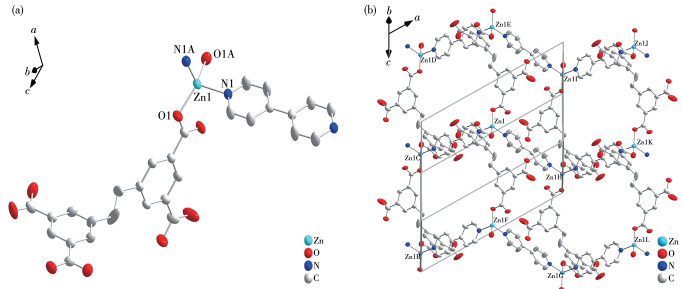
50% ellipsoid probability; Symmetry codes: A: 1-x, y, 0.5-z; B: 0.5-x, 0.5-y, 1-z; C: 0.5-x, 0.5-y, -z; D: 0.5-x, 0.5-y, -1-z; E: x, y, -1-z; F: x, y, 1+z; G: 1.5-x, 0.5-y, 2-z; H: 1.5-x, 0.5-y, 1-z; I: 1.5-x, 0.5-y, -z; J: 1+x, y, z; K: 1+x, y, 1+z; L: 1+x, y, 2+z
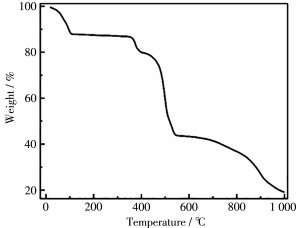
To identify the thermal stability of MOF 1, the TGA was performed. As shown in Fig. 2, the weight loss of 1 was 12.1% before 110 ℃, which corresponds to the release of the free water. The 2D networks started to decompose upon further heating up to about 400 ℃.
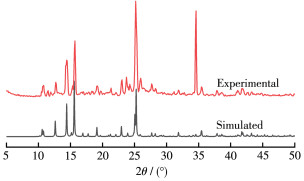
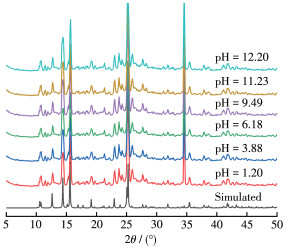
To confirm the purity of MOF 1, the PXRD pattern of 1 was measured. The position of the diffraction peak in the PXRD experiment was consistent with those of single crystal structure simulation, implying the pure phase of 1 (Fig. 3). The skeleton is basically unchanged when 1 was immersed in acidic and basic aqueous solutions for 24 h, indicating that 1 has good acid and alkali resistance (Fig. 4).
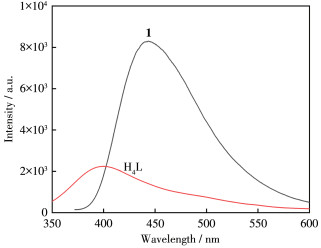
Due to the excellent luminescence properties of d10 metal MOFs, the luminescence of 1 and the H4L ligand were investigated. As shown in Fig. 5, H4L had an emission peak at 444 nm (λex=362 nm). Compared to the fluorescence spectrum of the ligand, the fluores- cence intensity of 1 was stronger than that of the ligand, which may be due to coordination interactions[22]. The emission spectrum of 1 had a partial redshift, which may be caused by the charge transfer between H4L and Zn(Ⅱ)[23].
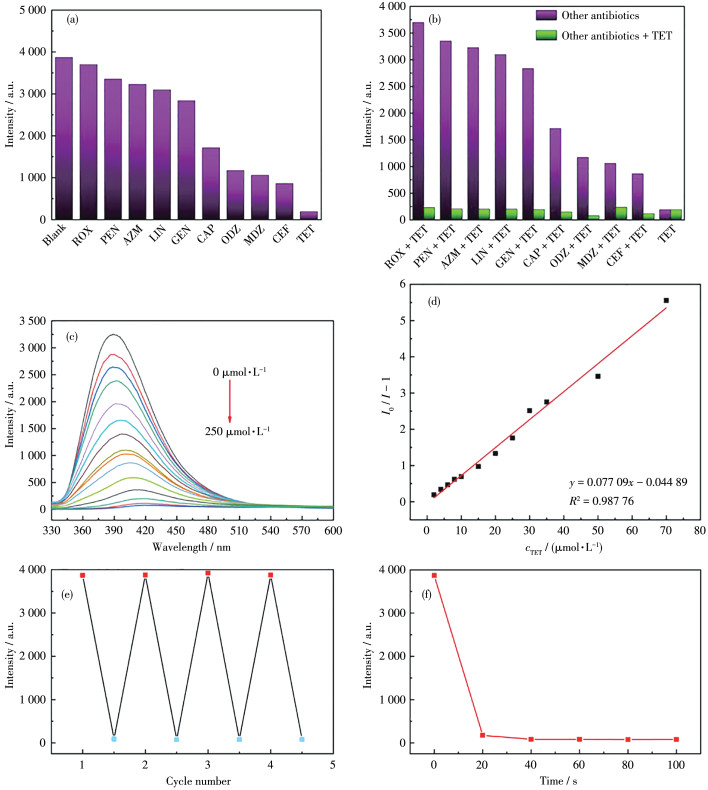
The wanton use of antibiotics has caused great pollution to the water system and environment. Therefore, it is very urgent for us to find a simple and efficient method to detect antibiotics[24]. Therefore, the luminescence sensing of 1 for different antibiotics was investigated, including lincomycin hydrochloride (LIN), metronidazole (MDZ), ornidazole (ODZ), TET, roxithromycin (ROX), chloramphenicol (CAP), gentamicin sulfate (GEN), azithromycin (AZM), cefixime (CEF) and penicillin sodium (PEN). As shown in Fig. 6a, when TET was added, the fluorescence of 1 showed the maximum quenching. In the presence of other antibiotics, anti - interference experiments were carried out for TET. The experimental results showed that the fluorescence of 1 was also quenched to a large extent when TET was added in the presence of other antibiotics (Fig. 6b). Subsequently, the quantitative experiment of TET was carried out. When the concentration of TET increased, the fluorescence intensity of 1 gradually decreased. When the concentration of TET reached 250 µmol·L-1, the quenching efficiency of TET was as high as 97.97% (Fig. 6c). And I0/I value was also linearly correlated with a low TET concentration (Fig. 6d). The detection limit was calculated using 3σ/k (σ: standard deviation, k: slope), and the detection limit for 1 towards TET was 0.17 µmol·L-1. In addition, after four cycles, we found that the fluorescence intensity could still be restored to the original intensity. 1 may be a recyclable fluorescent sensor (Fig. 6e). It was found that when TET of 250 µmol·L-1 was added, the luminescence intensities decreased rapidly and the fluorescence hardly changed after 20 s (Fig. 6f).
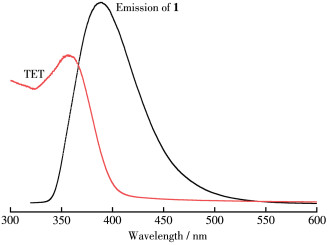
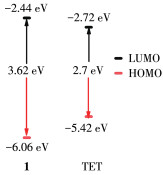
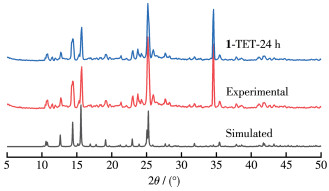
The reasons for fluorescence quenching that have been reported are as follows: (Ⅰ)the collapse and disintegration of the crystal framework, the mechanism of energy competition and absorption, the exchange of central metal ions, the mechanism of energy transfer, the mechanism of photoinduced electron transfer (PET)[25-31]. First of all, as shown in Fig. 7, PXRD patterns of 1 were consistent with as-synthesized samples immersed in TET solution for 24 h, indicating that the crystal structure was intact. Therefore, framework collapse is not the reason for fluorescence quenching. Secondly, because 1 detects antibiotics, it indicates that there is no metal ion exchange during fluorescence quenching. Another possible mechanism is energy allocation and transfer. We can see that there is a partial overlap between the emission spectrum of 1 and the UV absorption (300-400 nm) spectrum of TET (Fig. 8). The reason for the fluorescence quenching of 1 may be due to energy absorption and energy transfer. Finally, the LUMO level of TET (-2.72 eV) is lower than 1 (Fig. 9). The reason for fluorescence quenching may be that the electron transfers from the LUMO level of 1 to TET. At the same time, I0/I value was also linearly correlated with low TET concentration (Fig. 6d), indicating that the mechanism for fluorescence quenching should be more than one. When the concentration is low, it is linear, indicating that the competitive absorption is weak. With the increase in concentration, it is nonlinear, and the absorption also increases[32-34].
To prove the practicability of this method, TET was tested in Yanhe River water through the spiked recovery experiment. As shown in Table 3, the spiked recoveries at different concentrations were obtained, ranging from 94% to 103%. The relative standard deviation (RSD) values were 1.7% - 2.4%, indicating the reliability and practicability of 1 to detect TET in real samples.
下载:
导出CSV
| Spiked /(µmol·L-1) | Detected /(µmol·L-1) | RSD* / % | Recovery / % |
| 0 | Not detected | — | — |
| 5 | 4.7 | 1.7 | 94 |
| 15 | 15.1 | 1.9 | 101 |
| 30 | 30.8 | 2.4 | 103 |
| *n=3 | |||
In summary, a Zn-MOF (1) is successfully synthe- sized under solvothermal conditions. Structural analysis shows that 1 is a 2D wavelike network. It has high selectivity and sensitivity for the detection of TET by fluorescence quenching. Through the spiked recovery experiment, TET in the actual water samples along the river can also be detected. Finally, the sensing mechanism is discussed in detail. The cause of TET quenching might be energy resonance transfer or electron transfer.
Bai Y H, Su J F, Wen Q, Li G Q, Xue L, Huang T L. . Removal of tetracycline by denitrifying Mn - oxidizing bacterium Pseudomonas sp. H117 and biomaterials (BMO and MBMO): Efficiency and mechanisms[J]. Bioresour. Technol, 2020, 312: 123565. doi: 10.1016/j.biortech.2020.123565
Yaghi O M, O′Keeffe M, Ockwig N W, Ch ae, H K, Eddaoudi M, Kim J. Reticular synthesis and the design of new materials[J]. Nature, 2003, 423: 705-714. doi: 10.1038/nature01650
Butova V V, Soldatov M A, Guda A A, Lomachenko K A, Lamberti C. Metal-organic frameworks: Structure, properties, methods of synthesis and characterization[J]. Russ. Chem. Rev, 2016, 85: 280-307. doi: 10.1070/RCR4554
Liang Q N, Chen J M, Wang F L, Li Y W. Transition metal - based metal-organic frameworks for oxygen evolution reaction[J]. Coord. Chem. Rev, 2020, 424: 213488. doi: 10.1016/j.ccr.2020.213488
Sakamoto N, Nishimura Y F, Nonaka T, Ohashi M, Ishida N, Kitazumi K, Kato Y, Sekizawa K, Morikawa T, Arai T. Self-assembled cuprous coordination polymer as a catalyst for CO2 electrochemical reduction into C2 products[J]. ACS Catal, 2020, 10(18): 10412-10419. doi: 10.1021/acscatal.0c01593
Woldu A R, Huang Z L, Zhao P X, Hu L S, Astruc D. Electrochemical CO2 reduction (CO2RR) to multi- carbon products over copper - based catalysts[J]. Chem. Rev, 2022, 454: 214340.
Zhou Y T, Abazari R, Chen J, Tahir M, Kumar A, Ikreedeegh R R, Rani E, Singh H, Kirillov A M. Bimetallic metal-organic frameworks and MOF-derived composites: Recent progress on electro and photoelectrocatalytic applications[J]. Coord. Chem. Rev, 2022, 451: 214264. doi: 10.1016/j.ccr.2021.214264
Lin J B, Zhang J P, Chen X M. Nonclassical active site for enhanced gas sorption in porous coordination polymer[J]. J. Am. Chem. Soc, 2010, 132: 6654-6656. doi: 10.1021/ja1009635
Duan J G, Jin W Q, Kitagawa S. Water-resistant porous coordination polymers for gas separation[J]. Coord. Chem. Rev, 2017, 332: 48-74. doi: 10.1016/j.ccr.2016.11.004
Duan J G, Higuchi M, Krishna R, Kiyonaga T, Tsutsumi Y, Sato Y, Kubota Y, Takata M, Kitagawa S. High CO2/N2/O2 /CO separation in a chemically robust porous coordination polymer with low binding energy[J]. Chem. Sci, 2014, 5(2): 660-666. doi: 10.1039/C3SC52177J
Imaz I, Rubio-Martinez M, Garcia-Fernandez L, Garcia F, Ruiz-Moli-na D, Hernando J, Puntes V, Maspoch D. Coordination polymer particles as potential drug delivery systems[J]. Chem. Commun, 2010, 46: 4737-4739. doi: 10.1039/c003084h
Dutta B, Hazra A, Dey A, Sinha C, Ray P P, Banerjee P, Mir M H. Construction of a succinate - bridged Cd - based two - dimensional coordination polymer for efficient optoelectronic device fabrication and explosive sensing application[J]. Cryst. Growth Des, 2020, 20(2): 765-776. doi: 10.1021/acs.cgd.9b01181
Wen T, Zhang D X, Liu J, Lin R, Zhang J. A multifunctional helical Cu coordination polymer with mechanochromic, sensing and photocatalytic properties[J]. Chem. Commun, 2013, 49: 5660-5662. doi: 10.1039/c3cc42241k
Luo X Z, Abazari R, Tahir M, Fan W K, Kumar A, Kalhorizadeh T, Kirillov A M, Amani- Ghadim A R, Chen J, Zhou Y T. Trimetallic metal - organic frameworks and derived materials for environmental remediation and electrochemical energy storage and conversion[J]. Coord. Chem. Rev, 2022, 461: 214505. doi: 10.1016/j.ccr.2022.214505
Horike S, Umeyama D, Kitagawa S. Ion conductivity and transport by porous coordination polymers and metal-organic frameworks[J]. Acc.Chem. Re, 2013, 46(11): 2376-2384. doi: 10.1021/ar300291s
陈小莉, 刘露, 商璐, 蔡苗, 崔华莉, 杨华, 王记江. 一种高灵敏、多响应的Zn-MOF荧光传感器对Fe3+、2, 4, 6-三硝基苯酚和奥硝唑的检测[J]. 无机化学学, 2022,38,(4): 735-744. CHEN X L, LIU L, SHANG L, CAI M, CUI H L, YANG H, WANG J J. A highly sensitive and multi-responsive Zn-MOF fluorescent sensor for detection of Fe3+, 2, 4, 6 - trinitrophenol, and ornidazole[J]. Chinese J. Inorg. Chem, 2022, 38(4): 735-744.
张龄文, 刘淑芹, 张佩佩, 倪爱云, 张建军. 一例基于5-((萘-1-基甲基)氨基)间苯二甲酸配体的Cd金属有机骨架的合成、晶体结构及对酸性氨基酸的检测[J]. 无机化学学, 2022,38,(9): 1871-1877. ZHANG L W, LIU S Q, ZHANG P P, NI A Y, ZHANG J J. Synthe- sis, crystal structure, and detection of acidic amino acids of a Cd metal-organic framework based on 5-((naphthalen-1-ylmethyl) ami- no) isophthalic acid[J]. Chinese J. Inorg. Chem, 2022, 38(9): 1871-1877.
徐涵, 潘兆瑞, 亓昭鹏, 孙洁. 基于V型配体的三个荧光Zn-MOF对水溶液中2, 4, 6-三硝基苯酚和Fe3+的荧光传感[J]. 无机化学学, 2022,38,(12): 2479-2490. XU H, PAN Z R, QI Z P, SUN J. Three luminescent Zn-MOFs based on V-shaped ligands for fluorescence sensing of 2, 4, 6-trinitrophenol and Fe3+ in aqueous solution[J]. Chinese J. Inorg. Chem, 2022, 38(12): 2479-2490.
Wang S Q, Wang L, Zhu Y M, Song Y H. Fluorescent detection of S2- based on ZnMOF-74 and CuMOF-74. Spectroc[J]. Acta Pt. A-Molec. Biomolec. Spectr, 2020, 236: 118327. doi: 10.1016/j.saa.2020.118327
Farahani Y D, Safarifard V. Highly selective detection of Fe3+, Cd2+ and CH2Cl2 based on a fluorescent Zn- MOF with azine- decorated pores[J]. J.Solid State Chem, 2019, 275: 131-140. doi: 10.1016/j.jssc.2019.04.018
Chandrasekhar P, Mukhopadhyay A, Savitha G, Moorthy J N. Remarkably selective and enantiodifferentiating sensing of histidine by a fluorescent homochiral Zn - MOF based on pyrene- tetralactic acid[J]. Chem Sc, 2016, 7: 3085-3091. doi: 10.1039/C5SC03839A
Gogia A, Mandal S K. A rational design and green synthesis of 3D metal organic frameworks containing a rigid heterocyclic nitrogen - rich dicarboxylate: Structural diversity, CO2 sorption and selective sensing of 2, 4, 6-TNP in water[J]. Dalton Trans, 2019, 48: 2388-2398. doi: 10.1039/C8DT04474K
Liu T Y, Qu X L, Zhang Y, Yan B. A stable Cd -based metal-organic framework: Synthesis, structure, and its Eu3+ functionalization for ratiometric sensing on the biomarker 2-(2 - methoxyethoxy) acetic acid[J]. Inorg. Chem, 2021, 60(12): 8613-8620. doi: 10.1021/acs.inorgchem.1c00589
Wang L B, Wang J J, Yue Er L, Li J F, Tang L, Bai Ch, Wang X, Hou X Y, Zhang Y Q. Information encryption, highly sensitive detection of nitrobenzene, tetracycline based on a stable luminescent Cd - MOF. Spectroc[J]. Acta Pt. A - Molec. Biomolec. Spect, 2022, 269: 120752. doi: 10.1016/j.saa.2021.120752
Dang S, Ma E, Sun Z M, Zhang H J. A layer-structured Eu-MOF as a highly selective fluorescent probe for Fe3+ detection through a cationexchange approach[J]. J. Mater. Chem., 2012, 22: 16920-16926. doi: 10.1039/c2jm32661b
Chen Z, Sun Y W, Zhang L L, Sun D, Liu F L, Meng Q G, Wang R M, Sun D F. . A tubular europium-organic framework exhibiting selective sensing of Fe3+ and Al3+ over mixed metal ions[J]. Chem.Commu, 2013, 49: 11557-11559. doi: 10.1039/c3cc46613b
Zhao X L, Tian D, Gao Q, Sun H W, Xu J, Bu X H. A chiral lantha- nide metal - organic framework for selective sensing of Fe ions[J]. Dalton Tran, 2016, 45: 1040-1046. doi: 10.1039/C5DT03283K
Nagarkar S S, Joarder B, Chaudhari A K, Mukherjee S, Ghosh S K. Highly selective detection of nitro explosives by a luminescent metalorganic framework[J]. Angew. Chem. Int. Ed, 2013, 52(10): 2881-2885. doi: 10.1002/anie.201208885
Pramanik S, Zheng C, Zhang X, Emge T J, Li J. New microporous metal- organic framework demonstrating unique selectivity for detection of high explosives and aromatic compounds[J]. J. Am. Chem. Soc, 2011, 133(12): 4153-4155. doi: 10.1021/ja106851d
Liu Z P, He W J, Guo Z J. Metal coordination in photoluminescent sensing[J]. Chem. Soc. Rev, 2013, 42: 1568-1600. doi: 10.1039/c2cs35363f
He T S, Lan Y L, Li Z Y, Zhu L N, Li X Z. Chiral coordination polymers from a new 2 - deoxy - D - ribose derivative linker: Syntheses, structures, and Fe3+ fluorescent probe functions[J]. Cryst. Growth Des, 2021, 21(4): 2233-2242. doi: 10.1021/acs.cgd.0c01661
Huang Y, Qin Y, Ge Y, Cui Y F, Zhang X M, Li Y H, Yao J L. Ratio- nally assembled nonanuclear lanthanide clusters: Dy9 displays slow relaxation of magnetization and Tb9 serves as luminescent sensor for Fe3+, CrO42- and Cr2O72-[J]. New J. Chem, 2019, 43: 19344-19354. doi: 10.1039/C9NJ04893F
Smith J A, Singh-Wilmot M A, Carter K P, Cahill C L, Ridenour J A. Lanthanide-2, 3, 5, 6- tetrabromoterephthalic acid metal-organic frame- works: Evolution of halogen…halogen interactions across the lantha- nide series and their potential as selective bifunctional sensors for the detection of Fe3+, Cu2+, and nitroaromatics[J]. Cryst. Growth Des, 2019, 19(1): 305-319. doi: 10.1021/acs.cgd.8b01426
Chen S, Yu Y L, Wang J H. Inner filter effect-based fluorescent sens- ing systems: A review[J]. Anal. Chim. Act, 2018, 999: 13-26. doi: 10.1016/j.aca.2017.10.026

Figure 1 (a) Ellipsoid diagram of the molecular structure of MOF 1; (b) 2D wavelike network of 1
50% ellipsoid probability; Symmetry codes: A: 1-x, y, 0.5-z; B: 0.5-x, 0.5-y, 1-z; C: 0.5-x, 0.5-y, -z; D: 0.5-x, 0.5-y, -1-z; E: x, y, -1-z; F: x, y, 1+z; G: 1.5-x, 0.5-y, 2-z; H: 1.5-x, 0.5-y, 1-z; I: 1.5-x, 0.5-y, -z; J: 1+x, y, z; K: 1+x, y, 1+z; L: 1+x, y, 2+z

Figure 4 PXRD patterns of MOF 1 immersed in the aqueous solutions with different pH values for 24 h

Figure 6 (a) Luminescent intensity of 1 in different antibiotics; (b) Luminescence intensity of 1 in mixed antibiotics; (c) Emission spectra of 1 with different concentrations of TET; (d) Stern-Volmer plot for MOF 1 detecting TET in low concentration; (e) Cycle stability of 1 for the detection of TET (red square: 1, blue square: 1 + TET); (f) Effect of response time on the fluorescent intensities upon the addition of TET

Figure 7 PXRD patterns of 1 and as⁃synthesized samples immersed in TET solution for 24 h
Table 1. Crystal data and structure refinement parameters for 1
| Parameter | 1 | Parameter | 1 | |
| Formula | C28H20N2O8Zn | V / nm3 | 2.398 1(6) | |
| Formula weight | 577.81 | Z | 4 | |
| Crystal system | Monoclinic | Dc / (g·cm-3) | 1.595 | |
| Space group | C2/c | F(000) | 1 176 | |
| a / nm | 2.029 1(3) | Goodness-of-fit (on F2) | 1.021 | |
| b / nm | 1.0105 5(14) | R1, wR2 [I > 2σ(I)] | 0.038 5, 0.092 5 | |
| c / nm | 1.419 233(19) | R1, wR2 (all data) | 0.049 1, 0.098 4 | |
| β / (°) | 124.508(2) |
 下载: 导出CSV
Table 2. Selected bond lengths (nm) and angles (°) for 1
| Zn1—O1 | 0.197 93(16) | Zn1—O1A | 0.197 93(16) | Zn1—N1 | 0.207 03(18) |
| Zn1—N1A | 0.207 04(18) | ||||
| O1—Zn1—O1A | 13.803(11) | O—Zn1—N1 | 10.786(7) | O1A—Zn1—N1 | 9.937(7) |
| O—Zn1—N1A | 9.937(7) | O1A—Zn1—N1A | 10.786(7) | N1—Zn1—N1A | 9.807(10) |
| Symmetry code: A: 1-x, y, 0.5-z. | |||||
下载: 导出CSV
Table 3. Recovery test of TET spiked in Yanhe River water samples
| Spiked /(µmol·L-1) | Detected /(µmol·L-1) | RSD* / % | Recovery / % |
| 0 | Not detected | — | — |
| 5 | 4.7 | 1.7 | 94 |
| 15 | 15.1 | 1.9 | 101 |
| 30 | 30.8 | 2.4 | 103 |
| *n=3 | |||
下载: 导出CSV

 扫一扫看文章


扫一扫关注我们