γ-石墨单炔的制备及在能量储存与转化领域的应用

郝紫项 ,  陈阳 ,  王霖锐 ,  崔晓莉

引用本文: 郝紫项, 陈阳, 王霖锐, 崔晓莉. γ-石墨单炔的制备及在能量储存与转化领域的应用[J]. 无机化学学报, 2022, 38(12): 2321-2341. doi: 10.11862/CJIC.2022.254 shu
Citation:  Zi-Xiang HAO, Yang CHEN, Lin-Rui WANG, Xiao-Li CUI. Synthesis of γ-Graphyne and Its Applications in the Fields of Energy Storage and Conversion[J]. Chinese Journal of Inorganic Chemistry, 2022, 38(12): 2321-2341. doi: 10.11862/CJIC.2022.254 shu

γ-石墨单炔的制备及在能量储存与转化领域的应用

    通讯作者: 陈阳, E-mail: yangchen@fudan.edu.cn; 崔晓莉, E-mail: xiaolicui@fudan.edu.cn
  • 基金项目:

    上海市自然科学基金项目 20ZR1403300

    国家自然科学基金项目 52002076

摘要: 炔碳材料是一种新兴的二维碳同素异形体,具有一定的导电性和较高的比表面积,其sp2和sp型杂化碳组成的多孔结构,拓展了离子输运通道,提升了电荷转移能力,在能量储存与转化领域展现出广阔的应用前景。γ-石墨单炔(γ-GY)是理论上结构最稳定的单炔类炔碳材料,具有稳定的共轭体系、独特的三角孔结构,有助于离子的脱嵌和迁移;同时γ-GY还具有良好的半导体性能,在光电催化方面也具有很大的应用潜力。另外,通过异原子掺杂或前驱体分子结构设计调控γ-GY的构型和电子排布,有利于拓展γ-GY在能源领域的应用。本文重点总结了γ-GY的制备方法及其在锂(钠、钾)离子电池和光电催化方面的应用研究进展,提出了γ-GY类材料面临的挑战与机遇,并展望其在能源领域的发展趋势。

English

  • 近年来,化石燃料等不可再生能源不断消耗,环境污染问题日益严峻。清洁能源的多元发展可降低社会对不可再生化石燃料的依赖,并改善生态环境。开发并利用风能、潮汐能和太阳能等可再生能源成为科学家们的研究重点,其关键在于发展可靠、高效的能源存储与转化技术,其中包括电化学系统中的二次电池技术以及光电转换系统中的光催化、电催化技术等。储能材料是能源整合与管理的核心媒介,探索新型储能材料、提升材料储能性能是目前的研究热点,也促进了以锂离子电池为代表的储能电池材料的快速发展。锂离子电池的性能主要依赖于电极材料,为了提高电池的能量密度和功率密度,研究人员投入了大量精力合成具有特定组成、结构和形态的先进电极材料。

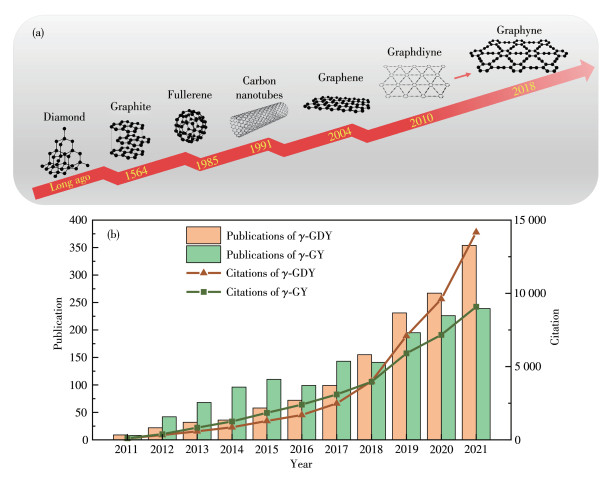
    在诸多储能电极材料中,碳材料具有易制备、成本低、环境友好、导电性高以及适合金属离子迁移和存储等优点,目前已成为电化学储能器件中最主要的材料之一。碳原子具有多种杂化方式,sp3、sp2、sp杂化的不同组合可呈现出多种可能的同素异形体。sp3杂化碳材料如金刚石等,拥有稳定的三维构型,可提升材料强度;sp2杂化碳(如石墨、石墨烯等)会提升材料导电性;由sp杂化碳构成的碳材料具有共轭结构,从而降低材料的空间电荷密度,提高材料孔隙度。如图 1a所示,碳材料的发展历程贯穿了人类发展历史,在材料科学领域占据重要地位,从最初的金刚石、石墨到20世纪80年代的富勒烯[1],人们逐步发现碳纳米管[2]、石墨烯[3]、石墨双炔(GDY)[4]、石墨单炔(GY)[5]等。这些碳材料由于出色的性能和独特的电子结构,在航天航空、环境、储能、催化以及非线性光学[6-7]等领域广泛应用。其中γ-石墨双炔(γ-GDY,γ-graphdiyne)和γ-石墨单炔(γ-GY,γ-graphyne)研究领域近十年论文发表量和被引量呈现总体增长趋势(图 1b)。

    图 1

    图 1.  (a) 碳材料的发展历程; (b) γ-GDY和γ-GY近十年的论文发表量和被引量(数据来自Web of Science数据库)
    Figure 1.  (a) History of representative carbon materials; (b) Yearly publications and citations of γ-GDY and γ-GY in recent ten years (Date were obtained from Web of Science)

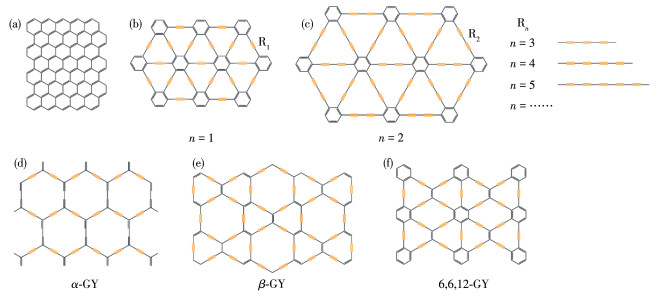
    1987年,石墨炔的概念首次被提出[8]。一般认为炔碳材料含有sp杂化和sp2杂化碳原子,根据石墨炔的空间构型又可分为α型(图 2d)、β型(图 2e)、γ型(图 2b和图 2c)以及6,6,12型(图 2f)等石墨炔[9]。γ-石墨炔是由sp2碳原子组成的苯环和sp碳原子组成的炔键交替连接的平面二维结构(图 2b和2c)。根据连接苯环的炔键数量n可将石墨炔命名为γ-GY(n= 1,γ-石墨一炔)、γ-GDY(n=2,γ-石墨二炔)以及γ-石墨多炔(n≥3)。虽然石墨炔的理论构型十分丰富,但其在实验室合成时遇到很大的障碍,直到2010年,我国科学家李玉良院士团队首次成功合成γ-GDY[4]。截至目前,实际实验室成功制备的仅有γ-GDY[4]、β-GDY[10]及γ-GY[5]。

    图 2

    图 2.  (a) 石墨烯、(b) γ-GY、(c) γ-GDY、(d) α-GY、(e) β-GY和(f) 6, 6, 12-GY的结构示意图[11]
    Figure 2.  Structural geometries of (a) graphene, (b) γ-GY, (c) γ-GDY, (d) α-GY, (e) β-GY, and (f) 6, 6, 12-GY[11]

    石墨炔的合成是碳材料发展史的一大重要节点。由于其sp2和sp复合杂化形式和层状二维碳平面的特点,石墨炔具有共轭网络及丰富的大三角孔隙,这使其拥有诸多其他碳材料所不具备的性质[12]。石墨炔的炔键中的π键为分子平面贡献了大量π-π共轭电子,稳定的分子平面共轭结构使得石墨炔材料具有良好的化学稳定性,并且可通过掺杂异原子调整其电子结构[13]。当石墨炔作为电极材料时,金属离子不仅可在石墨炔面内扩散,还可在面间规整的离子通道中迁移,且几乎不损坏炔碳结构,因而石墨炔拥有理想的载流子迁移率[14]。理论研究表明,石墨炔具有良好的储锂性能。γ-GDY储锂位点在三角共轭环和苯环之间,最高储锂比容量为788 mAh·g-1[15]。嵌锂状态稳定的情况下,γ-GY的储锂位点在三角共轭环,最高储锂比容量为623 mAh· g-1 [15]。对单层γ-GY施加12% 的外界应力,最高理论储锂比容量为2 233 mAh·g-1[16]。通过炔键与苯环对金属离子的吸附,石墨炔的理论容量远高于其它碳材料。另外,与零带隙的石墨烯相比,石墨炔具有天然的带隙,预测最小为0.46~1.22 eV[17],接近硅的带隙。直接带隙的存在使石墨炔在光电子器件与光电催化等方面具有很大应用前景[18-19]。

    在已有的石墨炔家族中,γ-GDY的研究最为广泛,目前多篇文章总结了γ-GDY的制备与应用[11, 20-32]。由于苯环取代基间的空间位阻效应,γ-GDY的制备方式无法直接应用到γ-GY。本文将从石墨炔发展的角度出发,总结γ-GY制备方法的探索历程以及γ-GY的储能和能源转换应用方向的研究进展。

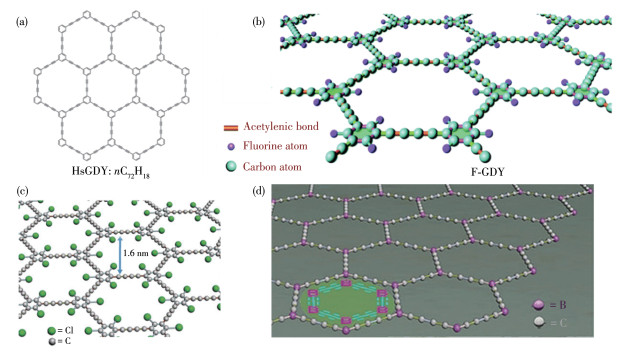
    石墨炔碳材料的合成从交叉偶联法制备γ-GDY开始,进一步发展到γ-GDY的各种衍生物,如图 3所示的氢取代γ-GDY(hydrogen-substitutedγ-graphdiyne,HsGDY)[33]、卤素取代γ-GDY[34-35]、硼化α-GDY[36]等。在GY领域中,最初合成了氢取代γ-GY (hydrogen-substituted γ-graphyne,HsGY),随后相继通过机械化学法和炔烃复分解反应法成功制备γ-GY。

    图 3

    图 3.  (a) HsGDY[33]、(b) 氟取代γ-GDY[34]、(c) 氯取代γ-GDY[35]和(d) 硼取代α-GDY[36]的结构示意图
    Figure 3.  Structural geometries of (a) HsGDY[33], (b) F-substituted γ-GDY[34], (c) Cl-substituted γ-GDY[35], and (d) boron-substituted α-GDY[36]

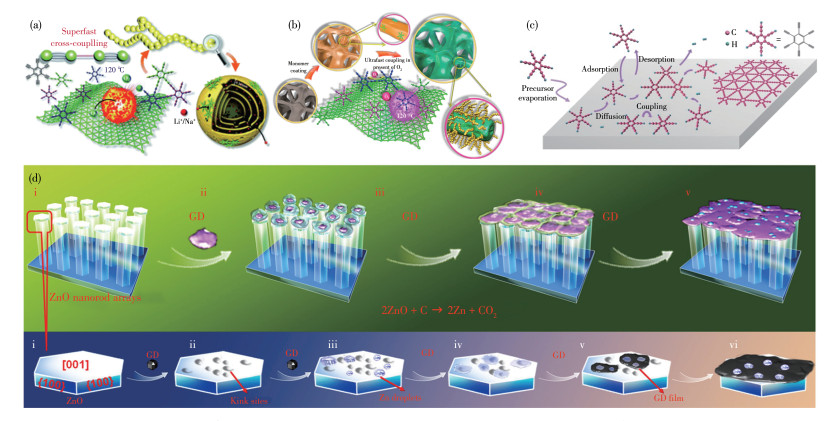
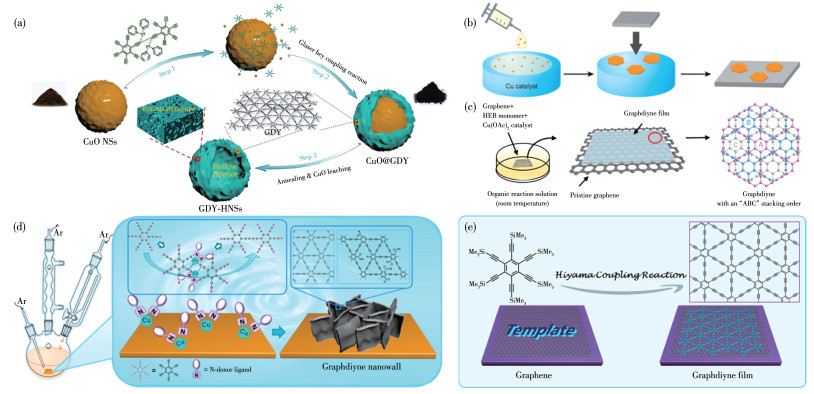
    2010年Li等首次通过六乙炔基苯在铜箔上交叉偶联制得γ-GDY[4]。具体地,在8 ℃下将四丁基氟化铵添加到六[(三甲基甲硅烷基)乙炔基]苯的四氢呋喃溶液中反应10 min,合成六乙炔基苯前驱单体。在60 ℃氮气气氛下引入吡啶,六乙炔基苯单体在铜箔表面发生交叉偶联反应,持续72 h。吡啶促使铜箔表面生成微量铜离子,催化交叉偶联反应,因此铜箔既是γ-GDY薄膜生长的基材又是催化剂。自此,后续发展了一系列γ-GDY制备方法,包括干法(图 4)和湿法(图 5)制备方法。干法制备包含:爆炸法(图 4a)、基板交织γ-GDY纳米链法(图 4b);化学气相沉积法(图 4c)和ZnO纳米阵列顶部沉积法(图 4d)。在干化学法的探索中,Zuo等[37]开发了在空气气氛中120 ℃下不使用催化剂的爆炸法;Wang等[38]同样不采用金属催化剂,令超细γ-GDY纳米链在大气中任意基材上超快速交织生长;Liu等[39]采用化学气相沉积法在银箔上成功沉积单层γ-GDY;Qian等[40]通过气相沉积在ZnO纳米棒阵列上合成γ-GDY薄膜。

    图 4

    图 4.  干法制备γ-GDY: (a) 爆炸法[37]; (b) 基板上交织γ-GDY纳米链[38]; (c) 化学气相沉积法[39]; (d) ZnO纳米阵列上沉积γ-GDY薄膜[40]
    Figure 4.  Overview of the dry chemistry synthesis methods of γ-GDY: (a) an explosion approach[37]; (b) interweaving γ-GDY nanochain on substrates[38]; (c) chemical vapor deposition[39]; (d) γ-GDY film on the top surface of ZnO nanorod arrays[40]

    图 5

    图 5.  湿法制备γ-GDY: (a) 溶剂热方法制备中空γ-GDY纳米球[41]; (b) 气/液界面合成法[42]; (c) 溶液相范德瓦耳斯外延法[43]; (d) 偶联反应制备γ-GDY纳米墙[44]; (e) 模板法[45]
    Figure 5.  Overview of the wet chemistry synthesis methods of γ-GDY: (a) hierarchical γ-GDY hollow nanospheres by solvothermal method[41]; (b) gas/liquid interfacial synthesis[42]; (c) γ-GDY film through solution-phase van der Waals epitaxy[43]; (d) γ-GDY nanowalls using acetylenic coupling reaction[44]; (e) surface template method[45]

    湿法制备γ-GDY包含溶剂热方法(图 5a)、气/液界面合成方法(图 5b)、溶液相范德瓦耳斯外延方法(图 5c)、改良偶联方法(图 5d)和模板方法(图 5e)。例如Zhao等[41]采用溶剂热法成功制备γ-GDY中空纳米球;Matsuoka等[42]尝试在室温下在液/液和气/液界面合成了超薄的结晶γ-GDY;Gao等[43]通过溶液相范德瓦耳斯外延在石墨烯上形成了超薄γ-GDY薄膜;Zhou等[44]改良了Glaser-Hay偶联反应,在铜板上成功制备γ-GDY纳米墙,后续又采用石墨烯为模板[45],成功制备超薄γ-GDY。

    同时,对石墨炔的形态也有多元探索。Zhou等[44]利用氮配体N,N,N',N'-四甲基乙二胺作为催化剂,使用Glaser-Hay偶联法制备出超薄纳米墙。Li等[46]通过模板辅助法成功制备了γ-GDY纳米管,具有高性能的场发射特性。Li团队[47]又通过固-液-气方法成功在硅片上的ZnO纳米棒上合成具有优良的半导体特性的γ-GDY纳米线。

    利用有机化学方法合成炔碳材料可以精准控制制备过程,产物相对纯净、纳米结构多样,取得了巨大的进步和成功,极大地促进了炔碳材料的制备与应用研究。然而,实际制备出的γ-GDY与理想结构仍有一定差距。受限于六乙炔基苯等前驱单体末端炔基较低的偶联效率、反应过程中不可避免的氧化加成等副反应,以及相邻炔基间C—C单键自由旋转诱导的结构无序等因素[48],制得的γ-GDY存在难以控制的厚度和缺陷,尚无法达到完美的理论结构,更多γ-GDY合成方法有待进一步研究开发。

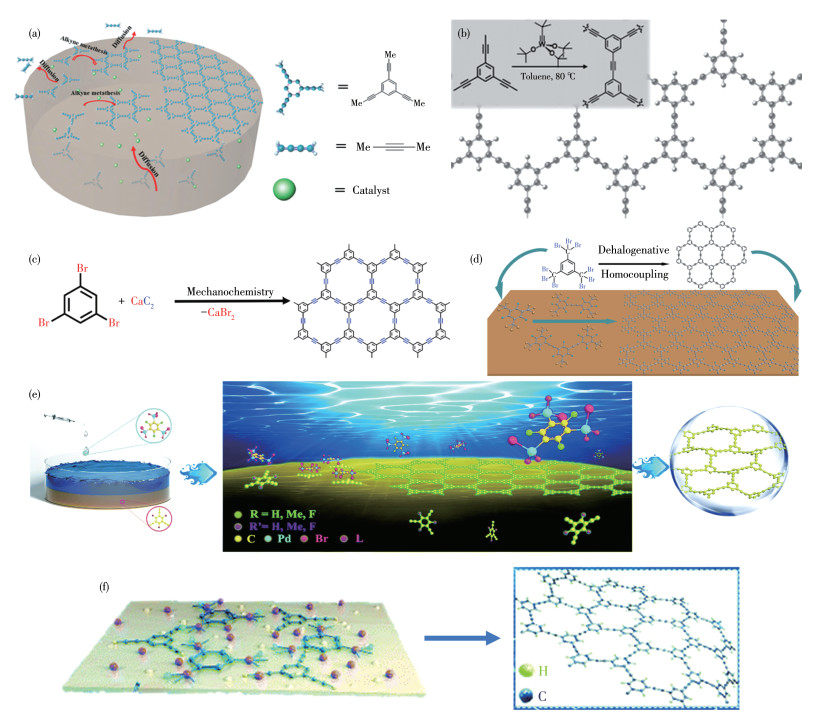
    目前,γ-GDY的研究日趋深入完善,与之结构类似的γ-GY的研究也增多(图 6)。化学交叉偶联法难以制备苯环间由单个炔键相连的石墨炔,这是由于单一前驱体溶解在该反应条件下易于自偶联形成γ-GDY。Huang等[49]提出将2种不同的单体1,3,5-三乙酰苯(TEB,1,3,5-triacetylenylbenzene)与1,3,5-三溴苯(TBB,1,3,5-tribromobenzene)溶解在不同的相中,于界面处交叉偶联合成类γ-GY的思路,首次制备出γ-GY类似物,该产物具有优良的导电性。为提升产率,该团队选取在同一相内将TEB缓慢滴加到含有TBB的溶液中,制备出多孔状HsGY[50],HsGY的高比表面积、宽层间距、分级多孔结构、优异的导电性和低载流子势垒可促进碱金属离子的插层扩散,适合作为二次电池的负极材料。以上2种方法中,由于γ-GY炔键的电子云密度高,在取代过程中存在巨大的空间位阻[51],因此倾向于合成间位存在三键的类γ-GY。炔基复分解与此相似,空间位阻导致难以合成六取代的γ-GY。2017年,Wu等[52]以1,3,5-三丙炔基苯作为前驱体,采用炔烃复分解反应合成了HsGY。2019年,Li等[53]选用价格更低廉的对氯苯酚作为速溶催化剂,通过炔烃复分解反应合成了HsGY。脱卤偶联反应也可用以合成HsGY,Sun等[54]证实可以使1,3,5-三(三溴甲基)苯(tTBP,three tribromomethyl groups)脱卤并以碳碳三键偶联;Liang等[55]使用tTBP在超高真空下成功制备HsGY,产物具备析氧反应(oxygen evolution reaction,OER)和析氢反应(hydrogen evolution reaction, HER) 活性。除此之外,机械化学法也在合成HsGY上有所应用。Cui及其团队[56]将1,3,5-三溴苯和碳化钙混料球磨,制备出HsGY,并证实其为p型半导体,在OER方面有催化潜力。

    图 6

    图 6.  HsGY制备方法总述: (a、b) 炔烃复分解法[52-53]; (c) 机械化学法[56]; (d) 脱卤自偶联反应[55]; (e) 液/液界面法[49]; (f) 滴定法[50]
    Figure 6.  Overview of the synthesis methods of HsGY: (a, b) alkyne metathesis reaction[52-53]; (c) mechanochemistry[56]; (d) dehalogenative homocoupling reaction[55]; (e) liquid/liquid interface synthesis method [49]; (f) HsGY film growing on the Cu substrate by adding precursors dropwise[50]

    由于HsGY为间位取代γ-GY,苯环上的取代基少且取代基位点化学环境一致,相应的空间位阻较弱。因此,可直接利用炔烃复分解法或通过机械化学法外部引入C≡C制备HsGY。相对而言,炔烃复分解、脱卤偶联方法制备的HsGY缺陷较少,其中机械化学法较为简便,但需严格控制实验条件。

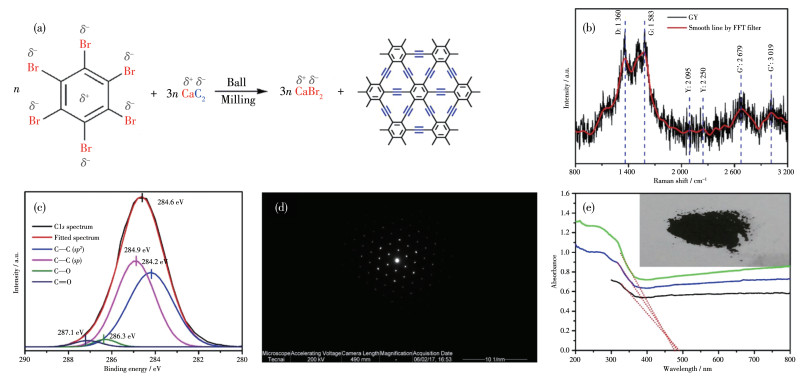
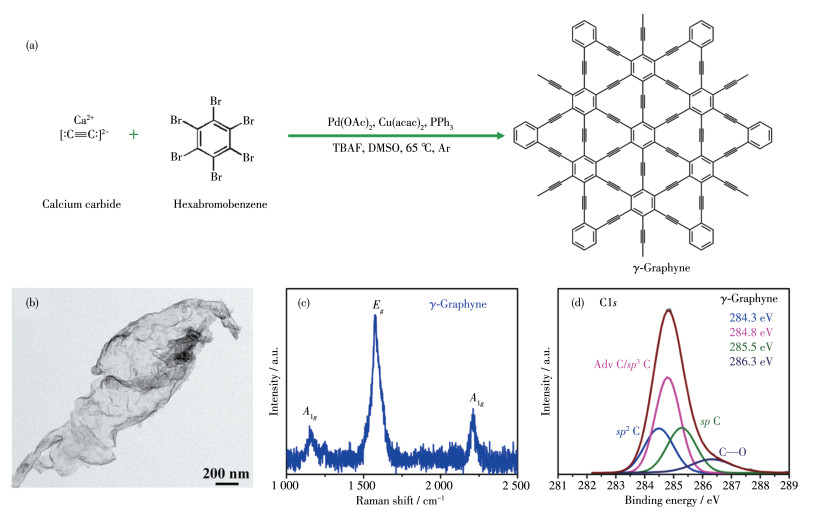
    机械化学法是一种含卤有机物脱卤减毒的途径[57-58],Cui等[59]注意到其产物实际上为一种碳材料,即该方法有可能局域克服高晶格能及化学键能形成炔碳材料,故提出利用球磨法克服空间位阻将六溴苯和碳化钙混合球磨,首次通过机械化学法制备出γ-GY[5](图 7)。在这项工作中,透射电镜(TEM)反映出所制备的γ-GY是单晶纳米片形态,层间距0.35 nm。拉曼光谱证实样品中存在sp和sp2两种杂化碳。C1s XPS(X射线光电子能谱)谱图中,sp和sp2的面积比约为1∶1,证实苯环上的sp2杂化碳由sp杂化碳原子相互连接。另外,γ-GY也拥有半导体特性,是带隙为2.58 eV的p型半导体。机械化学法制备γ-GY简便高产,后在此基础上,该团队采用廉价的苯替换六溴苯作为前驱体,成功制备了γ-GY[60]。在原子力显微镜(AFM)揭示的二维形貌图中,制备样品的尺寸约为400 nm,厚度约为0.7 nm。机械化学法具有工艺简便、环境友好、原料易得的优势,但是在制备过程中会形成石墨化碳杂质。该课题组最近的研究发现,控制前驱体的对称性可以有效抑制杂质的生长[61]。此外,球磨过程不可避免地会引入少量球磨介质的污染。因此,如何制备高纯度γ-GY仍面临很大挑战。

    图 7

    图 7.  机械化学法制备γ-GY: (a) 机械化学法示意图; (b) 拉曼光谱; (c) XPS C1s高分辨谱; (d) 选区电子衍射(SAED)图; (e)UV-Vis漫反射光谱图[5]
    Figure 7.  Synthesis of γ-GY by the mechanochemical method: (a) synthesis mechanism; (b) Raman spectrum; (c) high-resolution C1s core-level XPS spectrum; (d) selected electron diffraction (SAED) pattern; (e) UV-Vis diffuse reflectance spectra[5]

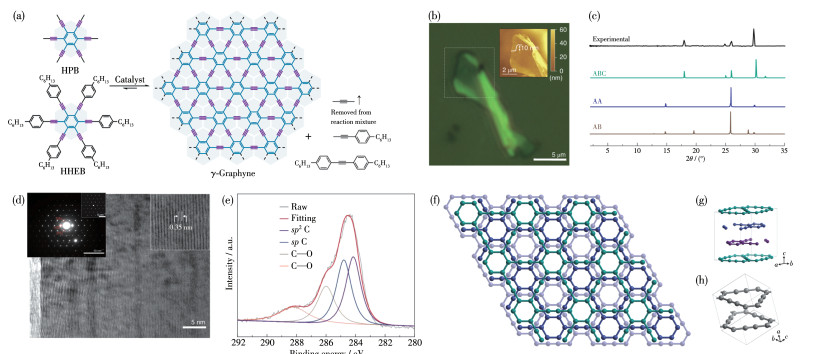
    除了机械化学方法,最近Hu等[62]采用2种不同的六炔基苯作为共聚单体,利用动态可逆的炔烃复分解反应合成了γ-GY(图 8a)。在此项工作中,以1,2,3,4,5,6-六丙炔基苯(HPB)作为主要单体。HPB炔烃复分解后产生的低沸点副产物2-丁炔可在低压下去除,进而推进反应进行。为了促进生长过程中的自校正机制以提升产率,添加1,2,3,4,5,6-六[2-(4-己基苯基)乙炔基]苯(HHEB)作为共聚单体,并加入Mo(Ⅳ)作为催化剂。当前驱体HPB和HHEB物质的量之比为90∶10时,有最大产率72%。图 8b为样品的光学显微镜和AFM表征的结果,表明生成了约30层的薄膜。Tacu法测定其光学带隙为0.96 eV。图 8c为所获得的γ-GY的广角X射线散射图(WAXS),发现样品呈ABC(交错)堆叠,与实验结果匹配良好。高分辨TEM(HRTEM)图像显示材料(110) 间距为0.35 nm,与衍射光斑相匹配。且C1s XPS谱图中,sp和sp2的面积比约为1∶1,与γ-GY化学结构相符。然而,作者没有给出样品的拉曼光谱进一步印证。此外,γ-GY的堆叠模式为ABC堆叠,具有六边晶胞,也可进一步简化为图 8h的菱面体单元。该动态可逆炔烃复分解法所制备的γ-GY聚合度较高,缺陷较少,但反应条件较为苛刻,成本较高。

    图 8

    图 8.  炔烃复分解反应制备γ-GY: (a) 合成示意图; (b) 光学显微镜图像(插图为AFM图); (c) WAXS图及模拟ABC、AA、AB堆叠WAXS图; (d) HRTEM图(插图为SAED图); (e) XPS C1s高分辨谱图; (f) ABC堆叠γ-GY层的结构示意图及其(g) 六边晶胞和(h) 菱形原胞[62]
    Figure 8.  Synthesis of γ-GY by the alkyne metathesis reaction: (a) synthesis mechanism; (b) optical microscopy and AFM (Inset) images; (c) WAXS patterns and simulated patterns in ABC, AA, and AB stacking models; (d) HRTEM image and SAED pattern (Inset); (e) high-resolution C1s core-level XPS spectrum; (f) structure of ABC-stacked γ-GY and corresponding (g) hexagonal unit cell and (h) rhombohedral primitive cell[62]

    Barua等[63]报道了一种简单的一锅煮Sonogashira交联策略,在温和条件下高产率地合成较纯的γ-GY(图 9a)。实验以六溴苯、碳化钙为前驱体,以乙酸钯、乙酰丙酰铜为催化剂,在加有四丁基氟化铵(反应助剂)、三苯基膦(催化配体)的DMSO溶液中,保持65 ℃无水无氧搅拌24 h,经硝酸、去离子水与乙醚洗涤后,冷冻干燥获得最终产物。从TEM图可看出,制备的γ-GY呈二维褶皱状。拉曼谱图证明产物无缺陷特性,合成的产物纯度高且产物的sp杂化碳与sp2杂化碳比例为1∶1(图 9d),所测带隙为2.3 eV,远大于γ-GY的理论值。该方法较为简洁,反应条件较温和,合成产物纯度高,且有助于启发其它类GY合成策略。

    图 9

    图 9.  一锅煮Sonogashira交联反应制备γ-GY: (a) 合成示意图; (b) 亮场TEM图; (c) 拉曼谱图; (d) XPS C1s高分辨谱[63]
    Figure 9.  Synthesis of γ-GY by the one-pot Sonogashira cross-linking reaction: (a) synthesis mechanism; (b) bright-field TEM image; (c) Raman spectra; (d) C1s XPS core-level spectra[63]

    锂离子电池是当今最普遍的储能器件之一。为了满足社会日益增长的低碳环保、高储能的需求,人们对锂离子电池的储锂容量、倍率性能和循环稳定性的要求越来越高。电极材料是影响电池性能的重要组分,根据已有研究报道,电池负极材料可主要分为碳质材料和非碳质材料,其中碳材料由于原材料丰富、制备成本低、制备方式简单、结构多样占据主要优势。目前,石墨是锂离子电池的商业负极材料,但石墨的理论容量最高为372 mAh· g-1,仍需要开发新型负极材料提升性能。新型负极材料包括硅、锡[64-68]和其他二维碳材料等[69-71],[15, 72-75]其中二维碳材料如石墨烯具有化学稳定性和良好机械强度,近年来被广泛研究。从材料设计角度而言,缩小材料微粒粒径、提高孔隙率可缩短锂离子的扩散路径[74]。石墨炔是一类高孔隙率的纳米碳材料,储锂比容量较高。Srinivasu等[15]对γ-GDY和γ-GY的储锂活性进行了密度泛函理论(DFT)计算,γ-GDY的理论最高储锂比容量为788 mAh·g-1,γ-GY为623 mAh·g-1。此后,Zhang等[16]发现γ-GY在受到外应力的作用下,其最高比容量可达2 233 mAh· g-1。因此,自从2010年首次成功合成γ-GDY以来,已有大量以γ-GDY作为锂离子电池负极的研究[76-79]。。

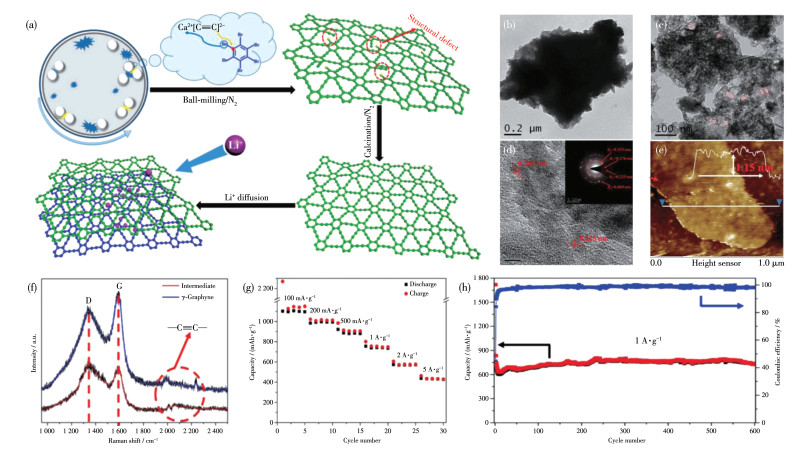
    在2018年成功合成γ-GY后,Cui团队开展了对γ-GY储锂性能的系列实验研究。Yang等[80]为提高γ-GY分子结构的完整性,在球磨碳化钙和六溴苯的基础上,进一步引入煅烧退火流程(图 10a)。通过TEM和AFM,可看出球磨后的中间体为直径约3 µm的团聚体,经过煅烧和酸洗,最终获得的样品呈现出多孔多层结构。HRTEM图表明样品晶面间距为0.362 nm,选区电子衍射图显示制备出的γ-GY具有多晶性。AFM探测出所制备材料的高度约为1.15 nm,表明样品约为3层。从拉曼光谱中D带和G带的强度比可看出,煅烧后的石墨化缺陷变少,即煅烧过程促进了中间体的自偶联。从图 10g可看出,结构优化后的γ-GY展现出良好的倍率性能,且在大电流密度(1 A·g-1) 下循环600圈后保持730 mAh·g-1的可逆容量,库仑效率为98% 以上。γ-GY优异的电化学性能主要归因于其独特的大共轭环、较大的晶面间距和较高的结构完整性,有利于锂离子的快速扩散,提升理论储锂容量,成为高比能锂离子电池的潜在负极材料。

    图 10

    图 10.  γ-GY的储锂性能: (a) 合成及锂离子存储示意图; (b) 球磨后中间体和(c) 最终产物TEM图; (d) SAED图、(e) AFM图和(f) 拉曼光谱; (g) 倍率性能和(h) 1 A·g-1电流密度下的循环性能[80]
    Figure 10.  Lithium storage performance of γ-GY: (a) schematic illustration of the preparation; TEM images of (b) the ball-milled intermediate and (c) the final sample; (d) SAED pattern, (e) AFM image, and (f) Raman spectra; (g) rate capability and (h) cycling performance at 1 A·g-1 [80]

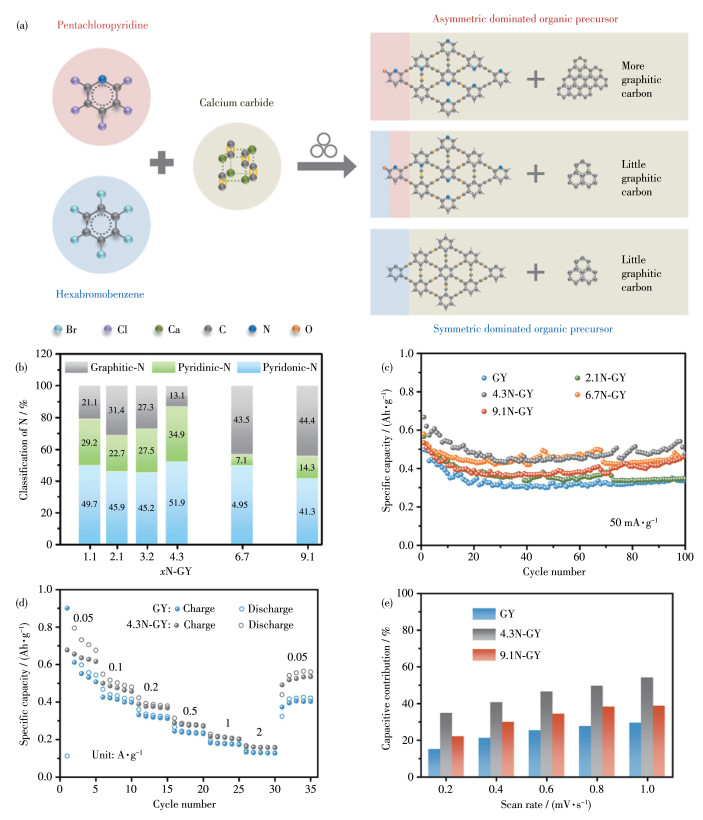
    为了进一步探索γ-GY衍生物分子构型对储锂性能的影响,Lu等[61]采用不对称五氯吡啶和碳化钙作为前驱体,通过机械化学法合成了吡啶氮/吡啶酮氮掺杂γ-GY(xN-GY)(图 11a)。xN-GY和石墨化碳杂质的形成互为竞争过程,非对称性五氯吡啶前驱体的引入导致大量石墨化碳杂质的生长。图 11b显示了不同理论氮含量的xN-GY中不同种类氮的比例,4.3N-GY样品(前驱体中六溴苯和五氯吡啶单体的物质的量之比为1∶1)中石墨氮含量最低。图 11c显示了在50 mA·g-1电流密度下的循环性能,其中4.3N-GY的比容量最高,循环100次后仍可保持519mAh·g-1的比容量。在不同电流密度下,4.3N-GY比纯γ-GY的循环性能更优(图 11d)。在不同扫速下,4.3N-GY的电容贡献比单纯的γ-GY和9.1N-GY(前驱体仅五氯吡啶单体球磨)更高(图 11e)。另外,由DFT计算可看出,4.3N-GY比9.1N-GY更稳定,更有利于锂离子的扩散。因此,当六溴苯和五氯吡啶物质的量之比为1∶1时,得到的4.3N-GY具有最优的锂离子吸附性能和结构稳定性。

    图 11

    图 11.  xN-GY的合成及其储锂性能: (a) 有机单体对称性主导的合成机制示意图; (b) 氮的不同位点含量分布; (c) 50 mA·g-1电流密度下的循环性能; (d) 倍率性能; (e) 电容容量贡献[61]
    Figure 11.  Synthesis and lithium storage performance of xN-GY: (a) schematic symmetry-dominated synthesis mechanism; (b)relative N content of various sites; (c) cycling properties at 50 mA·g-1; (d) rate capability; (e)capacitive contribution[61]

    考虑到全球锂资源短缺导致的潜在资源危机,近年来对钠离子电池的研究也呈现增长趋势。钠与锂属于同一主族,化学性质相似,且钠的自然储量丰富,可以降低储能装置的成本。但是,由于钠离子半径(0.102 nm)远大于锂离子半径(0.069 nm),钠离子在传统碳电极中的吸附和扩散会受到阻碍。为了保持碳电极对钠原子的吸附,可通过引入杂原子(如B[81-82]和N[83-87]等)的方法来优化碳电极的电子分布,从而提高电池的倍率性能。

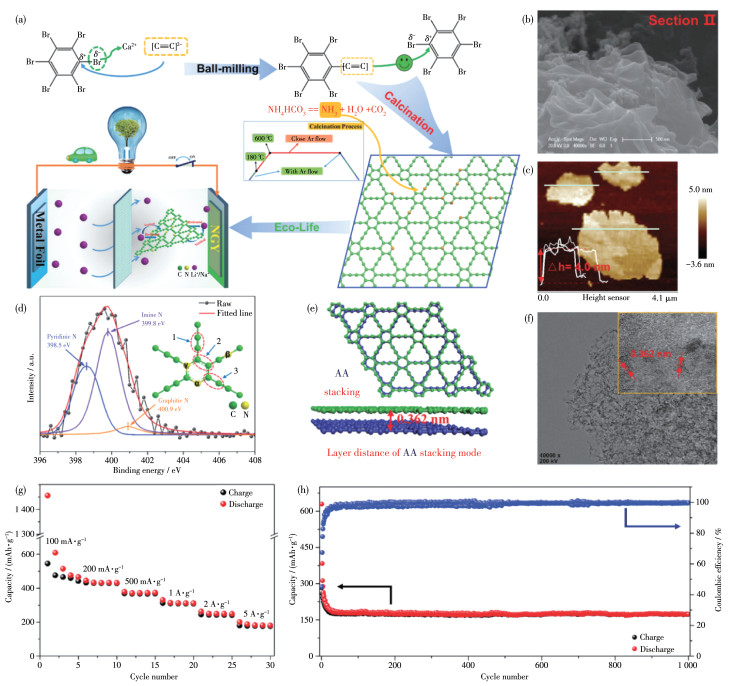
    Yang等[88]对γ-GY进行氮掺杂,探究其储钠性能(图 12a)。此项工作中,采用NH4HCO3作为氮源,通过煅烧工艺制备吡啶氮/亚胺氮掺杂γ-GY(N-GY)。从图 12b和12c可观察到N-GY为尺寸范围为1~3 µm的二维膜,平均厚度约为4 nm,表明样品有大约10个碳层。在γ-GY骨架中,氮原子主要有3种掺杂位置(图 12d),即吡啶-N(α位)、亚胺-N(β位)和石墨-N(γ位)。通过N1s的高分辨率XPS谱图可推出,吡啶-N和亚胺-N为主要掺杂类型。通过HRTEM和DFT确定N-GY的堆叠为AA模式,层间距为0.36 nm。随着电流密度从100 mA·g-1增加到2 A·g-1,N-GY电极可提供546和246 mAh·g-1的可逆容量,在5 A·g-1下仍保持180 mAh·g-1,电流密度恢复到200 mA·g-1后,可逆容量达到465 mAh·g-1。N-GY在5 A·g-1的高电流密度下表现出优异的循环稳定性,1 000次循环后的可逆容量为173 mAh·g-1。该工作还通过DFT计算了N-GY在不同氮掺杂位点的Li/ Na吸附能力。吡啶-N掺杂γ-GY(N-GY-P)和亚胺-N掺杂γ-GY(N-GY-I)可增强Li/Na的吸附能力并优化电子密度分布,有利于提升N-GY的Li/Na存储性能,其中N-GY-I效果最佳。以上结果表明,在γ-GY中掺杂亚胺型氮可有效提高电化学储钠性能。

    图 12

    图 12.  吡啶/亚胺-N-GY的制备与储钠性能: (a) 合成示意图; (b) SEM图; (c) AFM图; (d) XPS N1s高分辨谱图; (e) DFT计算的AA堆叠模式; (f) HRTEM图; (g) 倍率性能和(h) 循环性能[88]
    Figure 12.  Synthesis and sodium storage performance of pyridinic/imine-N-GY: (a) Schematic illustration of the preparation process; (b) SEM image; (c) AFM image; (d) high-resolution N1s core-level XPS spectrum; (e) AA stacking mode from DFT; (f) HRTEM image; (g) rate capability; (h) cycling performance[88]

    钾元素与锂、钠同主族,且钾在地壳中的丰度值与钠元素相当,因而钾离子电池有望应用于大规模储能。钾离子半径比锂离子和钠离子半径都大,其在充放电过程中扩散速度相对缓慢,在电极脱嵌的过程中易导致电极不可逆的结构变化,进而出现电极材料剥落的现象。在应用过程中,通常需要对碳质材料(硬碳、软碳[89-91]、石墨烯[92-94]、[95-97]MXene[98-100])进行结构优化或电子结构调整。其中,异原子掺杂碳材料[85, 93, 95, 97, 101]可引入吸附位点和孔隙,调节电子分布并扩大层间距,提升循环性能和倍率能力。

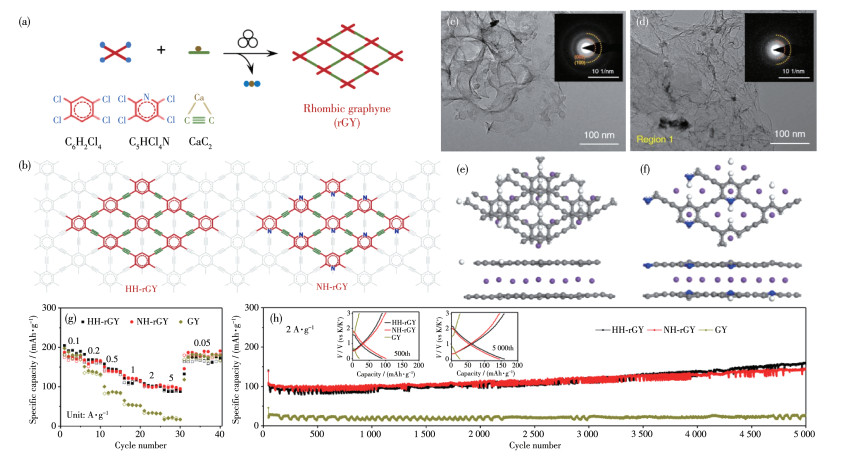
    Chen等[102]采用机械化学法构建了菱形孔道γ-GY(rGY),产物具备有序的菱形通道,可实现钾离子的快速迁移(图 13)。在该工作中,以D2h对称四卤代有机物和碳化钙作为前驱体,分别制备了双氢取代rGY(HH-rGY)与氮/氢共取代rGY(NH-rGY),二者均具有特殊的菱形孔道结构。由图 13c和13d可看出,产物皆为二维层状形态,呈现褶皱状,包裹大量直径为100~200 nm的球形空腔。图 13e和13f为理论计算模拟多层rGY的堆叠模式以及钾离子存储机制,全钾化HH-rGY和NH-rGY构型的每个结构单元可容纳3个钾离子,理论储钾比容量分别为660和654 mAh·g-1。在电化学循环测试中,HH-rGY和NH-rGY有优良的循环性能,在5 A·g-1相对于0.1 A· g-1的电流密度下容量保持率超过50%。在2 A·g-1下循环5 000次后,HH-rGY和NH-rGY仍分别保持160和146 mAh·g-1的可逆容量,证实样品具有极高的循环稳定性。此工作设计的rGY碳骨架,有利于钾离子快速脱嵌,并保持长期循环稳定性,为设计高性能钾离子电池负极材料提供了新思路。

    图 13

    图 13.  rGY的制备与储钾性能: (a) rGY的合成示意图; (b) HH-rGY和NH-rGY的分子结构; (c、e) HH-rGY和(d、f) NH-rGY的TEM图和理论储钾位点; (g) 倍率性能和(h) 2 A·g-1电流密度下的循环性能[102]
    Figure 13.  Synthesis and potassium storage performance of rGY: (a) synthesis of rGY; (b) schematic molecular structure of HH-rGY and NH-rGY; TEM images and theoretical calculations of potassium storage sites of (c, e) HH-rGY and (d, f) NH-rGY;(g) rate capability; (h) long-term cycling performance at 2 A·g-1 [102]

    电化学分解水可间接将可再生能源如太阳能、风能转化为氢燃料。分解水的反应中,四电子OER由于反应过程中涉及电子较多、过电位较大、动力学较慢,是反应速率决定步骤。因此,需设计OER的电催化剂。然而,贵金属氧化物催化剂成本高且稀缺,目前纳米结构碳材料结合其他催化剂形成高活性杂化材料替代贵金属是一个大的研究方向,γ-GY在该方向上有较高应用前景。

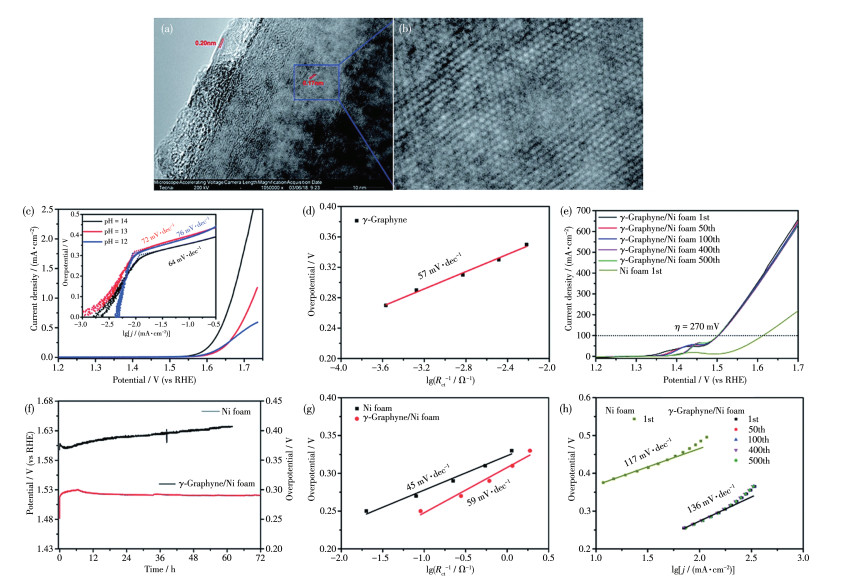
    Li等[60]构建了γ-GY/泡沫镍电极,有效提高了OER性能(图 14)。首先制备γ-GY,由HRTEM图可看出,制备的样品具备六方晶系特征。将样品沉积在玻璃碳电极上,在KOH电解质中测试OER活性。图 14c为不同pH值下的线性扫描伏安(LSV)曲线和相应的Tafel图,在较高的pH值下γ-GY的电催化性能会上升。图 14d可看出样品的纯Tafel斜率为57 mV·dec-1,略小于极化曲线中获得的斜率(64 mV· dec-1),表明γ-GY中的电荷传输速率较高。将γ-GY与泡沫镍复合后,γ-GY附着在泡沫镍表面,扩大了表面积。进行OER后,材料间隙中的γ-GY发生膨胀。图 14e为不同循环下的极化曲线。与纯泡沫镍相比,γ-GY/泡沫镍电极的OER活性显著增强。在电流密度100 mA·cm-2下,泡沫镍电极的过电位为380 mV,γ-GY/泡沫镍电极的过电位为270 mV。图 14f表明复合电极的催化稳定性高于镍催化稳定性。从图 14g可看出,泡沫镍的Tafel斜率为45 mV· dec-1,γ-GY/泡沫镍为59 mV·dec-1,几乎等于γ-GY/玻碳电极的Tafel斜率,意味着OER在γ-GY上发生。图 14h显示了从极化曲线获得的相应Tafel斜率,所得结果远大于图 14g中计算所得的斜率,说明与电极/电解质界面的电荷转移以及γ-GY中的电荷转移相比,泡沫镍中的电荷转移占主导地位。γ-GY/泡沫镍优异的OER性能使γ-GY成为可再生能源转化中作为OER电催化剂的候选者。

    图 14

    图 14.  γ-GY的电催化OER性能: (a、b) HRTEM图; (c) 电极的LSV曲线(插图为Tafel曲线); (d) Tafel斜率; (e) 不同循环下的正极极化曲线; (f) 在100 mA·cm-2下1 mol·L-1 KOH溶液中72 h的计时电位曲线; (g) 泡沫镍和γ-GY/泡沫镍的Tafel斜率; (h) 极化曲线算得的Tafel斜率[60]
    Figure 14.  Electrocatalytic OER performance of γ-GY: (a, b) HRTEM images; (c) LSV curves (Inset: Tafel curves) of the electrode; (d) Tafel slope from impedance data; (e) positive polarization curves at different cycles; (f) chronopotentiometric curves at 100 mA·cm-2 in 1 mol·L-1 KOH solution for 72 h; (g) Tafel slope from impedance data of Ni foam and γ-GY/Ni foam; (h) Tafel slope from the polarization curves at different cycles[60]

    半导体光催化可将太阳能转化为化学能,产生化学燃料,降解污染物质,有助于解决能源危机和环境污染问题。在光催化过程中,为降低载流子复合概率,可将半导体与纳米碳材料结合形成复合材料,转移半导体中的光激发电子[103-107]。γ-GY作为大π共轭碳材料,可与半导体材料构建异质结,用以光催化HER。

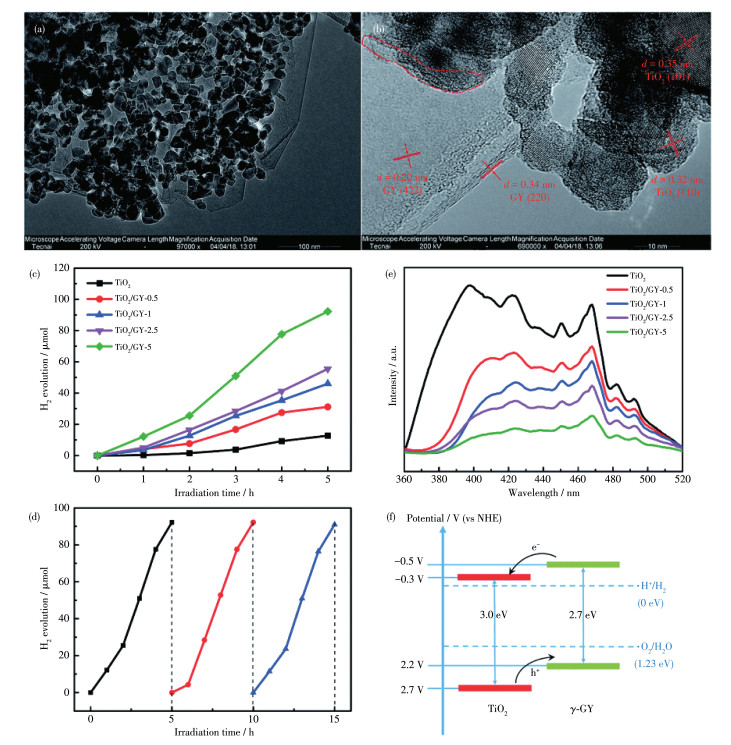
    Wu等[108]用水热法制备出二氧化钛/γ-GY纳米复合材料,研究不同质量比的γ-GY对光催化制氢活性的影响。TEM图(图 15a)显示,γ-GY为边缘具有褶皱的薄片状结构,二氧化钛纳米颗粒均匀附着在片材上。从HRTEM图(图 15b)可看出锐钛矿二氧化钛的(101)晶面和二氧化钛的(110)晶面的晶格条纹。由图 15c中水分解产生的氢气量可知,光催化活性随γ-GY含量的增加而提高。其中TiO2/GY-5(γ-GY质量分数为5%)样品的氢气产量最高,4 h内放出的氢气量为77.6 µmol,约为纯TiO2的8.4倍。图 15d为对TiO2/GY-5样品进行的3个连续的析氢测试循环,证实了其作为光催化剂的稳定性。光致发光光谱也表明,随着γ-GY的含量增加,TiO2/γ-GY纳米复合材料的电子和空穴复合率降低,有助于提升光催化活性。产物能带结构如图 15f所示,TiO2的光生空穴转移到γ-GY的价带,促进光生载流子的转移,TiO2中的光生电子有更多机会参与质子还原析出氢气。

    图 15

    图 15.  TiO2/γ-GY复合材料的光催化制氢性能: (a) TEM图和(b) HRTEM图; (c) 析氢量; (d) TiO2/GY-5的析氢循环测试; (e) 330 nm激发波长下的光致发光光谱; (f) 能带结构示意图[108]
    Figure 15.  Photocatalytic hydrogen evolution of the TiO 2/γ-GY composites: (a) TEM and (b) HRTEM images; (c) hydrogen evolution property; (d) hydrogen evolution cycling test of TiO2/GY-5; (e) photoluminescence spectra with an excitation wavelength of 330 nm; (f) schematic illustration of possible band structures[108]

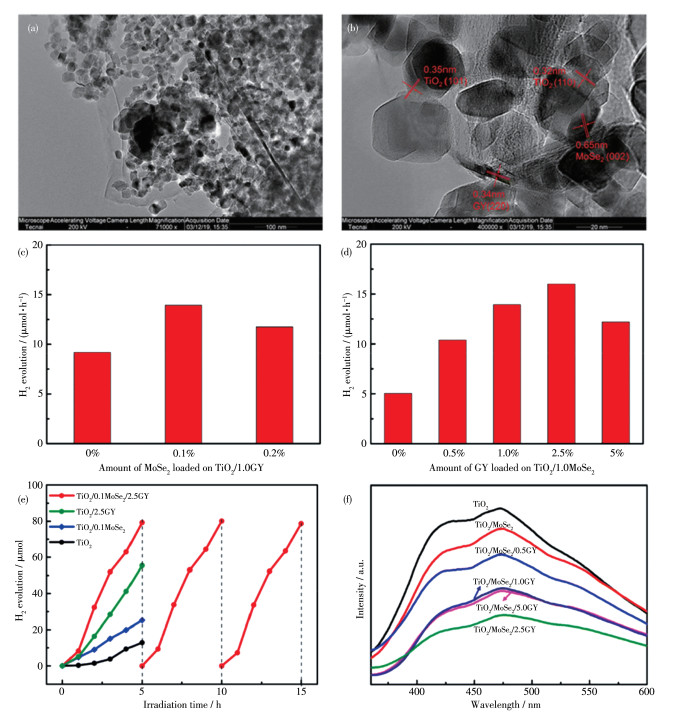
    在此基础上,Wu等[6]通过水热法构建了三元TiO2/MoSe2/γ-GY异质结。由TEM图(图 16a)可看出,层状γ-GY载体上均匀分布着TiO2和MoSe2,HRTEM图(图 16b)表征出锐钛矿相和金红石相的TiO2,以及六方相的MoSe2。当MoSe2含量为0.1%,γ-GY含量为2.5% 时,样品的产氢量最高,可达到16 µmol·h-1。此外,样品作为光催化剂的稳定性良好,如图 16e所示,异质结在3个测量周期前后均保持了较高的析氢活性。光致发光谱表明,加入MoSe2和γ-GY都能抑制光生电荷的复合,且γ-GY起到了主导作用。三元纳米复合材料具有更强的光吸收能力和电荷转移能力,从而提高了产氢性能。

    图 16

    图 16.  TiO2/MoSe2/γ-GY三元复合材料的光催化制氢性能: (a) TEM图和(b) HRTEM图; 不同(c) MoSe2含量和(d) γ-GY含量的纳米复合材料的析氢性能; (e) 析氢循环测试; (f) 光致发光光谱[6]
    Figure 16.  Photocatalytic hydrogen evolution of the TiO2/MoSe2/γ-GY composite: (a) TEM image; (b) HRTEM image; hydrogen evolution rate of composites with different contents of (c) MoSe2 and (d) γ-GY; (e) cycling test of hydrogen evolution; (f) photoluminescence spectra[6]

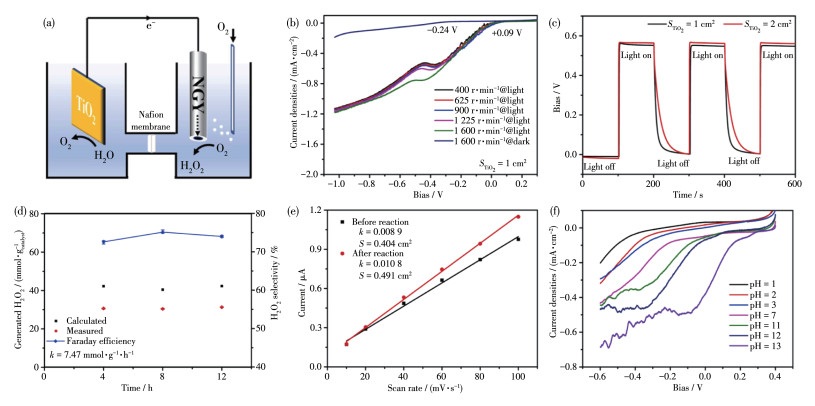
    电催化和光电化学结合可以兼具太阳能驱动和抑制逆反应的优点,可通过设计双电极,在太阳能的驱动下扩大充放电电压差距[109-110],实现无偏压下的电催化,分解水发生HER和OER[111-114],或通过氧还原反应(oxygen reduction reaction,ORR)产生过氧化氢[115-116]。

    Li等[117]通过机械化学方法将吡啶引入γ-GY中原位掺杂氮元素,将其作为催化剂与n型TiO2半导体光阳极连接,并选取0.1 mol·L-1的KOH溶液作为电解液(图 17a)。N掺杂γ-GY呈现出0.6~1 µm的二维重叠纳米片形态,样品厚度为1.8~2.1 nm,对应5~6层的二维片层。将制备的N掺杂γ-GY作为阴极连接TiO2光阳极,当打开光源时,启动ORR偏压为0.09 V,且呈现负电流密度。进一步研究发现,该ORR为2e-过程。在间歇照明下,施加光照时,器件的开路电压也会发生正偏移,且不会随着光阳极的面积变化。

    图 17

    图 17.  (a) 氮掺杂γ-GY作为阴极、TiO2作为光阳极的双电极装置示意图; (b) 在光照和暗态条件下的旋转圆盘伏安图; (c) 间歇照明下器件的开路电压; (d) H2O2产率和选择性; (e) 0.1 V (vs SCE)电位下的电流-扫速关系图; (f) LSV曲线[117]
    Figure 17.  (a) Illustration of the dual-electrode device with N-doped γ-GY as cathode and TiO2 as photoanode; (b) rotating disk voltammograms under dark and irradiation; (c) open-circuit voltage under intermittent illumination; (d) measured H2O2 yield, calculated H2O2 yield and H2O2 selectivity; (e) relationship between charging currents and scan rate at 0.1 V (vs SCE); (f) LSV curves[117]

    图 17d对比了通过电量-时间曲线计算出的H2O2理想产量和KMnO4光谱滴定法测量得到的实际H2O2产量。H2O2的生成速率为7.47 mmol·h-1·g-1,与计算的理想产率相比,H2O2的选择性达到74%。根据图 17e,循环反应后电化学活性表面积增加了21.5%,表明在循环中器件产生了更多活性位点。另外,器件的电流密度强烈依赖于电解质溶液的酸碱度,在酸性电解质和中性电解质中,电流密度随pH值增加而逐渐增加;在碱性电解质中,起始偏压正移,电流密度随着pH值增加而剧烈增加。因此,计算了反应步骤中的相对能量,发现当吡啶氮作为活性位点时,速率决定步骤的能量大大降低,因此γ-GY中掺杂吡啶氮可提升H2O2的选择性。这一工作拓展了N掺杂γ-GY的应用范围。

    以上总结了γ-GY在能源方面的应用,此外,γ-GY还可以应用于污染防治方面[118-119]。

    γ-GY作为电极材料在储能(锂离子电池、钠离子电池、钾离子电池)及光电催化等方面展现了广阔的应用前景,也表明γ-GY及其异原子掺杂或衍生材料在电极材料应用方面具有特殊优势:(1) γ-GY具有丰富的孔结构以及大共轭环,适合离子嵌入/脱出,能够展现出高功率密度;(2) γ-GY独特的三角孔道富含活性位点,可以提升储能器件的能量密度;(3)γ-GY具有优异的半导体性能和催化稳定性,可提升电催化OER、光催化HER的效率;(4) γ-GY可进行异原子掺杂、结构设计以调控化学组分和电子结构,促进储能应用。

    γ-GY在实验室制备方面已经取得较好的突破,并在储能方面拥有广阔的前景,但目前仍处于起步阶段,在实际应用方面还需进一步研究:(1) 探究高品质γ-GY的规模化制备工艺:目前机械化学法制备的γ-GY仍有较多缺陷,建议选取更合适的原料、工艺参数或者在制备过程中设计柔性基板诱导γ-GY的生长;炔烃复分解方法目前对反应物的要求较高,可以寻找低毒、成本更低的前驱体。(2) 研究特殊分子构型GY衍生物的可控制备新方法:γ-GY结构相对石墨烯复杂,其衍生物种类较多,且制备γ-GY衍生物所需克服的空间位阻较小,有利于推进炔烃复分解等湿化学法。(3) 阐明异原子修饰对分子结构和理化性质的影响机制:单元素掺杂的饱和限度及原理、元素共掺杂的竞争合作机制。(4) 进一步拓宽GY类炔碳新材料的应用领域,如锂-硫电池、电子器件和生物传感等。相信γ-GY会成为今后碳材料领域的研究热点。


    1. [1]

      Kratschmer W, Lamb L D, Fostiropoulos K, Huffman D R. Solid C60—A New Form of Carbon[J]. Nature, 1990, 347(6291):  354-358. doi: 10.1038/347354a0

    2. [2]

      Ugarte D. Curling and Closure of Graphitic Networks under Electron-Beam Irradiation[J]. Nature, 1992, 359(6397):  707-709. doi: 10.1038/359707a0

    3. [3]

      Novoselov K S, Geim A K, Morozov S V, Jiang D, Zhang Y, Dubonos S V, Grigorieva I V, Firsov A A. Electric Field Effect in Atomically Thin Carbon Films[J]. Science, 2004, 306(5696):  666-669. doi: 10.1126/science.1102896

    4. [4]

      Li G X, Li Y L, Liu H B, Guo Y B, Li Y J, Zhu D B. Architecture of Graphdiyne Nanoscale Films[J]. Chem. Commun., 2010, 46(19):  3256-3258. doi: 10.1039/b922733d

    5. [5]

      Li Q D, Li Y, Chen Y, Wu L L, Yang C F, Cui X L. Synthesis of γ-Graphyne by Mechanochemistry and Its Electronic Structure[J]. Carbon, 2018, 136:  248-254. doi: 10.1016/j.carbon.2018.04.081

    6. [6]

      Wu L L, Li Q D, Yang C F, Chen Y, Dai Z Q, Yao B Y, Zhang X Y, Cui X L. Ternary TiO2/MoSe2/γ-Graphyne Heterojunctions with Enhanced Photocatalytic Hydrogen Evolution[J]. J. Mater. Sci.-Mater. Electron., 2020, 31(11):  8796-8804. doi: 10.1007/s10854-020-03414-7

    7. [7]

      Zhang X Y, Wang H Q, Wu K, Li Q D, Shao Z P, Yang Q, Chen C D, Cui X L, Chen J P, Wang J. Two-Dimensional γ-Graphyne for Ultrafast Nonlinear Optical Applications[J]. Opt. Mater. Express, 2020, 10(2):  293-301. doi: 10.1364/OME.377354

    8. [8]

      Baughman R H, Eckhardt H, Kertesz M. Strcture-Property Predictions for New Planar Forms of Carbon-Layered Phases Containing sp2 and sp Atoms[J]. J. Chem. Phys., 1987, 87(11):  6687-6699. doi: 10.1063/1.453405

    9. [9]

      Zhang Y Y, Pei Q X, Wang C M. A Molecular Dynamics Investigation on Thermal Conductivity of Graphynes[J]. Comput. Mater. Sci., 2012, 65:  406-410. doi: 10.1016/j.commatsci.2012.07.044

    10. [10]

      Li J Q, Xie Z Q, Xiong Y, Li Z Z, Huang Q X, Zhang S Q, Zhou J Y, Liu R, Gao X, Chen C G, Tong L M, Zhang J, Liu Z F. Architecture of β-Graphdiyne-Containing Thin Film Using Modified Glaser-Hay Coupling Reaction for Enhanced Photocatalytic Property of TiO2[J]. Adv. Mater., 2017, 29(19):  1700421. doi: 10.1002/adma.201700421

    11. [11]

      Huang C S, Li Y J, Wang N, Xue Y R, Zuo Z C, Liu H B, Li Y L. Progress in Research into 2D Graphdiyne-Based Materials[J]. Chem. Rev, 2018, 118(16):  7744-7803. doi: 10.1021/acs.chemrev.8b00288

    12. [12]

      李玉良, 李勇军. 石墨炔: 从发现到应用. 北京: 科学出版社, 2018: 42-96LI Y L, LI Y J. Graphyne: From Discovery to Application. Beijing: Science Press, 2018: 42-96

    13. [13]

      李勇军, 李玉良. 石墨炔的化学修饰及功能化[J]. 物理化学学报, 2018,34,(9): 992-1013. LI Y J, LI Y L. Chemical Modification and Functionalization of Graphdiyne[J]. Acta Phys.-Chim. Sin., 2018, 34(9):  992-1013.

    14. [14]

      神祥艳, 何建江, 王宁, 黄长水. 石墨炔在电化学储能器件中的应用[J]. 物理化学学报, 2018,34,(9): 1029-1047. SHEN X Y, HE J J, WANG N, HUANG C S. Graphdiyne for Electrochemical Energy Storage Devices[J]. Acta Phys.-Chim. Sin., 2018, 34(9):  1029-1047.

    15. [15]

      Srinivasu K, Ghosh S K. Graphyne and Graphdiyne: Promising Materials for Nanoelectronics and Energy Storage Applications[J]. J. Phys. Chem. C, 2012, 116(9):  5951-5956. doi: 10.1021/jp212181h

    16. [16]

      Zhang Q Y, Tang C M, Zhu W H, Cheng C. Strain-Enhanced Li Storage and Diffusion on the Graphyne as the Anode Material in the Li-Ion Battery[J]. J. Phys. Chem. C, 2018, 122(40):  22838-22848. doi: 10.1021/acs.jpcc.8b05272

    17. [17]

      Ivanovskii A L. Graphynes and Graphdyines[J]. Progress in Solid State Chemistry, 2013, 41(1):  1-19.

    18. [18]

      卢秀利, 韩莹莹, 鲁统部. 石墨炔结构的表征及在光电催化反应中的应用[J]. 物理化学学报, 2018,34,(9): 1014-1028. LU X L, HAN Y Y, LU T B. Structure Characterization and Application of Graphdiyne in Photocatalytic and Electrocatalytic Reactions[J]. Acta Phys.-Chim. Sin., 2018, 34(9):  1014-1028.

    19. [19]

      马晓清. 石墨炔在光催化及光电催化中的应用[J]. 化学进展, 2022,34,(5): 1042-1060. MA X Q. Graphynes for Photocatalytic and Photoelectrochemical Applications[J]. Progress in Chemistry, 2022, 34(5):  1042-1060.

    20. [20]

      Jia Z Y, Li Y J, Zuo Z C, Liu H B, Huang C S, Li Y L. Synthesis and Properties of 2D Carbon-Graphdiyne[J]. Acc. Chem. Res., 2017, 50(10):  2470-2478. doi: 10.1021/acs.accounts.7b00205

    21. [21]

      Gao X, Liu H B, Wang D, Zhang J. Graphdiyne: Synthesis, Properties, and Applications[J]. Chem. Soc. Rev., 2019, 48(3):  908-936. doi: 10.1039/C8CS00773J

    22. [22]

      Jia Z Y, Li Y J, Zuo Z C, Liu H B, Huang C S, Li Y L. Synthesis and Properties of 2D Carbon—Graphdiyne[J]. Acc. Chem. Res., 2017, 50(10):  2470-2478. doi: 10.1021/acs.accounts.7b00205

    23. [23]

      Zuo Z C, Wang D, Zhang J, Lu F S, Li Y L. Synthesis and Applications of Graphdiyne-Based Metal-Free Catalysts[J]. Adv. Mater., 2019, 31(13):  1803762. doi: 10.1002/adma.201803762

    24. [24]

      Chen X Y, Jiang X, Yang N J. Graphdiyne Electrochemistry: Progress and Perspectives[J]. Small, 2022, 18(24):  2201135. doi: 10.1002/smll.202201135

    25. [25]

      He J J, Li X D, Lu T T, Shen X Y, Wang N, Huang C S. Graphdiyne Applied for Electrochemical Energy Storage[J]. Dalton Trans., 2019, 48(39):  14566-14574. doi: 10.1039/C9DT02862E

    26. [26]

      Li J F, Wang C, Zhang B, Wang Z H, Yu W J, Chen Y, Liu X K, Guo Z Y, Zhang H. Artificial Carbon Graphdiyne: Status and Challenges in Nonlinear Photonic and Optoelectronic Applications[J]. ACS Appl. Mater. Interfaces, 2020, 12(44):  49281-49296. doi: 10.1021/acsami.0c13030

    27. [27]

      Liu J M, Chen C Y, Zhao Y L. Progress and Prospects of Graphdiyne-Based Materials in Biomedical Applications[J]. Adv. Mater., 2019, 31(42):  1804386. doi: 10.1002/adma.201804386

    28. [28]

      Zhao Y, Chai L X, Yan X B, Huang W C, Fan T J, Al-Hartomy O A, Al-Ghamdi A, Wageh S, Al-Sehemi A G, Xie Z J, Zhang H. Characteristics, Properties, Synthesis and Advanced Applications of 2D Graphdiyne versus Graphene[J]. Mater. Chem. Front., 2022, 6(5):  528-552. doi: 10.1039/D1QM01342D

    29. [29]

      Xie C P, Wang N, Li X F, Xu G R, Huang C S. Research on the Preparation of Graphdiyne and Its Derivatives[J]. Chem.-Eur. J.,, 2020, 26(3):  569-583. doi: 10.1002/chem.201903297

    30. [30]

      Li Y J, He J Y, Shen H. Journey from Small-Molecule Diyne Structures to 2D Graphdiyne: Synthetic Strategies[J]. Chem.-Eur. J., 2020, 26(54):  12310-12321. doi: 10.1002/chem.202001898

    31. [31]

      Wang N, He J J, Wang K, Zhao Y J, Jiu T G, Huang C S, Li Y L. Graphdiyne-Based Materials: Preparation and Application for Electrochemical Energy Storage[J]. Adv. Mater., 2019, 31(42):  1803202. doi: 10.1002/adma.201803202

    32. [32]

      Wang Z Q, Qi L, Zheng Z Q, Xue Y R, Li Y L. 2D Graphdiyne: A Rising Star on the Horizon of Energy Conversion[J]. Chem. Asian J., 2021, 16(21):  3259-3271. doi: 10.1002/asia.202100858

    33. [33]

      Zhuo S F, Shi Y S, Liu L M, Li R Y, Shi L, Anjum D H, Han Y, Wang P. Dual-Template Engineering of Triple-Layered Nanoarray Electrode of Metal Chalcogenides Sandwiched with Hydrogen-Substituted Graphdiyne[J]. Nat. Commun., 2018, 9:  3132. doi: 10.1038/s41467-018-05474-0

    34. [34]

      He J J, Wang N, Yang Z, Shen X Y, Wang K, Huang C S, Yi Y P, Tu Z Y, Li Y L. Fluoride Graphdiyne as a Free-Standing Electrode Displaying Ultra-Stable and Extraordinary High Li Storage Perfor-mance[J]. Energy Environ. Sci., 2018, 11(10):  2893-2903. doi: 10.1039/C8EE01642A

    35. [35]

      Wang N, He J J, Tu Z Y, Yang Z, Zhao F H, Li X D, Huang C S, Wang K, Jiu T G, Yi Y P, Li Y L. Synthesis of Chlorine-Substituted Graphdiyne and Applications for Lithium-Ion Storage[J]. Angew. Chem. Int. Ed., 2017, 56(36):  10740-10745. doi: 10.1002/anie.201704779

    36. [36]

      Wang N, Li X D, Tu Z Y, Zhao F H, He J J, Guan Z Y, Huang C S, Yi Y P, Li Y L. Synthesis and Electronic Structure of Boron-Graphdiyne with an sp-Hybridized Carbon Skeleton and Its Application in Sodium Storage[J]. Angew. Chem. Int. Ed., 2018, 57(15):  3968-3973. doi: 10.1002/anie.201800453

    37. [37]

      Zuo Z C, Shang H, Chen Y H, Li J F, Liu H B, Li Y J, Li Y L. A Facile Approach for Graphdiyne Preparation Under Atmosphere for an Advanced Battery Anode[J]. Chem. Commun., 2017, 53(57):  8074-8077. doi: 10.1039/C7CC03200E

    38. [38]

      Wang F, Zuo Z C, Shang H, Zhao Y J, Li Y L. Ultrafastly Interweaving Graphdiyne Nanochain on Arbitrary Substrates and Its Performance as a Supercapacitor Electrode[J]. ACS Appl. Mater. Interfaces, 2019, 11(3):  2599-2607. doi: 10.1021/acsami.8b01383

    39. [39]

      Liu R, Gao X, Zhou J Y, Xu H, Li Z Z, Zhang S Q, Xie Z Q, Zhang J, Liu Z F. Chemical Vapor Deposition Growth of Linked Carbon Monolayers with Acetylenic Scaffoldings on Silver Foil[J]. Adv. Mater., 2017, 29(18):  1604665. doi: 10.1002/adma.201604665

    40. [40]

      Qian X M, Liu H B, Huang C S, Chen S H, Zhang L, Li Y J, Wang J Z, Li Y L. Self-Catalyzed Growth of Large-Area Nanofilms of Two-Dimensional Carbon[J]. Sci. Rep., 2015, 5(1):  7756. doi: 10.1038/srep07756

    41. [41]

      Zhao F H, Li X D, He J J, Wang K, Huang C S. Preparation of Hierarchical Graphdiyne Hollow Nanospheres as Anode for Lithium-Ion Batteries[J]. Chem. Eng. J, 2021, 413:  127486. doi: 10.1016/j.cej.2020.127486

    42. [42]

      Matsuoka R, Sakamoto R, Hoshiko K, Sasaki S, Masunaga H, Nagashio K, Nishihara H. Crystalline Graphdiyne Nanosheets Produced at a Gas/Liquid or Liquid/Liquid Interface[J]. J. Am. Chem. Soc., 2017, 139(8):  3145-3152. doi: 10.1021/jacs.6b12776

    43. [43]

      Gao X, Zhu Y H, Yi D, Zhou J Y, Zhang S S, Yin C, Ding F, Zhang S Q, Yi X H, Wang J Z, Tong L M, Han Y, Liu Z F, Zhang J. Ultrathin Graphdiyne Film on Graphene through Solution-Phase Van Der Waals Epitaxy[J]. Sci. Adv., 2018, 4(7):  eaat6378. doi: 10.1126/sciadv.aat6378

    44. [44]

      Zhou J Y, Gao X, Liu R, Xie Z Q, Yang J, Zhang S Q, Zhang G M, Liu H B, Li Y L, Zhang J, Liu Z F. Synthesis of Graphdiyne Nanowalls Using Acetylenic Coupling Reaction[J]. J. Am. Chem. Soc., 2015, 137(24):  7596-7599. doi: 10.1021/jacs.5b04057

    45. [45]

      Zhou J Y, Xie Z Q, Liu R, Gao X, Li J Q, Xiong Y, Tong L M, Zhang J, Liu Z F. Synthesis of Ultrathin Graphdiyne Film Using a Surface Template[J]. ACS Appl. Mater. Interfaces, 2019, 11(3):  2632-2637. doi: 10.1021/acsami.8b02612

    46. [46]

      Li G X, Li Y L, Qian X M, Liu H B, Lin H W, Chen N, Li Y J. Construction of Tubular Molecule Aggregations of Graphdiyne for Highly Efficient Field Emission[J]. J. Phys. Chem. C, 2011, 115(6):  2611-2615. doi: 10.1021/jp107996f

    47. [47]

      Qian X M, Ning Z Y, Li Y L, Liu H B, Ouyang C B, Chen Q, Li Y J. Construction of Graphdiyne Nanowires with High-Conductivity and Mobility[J]. Dalton Trans., 2012, 41(3):  730-733. doi: 10.1039/C1DT11641J

    48. [48]

      Kong Y, Li J Q, Zeng S, Yin C, Tong L M, Zhang J. Bridging the Gap between Reality and Ideality of Graphdiyne: The Advances of Synthetic Methodology[J]. Chem, 2020, 6(8):  1933-1951. doi: 10.1016/j.chempr.2020.06.011

    49. [49]

      Song Y W, Li X D, Yang Z, Wang J, Liu C Y, Xie C P, Wang H L, Huang C S. A Facile Liquid/Liquid Interface Method to Synthesize Graphyne Analogs[J]. Chem. Commun., 2019, 55(46):  6571-6574. doi: 10.1039/C9CC02786F

    50. [50]

      Yang Z, Zhang C F, Hou Z F, Wang X, He J J, Li X D, Song Y W, Wang N, Wang K, Wang H L, Huang C S. Porous Hydrogen Substituted Graphyne for High Capacity and Ultra-stable Sodium Ion Storage[J]. J. Mater. Chem. A, 2019, 7(18):  11186-11194. doi: 10.1039/C9TA02100K

    51. [51]

      Miljanic O S, Vollhardt K P C, Whitener G D. An Alkyne Metathesis-Based Route to Ortho-dehydrobenzannulenes[J]. Synlett, 2003, (1):  29-34.

    52. [52]

      Wu B, Li M R, Xiao S N, Qu Y K, Qiu X Y, Liu T F, Tian F H, Li H X, Xiao S X. A Graphyne-like Porous Carbon-Rich Network Synthesized via Alkyne Metathesis[J]. Nanoscale, 2017, 9(33):  11939-11943. doi: 10.1039/C7NR02247F

    53. [53]

      Li J Q, Li S, Liu Q, Yin C, Tong L M, Chen C G, Zhang J. Synthesis of Hydrogen-Substituted Graphyne Film for Lithium-Sulfur Battery Applications[J]. Small, 2019, 15(13):  1805344. doi: 10.1002/smll.201805344

    54. [54]

      Sun Q, Yu X, Bao M L, Liu M X, Pan J L, Zha Z Q, Cai L L, Ma H H, Yuan C X, Qiu X H, Xu W. Direct Formation of C—C Triple-Bonded Structural Motifs by On-Surface Dehalogenative Homocouplings of Tribromomethyl-Substituted Arenes[J]. Angew. Chem. Int. Ed., 2018, 57(15):  4035-4038. doi: 10.1002/anie.201801056

    55. [55]

      Liang J Z, Wu J S, Zhang Y J, Zhao X L, Yuan C X. Synthesis of Hydrogen-Substituted Graphyne Film via Dehalogenative Homocoupling Reaction[J]. Tetrahedron, 2021, 89:  132171. doi: 10.1016/j.tet.2021.132171

    56. [56]

      李乔丹, 李永, 唐佳宁, 崔晓莉. 氢取代石墨单炔的机械化学合成及其电催化特性[J]. 物理化学学报, 2018,34,(9): 1080-1087. LEE J, LI Y, TANG J N, CUI X L. Synthesis of Hydrogen Substituted Graphyne through Mechanochemistry and Its Electrocatalytic Properties[J]. Acta Phys.-Chim. Sin., 2018, 34(9):  1080-1087.

    57. [57]

      Li Y J, Liu Q N, Li W F, Lu Y Z, Meng H, Li C X. Efficient Destruction of Hexachlorobenzene by Calcium Carbide through Mechanochemical Reaction in a Planetary Ball Mill[J]. Chemosphere, 2017, 166:  275-280. doi: 10.1016/j.chemosphere.2016.09.135

    58. [58]

      Li Y J, Liu Q N, Li W F, Meng H, Lu Y Z, Li C X. Synthesis and Supercapacitor Application of Alkynyl Carbon Materials Derived from CaC2 and Polyhalogenated Hydrocarbons by Interfacial Mechanochemical Reactions[J]. ACS Appl. Mater. Interfaces, 2017, 9(4):  3895-3901. doi: 10.1021/acsami.6b13610

    59. [59]

      Do J L, Friscic T. Mechanochemistry: A Force of Synthesis[J]. ACS Central Science, 2017, 3(1):  13-19. doi: 10.1021/acscentsci.6b00277

    60. [60]

      Li Q D, Yang C F, Wu L L, Wang H, Cui X L. Converting Benzene into γ-Graphyne and Its Enhanced Electrochemical Oxygen Evolution Performance[J]. J. Mater. Chem. A, 2019, 7(11):  5981-5990. doi: 10.1039/C8TA10317H

    61. [61]

      Lu Y X, Chen Y, Li Q D, Hao Z X, Wang L R, Qiu D, He C L, Wang M Y, Cui X L. Regulating Symmetry of Organic Precursors for Mechanochemical Synthesizing Rich Pyridonic-/Pyridinic-Nitrogen Doped Graphyne[J]. Carbon, 2022, 194:  274-281. doi: 10.1016/j.carbon.2022.03.069

    62. [62]

      Hu Y M, Wu C Y, Pan Q Y, Jin Y H, Lyu R, Martinez V, Huang S F, Wu J Y, Wayment L J, Clark N A, Raschke M B, Zhao Y J, Zhang W. Synthesis of γ-Graphyne Using Dynamic Covalent Chemistry[J]. Nat. Synth., 2022, 1:  449-454. doi: 10.1038/s44160-022-00068-7

    63. [63]

      Barua M, Saraswat A, Rao C N R. A Novel Method for Synthesis of γ-graphyne and Their Charge Transfer Properties[J]. Carbon, 2022, 200:  247-252. doi: 10.1016/j.carbon.2022.08.061

    64. [64]

      Feng K, Li M, Liu W W, Kashkooli A G, Xiao X C, Cai M, Chen Z W. Silicon-Based Anodes for Lithium-Ion Batteries: From Fundamentals to Practical Applications[J]. Small, 2018, 14(8):  1702737. doi: 10.1002/smll.201702737

    65. [65]

      Ren W F, Zhou Y, Li J T, Huang L, Sun S G. Si Anode for Next-Generation Lithium-Ion Battery[J]. Curr. Opin. Electrochem., 2019, 18:  46-54. doi: 10.1016/j.coelec.2019.09.006

    66. [66]

      Zhu G J, Luo W, Wang L J, Jiang W, Yang J P. Silicon: Toward Ecofriendly Reduction Techniques for Lithium-Ion Battery Applications[J]. J. Mater. Chem. A, 2019, 7(43):  24715-24737. doi: 10.1039/C9TA08554H

    67. [67]

      Li P, Kim H, Myung S T, Sun Y K. Diverting Exploration of Silicon Anode into Practical Way: A Review Focused on Silicon-Graphite Composite for Lithium Ion Batteries[J]. Energy Storage Mater., 2021, 35:  550-576. doi: 10.1016/j.ensm.2020.11.028

    68. [68]

      Zhao X Y, Lehto V P. Challenges and Prospects of Nanosized Silicon Anodes in Lithium-Ion Batteries[J]. Nanotechnology, 2020, 32(4):  042002.

    69. [69]

      Ying H J, Han W Q. Metallic Sn-Based Anode Materials: Application in High-Performance Lithium-Ion and Sodium-Ion Batteries[J]. Adv. Sci., 2017, 4(11):  1700298. doi: 10.1002/advs.201700298

    70. [70]

      Mou H Y, Xiao W, Miao C, Li R, Yu L M. Tin and Tin Compound Materials as Anodes in Lithium-Ion and Sodium-Ion Batteries: A Review[J]. Front. Chem., 2020, 8:  141. doi: 10.3389/fchem.2020.00141

    71. [71]

      Huang B, Pan Z F, Su X Y, An L. Tin-Based Materials as Versatile Anodes for Alkali (Earth)-Ion Batteries[J]. J. Power Sources, 2018, 395:  41-59. doi: 10.1016/j.jpowsour.2018.05.063

    72. [72]

      Li Y J, Li Y Y, Lin P, Gu J, He X J, Yu M X, Wang X T, Liu C, Li C X. Architecture and Electrochemical Performance of Alkynyl-Linked Naphthyl Carbon Skeleton: Naphyne[J]. ACS Appl. Mater. Interfaces, 2020, 12(29):  33076-33082. doi: 10.1021/acsami.0c05741

    73. [73]

      Shang H, Zuo Z C, Li L, Wang F, Liu H B, Li Y J, Li Y L. Ultrathin Graphdiyne Nanosheets Grown In Situ on Copper Nanowires and Their Performance as Lithium-Ion Battery Anodes[J]. Angew. Chem. Int. Ed., 2018, 57(3):  774-778. doi: 10.1002/anie.201711366

    74. [74]

      Tian W J, Zhang H Y, Duan X G, Sun H Q, Shao G S, Wang S B. Porous Carbons: Structure-Oriented Design and Versatile Applications[J]. Adv. Funct. Mater., 2020, 30(17):  1909265. doi: 10.1002/adfm.201909265

    75. [75]

      Balogun M S, Luo Y, Qiu W T, Liu P, Tong Y X. A Review of Carbon Materials and Their Composites with Alloy Metals for Sodium Ion Battery Anodes[J]. Carbon, 2016, 98:  162-178. doi: 10.1016/j.carbon.2015.09.091

    76. [76]

      Zhang H Y, Xia Y Y, Bu H X, Wang X P, Zhang M, Luo Y H, Zhao M W. Graphdiyne: A Promising Anode Material for Lithium Ion Batteries with High Capacity and Rate Capability[J]. J. Appl. Phys., 2013, 113(4):  044309. doi: 10.1063/1.4789635

    77. [77]

      Huang C S, Zhang S L, Liu H B, Li Y J, Cui G T, Li Y L. Graphdiyne for High Capacity and Long-Life Lithium Storage[J]. Nano Energy, 2015, 11:  481-489. doi: 10.1016/j.nanoen.2014.11.036

    78. [78]

      Zhang S L, Liu H B, Huang C S, Cui G L, Li Y L. Bulk Graphdiyne Powder Applied for Highly Efficient Lithium Storage[J]. Chem. Commun., 2015, 51(10):  1834-1837. doi: 10.1039/C4CC08706B

    79. [79]

      Du H P, Yang H, Huang C S, He J J, Liu H B, Li Y L. Graphdiyne Applied for Lithium-Ion Capacitors Displaying High Power and Energy Densities[J]. Nano Energy, 2016, 22:  615-622. doi: 10.1016/j.nanoen.2016.02.052

    80. [80]

      Yang C F, Li Y, Chen Y, Li Q D, Wu L L, Cui X L. Mechanochemical Synthesis of γ-Graphyne with Enhanced Lithium Storage Performance[J]. Small, 2019, 15(8):  1804710. doi: 10.1002/smll.201804710

    81. [81]

      Wang D, Wang Z Y, Li Y, Dong K Z, Shao J H, Luo S H, Liu Y G, Qi X W. In Situ Double-Template Fabrication of Boron-Doped 3D Hierarchical Porous Carbon Network as Anode Materials for Li-and Na-Ion Batteries[J]. Appl. Surf. Sci., 2019, 464:  422-428. doi: 10.1016/j.apsusc.2018.09.035

    82. [82]

      Rodriguez-Garcia J, Camean I, Ramos A, Rodriguez E, Garcia A B. Graphitic Carbon Foams as Anodes for Sodium-Ion Batteries in Glyme-Based Electrolytes[J]. Electrochim. Acta, 2018, 270:  236-244. doi: 10.1016/j.electacta.2018.03.084

    83. [83]

      Zhang F, Alhajji E, Lei Y J, Kurra N, Alshareef H N. Highly Doped 3D Graphene Na-Ion Battery Anode by Laser Scribing Polyimide Films in Nitrogen Ambient[J]. Adv. Energy Mater., 2018, 8(23):  1800353. doi: 10.1002/aenm.201800353

    84. [84]

      Ou J K, Yang L, Zhang Z. Chrysanthemum Derived Hierarchically Porous Nitrogen-Doped Carbon as High Performance Anode Material for Lithium/Sodium Ion Batteries[J]. Powder Technol., 2019,, 344:  89-95. doi: 10.1016/j.powtec.2018.11.100

    85. [85]

      Zhang W L, Sun M L, Yin J, Wang W X, Huang G, Qiu X Q, S chwingenschlogl U, Alshareef H N. Rational Design of Carbon Anodes by Catalytic Pyrolysis of Graphitic Carbon Nitride for Efficient Storage of Na and K Mobile Ions[J]. Nano Energy, 2021, 87:  106184. doi: 10.1016/j.nanoen.2021.106184

    86. [86]

      Liu C K, Hu J T, Yang L Y, Zhao W G, Li H J, Pan F. Low-Surface-Area Nitrogen Doped Carbon Nanomaterials for Advanced Sodium Ion Batteries[J]. Chem. Commun., 2018, 54(17):  2142-2145. doi: 10.1039/C7CC09911H

    87. [87]

      Fu L J, Tang K, Song K P, van Aken P A, Yu Y, Maier J. Nitrogen Doped Porous Carbon Fibres as Anode Materials for Sodium Ion Batteries with Excellent Rate Performance[J]. Nanoscale, 2014, 6(3):  1384-1389. doi: 10.1039/C3NR05374A

    88. [88]

      Yang C F, Qiao C, Chen Y, Zhao X Q, Wu L L, Li Y, Jia Y, Wang S Y, Cui X L. Nitrogen Doped γ-Graphyne: A Novel Anode for High-Capacity Rechargeable Alkali-Ion Batteries[J]. Small, 2020, 16(10):  1907365. doi: 10.1002/smll.201907365

    89. [89]

      Xu F, Zhai Y X, Zhang E, Liu Q H, Jiang G S, Xu X S, Qiu Y Q, Liu X M, Wang H Q, Kaskel S. Ultrastable Surface-Dominated Pseudocapacitive Potassium Storage Enabled by Edge-Enriched N-Doped Porous Carbon Nanosheets[J]. Angew. Chem. Int. Ed., 2020, 59(44):  19460-19467. doi: 10.1002/anie.202005118

    90. [90]

      Liu M Q, Chang L M, Wang J, Li J H, Jiang J M, Pang G, Wang H R, Nie P, Zhao C M, Xu T H, Wang L M. Hierarchical N-Doped Carbon Nanosheets Submicrospheres Enable Superior Electrochemical Properties for Potassium Ion Capacitors[J]. J. Power Sources, 2020, 469:  228415. doi: 10.1016/j.jpowsour.2020.228415

    91. [91]

      Tian S, Guan D C, Lu J, Zhang Y, Liu T Z, Zhao X Y, Yang C H, Nan J M. Synthesis of the Electrochemically Stable Sulfur-Doped Bamboo Charcoal as the Anode Material of Potassium-Ion Batteries[J]. J. Power Sources, 2020, 448:  227572. doi: 10.1016/j.jpowsour.2019.227572

    92. [92]

      Liu Y, Lu Y X, Xu Y S, Meng Q S, Gao J C, Sun Y G, Hu Y S, Chang B B, Liu C T, Cao A M. Pitch-Derived Soft Carbon as Stable Anode Material for Potassium Ion Batteries[J]. Adv. Mater., 2020, 32(17):  2000505. doi: 10.1002/adma.202000505

    93. [93]

      Xu Y, Zhang C L, Zhou M, Fu Q, Zhao C X, Wu M H, Lei Y. Highly Nitrogen Doped Carbon Nanofibers with Superior Rate Capability and Cyclability for Potassium Ion Batteries[J]. Nat. Commun., 2018, 9(1):  1720. doi: 10.1038/s41467-018-04190-z

    94. [94]

      Wang M Y, Zhu Y Y, Zhang Y, Duan J Y, Wang K K, Wang R, Sun G Y, Wang C Y. Isotropic High Softening Point Petroleum Pitch-Based Carbon as Anode for High-Performance Potassium-Ion Batteries[J]. J. Power Sources, 2021, 481:  228902. doi: 10.1016/j.jpowsour.2020.228902

    95. [95]

      Share K, Cohn A P, Carter R, Rogers B, Pint C L. Role of Nitrogen-Doped Graphene for Improved High-Capacity Potassium Ion Battery Anodes[J]. ACS Nano, 2016, 10(10):  9738-9744. doi: 10.1021/acsnano.6b05998

    96. [96]

      Han J W, Zhang C, Kong D B, He X Z, Xiao J, Chen F Q, Tao Y, Wan Y, Yang Q H. Flowable Sulfur Template Induced Fully Interconnected Pore Structures in Graphene Artefacts towards High Volumetric Potassium Storage[J]. Nano Energy, 2020, 72:  104729. doi: 10.1016/j.nanoen.2020.104729

    97. [97]

      Yang W X, Zhou J H, Wang S, Wang Z C, Lv F, Zhang W S, Zhang W Y, Sun Q, Guo S J. A Three-Dimensional Carbon Framework Constructed by N/S Co-doped Graphene Nanosheets with Expanded Interlayer Spacing Facilitates Potassium Ion Storage[J]. ACS Energy Lett., 2020, 5(5):  1653-1661. doi: 10.1021/acsenergylett.0c00413

    98. [98]

      Wu Y J, Sun Y J, Zheng J F, Rong J H, Li H Y, Niu L. MXenes: Advanced Materials in Potassium Ion Batteries[J]. Chem. Eng. J., 2021, 404:  126565. doi: 10.1016/j.cej.2020.126565

    99. [99]

      Cao J M, Sun Z Q, Li J Z, Zhu Y K, Yuan Z Y, Zhang Y M, Li D D, Wang L L, Han W. Microbe-Assisted Assembly of Ti3C 2Tx MXene on Fungi-Derived Nanoribbon Heterostructures for Ultrastable Sodium and Potassium Ion Storage[J]. ACS Nano, 2021, 15(2):  3423-3433. doi: 10.1021/acsnano.0c10491

    100. [100]

      Zhao R Z, Di H X, Wang C X, Hui X B, Zhao D Y, Wang R T, Zhang L Y, Yin L W. Encapsulating Ultrafine Sb Nanoparticles in Na+ Pre-Intercalated 3D Porous Ti3C2Tx MXene Nanostructures for Enhanced Potassium Storage Performance[J]. ACS Nano, 2020, 14(10):  13938-13951. doi: 10.1021/acsnano.0c06360

    101. [101]

      Ju Z C, Zhang S, Xing Z, Zhuang Q C, Qiang Y H, Qian Y T. Direct Synthesis of Few-Layer F-Doped Graphene Foam and Its Lithium/ Potassium Storage Properties[J]. ACS Appl. Mater. Interfaces, 2016, 8(32):  20682-20690. doi: 10.1021/acsami.6b04763

    102. [102]

      Chen Y, Li Q D, Wang W J, Lu Y X, He C L, Qiu D, Cui X L. Mechanochemical Constructing Ordered Rhombic Channels in Graphyne Analogues for Rapid Potassium-Ion Storage. 2[J]. D Mater., 2021, 8(4):  044012.

    103. [103]

      Li X B, Kang B B, Dong F, Zhang Z Q, Luo X D, Han L, Huang J T, Feng Z J, Chen Z, Xu J L, Peng B L, Wang Z L. Enhanced Photocatalytic Degradation and H2/H2O2 Production Performance of S-pCN/WO2.72 S-Scheme Heterojunction with Appropriate Surface Oxygen Vacancies[J]. Nano Energy, 2021, 81:  105671. doi: 10.1016/j.nanoen.2020.105671

    104. [104]

      Liu J H, Wei X N, Sun W Q, Guan X X, Zheng X C, Li J. Fabrication of S-Scheme CdS-g-C3N4-Graphene Aerogel Heterojunction for Enhanced Visible Light Driven Photocatalysis[J]. Environ. Res., 2021, 197:  111136. doi: 10.1016/j.envres.2021.111136

    105. [105]

      Jiang D L, Ma W X, Xiao P, Shao L Q, Li D, Chen M. Enhanced Photocatalytic Activity of Graphitic Carbon Nitride/Carbon Nanotube/Bi 2 WO6 Ternary Z-Scheme Heterojunction with Carbon Nanotube as Efficient Electron Mediator[J]. J. Colloid Interface Sci, 2018, 512:  693-700. doi: 10.1016/j.jcis.2017.10.074

    106. [106]

      Yu H T, Quan X, Chen S, Zhao H M, Zhang Y B. TiO2-Carbon Nanotube Heterojunction Arrays with a Controllable Thickness of TiO2 Layer and Their First Application in Photocatalysis[J]. J. Photochem. Photobiol. A, 2008, 200(2/3):  301-306.

    107. [107]

      Xu Q L, Zhu B C, Cheng B, Yu J G, Zhou M H, Ho W K. Photocatalytic H2 Evolution on Graphdiyne/g-C3N 4 Hybrid Nanocomposites[J]. Appl. Catal. B-Environ., 2019, 255:  117770. doi: 10.1016/j.apcatb.2019.117770

    108. [108]

      Wu L L, Li Q D, Yang C F, Ma X Q, Zhang Z F, Cui X L. Constructing a Novel TiO2/γ-Graphyne Heterojunction for Enhanced Photocatalytic Hydrogen Evolution[J]. J. Mater. Chem. A, 2018, 6(42):  20947-20955. doi: 10.1039/C8TA07307D

    109. [109]

      Du D F, Zhao S, Zhu Z, Li F J, Chen J. Photo-excited Oxygen Reduction and Oxygen Evolution Reactions Enable a High-Performance Zn-Air Battery[J]. Angew. Chem. Int. Ed., 2020, 59(41):  18140-18144. doi: 10.1002/anie.202005929

    110. [110]

      Zhang B Q, Wang S Y, Fan W J, Ma W G, Liang Z X, Shi J Y, Liao S J, Li C. Photoassisted Oxygen Reduction Reaction in H2O2 Fuel Cells[J]. Angew. Chem. Int. Ed., 2016, 55(47):  14748-14751. doi: 10.1002/anie.201607118

    111. [111]

      Qiu Y C, Liu W, Chen W, Chen W, Zhou G M, Hsu P C, Zhang R F, Liang Z, Fan S S, Zhang Y G, Cui Y. Efficient Solar-Driven Water Splitting by Nanocone BiVO4-Perovskite Tandem Cells[J]. Sci. Adv., 2016, 2(6):  e1501764. doi: 10.1126/sciadv.1501764

    112. [112]

      Sokol K P, Robinson W E, Warnan J, Kornienko N, Nowaczyk M M, Ruff A, Zhang J Z, Reisner E. Bias-Free Photoelectrochemical Water Splitting with Photosystem Ⅱ on a Dye-Sensitized Photoanode Wired to Hydrogenase[J]. Nat. Energy, 2018, 3(11):  944-951. doi: 10.1038/s41560-018-0232-y

    113. [113]

      Zhang H, Wang H Z, Xuan J. Rational Design of Photoelectrochemical Cells towards Bias-Free Water Splitting: Thermodynamic and Kinetic Insights[J]. J. Power Sources, 2020, 462:  228113. doi: 10.1016/j.jpowsour.2020.228113

    114. [114]

      Kim H, Bae S, Jeon D, Ryu J. Fully Solution-Processable Cu2O-BiVO4 Photoelectrochemical Cells for Bias-Free Solar Water Splitting[J]. Green Chem., 2018, 20(16):  3732-3742. doi: 10.1039/C8GC00681D

    115. [115]

      Jakešová M, Apaydin D H, Sytnyk M, Oppelt K, Heiss W, Sariciftci N S, Głowacki E D. Hydrogen-Bonded Organic Semiconductors as Stable Photoelectrocatalysts for Efficient Hydrogen Peroxide Photosynthesis[J]. Adv. Funct. Mater., 2016, 26(29):  5248-5254. doi: 10.1002/adfm.201601946

    116. [116]

      Fan W J, Zhang B Q, Wang X Y, Ma W G, Li D, Wang Z L, Dupuis M, Shi J Y, Liao S J, Li C. Efficient Hydrogen Peroxide Synthesis by Metal-Free Polyterthiophene via Photoelectrocatalytic Dioxygen Reduction[J]. Energy Environ. Sci., 2020, 13(1):  238-245. doi: 10.1039/C9EE02247C

    117. [117]

      Li Q D, Chen Y, Du F, Cui X L, Dai L M. Bias-Free Synthesis of Hydrogen Peroxide from Photo-Driven Oxygen Reduction Reaction Using N-Doped γ-Graphyne Catalyst[J]. Appl. Catal. B-Environ., 2022, 304:  120959. doi: 10.1016/j.apcatb.2021.120959

    118. [118]

      Lin Y, Liu H Y, Yang C P, Wu X, Du C, Jiang L M, Zhong Y Y. γ-Graphyne as Photogenerated Electrons Transfer Layer Enhances Photocatalytic Performance of Silver Phosphate[J]. Appl. Catal. B-Environ., 2020, 264:  118479. doi: 10.1016/j.apcatb.2019.118479

    119. [119]

      Yang J, Bi Z S, Zhang S Y, Zeng L R, Zhang Y N, Wang Y N, Yan J F, Zhao W, Dai Y, Yun J N. Synthesis of γ-Graphyne by Modified Mechanochemistry with Enhanced Adsorption of Organic Dyes[J]. Diam. Relat. Mat., 2022, 129:  109336. doi: 10.1016/j.diamond.2022.109336

  • 图 1  (a) 碳材料的发展历程; (b) γ-GDY和γ-GY近十年的论文发表量和被引量(数据来自Web of Science数据库)

    Figure 1  (a) History of representative carbon materials; (b) Yearly publications and citations of γ-GDY and γ-GY in recent ten years (Date were obtained from Web of Science)

    图 2  (a) 石墨烯、(b) γ-GY、(c) γ-GDY、(d) α-GY、(e) β-GY和(f) 6, 6, 12-GY的结构示意图[11]

    Figure 2  Structural geometries of (a) graphene, (b) γ-GY, (c) γ-GDY, (d) α-GY, (e) β-GY, and (f) 6, 6, 12-GY[11]

    图 3  (a) HsGDY[33]、(b) 氟取代γ-GDY[34]、(c) 氯取代γ-GDY[35]和(d) 硼取代α-GDY[36]的结构示意图

    Figure 3  Structural geometries of (a) HsGDY[33], (b) F-substituted γ-GDY[34], (c) Cl-substituted γ-GDY[35], and (d) boron-substituted α-GDY[36]

    图 4  干法制备γ-GDY: (a) 爆炸法[37]; (b) 基板上交织γ-GDY纳米链[38]; (c) 化学气相沉积法[39]; (d) ZnO纳米阵列上沉积γ-GDY薄膜[40]

    Figure 4  Overview of the dry chemistry synthesis methods of γ-GDY: (a) an explosion approach[37]; (b) interweaving γ-GDY nanochain on substrates[38]; (c) chemical vapor deposition[39]; (d) γ-GDY film on the top surface of ZnO nanorod arrays[40]

    图 5  湿法制备γ-GDY: (a) 溶剂热方法制备中空γ-GDY纳米球[41]; (b) 气/液界面合成法[42]; (c) 溶液相范德瓦耳斯外延法[43]; (d) 偶联反应制备γ-GDY纳米墙[44]; (e) 模板法[45]

    Figure 5  Overview of the wet chemistry synthesis methods of γ-GDY: (a) hierarchical γ-GDY hollow nanospheres by solvothermal method[41]; (b) gas/liquid interfacial synthesis[42]; (c) γ-GDY film through solution-phase van der Waals epitaxy[43]; (d) γ-GDY nanowalls using acetylenic coupling reaction[44]; (e) surface template method[45]

    图 6  HsGY制备方法总述: (a、b) 炔烃复分解法[52-53]; (c) 机械化学法[56]; (d) 脱卤自偶联反应[55]; (e) 液/液界面法[49]; (f) 滴定法[50]

    Figure 6  Overview of the synthesis methods of HsGY: (a, b) alkyne metathesis reaction[52-53]; (c) mechanochemistry[56]; (d) dehalogenative homocoupling reaction[55]; (e) liquid/liquid interface synthesis method [49]; (f) HsGY film growing on the Cu substrate by adding precursors dropwise[50]

    图 7  机械化学法制备γ-GY: (a) 机械化学法示意图; (b) 拉曼光谱; (c) XPS C1s高分辨谱; (d) 选区电子衍射(SAED)图; (e)UV-Vis漫反射光谱图[5]

    Figure 7  Synthesis of γ-GY by the mechanochemical method: (a) synthesis mechanism; (b) Raman spectrum; (c) high-resolution C1s core-level XPS spectrum; (d) selected electron diffraction (SAED) pattern; (e) UV-Vis diffuse reflectance spectra[5]

    图 8  炔烃复分解反应制备γ-GY: (a) 合成示意图; (b) 光学显微镜图像(插图为AFM图); (c) WAXS图及模拟ABC、AA、AB堆叠WAXS图; (d) HRTEM图(插图为SAED图); (e) XPS C1s高分辨谱图; (f) ABC堆叠γ-GY层的结构示意图及其(g) 六边晶胞和(h) 菱形原胞[62]

    Figure 8  Synthesis of γ-GY by the alkyne metathesis reaction: (a) synthesis mechanism; (b) optical microscopy and AFM (Inset) images; (c) WAXS patterns and simulated patterns in ABC, AA, and AB stacking models; (d) HRTEM image and SAED pattern (Inset); (e) high-resolution C1s core-level XPS spectrum; (f) structure of ABC-stacked γ-GY and corresponding (g) hexagonal unit cell and (h) rhombohedral primitive cell[62]

    图 9  一锅煮Sonogashira交联反应制备γ-GY: (a) 合成示意图; (b) 亮场TEM图; (c) 拉曼谱图; (d) XPS C1s高分辨谱[63]

    Figure 9  Synthesis of γ-GY by the one-pot Sonogashira cross-linking reaction: (a) synthesis mechanism; (b) bright-field TEM image; (c) Raman spectra; (d) C1s XPS core-level spectra[63]

    图 10  γ-GY的储锂性能: (a) 合成及锂离子存储示意图; (b) 球磨后中间体和(c) 最终产物TEM图; (d) SAED图、(e) AFM图和(f) 拉曼光谱; (g) 倍率性能和(h) 1 A·g-1电流密度下的循环性能[80]

    Figure 10  Lithium storage performance of γ-GY: (a) schematic illustration of the preparation; TEM images of (b) the ball-milled intermediate and (c) the final sample; (d) SAED pattern, (e) AFM image, and (f) Raman spectra; (g) rate capability and (h) cycling performance at 1 A·g-1 [80]

    图 11  xN-GY的合成及其储锂性能: (a) 有机单体对称性主导的合成机制示意图; (b) 氮的不同位点含量分布; (c) 50 mA·g-1电流密度下的循环性能; (d) 倍率性能; (e) 电容容量贡献[61]

    Figure 11  Synthesis and lithium storage performance of xN-GY: (a) schematic symmetry-dominated synthesis mechanism; (b)relative N content of various sites; (c) cycling properties at 50 mA·g-1; (d) rate capability; (e)capacitive contribution[61]

    图 12  吡啶/亚胺-N-GY的制备与储钠性能: (a) 合成示意图; (b) SEM图; (c) AFM图; (d) XPS N1s高分辨谱图; (e) DFT计算的AA堆叠模式; (f) HRTEM图; (g) 倍率性能和(h) 循环性能[88]

    Figure 12  Synthesis and sodium storage performance of pyridinic/imine-N-GY: (a) Schematic illustration of the preparation process; (b) SEM image; (c) AFM image; (d) high-resolution N1s core-level XPS spectrum; (e) AA stacking mode from DFT; (f) HRTEM image; (g) rate capability; (h) cycling performance[88]

    图 13  rGY的制备与储钾性能: (a) rGY的合成示意图; (b) HH-rGY和NH-rGY的分子结构; (c、e) HH-rGY和(d、f) NH-rGY的TEM图和理论储钾位点; (g) 倍率性能和(h) 2 A·g-1电流密度下的循环性能[102]

    Figure 13  Synthesis and potassium storage performance of rGY: (a) synthesis of rGY; (b) schematic molecular structure of HH-rGY and NH-rGY; TEM images and theoretical calculations of potassium storage sites of (c, e) HH-rGY and (d, f) NH-rGY;(g) rate capability; (h) long-term cycling performance at 2 A·g-1 [102]

    图 14  γ-GY的电催化OER性能: (a、b) HRTEM图; (c) 电极的LSV曲线(插图为Tafel曲线); (d) Tafel斜率; (e) 不同循环下的正极极化曲线; (f) 在100 mA·cm-2下1 mol·L-1 KOH溶液中72 h的计时电位曲线; (g) 泡沫镍和γ-GY/泡沫镍的Tafel斜率; (h) 极化曲线算得的Tafel斜率[60]

    Figure 14  Electrocatalytic OER performance of γ-GY: (a, b) HRTEM images; (c) LSV curves (Inset: Tafel curves) of the electrode; (d) Tafel slope from impedance data; (e) positive polarization curves at different cycles; (f) chronopotentiometric curves at 100 mA·cm-2 in 1 mol·L-1 KOH solution for 72 h; (g) Tafel slope from impedance data of Ni foam and γ-GY/Ni foam; (h) Tafel slope from the polarization curves at different cycles[60]

    图 15  TiO2/γ-GY复合材料的光催化制氢性能: (a) TEM图和(b) HRTEM图; (c) 析氢量; (d) TiO2/GY-5的析氢循环测试; (e) 330 nm激发波长下的光致发光光谱; (f) 能带结构示意图[108]

    Figure 15  Photocatalytic hydrogen evolution of the TiO 2/γ-GY composites: (a) TEM and (b) HRTEM images; (c) hydrogen evolution property; (d) hydrogen evolution cycling test of TiO2/GY-5; (e) photoluminescence spectra with an excitation wavelength of 330 nm; (f) schematic illustration of possible band structures[108]

    图 16  TiO2/MoSe2/γ-GY三元复合材料的光催化制氢性能: (a) TEM图和(b) HRTEM图; 不同(c) MoSe2含量和(d) γ-GY含量的纳米复合材料的析氢性能; (e) 析氢循环测试; (f) 光致发光光谱[6]

    Figure 16  Photocatalytic hydrogen evolution of the TiO2/MoSe2/γ-GY composite: (a) TEM image; (b) HRTEM image; hydrogen evolution rate of composites with different contents of (c) MoSe2 and (d) γ-GY; (e) cycling test of hydrogen evolution; (f) photoluminescence spectra[6]

    图 17  (a) 氮掺杂γ-GY作为阴极、TiO2作为光阳极的双电极装置示意图; (b) 在光照和暗态条件下的旋转圆盘伏安图; (c) 间歇照明下器件的开路电压; (d) H2O2产率和选择性; (e) 0.1 V (vs SCE)电位下的电流-扫速关系图; (f) LSV曲线[117]

    Figure 17  (a) Illustration of the dual-electrode device with N-doped γ-GY as cathode and TiO2 as photoanode; (b) rotating disk voltammograms under dark and irradiation; (c) open-circuit voltage under intermittent illumination; (d) measured H2O2 yield, calculated H2O2 yield and H2O2 selectivity; (e) relationship between charging currents and scan rate at 0.1 V (vs SCE); (f) LSV curves[117]

  • 加载中
计量
  • PDF下载量:  40
  • 文章访问数:  6270
  • HTML全文浏览量:  1324
文章相关
  • 发布日期:  2022-12-10
  • 收稿日期:  2022-07-10
  • 修回日期:  2022-09-27
通讯作者: 陈斌, bchen63@163.com
  • 1. 

    沈阳化工大学材料科学与工程学院 沈阳 110142

  1. 本站搜索
  2. 百度学术搜索
  3. 万方数据库搜索
  4. CNKI搜索

/

返回文章