Table 1.
Crystal data for complexes 1 and 2

Synthesis, Structure, and Properties of Zinc/Cadmium Complexes Based on Succinic Acid Ligand
Ying LÜ , Xiu-Mei LI , Yan-Ju HUANG , Bo LIU , Shi ZHOU


Recently, a growing number of interests have been focused on the design strategies and construction of architecture with diverse topologies in supramolecular chemistry and crystal engineering[1-6]. As we know, properties are derived from the natural structure, and also can be subtly moderated by slight structure changes[7]. It is well known that product topology can often be controlled and modulated. Admirable synthetic strategies have been developed for these new types of entanglement in recent years. It is well known that the resulting structures are determined by several factors, including the coordination geometry of the central metal ions, ligand structure, solvents, metal-ligand ratio, pH value, counterions, and so on[8-10]. With this understanding, one crucial aim of this work is to explore the essential factors of positional isomeric ligands for regulating the structural assembly, which may provide further insight into designing new hybrid crystalline materials[11-15]. Among these factors, the counterion and solvent effects on the self-assembly process are particularly of interest to give rise to a variety of self - assembled products. Meanwhile, solvents often affect the coordination behavior of the metal ions, which may determine the connectivity and dimensionality of the overall network. Guest solvent molecules can also affect the thermal stabilities via intermolecular interactions with the parent frameworks. Therefore, systematic investigation of an assembling system with fixed metal centers and coordinated organic molecules is crucial for gaining the expected target product[16-17]. Hydrogen bonds remain the most reliable and widely used means of enforcing molecular recognition. Besides these conventional strong hydrogen bonds, varieties of unconventional intermolecular contacts (carbonyl… π, π … π, and anion…π) have also been found to be instrumental in determining the supramolecular structure of solids[18-20]. Meanwhile, pyridyl - pyrazole ligands as neutral pyridine derivatives are deemed excellent organic building blocks. Among various pyridyl - pyrazole ligands, the 3 - (2 - pyridyl)pyrazole (HL) ligand displays attractive merits[21-22]. First, they exhibit good coordination ability during assembly with metal ions. In the next place, due to a semi - rigid organic skeleton, they have different conformations and good supporting power. As is well known, the coordination polymers (CPs) containing Zn (Ⅱ)/Cd (Ⅱ) often exhibit fluorescent, appealing applications in luminescence[14-15, 18, 23]. Therefore, it is of important significance to investigate the effect of carboxylate and pyridine-pyrazole ligands in adjusting the structures of Zn(Ⅱ) and Cd(Ⅱ) CPs.
Based on the above - mentioned considerations, semi-rigid HL and flexible succinic acid (H2suc) were selected to react with Zn(Ⅱ) and Cd(Ⅱ) cations in hydrothermal conditions. As a result, two new 2D complexes of [Zn(suc) (HL)]n (1) and [Cd(suc)0.5(L)]n (2) were obtained and structurally characterized by elemental analysis techniques, IR, powder X-ray diffraction (PXRD), thermogravimetric analysis (TGA), singlecrystal X - ray diffraction, fluorescence spectrum, and quantum-chemical calculations.
All reagents and solvents were used as received from commercial sources and no further purification was made. Elemental analyses (C, H, and N) were carried out using a Vario EL cube elemental analyzer. PXRD data were measured on a D/teX Ultra diffractometer (radiation source: Cu Kα, λ =0.154 184 nm, voltage: 40 kV, current: 40 mA, scan range: 5° - 90°). IR absorption spectra (KBr pellet) were recorded on a Varian 640 FTIR spectrometer within the scope of 4004 000 cm-1. Fluorescence spectra were obtained on a Hitachi F-7000 fluorescence spectrometer at 296 K.
A solution of Zn(NO3)2·6H2O (0.059 5 g, 0.2 mmol), HL (0.029 0 g, 0.2 mmol) and H2suc (0.023 6 g, 0.20 mmol) in 6 mL water and 4 mL 0.1 mol·L-1 NaOH was transferred into a 25 mL Teflon - lined autoclave and kept at 150 ℃ for 168 h. After slowly cooling to room temperature for one day, yellow block crystals of complex 1 were gained. Yield: 23% based on HL. Anal. Calcd. for C12H11N3O4Zn(%): C, 44.12; H, 3.39; N, 12.86. Found(%): C, 43.98; H, 3.07; N, 12.49. IR (KBr pellet, cm-1): 3 423m, 3 113w, 2 958w, 2 928w, 1 599s, 1 477m, 1 452m, 1 426s, 1 364m, 1 336w, 1 277 w, 1 216w, 1 145s, 1 128s, 1 090w, 1 072m, 1 033w, 1 048 w, 1 033w, 1 002w, 984w, 972w, 954w, 792w, 757s, 711m, 698w, 683w, 668w, 650w, 627w, 501w, 470m, 442w.
A solution of Cd(OAc)2·2H2O (0.053 0 g, 0.2 mmol), HL (0.029 0 g, 0.2 mmol) and H2suc (0.023 6 g, 0.20 mmol) in 6 mL water and 4.5 mL 0.1 mol·L-1 NaOH was transferred into a 25 mL Teflon-lined autoclave and kept at 150 ℃ for 168 h. After slowly cooling to room temperature for one day, yellow block crystals of complex 2 were gained. Yield: 27% based on HL. Anal. Calcd. for C10H8CdN3O2(%): C, 38.18; H, 2.56; N, 13.36. Found(%): C, 37.82; H, 2.12; N, 12.98. IR (KBr pellet, cm-1): 3 429w, 3 105w, 2 931w, 1 601s, 1 553m, 1 468w, 1 451m, 1 429m, 1 380m, 1 351w, 1 279w, 1 216w, 1 151w, 1 165m, 1 115m, 1 092w, 1 066w, 1 050w, 1 012w, 973w, 990w, 880w, 779w, 746s, 710m, 695w, 683w, 662w, 637w, 511w.
Two single crystals with dimensions of 0.15 mm× 0.12 mm×0.10 mm (1) and 0.21 mm×0.15 mm×0.10 mm (2) were collected at 293(2) K on an Oxford Diffraction Gemini R Ultra diffractometer with Mo Kα (λ = 0.071 073 nm). The structures were solved by direct methods using the SHELXS-97 program of the SHELXL - 97 crystallographic software package and refined on F2 by full-matrix least-squares methods. All non - hydrogen atoms were refined anisotropically. All the hydrogen atoms were positioned geometrically and refined using a riding model. A summary of the crystallography data and structure refinements for 1 and 2 is given in Table 1. The selected bond lengths and angles for complexes 1 and 2 are listed in Table 2. The hydrogen bond parameters of complex 1 are given in Table 3.
 下载:
导出CSV
| Parameter | 1 | 2 |
| Empirical formula | C12H11N3O4Zn | C10H8CdN3O2 |
| Formula weight | 326.61 | 314.59 |
| Crystal system | Monoclinic | Monoclinic |
| Space group | P21/c | C2/c |
| a/nm | 0.794 00(5) | 2.399 33(15) |
| b/nm | 1.964 77(12) | 0.677 85(4) |
| c/nm | 0.780 43(5) | 1.344 90(8) |
| β/(°) | 96.088 0(10) | 114.364(2) |
| Volume/nm3 | 1.210 63(13) | 1.992 5(2) |
| Z | 4 | 8 |
| F(000) | 664 | 1 224 |
| Dc/(g·cm-3) | 1.792 | 2.097 |
| GOF | 0.948 | 1.055 |
| Reflection collected, unique | 8 059, 2 230 | 7 864, 2 418 |
| Rint | 0.049 6 | 0.020 8 |
| R1 [I > 2σ(I)] | 0.027 9 | 0.018 3 |
| wR2 | 0.069 1 | 0.042 7 |
下载:
导出CSV
| 1 | |||||
| Zn1—O1 | 0.198 27(15) | Zn1—O3a | 0.215 18(16) | Zn1—O4b | 0.199 92(16) |
| Zn1—N1 | 0.213 69(19) | Zn1—N2 | 0.214 32(19) | ||
| O3—Zn1—O4b | 117.59(7) | O1—Zn1—N1 | 132.95(7) | O4b—Zn1—N1 | 109.46(7) |
| O1—Zn1—N2 | 96.36(7) | O4b—Zn1—N2 | 97.36(7) | N1—Zn1—N2 | 76.53(7) |
| O1—Zn1—O3a | 86.75(6) | O4b—Zn1—O3a | 89.25(7) | N1—Zn1—O3a | 94.62(7) |
| N2—Zn1—O3a | 170.31(7) | ||||
| 2 | |||||
| Cd1—O1 | 0.229 69(13) | Cd1—O1a | 0.243 85(15) | Cd1—O2b | 0.242 78(15) |
| Cd1—N1a | 0.222 40(16) | Cd1—N2 | 0.235 19(16) | Cd1—N3 | 0.234 96(17) |
| N1a—Cd1—O1 | 103.93(6) | N1a—Cd1—N3 | 167.96(6) | O1—Cd1—N3 | 87.95(6) |
| N1—Cd1—N2 | 97.36(6) | O1—Cd1—N2 | 157.28(5) | N3—Cd1—N2 | 71.17(6) |
| O1—Cd1—O2b | 98.10(5) | N3—Cd1—O2b | 78.85(5) | N2—Cd1—O2b | 86.82(5) |
| O1—Cd1—O1a | 70.63(5) | N3—Cd1—O1a | 89.21(5) | N2—Cd1—O1a | 99.44(5) |
| Symmetry codes: a: x-1, y, z; b: x-1, -y+1/2, z-1/2 for 1; a: x+1, -y, z-1/2; b: x+1, 1-y, z-1/2 for 2. | |||||
下载:
导出CSV
| D—H…A | d(D—H)/nm | d(H…A)/nm | d(D…A)/nm | ∠DHA/(°) | Symmetry code |
| N3—H3A…O1 | 0.086 | 0.187 | 0.272 7(3) | 176 | x, 1/2-y, -1/2+z |
| C5—H5A…O2 | 0.093 | 0.243 | 0.330 0(3) | 155 | x, y, -1+z |
| C6—H6A…O2 | 0.093 | 0.239 | 0.326 8(3) | 157 | -x, -y, -z |
| C9—H9A…O2 | 0.093 | 0.268 | 0.347 6(3) | 161 | -x, -y, -z |
CCDC: 2107594, 1; 2162815, 2.
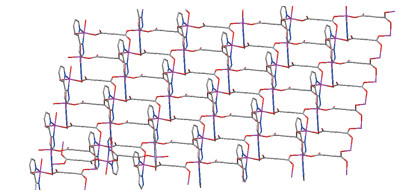
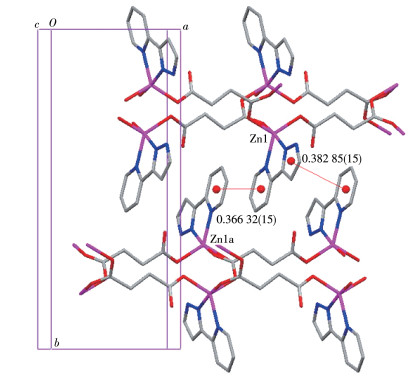
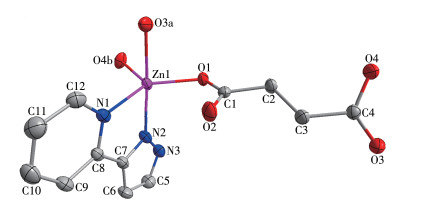
The single- crystal X-ray study reveals that complex 1 is a 3D supramolecular structure based on a 2D network complex. There are one crystallographically independent Zn (Ⅱ) cation, one HL molecule, and one suc2- anion, as displayed in Fig. 1. The central Zn1 cation is five-coordinated by two nitrogen atoms from one HL molecule and three carboxylic oxygen atoms of three suc2- anions. The Zn—N bond distances are in a range of 0.213 69(19)-0.214 32(19) nm, and the Zn—O bond lengths lie in the 0.198 27(15)-0.215 18(16) nm range. The bond angles around Zn(Ⅱ) cations vary from 76.53(7)° to 170.31(7)°, indicating that the trigonal bipyramid is slightly distorted. In complex 1, HL shows a bidentate coordination mode, which is different from the reported complex[21]. In the suc2- anion, one carboxylic group coordinates with one Zn(Ⅱ) ion in a monodentate coordination mode, and other coordinates with two Zn (Ⅱ) ions in a bidentate coordination mode to form a 2D network structure with an 18-membered ring (Fig. 2). Finally, the 2D network is extended into a 3D supramolecular architecture by hydrogen bonds between the N atoms, C atoms of HL and carboxylic oxygen atoms of suc2-. The corresponding hydrogen-bonding parameters of complex 1 are given in Table 3. It is worth mentioning that there are π … π interactions in complex 1 between the pyrazole and pyridine rings, pyridine rings of HL molecules (Fig. 3). The centroid-to-centroid distances between adjacent rings are 0.382 85(15) nm for N2N3C5C6C7 pyrazole ring and N1C8C9C10C11 pyridine ring (Symmetry code: 2-x, -y, -z) and 0.366 32(15) nm for N1C8C9C10C11 and N1aC8aC9a C10aC11a pyridine rings (Symmetry code: 1-x, -y, -z). The dihedral angles are 2.66(14)° and 0.00(12)°, respectively. Generally speaking, organic dicarboxylate and pyridyl - pyrazole are two kinds of well - bridged ligands and are usually used to construct 1D, 2D, and 3D coordination polymers. In 1, HL acts as a terminaltype ligand to form a discrete complex, which is unusual.
Symmetry codes: a: x-1, y, z; b: x-1, -y+1/2, z-1/2
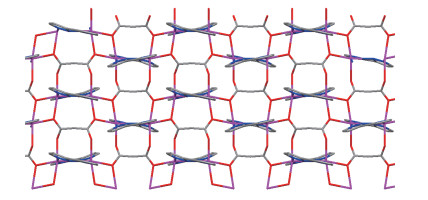
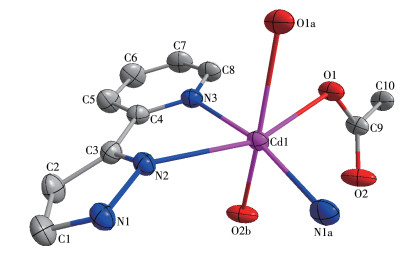
Complex 2 crystallizes in the monoclinic C2/c space group, with one Cd(Ⅱ) ion, half a suc2- anion, and an L- anion in its asymmetric unit (Fig. 4). The sixcoordinated Cd(Ⅱ) center is surrounded by three oxygen atoms (O1, O1a, O2b) from three different suc2- anions, three nitrogen atoms (N1a, N2, N3) from two different L- anions, adopting a distorted octahedral {CdO3N3} geometry with Cd—O bond lengths are 0.229 69(13), 0.242 78(15), 0.243 85(15) nm and Cd—N bond distances are 0.222 40(16), 0.234 96(17), and 0.235 19(16) nm, respectively. The O(N) —Cd—N(O) bond angles are in a range of 70.63(5)°-164.02(5)°, all of which are within the reasonable range of those reported for other six-coordinated Cd(Ⅱ) complexes[15, 22]. In the polymeric structure of complex 2 (Fig. 5), the suc2- anion adopts the bridging - μ6 mode to connect six cadmium ions, whereas the L- anion adopts a bridging-μ3 mode to connect two metal ions. In this manner, an ideal 2D coordination polymer with two - nuclear structure along the a-axis has been built.
Symmetry codes: a: x+1, -y, z-1/2; b: x+1, 1-y, z-1/2
It should be noted that all the nitrogen atoms of L- in complex 2 have been involved in the coordination. As a result, it serves to balance the charge. However, only two nitrogen atoms of HL in complex 1 are involved in the coordination and there is no need to balance the charge.
IR spectrum of 1 is exhibited in the wavenumber range of 4 000 to 400 cm-1 (Fig.S1, Supporting information). The strong band at about 1 599 cm-1 is attributed to the νC—O vibration of the groups of suc2- [24]. The peak located at 1 452 cm-1 is identified as the stretching vibration of carboxylic groups[25]. The strong bands in the region of 668 - 757 cm-1 can be vested in the νC—N vibration of the N-heterocyclic rings of HL[26].
IR spectrum of 2 is exhibited in the wavenumber range of 4 000 to 400 cm-1 (Fig.S2). The strong band at about 1 601 cm-1 is attributed to the νC—O vibration of suc2- [24]. The peak located at 1 451 cm-1 is identified as the stretching vibration of carboxylic groups[25]. The strong bands in the region of 662 - 746 cm-1 can be vested in the νC—N vibration of the N-heterocyclic rings of L- [26].
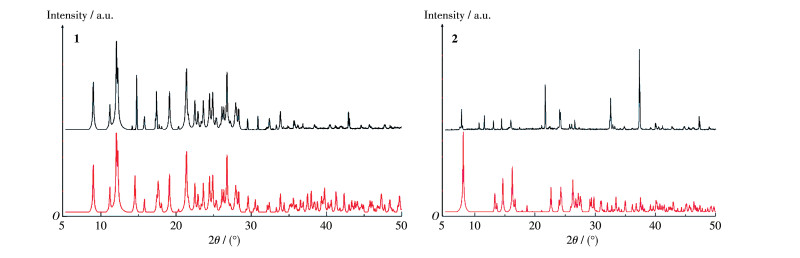
To substantiate the phase purity of complexes 1 and 2, their PXRD was performed before their photoluminescent properties were measured. The experimental PXRD patterns were in good agreement with the corresponding simulated ones (Fig. 6) except for the relative intensity variation because of the preferred orientations of the crystals.
Complexes 1 and 2 are stable under environmental conditions, and the thermal stability was explored by TGA. For 1, there were two separate weight loss steps. The first weight loss of 41.8% occurred at 215268 ℃, which is due to the departure of coordinated HL ligand (Calcd. 44.4%). The second weight loss of 33.8% from 390 to 600 ℃ corresponds to the loss of all the remaining suc2- anions (Calcd. 35.5%), as shown in Fig. S3. For 2, the first weight loss of 46.2% occurred at 100-175 ℃, which is due to the removal of coordinated L- ligand (Calcd. 45.8%). The second weight loss of 34.8% from 175 to 600 ℃ corresponds to the loss of all the remaining suc2- anions (Calcd. 36.9%), as shown in Fig.S4.
CPs with d10 metal centers have many potential applications such as in chemical sensors, photochemistry, and electroluminescent display[27]. Therefore, in the present work, the photoluminescent properties of HL and complexes 1 and 2 have been investigated in the solid state at room temperature. The emission peaks are shown in Fig. 7, and the solid - state fluorescence quantum yield of complex 1 was 20%, while that of complex 2 was 24%.
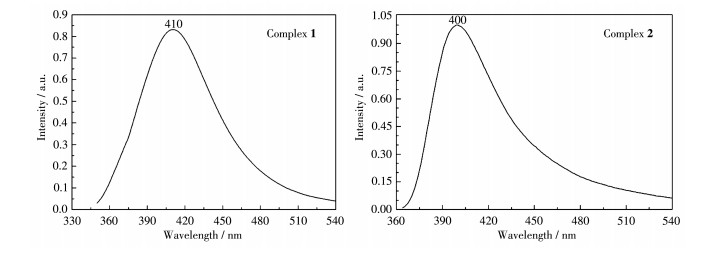
The main emission peak of H2suc is at 258 nm[28]. HL show emission peak at 443 nm (λex=350 nm). The emission bands of these free ligands are probably caused by the π* →n or π* → π transition[29]. Upon complexation of these ligands with Zn (Ⅱ)/Cd (Ⅱ) ions, the emission peaks occurred at 410 nm (λex=294 nm) for 1 and 400 nm (λex=335 nm) for 2. For complexes 1 and 2, the main emission peaks were highly blueshifted by 33 and 43 nm with respect to the free HL, respectively. Because the Zn(Ⅱ) and Cd(Ⅱ) ions are difficult to oxidize or reduce due to the d10 configuration, the emissions of the complexes are neither MLCT nor LMCT in nature[30]. As a result, the emission can be assigned to intraligand transitions[31].
All calculations were accomplished by the Gaussian16 program. The parameters of the molecular fragments used for calculations were extracted from the crystal structure of complexes 1 and 2, respectively. Furthermore, we explained natural bond orbital (NBO) by density functional theory (DFT)[32] using the PBE0[33] hybrid functional and the LANL2DZ basis set[34].
In Table 4, we summarize the selected net charges, natural electron configurations, Wiberg bond indexes, and NBO bond orders for 1. Clearly, the electronic configurations of Zn1, N and O atoms are 4s0.313d9.984p0.40, 2s1.33-1.372p3.65-4.19, and 2s1.682p4.99-5.14, respectively. Based on the above understanding, the Zn1 atom coordination with N and O atoms is mainly on 3d, 4s and 4p orbitals. The N atoms use 2s and 2p orbitals to form coordination bonds with the Zn1 atom. All O atoms provide 2s and 2p electrons to the Zn1 atom and form coordination bonds. Consequently, the Zn1 atom obtains some electrons from two nitrogen atoms of HL and three oxygen atoms of suc2- [35-36]. Accordingly, in light of valence-bond theory, the atomic net charge distribution and NBO bond orders of 1 (Table 4) show obvious covalent interaction between the coordinated atoms and Zn(Ⅱ) ion. The differences in the NBO bond orders for Zn—O and Zn—N make their bond lengths different, which is in good agreement with the X-ray crystal structure data of 1.
下载:
导出CSV
| Atom | Net charge | Electron configuration | Bond | Wiberg bond index | NBO bond order/a.u. |
| 1 | |||||
| Zn1 | 1.307 68 | [core]4s0.313d9.984p0.40 | |||
| O1 | -0.788 84 | [core]2s1.682p5.05 | Zn1—O1 | 0.259 8 | 0.308 8 |
| O3a | -0.684 19 | [core]2s1.682p4.99 | Zn1—O3a | 0.179 8 | 0.239 2 |
| O4b | -0.830 31 | [core]2s1.682p5.14 | Zn1—O4b | 0.249 6 | 0.300 9 |
| N1 | -0.537 74 | [core]2s1.332p4.19 | Zn1—N1 | 0.182 6 | 0.279 8 |
| N2 | -0.345 84 | [core]2s1.372p3.95 | Zn1—N2 | 0.169 6 | 0.271 0 |
| 2 | |||||
| Cd1 | 1.414 83 | [core]5s0.304d9.985p0.29 | |||
| N1a | -0.437 19 | [core]2s1.412p4.00 | Cd1—N1a | 0.151 6 | 0.217 0 |
| N2 | -0.468 08 | [core]2s1.382p4.06 | Cd1—N2 | 0.155 7 | 0.216 9 |
| N3 | -0.545 84 | [core]2s1.332p4.19 | Cd1—N3 | 0.117 4 | 0.182 2 |
| O1 | -0.766 27 | [core]2s1.712p5.05 | Cd1—O1 | 0.172 0 | 0.197 7 |
| O1a | -0.658 52 | [core]2s1.712p4.94 | Cd1—O1a | 0.127 9 | 0.167 1 |
| O2b | -0.628 87 | [core]2s1.692p4.92 | Cd1—O2b | 0.121 5 | 0.161 4 |
| Symmetry codes: a: x-1, y, z; b: x-1, -y+1/2, z-1/2 for 1; a: x+1, -y, z-1/2; b: x+1, 1-y, z-1/2 for 2. | |||||
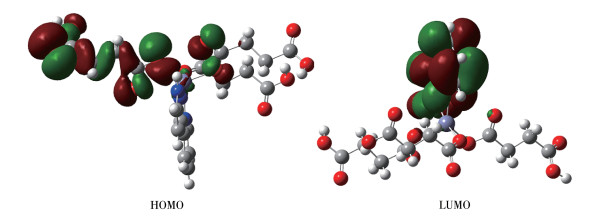
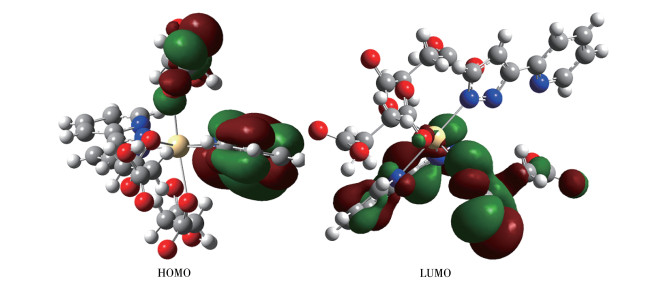
As can be seen in Fig. 8, the HOMO of 1 is mainly composed of suc2-. Nevertheless, the LUMO mainly consists of HL. Therefore, the ligand-to-ligand charge transfer (LLCT) may be concluded from some contours of molecular orbitals of 1.
Similar parameters of 2 are also listed in Table 4. We can see that the electronic configurations of Cd1, N, and O atoms are 5s0.304d9.985p0.29, 2s1.33-1.412p4.00-4.19, and 2s1.69-1.712p4.92-5.05, respectively. From this, we can conclude that the Cd1 atom coordination with N and O atoms is mainly on 4d, 5s, and 5p orbitals. All N atoms and O atoms form coordination bonds with Cd (Ⅱ) ion using 2s and 2p orbitals. Consequently, the Cd1 atom obtains some electrons from the N atoms of L- and O atoms of suc2- [35-36]. Thus, according to valence - bond theory, the atomic net charge distribution in 2 shows the obvious covalent interaction between the coordinated atoms and the Cd1 atom. As can be seen from Fig. 9, the HOMO mainly consists of suc2-, while the LUMO is mainly composed of suc2- and HL. So, the LLCT and intramolecular charge transfer (ILCT) may be inferred from some contours of molecular orbitals of 2.
Two new complexes based on succinic acid were successfully synthesized by the hydrothermal method. They are also structurally characterized by elemental analysis techniques, IR, PXRD, TGA, singlecrystal X - ray diffraction, fluorescence spectrum, and quantum - chemical calculations. The complexes have the 2D network structure formed by metal ions and the ligands connecting infinitely in a carboxyl bridging manner.
Supporting information is available at http://www.wjhxxb.cn
Li H L, Eddaoudi M, O'Keeffe M, Yaghi O M. Design and Synthesis of an Exceptionally Stable and Highly Porous Metal-Organic Framework[J]. Nature, 1999, 402: 276-279. doi: 10.1038/46248
Ge J Y, Chen Z Y, Zhang L, Liang X, Xu J, Kurmoo M, Zuo J L. A Two-Dimensional Iron(Ⅱ) Coordination Polymer with Synergetic Spin-Crossover and Luminescent Properties[J]. Angew. Chem. Int. Ed., 2019, 58(26): 8789-8793. doi: 10.1002/anie.201903281
Shi C, Zhang M, Hang X X, Bi Y F, Huang L L, Zhou K, Xu Z H, Zheng Z P. Assembly of Thiacalix[4] Arene-Supported High-Nuclearity Cd24 Cluster with Enhanced Photocatalytic Activity[J]. Nanoscale, 2018, 10(30): 14448-11454. doi: 10.1039/C8NR03474E
Zhang M, Chen M W, Bi Y F, Huang L L, Zhou K, Zheng Z P. A Bimetallic Co4Mo8 Cluster Built from Mo8 Oxothiomolybdate Capped by a Co4-Thiacalix[4] arene Unit: The Observation of the Co-Mo Synergistic Effect for Binder-Free Electrocatalysts[J]. J. Mater. Chem. A, 2019, 7(20): 12893-12899. doi: 10.1039/C9TA01603A
Liu C, Jiang W, Hu F, Wu X, Xue D F. Mesoporous NiCo2O4 Nanoneedle Arrays as Supercapacitor Electrode Materials with Excellent Cycling Stabilities[J]. Inorg. Chem. Front., 2018, 5(4): 835-843. doi: 10.1039/C8QI00010G
Cui J W, Hou S X, Li Y H, Cui G H. A Multifunctional Ni(Ⅱ) Coordination Polymer: Synthesis, Crystal Structure and Applications as a Luminescent Sensor, Electrochemical Probe, and Photocatalyst[J]. Dalton Trans., 2017, 46(48): 16911-16924. doi: 10.1039/C7DT03874G
Meng F Y, Zhou Y L, Zou H H, Zeng M H, Liang H. Solution and Solid-State Photoluminescence of Bis{succinatobis[2, 6-bis(2-benzimidazolyl)] Lead (Ⅱ)}: A Comment on the Lone-pair Stereochemistry and Its Effect on Supramolecular Interaction[J]. J. Mol. Struct., 2009, 920(1/2/3): 238-241.
Cui L S, Meng X M, Li Y G, Huang K R, Li Y C, Long J Q, Yao P F. Syntheses, Structural Diversity, and Photocatalytic-Degradation Properties for Methylene Blue of Co (Ⅱ) and Ni (Ⅱ) MOFs Based on Terephthalic Acid and Different Imidazole Bridging Ligands[J]. CrystEngComm, 2019, 21(25): 3798-3809. doi: 10.1039/C9CE00433E
Gao Q, Xu J, Bu X H. Recent Advances about Metal-Organic Frameworks in the Removal of Pollutants from Wastewater[J]. Coord. Chem. Rev., 2019, 378: 17-31. doi: 10.1016/j.ccr.2018.03.015
Li C, Deng Z P, Huo L H, Gao S. Cooperative Effects of Metal Cations and Coordination Modes on Luminescent s-Block Metal-Organic Complexes Constructed from V-Shaped 4, 4'-Sulfonyldiphenol[J]. CrystEngComm, 2018, 20(46): 7513-7525. doi: 10.1039/C8CE01591K
Zhang H, Ji L Q, Song Y Z, Kong Z G, Li C, Wang X Y. Syntheses, Crystal Structures and Properties of Mn (Ⅱ) and Co (Ⅱ) Coordination Complexes Based on 1, 10-Phenanthroline Derivative[J]. Chin. J. Struct. Chem., 2021, 40(3): 336-342.
Vizuet J P, Howlett T S, Lewis A L, Chroust Z D, McCandless G T, Balkus K J. Transition from a 1D Coordination Polymer to a Mixed-Linker Layered MOF[J]. Inorg. Chem., 2019, 58(8): 5031-5041. doi: 10.1021/acs.inorgchem.9b00077
Liu G C, Li Y, Chi J, Xu N, Wang X L, Lin H Y, Chen Y Q. Multifunctional Fluorescent Responses of Cobalt Complexes Derived from Functionalized Amide-Bridged Ligand[J]. Dyes Pigment., 2020, 174: 108064. doi: 10.1016/j.dyepig.2019.108064
Pan Y R, Li X M, Liu B, Zhou S, Chang Y F. Two New Zn(Ⅱ) and Co (Ⅱ) Coordination Polymers Constructed by 4-Bromobenzoic Acid and 1, 4-Bis(imidazol-1-yl)-butane: Synthesis, Crystal Structure and Theoretical Calculations[J]. Chin. J. Struct. Chem., 2019, 38(4): 635-643.
李秀梅, 潘亚茹, 刘博, 周实. 两个由双咪唑基配体构筑的镉配合物的合成、晶体结构及理论计算[J]. 无机化学学报, 2019,35,(7): 1275-1282. LI X M, PAN Y R, LIU B, ZHOU S. Syntheses, Crystal Structures and Theoretical Calculations of Two Cadmium(Ⅱ) Complexes Assembled by Bis(imidazol) Ligands[J]. Chinese J. Inorg. Chem., 2019, 35(7): 1275-1282.
Kirchon A, Feng L, Drake H F, Joseph E A, Zhou H C. From Fundamentals to Applications: A Toolbox for Robust and Multifunctional MOF Materials[J]. Chem. Soc. Rev., 2018, 47(23): 8611-8638. doi: 10.1039/C8CS00688A
Fang W H, Yang G Y. Induced Aggregation and Synergistic Coordination Strategy in Cluster Organic Architectures[J]. Acc. Chem. Res., 2018, 51(11): 2888-2896. doi: 10.1021/acs.accounts.8b00346
Huang F P, Zhang Q, Yu Q, Liang H, Yan S P, Liao D Z, Cheng P. Coordination Assemblies of CoⅡ/NiⅡ/ZnⅡ/CdⅡ with Succinic Acid and Bent Connectors: Structural Diversity and Spin-Canted Antiferromagnetism[J]. Cryst. Growth Des., 2012, 12(4): 1890-1898. doi: 10.1021/cg201577w
Gong C H, Guo H Y, Zeng X H, Xu H, Zeng Q D, Zhang J Y, Xie J L. Flexible and Rigid Dicarboxylic Acids Enable the Assembly of Achiral and Chiral 3D Co (Ⅱ) Metal-Organic Frameworks[J]. Dalton Trans., 2018, 47(20): 6917-6923. doi: 10.1039/C8DT00600H
Wang J, Wei J, Guo F W, Li C Y, Zhu P F, Zhu W H. Homochiral 3D Coordination Polymer with Unprecedented Three-Directional Helical Topology from Achiral Precursor: Synthesis, Crystal Structure, and Luminescence Properties of Uranyl Succinate Metal-Organic Framework[J]. Dalton Trans., 2015, 44(31): 13809-13813. doi: 10.1039/C5DT02111A
Gao Y X, Li X M, Zhou S, Liu B. Synthesis, Structure and Theoretical Calculation of Metal Coordination Polymers with Pyrazine-2, 3-dicarboxylic Acid and 3-(2-Pyridyl)pyrazole as Co-ligands[J]. Chin. J. Struct. Chem., 2021, 40(6): 753-758.
Wang X Y, Li X M, Pan Y R, Liu B, Zhou S. A New Three-dimensional Cd(Ⅱ) Complex Assembled by 1, 3, 5-Benzenetricarboxylic Acid and 3-(2-Pyridyl)pyrazole[J]. Chin. J. Struct. Chem., 2019, 38(8): 1275-1282.
Liu G C, Han S W, Gao Y, Wang X L, Chen B K. Multifunctional Fluorescence Responses of Phenyl-Amide-Bridged d10 Coordination Polymers Structurally Regulated by Dicarboxylates and Metal Ions[J]. CrystEngComm, 2020, 22(45): 7952-7961. doi: 10.1039/D0CE01351J
Yang L, Wang F, Auphedeous D Y, Feng C L. Achiral Isomers Controlled Circularly Polarized Luminescence in Supramolecular Hydrogels[J]. Nanoscale, 2019, 11: 14210-14215. doi: 10.1039/C9NR05033G
Wang X L, Mu B, Lin H Y, Liu G C. Three New Two-Dimensional Metal-Organic Coordination Polymers Derived from Bis(pyridinecar-boxamide)-1, 4-benzene Ligands and 1, 3-Benzenedicarboxylate: Syntheses and Electrochemical Property[J]. J. Organomet Chem., 2011, 696(11/12): 2313-2321.
Dolensky B, Konvalinka R, Jakubek M, Kral V. Identification of Intramolecular Hydrogen Bonds as the Origin of Malfunctioning of Multitopic Receptors[J]. J. Mol. Struct., 2013, 1035: 124-128. doi: 10.1016/j.molstruc.2012.09.040
McGarrah J E, Kim Y J, Hissler M, Eisenberg R. Toward a Molecular Photochemical Device: A Triad for Photoinduced Charge Separation Based on a Platinum Diimine Bis(acetylide) Chromophore[J]. Inorg. Chem., 2001, 40(18): 4510-4511. doi: 10.1021/ic015559u
谭慧, 王丽影, 周悦, 苟丽宁, 吴盘亮, 郭栋才. 铽-芳香化合物-丁二酸发光配合物的合成及性能[J]. 发光学报, 2009,30,(1): 101-107. TAN H, WANG L Y, ZHOU Y, GOU L N, WU P L, GUO D C. Synthesis and Properties of Terbium-Aromatic Compound-Butyric Acid Luminous Complex[J]. Chinese Journal of Luminescence, 2009, 30(1): 101-107.
Lin J D, Long X F, Lin P, Du S W. A Series of Cation-Templated, Polycarboxylate-Based Cd(Ⅱ) or Cd(Ⅱ)/Li(Ⅰ) Frameworks with Second-Order Nonlinear Optical and Ferroelectric Properties[J]. Cryst. Growth Des., 2010, 10(1): 146-157. doi: 10.1021/cg9007476
Lin J G, Zang S Q, Tian Z F, Li Y Z, Xu Y Y, Zhu H Z, Meng Q J. Metal-Organic Frameworks Constructed from Mixed-Ligand 1, 2, 3, 4-Tetra-(4-pyridyl)-butane and Benzene-polycarboxylate Acids: Syntheses, Structures and Physical Properties[J]. CrystEngComm, 2007, 9(10): 915-921. doi: 10.1039/b708389k
Liu H Y, Wu H, Ma J F, Liu Y Y, Liu B, Yang J. Syntheses, Structures, and Photoluminescence of Zinc (Ⅱ) Coordination Polymers Based on Carboxylates and Flexible Bis-[(pyridyl)-benzimidazole] Ligands[J]. Cryst. Growth Des., 2010, 10(11): 4795-4805. doi: 10.1021/cg100688z
Parr R G, Yang W. Density Functional Theory of Atoms and Molecules. Oxford: Oxford University Press, 1989.
Ernzerhof M, Scuseria G E. Assessment of the Perdew-Burke-Ernzerhof Exchange-Correlation Functional[J]. J. Chem. Phys., 1999, 110: 5029-5036. doi: 10.1063/1.478401
Dunning T H, Hay P J. Gaussian Basis Sets for Molecular Calculations//Schaefer H F. Methods in Electronic Structure Theory (Modern Theoretical Chemistry). New York: Plenum Press, 1977: 1-28
Wang L, Zhao J, Ni L, Yao J. Synthesis, Structure, Fluorescence Properties, and Natural Bond Orbital (NBO) Analysis of Two Metal [EuⅢ, CoⅡ] Coordination Polymers Containing 1, 3-Benzenedicarboxylate and 2-(4-Methoxyphenyl)-1H-imidazo[4, 5-f] [1, 10] phenanthroline Ligands[J]. Z. Anorg. Allg. Chem., 2012, 638(1): 224-230. doi: 10.1002/zaac.201100345
李章朋, 邢永恒, 张元红, 白凤英, 曾小庆, 葛茂发. 蝎型钒氧苯甲酸配合物的合成、结构及量化计算[J]. 物理化学学报, 2009,25,(4): 741-746. doi: 10.3866/PKU.WHXB20090423LI Z P, XING Y H, ZHANG Y H, BAI F Y, ZENG X Q, GE M F. Synthesis, Structure and Quantification of Scorpion Vanadium Oxybenzoic Acid Complex[J]. Acta Phys.-Chim. Sin., 2009, 25(4): 741-746. doi: 10.3866/PKU.WHXB20090423

Figure 1 View of coordination environment (at 50% probability level) of Zn(Ⅱ) ion of complex 1
Symmetry codes: a: x-1, y, z; b: x-1, -y+1/2, z-1/2

Figure 4 View of coordination environment (at 50% probability level) of Cd(Ⅱ) ion of complex 2
Symmetry codes: a: x+1, -y, z-1/2; b: x+1, 1-y, z-1/2

Figure 7 Solid-state luminescence emission spectra of complexes 1 and 2 at room temperature
Table 1. Crystal data for complexes 1 and 2
| Parameter | 1 | 2 |
| Empirical formula | C12H11N3O4Zn | C10H8CdN3O2 |
| Formula weight | 326.61 | 314.59 |
| Crystal system | Monoclinic | Monoclinic |
| Space group | P21/c | C2/c |
| a/nm | 0.794 00(5) | 2.399 33(15) |
| b/nm | 1.964 77(12) | 0.677 85(4) |
| c/nm | 0.780 43(5) | 1.344 90(8) |
| β/(°) | 96.088 0(10) | 114.364(2) |
| Volume/nm3 | 1.210 63(13) | 1.992 5(2) |
| Z | 4 | 8 |
| F(000) | 664 | 1 224 |
| Dc/(g·cm-3) | 1.792 | 2.097 |
| GOF | 0.948 | 1.055 |
| Reflection collected, unique | 8 059, 2 230 | 7 864, 2 418 |
| Rint | 0.049 6 | 0.020 8 |
| R1 [I > 2σ(I)] | 0.027 9 | 0.018 3 |
| wR2 | 0.069 1 | 0.042 7 |
 下载: 导出CSV
Table 2. Selected bond distances (nm) and angles (°) for complexes 1 and 2
| 1 | |||||
| Zn1—O1 | 0.198 27(15) | Zn1—O3a | 0.215 18(16) | Zn1—O4b | 0.199 92(16) |
| Zn1—N1 | 0.213 69(19) | Zn1—N2 | 0.214 32(19) | ||
| O3—Zn1—O4b | 117.59(7) | O1—Zn1—N1 | 132.95(7) | O4b—Zn1—N1 | 109.46(7) |
| O1—Zn1—N2 | 96.36(7) | O4b—Zn1—N2 | 97.36(7) | N1—Zn1—N2 | 76.53(7) |
| O1—Zn1—O3a | 86.75(6) | O4b—Zn1—O3a | 89.25(7) | N1—Zn1—O3a | 94.62(7) |
| N2—Zn1—O3a | 170.31(7) | ||||
| 2 | |||||
| Cd1—O1 | 0.229 69(13) | Cd1—O1a | 0.243 85(15) | Cd1—O2b | 0.242 78(15) |
| Cd1—N1a | 0.222 40(16) | Cd1—N2 | 0.235 19(16) | Cd1—N3 | 0.234 96(17) |
| N1a—Cd1—O1 | 103.93(6) | N1a—Cd1—N3 | 167.96(6) | O1—Cd1—N3 | 87.95(6) |
| N1—Cd1—N2 | 97.36(6) | O1—Cd1—N2 | 157.28(5) | N3—Cd1—N2 | 71.17(6) |
| O1—Cd1—O2b | 98.10(5) | N3—Cd1—O2b | 78.85(5) | N2—Cd1—O2b | 86.82(5) |
| O1—Cd1—O1a | 70.63(5) | N3—Cd1—O1a | 89.21(5) | N2—Cd1—O1a | 99.44(5) |
| Symmetry codes: a: x-1, y, z; b: x-1, -y+1/2, z-1/2 for 1; a: x+1, -y, z-1/2; b: x+1, 1-y, z-1/2 for 2. | |||||
下载: 导出CSV
Table 3. Selected hydrogen bond parameters for complex 1
| D—H…A | d(D—H)/nm | d(H…A)/nm | d(D…A)/nm | ∠DHA/(°) | Symmetry code |
| N3—H3A…O1 | 0.086 | 0.187 | 0.272 7(3) | 176 | x, 1/2-y, -1/2+z |
| C5—H5A…O2 | 0.093 | 0.243 | 0.330 0(3) | 155 | x, y, -1+z |
| C6—H6A…O2 | 0.093 | 0.239 | 0.326 8(3) | 157 | -x, -y, -z |
| C9—H9A…O2 | 0.093 | 0.268 | 0.347 6(3) | 161 | -x, -y, -z |
下载: 导出CSV
Table 4. Natural atomic charges, natural valence electron configurations, Wiberg bond indexes, and NBO bond orders for complexes 1 and 2
| Atom | Net charge | Electron configuration | Bond | Wiberg bond index | NBO bond order/a.u. |
| 1 | |||||
| Zn1 | 1.307 68 | [core]4s0.313d9.984p0.40 | |||
| O1 | -0.788 84 | [core]2s1.682p5.05 | Zn1—O1 | 0.259 8 | 0.308 8 |
| O3a | -0.684 19 | [core]2s1.682p4.99 | Zn1—O3a | 0.179 8 | 0.239 2 |
| O4b | -0.830 31 | [core]2s1.682p5.14 | Zn1—O4b | 0.249 6 | 0.300 9 |
| N1 | -0.537 74 | [core]2s1.332p4.19 | Zn1—N1 | 0.182 6 | 0.279 8 |
| N2 | -0.345 84 | [core]2s1.372p3.95 | Zn1—N2 | 0.169 6 | 0.271 0 |
| 2 | |||||
| Cd1 | 1.414 83 | [core]5s0.304d9.985p0.29 | |||
| N1a | -0.437 19 | [core]2s1.412p4.00 | Cd1—N1a | 0.151 6 | 0.217 0 |
| N2 | -0.468 08 | [core]2s1.382p4.06 | Cd1—N2 | 0.155 7 | 0.216 9 |
| N3 | -0.545 84 | [core]2s1.332p4.19 | Cd1—N3 | 0.117 4 | 0.182 2 |
| O1 | -0.766 27 | [core]2s1.712p5.05 | Cd1—O1 | 0.172 0 | 0.197 7 |
| O1a | -0.658 52 | [core]2s1.712p4.94 | Cd1—O1a | 0.127 9 | 0.167 1 |
| O2b | -0.628 87 | [core]2s1.692p4.92 | Cd1—O2b | 0.121 5 | 0.161 4 |
| Symmetry codes: a: x-1, y, z; b: x-1, -y+1/2, z-1/2 for 1; a: x+1, -y, z-1/2; b: x+1, 1-y, z-1/2 for 2. | |||||
下载: 导出CSV

 扫一扫看文章


扫一扫关注我们