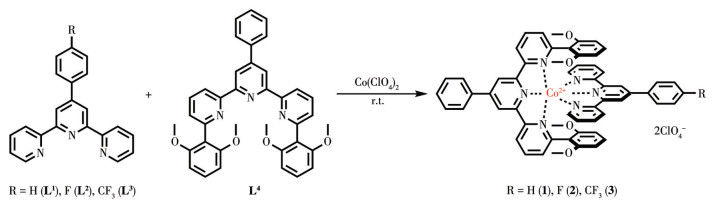
Scheme 1.
Directional assembly of three mononuclear cobalt(Ⅱ) complexes based on complementary terpy ligand pairing

Synthesis and Magnetic Properties of Mononuclear Cobalt(Ⅱ) Spin Crossover Complexes from Complementary Terpyridine Ligand Pairing
Rui YANG , Shu-Ya ZHANG , Run-Guo WANG , Yin-Shan MENG , Tao LIU , Yuan-Yuan ZHU


Spin-crossover (SCO) complexes belong to a class of interesting compounds whose spin states can be switched through external perturbations including thermal, light, pressure, solvent, magnetic field, etc[1-2]. The transition metal complexes with configurations of d4-7 electrons may be located in either the high-spin (HS) or low-spin (LS) state which is dependent on the ligand field strength. The interconversion of two spin states is essentially the consequence of the electron configuration rearrangement in the d orbital which is triggered by the relative energy magnitude of ligand field splitting between the t2g and eg molecular orbitals (Δ) and pairing energy of electrons (P)[3-4]. When Δ is larger than P, the pairing of electrons is favored, resulting in an LS state. When Δ is smaller than P, electrons are inclined to occupy maximum d orbitals and thus prefer the HS state[5-6]. Impressively, the transformations in electron configurations result in changes in several physical properties such as magnetic moment, color, dielectric constant, and electrical resistance[3, 7]. Since the first SCO compound, tris(dithiocarbamato)iron (Ⅲ), was discovered by Cambi et al. in 1931[8], numerous mononuclear, polynuclear, and polymeric complexes have been found to show a variety of SCO properties[9-10]. Among them, the vast majority of SCO-active cases are composed of Fe(Ⅱ) and Fe(Ⅲ) complexes[11-13]. In contrast, the reported examples of Co(Ⅱ) complexes with SCO behavior are relatively limited[14-15]. From the view of electron configuration, the transition in six-coordinate Co (Ⅱ) complexes from LS to HS state involves a change from 2E (t2g6eg1) with S=1/2 to a 4T1 (t2g5eg2) with S=3/2[16]. Due to the larger ligand field splitting energy (Δ) of Co(Ⅱ) ion compared with that of Fe (Ⅱ) ion, organic ligands with relatively stronger ligand field are required to build Co (Ⅱ) SCO-active compounds[6]. So that the cobalt (Ⅱ) complexes containing terpyridine (terpy) and its derivatives constitute SCO-active family compounds due to the moderate ligand field strength of these tri-imine type ligands[16-18]. Through the suitable substitutions in archetypical terpy and variations of counter anions and lattice solvent[19], the occurrences of SCO behaviour have been revealed in a variety of cobalt(Ⅱ) compounds built from terpy and its derivatives[20-23]. However, the majority of compounds are constructed from cobalt (Ⅱ) ion with two equivalent homoleptic terpy ligands so that the formed complexes have an S4 improper axis[24]. Due to the reversible characteristic of coordination reaction, it is difficult to control the complex that is constituted from two different terpy ligands[25]. The exploration of heteroleptic terpy cobalt (Ⅱ) complexes has great significance in research on SCO. These novel structures not only possess the advantage to subtly tuning the ligand field through the introduction of substitution at different positions but also provide a feasible approach to directionally assembling complicated metallo-supramolecular architectures bearing multinuclear paramagnetic centres. In 2016, Chan and co-workers developed a smart strategy for the directional synthesis of transition metal complexes from heteroleptic terpy ligands[26-28]. They designed and synthesized a complementary pair of terpy-based ligands, one is the normal terpy ligand and another one has 2, 6-dimethoxyphenyl groups at 6, 6″-positions of 4´-phenyl-terpy, to afford the directional heteroleptic complexation. By employing this structure as the connection unit, complicated metallo-supramolecular structures including macrocycles, cages, and multi-layered architectures have been accurately selfassembled from multi-components. To the best of our knowledge, there is no study on the magnetic properties of the cobalt (Ⅱ) complexes constructed from complementary terpy ligand pairing. The exploration of SCO behaviour on these novel terpy-based cobalt (Ⅱ) complexes will enrich the cobalt (Ⅱ) SCO-active compound family and find some unexpected properties. In addition, the substituents can influence the SCO behaviour via electronic effect and/or intermolecular weak interactions[29-31]. In this contribution, we report the synthesis, characterization and magnetic properties of three mononuclear cobalt(Ⅱ) complexes built from complementary terpy ligand pairing (Scheme 1).
NMR spectra were recorded on a Bruker 400, 500, or 600 MHz spectrometer. Elemental analysis of carbon, nitrogen, and hydrogen was performed using an Elementary Vario EL analyzer. Fourier transform infrared spectroscopy (FT-IR) data were collected on KBr pellet samples in a range of 4 000-400 cm-1 using an IS-50 FT-IR spectrometer.
Magnetic susceptibility data were collected using a Quantum Design MPMS XL-5 or PPMS-9T (EC-II) SQUID (superconducting quantum interference device) magnetometer. Measurements for all the samples were performed on microcrystalline powder restrained by a parafilm and loaded in a capsule. The magnetic susceptibility data were corrected for the diamagnetism of the samples using Pascal constants and the sample holder and parafilm by corrected measurement.
Crystals suitable for single-crystal X-ray diffraction were covered in a thin layer of hydrocarbon oil, mounted on a glass fiber attached to a copper pin, and placed under an N2 cold stream. The data for three compounds were collected on a Bruker D8 Venture CMOS-based diffractometer (Mo Kα radiation, λ=0.071 073 nm) using the SMART and SAINT programs. Final unit cell parameters were based on all observed reflections from the integration of all frame data. The structures were solved with the ShelXT structure solution program using Intrinsic Phasing and refined with the ShelXL refinement package using Least Squares minimization that was implanted in Olex2. For all compounds, all non-hydrogen atoms were refined anisotropically and the hydrogen atoms of organic ligands were located geometrically and fixed under isotropic thermal parameters. For 1, the solvent molecule acetonitrile and substituted phenyl were disordered, and the refined sites occupancy factor (SOF) values for the major and minor components of this rotational disorder were 0.589 and 0.411 for N15, C9-C14, C67-C72, and C121. For 2, guest water molecules were disordered by symmetric elements with occupancy of 0.5 at 120 and 299 K, respectively. For 3, solvent molecule methanol and perchlorate were disordered, the refined values of this rotational disorder were 0.571 and 0.429 for O10-O12, and O14 and C60 were disordered by symmetric elements with occupancy of 0.5.
XRD patterns were obtained on a D8 ADVANCE X-ray powder diffractometer with Cu Kα radiation (λ= 0.154 18 nm) in a 2θ range of 5°-50° at room temperature. Testing voltage and current were 240 kV and 50 mA, respectively. Thermogravimetry analysis (TGA) was carried out with a TGA/DSC 1 (Mettler Toledo) instrument from ambient temperature to 800 ℃ at a warming rate of 5 K·min-1. Differential scanning calorimetry (DSC) was carried out with a DSC 823e (Mettler Toledo) at a cooling/warming rate of 3 K·min-1. The solution UV-Vis absorption spectra were recorded using a TU-1900 spectrophotometer with a sample concentration of 50 μmol·L-1 in acetonitrile at ambient temperature.
The CV curves of the complexes and their corresponding ligands were measured in acetonitrile solution containing 1 mmol·L-1 substrates and 0.1 mol·L-1 tetrabutylammonium hexafluorophosphate electrolyte. The systems were run in a three-electrode cell (10 mL working volume), using a glassy carbon as a working electrode, Ag/AgCl in 3.5 mol·L-1 KCl aqueous solution as a reference electrode, and a platinum plate as a counter electrode. The glassy carbon surface was polished by 0.05 mm alumina, then washed with deionized water before use every time. The solution was degassed by bubbling nitrogen for 15 min before measurements and maintaining inert nitrogen over the solution during the measurements.
General procedure. Four terpy-type ligands were prepared according to the literature method and the detailed synthetic procedure and structural characterization were depicted in the Supporting information. The mixed solution (H2O/MeOH, 1∶1, V/V, 10 mL) of Co(ClO4)2·6H2O (0.01 mmol·L-1) was mixed with a 20 mL acetonitrile solution of L1/L2/L3 (0.1 mmol respectively) and L4 (31 mg, 0.1 mmol), and stirred for 5 h and then filtered. Dark red single crystals were obtained after slow evaporation of the solution at ambient temperature for several days.
[Co(L1)(L4)]2(ClO4)4·2H2O·3MeCN (1). Yield: 75%. IR (KBr pellet, cm-1): 3 425 (br), 3 068 (w), 2 940 (w), 2 838 (w), 1 616 (m), 1 604 (m), 1 568 (m), 1 548 (w), 1 474 (m), 1 439 (m), 1 421 (w), 1 380 (w), 1 303 (w), 1 283 (w), 1 252 (m), 1 107 (s), 1 096 (s), 1 022 (m), 999 (w), 882 (w), 820 (w), 785 (m), 770 (m), 754 (w), 734 (w), 695 (w), 649 (w), 624 (m), 602 (w), 502 (w), 440 (w). Anal. Calcd. for C122H105Cl4Co2N15O26(%): C, 59.59; H, 4.27; N, 8.55. Found(%): C, 60.05; H, 4.43; N, 9.01.
[Co(L2) (L4)] (ClO4)2·2.5H2O (2). Yield: 70%. IR (KBr pellet, cm-1): 3 425 (br), 3 070 (w), 2 839 (w), 1 616 (w), 1 602 (m), 1 568 (m), 1 549 (m), 1 516 (w), 1 474 (m), 1 438 (m), 1 400 (w), 1 380 (w), 1 283 (w), 1 252 (w), 1 162 (m), 1 144 (s), 1 108 (s), 1 022 (m), 1 000 (w), 896 (w), 850 (w), 836 (m), 821 (m), 785 (w), 773 (w), 754 (w), 735 (w), 693 (m), 650 (w), 625 (w), 602 (w), 518 (w), 483(w). Anal. Calcd. for C58H50Cl2CoFN6O14.5(%): C, 57.48; H, 4.16; N, 6.93. Found(%): C, 56.96; H, 4.39. N, 6.58.
[Co(L3)(L4)](ClO4)2·H2O·0.5MeOH (3). Yield: 71%. IR (KBr pellet, cm-1): 3 073 (br), 2 942 (w), 2 839 (w), 1 617 (w), 1 603 (m), 1 569 (m), 1 549 (m), 1 474 (w), 1 438 (m), 1 402 (m), 1 379 (w), 1 328 (w), 1 283 (w), 1 252 (w), 1 169 (m), 1 108 (s), 1 022 (s), 880 (m), 851 (w), 838 (w), 820 (w), 786 (m), 772 (m), 754 (w), 735 (w), 696 (w), 669 (w), 650 (m), 624 (w), 602 (w), 507 (w), 440 (w). Anal. Calcd. for C59.5H49Cl2CoF3N6O13.5(%): C, 57.13; H, 3.95; N, 6.72. Found(%): C, 56.68; H, 4.29; N, 6.34.
CAUTION! Perchlorates are potentially explosive. Such compounds should be synthesized and used in small quantities, and treated with the utmost care at all times.
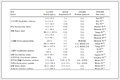
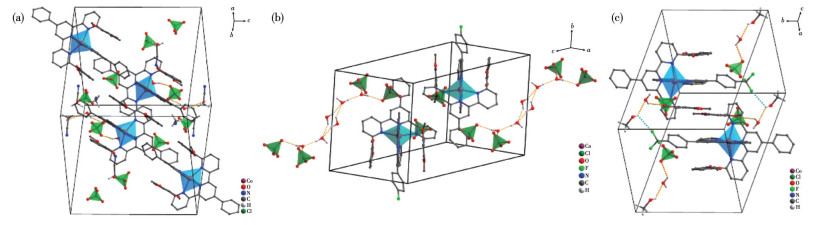
In this work, four terpy-type ligands were synthesized according to the literature method, and the detailed synthetic procedure and NMR characterization are depicted in the Supporting information (Fig. S1-S7)[26, 32-33]. The preparation of complexes was performed in a mild and facile reaction condition. To acetonitrile solution of L1/L2/L3 and L4 was added Co(ClO4)2·6H2O mixed solution of methanol and water (the molar ratio of L1/L2/L3, L4, and Co2+ was 1∶1∶1), and the selfassembly of heteroleptic complexes took place immediately at ambient temperature. Subsequently, dark red single crystals of complexes 1-3 were obtained by slow evaporation of the resulting solutions. Their structures were determined by single-crystal X-ray diffraction measurement and their crystal data and structure refinement is listed in Table 1. All the complexes crystallized in the triclinic space group P1 at the test temperatures and their molecular structures and packing diagrams are illustrated in Fig. 1 and 2. Different from that 1 contains two Co (Ⅱ) units, there is only one unique asymmetric unit in 2 and 3 (Fig. 1). In one unit cell, there are four, two, and two Co (Ⅱ) units in 1, 2, and 3, respectively (Fig. 2). The structure refinement revealed that there are lattice solvents including water and methanol in 1, water in 2, and water and acetonitrile in 3, respectively. The contents of the solvent were further confirmed by TGA (Fig.S8-S11) and elemental analysis. In addition, the imine-type ligand structure of complexes 1-3 was supported by FT-IR spectra (Fig. S12-S14). The purity of a large number of samples was confirmed by XRD (Fig.S15-S17).
 下载:
导出CSV
下载:
导出CSV
| Parameter | 1 | 2 | 2 | 3 |
| T/K | 150 | 120 | 299 | 120 |
| Formula | C122H105Cl4Co2N15O26 | C58H50Cl2CoFN6O14.5 | C58H50Cl2CoFN6O14.5 | C5.5H49Cl2CoF3N6O13.5 |
| Formula weight | 2 456.86 | 1 211.87 | 1 211.87 | 1 250.87 |
| Crystal system | Triclinic | Triclinic | Triclinic | Triclinic |
| Space group | P1 | P1 | P1 | P1 |
| a/nm | 1.802 35(11) | 1.236 94(6) | 1.241 08(12) | 1.254 2(4) |
| b/nm | 1.812 92(10) | 1.289 75(5) | 1.308 13(12) | 1.323 0(4) |
| c/nm | 1.830 15(10) | 1.807 07(8) | 1.816 3(2) | 1.801 8(6) |
| α/(°) | 94.494 0(10) | 101.676 0(10) | 101.037(3) | 101.877(9) |
| β/(°) | 92.307(2) | 109.732 0(10) | 109.845(2) | 109.360(10) |
| γ/(°) | 112.364(2) | 92.197(2) | 92.332(2) | 94.315(9) |
| V/nm3 | 5.497 3(5) | 2.639 6(2) | 2.704 5(5) | 2.726 8(15) |
| Z | 2 | 2 | 2 | 2 |
| F(000) | 2 518 | 1 252 | 1 252 | 1 288 |
| Dc/(g·cm-3) | 1.476 | 1.525 | 1.488 | 1.523 |
| μ/mm-1 | 0.485 | 0.508 | 0.496 | 0.498 |
| Crystal size / mm | 0.12x0.12x0.11 | 0.15x0.15x0.12 | 0.12x0.11x0.11 | 0.12x0.11x0.11 |
| θmin, θmax/(°) | 2.036, 27.572 | 2.25, 27.27 | 2.234, 27.485 | 2.34, 26.40 |
| Total reflection | 76 421 | 50 609 | 33 883 | 50 061 |
| Unique reflection, Rint | 25 247, 0.042 5 | 12 142, 0.048 5 | 11 926, 0.038 1 | 11 178, 0.067 5 |
| Parameter | 1 631 | 761 | 761 | 779 |
| R1[I≥2σ(I)]a | 0.077 3 | 0.044 1 | 0.078 8 | 0.070 8 |
| wR2b(all data) | 0.2147 | 0.1122 | 0.1733 | 0.2177 |
| S | 1.019 | 1.027 | 1.079 | 1.032 |
| (Δρ)max, (Δρ)min/(e·nm-3) | 1 150, -1 070 | 440, -540 | 790, -500 | 1 470, -1 140 |
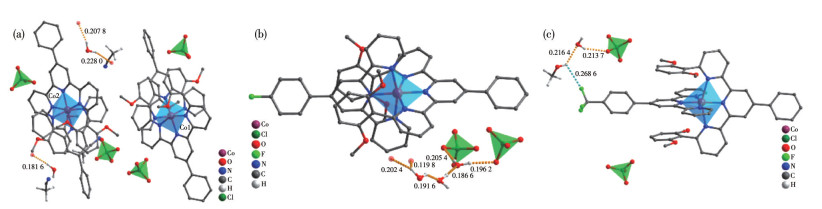
H atoms in the ligands are omitted for clarity
For all complex cations in this series, the Co (Ⅱ) ion is coordinated by six N atoms from two different types of terpy ligands in a bis-meridional fashion, forming an axially compressed CoN6 octahedron. Two 2, 6-dimethoxyphenyl in L4 and one pyridine in L1/L2/L3 provide ancillary ion-dipole interactions during the coordination process. The formed heteroleptic complexes are stabilized by π-π stacking between parallelly arranged 2, 6-dimethoxyphenyl and pyridine by which considerable geometric distortion is generated due to this extra weak interaction (Fig. S18). The distances between 2, 6-dimethoxyphenyl and pyridine planes are within 0.339-0.350 nm (Table S1), suggesting that one terpy ligand is tightly embraced by another substituted one through π-π stacking interactions. To quantitively analyze the structural distortions, some parameters including Co—N bond lengths, the continuous shape measure (CShM) values that reflect the deviation from ideal Oh symmetry, the distortion parameters ∑ (the sum of the deviation from 90° of the 12 cis N—Co—N angles), and the dihedral angles of two ligand planes are summarized in Table 2. The values of these parameters indicate that there exists considerably large geometrical distortion in the coordination sphere of this type of complex. In addition, the overlay of the crystal structures of 2 at 120 and 299 K shows a minor change in deformation, implying the spin state change in this temperature range is insignificant (Fig.S19).
下载:
导出CSV
| Complex | T/K | ∑/(°) | α/(°) | β/(°) | d/(Co—N)/nm | S(Oh) | Spin state |
| 1(Co1) | 150 | 88.64 | 89.049 | 178.10 | 0.204 4 | 2.906 | LS |
| 1(Co2) | 150 | 96.92 | 87.110 | 178.78 | 0.205 6 | 3.107 | LS |
| 2 | 120 | 93.47 | 87.956 | 178.64 | 0.204 6 | 3.026 | LS |
| 299 | 95.5 | 87.690 | 178.60 | 0.205 4 | 3.101 | SCO | |
| 3 | 120 | 92.41 | 87.788 | 177.84 | 0.204 3 | 2.942 | LS |
| *α: the dihedral angle between the least-squares planes of the tridentate ligands and the angle[34]; β: the trans-N(pyridine)—Fe—N(pyridine) angle[34]; d(Co—N): the average value of the six Co—N bond lengths in one CoN6 coordination sphere; ∑: the sum of the deviations from 90° of the cis angles[6, 35]; S(Oh): the result of CShM calculation denotes the deviation value of ideal Oh symmetry[36]. | |||||||
The average Co—N bond lengths are in a range of 0.204 4-0.205 6 nm, suggesting that the cobalt(Ⅱ) ions in complexes 1-3 approach the LS state at the test temperature. The detailed bond length data of the CoN6 coordination sphere in the structures are summarized in Table 3. For comparison of the structural discrimination between these asymmetric Co-terpy complexes and their symmetric analogues, the selective bond length data of four representative mononuclear cobalt (Ⅱ) complexes built from homoleptic ligands are listed in Table S2 as well. It shows that the existence of π-π stacking between two ligands causes the enhanced geometrical distortion in the part of cobalt(Ⅱ) ion with 2, 6-dimethoxyphenyl substituted ligand L4, reflecting the substantially lengthening Co—N bond lengths. In general, the distances between cobalt(Ⅱ) ions and N atoms from bilateral pyridines in L4 are more than 0.225 nm, 0.02-0.03 nm longer than that in unsubstituted terpy. Additionally, the two bilateral pyridine rings in L4 considerably deviate from the coplanarity than that of L1/ L2/L3 (Table S3).
下载:
导出CSV
| 1(150K) | |||||
| Co1—N1 | 0.196 2(3) | Col—N2 | 0.184 8(3) | Col—N3 | 0.196 5(3) |
| Col—N4 | 0.227 1(3) | Co1—N5 | 0.192 7(3) | Col—N6 | 0.229 3(3) |
| Co2—N7 | 0.196 9(3) | Co2—N8 | 0.187 3(3) | Co2—N9 | 0.197 6(3) |
| Co2—N10 | 0.227 1(3) | Co2—Nil | 0.195 1(3) | Co2—N12 | 0.229 7(3) |
| 2(120 K) | |||||
| Co1—N1 | 0.196 4(2) | Col—N2 | 0.185 8(2) | Col—N3 | 0.197 1(2) |
| Co1—N4 | 0.226 2(2) | Co1—N5 | 0.194 1(2) | Col—N6 | 0.228 2(2) |
| 2(299 K) | |||||
| Co1—N1 | 0.196 9(3) | Col—N2 | 0.187 1(3) | Col—N3 | 0.197 5(3) |
| Co1—N4 | 0.226 5(3) | Co1—N5 | 0.194 7(3) | Col—N6 | 0.229 4(3) |
| 3(120 K) | |||||
| Co1—N1 | 0.197 4(3) | Col—N2 | 0.186(3) | Col—N3 | 0.196 2(4) |
| Co1—N4 | 0.225 3(3) | Co1—N5 | 0.193 6(3) | Col—N6 | 0.227 3(3) |
Variable-temperature magnetic susceptibilities of complexes 1-3 were measured in the solid-state using a SQUID magnetometer. The measurement was performed in sweep mode with a scan rate of 3 K·min-1 at a field strength of 5 000 Oe. The solvated samples were sealed with parafilm to prevent solvent loss in the first cycle. At the end of the first heating semi-cycle, all samples were kept at 400 K for 2 h to ensure the complete removal of lattice solvents. Magnetic susceptibilities are displayed in the form of χMT vs T, where T is the absolute temperature and χM is the molar magnetic susceptibility. The χMT vs T plots of complexes 1-3 under successive cooling/heating cycles are illustrated in Fig. 3. Although they all displayed spin transition, their SCO behaviors had significant discriminations. For 1 and 3, both were observed to show gradual incomplete SCO behavior. At 2 K, the χMT values were 0.41 cm3·mol-1·K for 1 and 0.40 cm3·mol-1·K for 3, respectively. Upon heating to 400 K, it gradually increased to 1.00 cm3·mol-1·K for 1 and 1.19 cm3·mol-1·K for 3, indicating that they don´t reach the complete HS state at the test upper limit temperature. After preservation at 400 K, the lattice solvent molecules were fully removed, and the subsequent cycles showed the spin transition behavior of desolvated samples. Their roughly coincident curves reveal that the influence of lattice solvent molecules in two compounds on SCO behavior is minor.
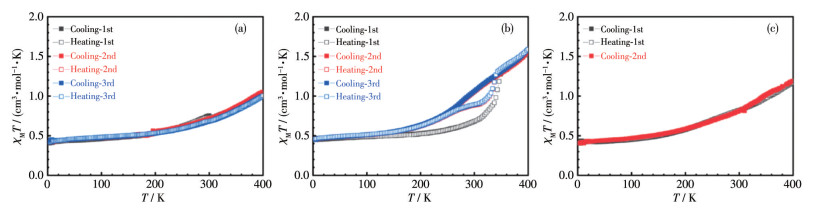
Complex 2 showed an interesting solventdependent SCO behavior. At the beginning of the measurement, the χMT value at 300 K was 0.68 cm3· mol-1·K which was far from the saturated value of 2.5 cm3·mol-1·K for the spin-only d7 cobalt(Ⅱ) ion with S=3/2. Upon cooling, it gradually decreased to 0.45 cm3· mol-1·K at 4 K, reaching a complete LS state with S= 1/2. In the following heating semi-cycle, the curve entirely coincided with the cooling one below 300 K. Subsequently accompanied by the temperature rise, the χMT value increased quickly and an inflection point was observed at about 350 K. According to the TGA data of 2 (Fig. S9), the dehydration occurred at the temperature range of 320-350 K. In combination of variable-temperature susceptibility and TGA data, the χMT vs T curve above 300 K can be divided into two steps. The dehydration takes place at the first step (300-350 K) and the structural phase transition caused by dehydration possesses considerable contribution to the spin transition. When the temperature was above 350 K, the following measurements revealed the SCO behavior of the desolvated sample. It is found that the dehydration of 2 results in significantly distinct SCO behavior. Upon cooling in the second cycle, the χMT value gradually dropped from 1.59 cm3·mol-1·K at 400 K to 0.45 cm3·mol-1·K at 4 K, reflecting the typical SCO of cobalt (Ⅱ) ion from the incomplete HS state to the complete LS state. Unexpectedly, the second cooling and heating semi-cycles didn´t overlap in the temperature range of 260-340 K and produced a large apparent thermal hysteresis loop of 50 K. This hysteresis loop was stable and repeatable which was repro- duced in the following third cycle. Due to the diffraction data considerably getting worse during the heating process to remove the lattice water molecules, the attempt to get the accurate structure of dehydration crystals was unsuccessful. It is supposed that the removal of lattice solvents makes the stacking of molecules more tightly, leading to enhanced interaction between adjacent complexes which may be the main source of the occurrence of the thermal hysteresis loop. It was found that the adsorption and desorption of water in 2 were reversible[37-38]. When the desolvated sample was exposed to air for a period of time, it could readsorb water to the originally solvated state, which was confirmed by the TGA trace of the re-adsorbed sample (Fig.S10). The re-adsorbed sample showed almost identical behaviour of variable-temperature magnetic susceptibilities to that of the pristine one (Fig. S20). DSC measurements of compound 2 were carried out at the temperature area of the thermal hysteresis loops. No noticeable thermal change was observed, suggesting that no apparent structural phase transition occurred in the SCO process (Fig.S21).
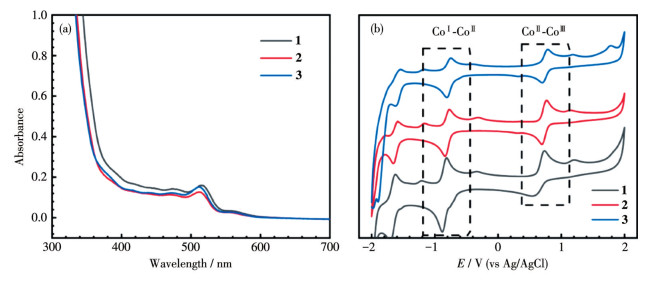
The influence of substituents on the electronic structures of complexes was further investigated by using absorption spectroscopy and CV. According to the UV-Vis spectra recorded in acetonitrile at ambient temperature, complexes 1-3 showed a broad absorption peak at around 520 nm (Fig. 4a). This wide absorption is ascribed to the metal to ligand charge transfer (MLCT) band. Their peak positions were at 515 nm for 1, and 511 nm for 2 and 3. Due to the strong electronwithdrawing effect, the MLCT band experienced a considerable blue shift. The strong electron-withdrawing groups of F and CF3 benefit the back bonding of cobalt(Ⅱ) ion to ligands, resulting in the enhancement of ligand field strength. The electrochemical properties of complexes 1-3 and the ligands were investigated using CV in acetonitrile. The CV curve of each complex showed the reversible CoⅠ-CoⅡ and CoⅡ-CoⅢ couples that centered at about -0.8 and 0.7 V, respectively (Fig. 4b and S21)[39]. It was found that their anode potential (Epa), cathode potential (Epc), and half-wave potential (E1/2) were all sensitive to the electronic effect of substituents (Table S4). In general, the presence of an electron drawing group pulls more electron density from the metal center, making its redox reaction easier.
In summary, three mononuclear SCO-active cobalt (Ⅱ) complexes have been prepared using the directional synthesis of complementary terpyridine ligand pairing. Complexes 1-3 were all located at complete LS state at low temperature and showed a gradually incomplete spin transition to HS state upon heating to 400 K. Impressively, the fluorine substituted complex 2 exhibited solvent-dependent SCO behavior. When three lattice water molecules were removed, a large thermal hysteresis loop with the width of ca. 50 K emerged at the temperature range of 260-340 K. In addition, the influence of substituents was also confirmed using absorption spectroscopy and cyclic voltammetry. This work demonstrates that this strategy is effective in the construction of asymmetric SCO-active cobalt (Ⅱ) complexes with interesting magnetic properties. It also provides the possibility to introduce more functional groups into one SCO compound. The research on Co-terpy SCO compounds bearing multifunctions is in progress.
Supporting information is available at http://www.wjhxxb.cn
Gütlich P, Goodwin H A. Spin Crossover—An Overall Perspective//Gütlich P, Goodwin H A. Spin Crossover in Transition Metal Compounds Ⅰ. Berlin: Springer Berlin, Heidelberg, 2004: 1-47
Halcrow M A. Spin-Crossover Materials: Properties and Applications. Chichester: John Wiley & Sons, 2013.
Nakaya M, Ohtani R, Hayami S. Guest Modulated Spin States of Metal Complex Assemblies[J]. Eur. J. Inorg. Chem., 2020, (39): 3709-3719.
Olguin J. Unusual Metal Centres/Coordination Spheres in Spin Crossover Compounds[J]. Coord. Chem. Rev., 2020, 407: 213148. doi: 10.1016/j.ccr.2019.213148
Brooker S. Spin Crossover with Thermal Hysteresis: Practicalities and Lessons Learnt[J]. Chem. Soc. Rev., 2015, 44(10): 2880-2892. doi: 10.1039/C4CS00376D
Halcrow M A. Structure: Function Relationships in Molecular Spin-Crossover Complexes[J]. Chem. Soc. Rev., 2011, 40(7): 4119-4142. doi: 10.1039/c1cs15046d
Sciortino N F, Scherl-Gruenwald K R, Chastanet G, Halder G J, Chapman K W, Letard J F, Kepert C J. Hysteretic Three-Step Spin Crossover in a Thermo-and Photochromic 3D Pillared Hofmann-Type Metal-Organic Framework[J]. Angew. Chem. Int. Ed., 2012, 51(40): 10154-10158. doi: 10.1002/anie.201204387
Cambi L, Szegö L. Über die Magnetische Susceptibilität der Komplexen Verbindungen. Ber. Dtsch. Chem. Ges. B, 1931, 64(10): 2591-2598
Cambi L, Szegö L. The Magnetic Susceptibility of Complex Compounds. Ber. Dtsch. Chem. Ges. B, 1931, 64(10): 2591-2598
Mathoniere C. Metal-To-Metal Electron Transfer: A Powerful Tool for the Design of Switchable Coordination Compounds[J]. Eur. J. Inorg. Chem., 2018, (3/4): 248-258.
王娅琴, 张海霞, 张舒恒, 何威, 葛芳圆, 陈雨欣, 顾志国. 亚铁烷基咪唑自旋交叉配合物的合成及其金属有机凝胶性能[J]. 无机化学学报, 2019,35,(12): 2260-2268. doi: 10.11862/CJIC.2019.254WANG Y Q, ZHANG H X, ZHANG S H, HE W, GE F Y, CHEN Y X, GU Z G. Synthesis and Gelation Ability of Spin-Crossover Iron(Ⅱ) Alkyl Imidazole Complexes[J]. Chinese J. Inorg. Chem., 2019, 35(12): 2260-2268. doi: 10.11862/CJIC.2019.254
Gütlich P, Gaspar A B, Garcia Y. Spin State Switching in Iron Coordination Compounds[J]. Beilstein J. Org. Chem., 2013, 9: 342-391. doi: 10.3762/bjoc.9.39
王康杰, 李鸿庆, 孙宇辰, 王新益. 氢键桥连一维铁-自旋交叉化合物的合成和性质[J]. 无机化学学报, 2020,36,(6): 1143-1148. WANG K J, LI H Q, SUN Y C, WANG X Y. Synthesis and Properties of an Iron(Ⅲ) Spin Crossover Compound with 1D Chains Bridged by Hydrogen Bonds[J]. Chinese J. Inorg. Chem., 2020, 36(6): 1143-1148.
Liu T, Liu Q, Hu J X, Meng Y S, Jiang W J, Wang J L, Wen W, Wu Q, Zhu H L, Zhao L. Asymmetric Coordination toward a Photoinduced Single-Chain Magnet Showing Large Coercivity[J]. Angew. Chem. Int. Ed., 2021, 60(19): 10537-10541. doi: 10.1002/anie.202017249
Guo Y, Yang X L, Wei R J, Zheng L S, Tao J. Spin Transition and Structural Transformation in a Mononuclear Cobalt (Ⅱ) Complex[J]. Inorg. Chem., 2015, 54(16): 7670-7672. doi: 10.1021/acs.inorgchem.5b01344
Xue S F, Guo Y N, Garcia Y. Spin Crossover Crystalline Materials Engineered via Single-Crystal-To-Single-Crystal Transformations[J]. CrystEngComm, 2021, 23(45): 7899-7915. doi: 10.1039/D1CE00234A
Krivokapic I, Zerara M, Daku M L, Vargas A, Enachescu C, Ambrus C, Tregenna-Piggott P, Amstutz N, Krausz E, Hauser A. Spin-Crossover in Cobalt(Ⅱ) Imine Complexes[J]. Coord. Chem. Rev., 2007, 251(3/4): 364-378.
Hayami S, Komatsu Y, Shimizu T, Kamihata H, Lee Y N. Spin-Crossover in Cobalt (Ⅱ) Compounds Containing Terpyridine and Its Derivatives[J]. Coord. Chem. Rev., 2011, 255(17/18): 1981-1990.
Bersuke I B. Spin Crossover and Magnetic-Dielectric Bistability Induced by Hidden Pseudo-Jahn-Teller Effect[J]. Magnetochemistry, 2020, 6(4): 64. doi: 10.3390/magnetochemistry6040064
Kilner C A, Halcrow M A. An Unusual Discontinuity in the Thermal Spin Transition in Co(terpy)2[BF4]2[J]. Dalton Trans., 2010, 39(38): 9008-9012. doi: 10.1039/c0dt00295j
Kou H Z, Sato O. New Oxalate-Bridged CrⅢ-MnⅡ Polymeric Network Incorporating a Spin-Crossover[Co(terpy)2]2+ Cation[J]. Inorg. Chem., 2007, 46(23): 9513-9515. doi: 10.1021/ic701043f
Zhang X, Wang Z X, Xie H, Li M X, Woods T J, Dunbar K R. A Cobalt (Ⅱ) Spin-Crossover Compound with Partially Charged TCNQ Radicals and an Anomalous Conducting Behavior[J]. Chem. Sci., 2016, 7(2): 1569-1574. doi: 10.1039/C5SC03547C
Shao D, Shi L, Shen F X, Wei X Q, Sato O, Wang X Y. Reversible On-Off Switching of the Hysteretic Spin Crossover in a Cobalt (Ⅱ) Complex via Crystal to Crystal Transformation[J]. Inorg. Chem., 2019, 58(17): 11589-11598. doi: 10.1021/acs.inorgchem.9b01436
Zenno H, Kobayashi F, Nakamura M, Sekine Y, Lindoy L F, Hayami S. Hydrogen Bond-Induced Abrupt Spin Crossover Behaviour in 1-D Cobalt (Ⅱ) Complexes—The Key Role of Solvate Water Molecules[J]. Dalton Trans., 2021, 50(22): 7843-7853. doi: 10.1039/D1DT01069G
Sinha P, Kumari N, Singh K, Singh K, Mishra L. Homoleptic Bisterpyridyl Complexes: Synthesis, Characterization, DNA Binding, DNA Cleavage and Topoisomerase Ⅱ Inhibition Activity[J]. Inorg. Chim. Acta, 2015, 432: 71-80. doi: 10.1016/j.ica.2015.03.026
Pankratova Y, Aleshin D, Nikovskiy I, Novikov V, Nelyubina Y. In Situ NMR Search for Spin-Crossover in Heteroleptic Cobalt(Ⅱ) Complexes[J]. Inorg. Chem., 2020, 59(11): 7700-7709. doi: 10.1021/acs.inorgchem.0c00716
Wang S Y, Fu J H, Liang Y P, He Y J, Chen Y S, Chan Y T. Metallo-Supramolecular Self-Assembly of a Multicomponent Ditrigon Based on Complementary Terpyridine Ligand Pairing[J]. J. Am. Chem. Soc., 2016, 138(11): 3651-3654. doi: 10.1021/jacs.6b01005
Wang S Y, Huang J Y, Liang Y P, He Y J, Chen Y S, Zhan Y Y, Hiraoka S, Liu Y H, Peng S M, Chan Y T. Multicomponent Self-Assembly of Metallo-Supramolecular Macrocycles and Cages through Dynamic Heteroleptic Terpyridine Complexation[J]. Chem. Eur. J., 2018, 24(37): 9274-9284. doi: 10.1002/chem.201801753
Fu J H, Wang S Y, Chen Y S, Prusty S, Chan Y T. One-Pot Self-Assembly of Stellated Metallosupramolecules from Multivalent and Complementary Terpyridine-Based Ligands[J]. J. Am. Chem. Soc., 2019, 141(41): 16217-16221. doi: 10.1021/jacs.9b08731
Mcpherson J N, Hogue R W, Akogun F S, Bondi L, Luis E T, Price J R, Garden A L, Brooker S, Colbran S B. Predictable Substituent Control of CoⅢ/Ⅱ Redox Potential and Spin Crossover in Bis(dipyridylpyrrolide)cobalt Complexes[J]. Inorg. Chem., 2019, 58(3): 2218-2228. doi: 10.1021/acs.inorgchem.8b03457
Kobayashi F, Iwaya K, Zenno H, Nakamura M, Li F, Hayami S. Spin State Modulation in Cobalt (Ⅱ) Terpyridine Complexes by Cocrystallization with 1, 3, 5-Triiodo-2, 4, 6-trifluorobenzene[J]. Bull. Chem. Soc. Jpn., 2021, 94(1): 158-163. doi: 10.1246/bcsj.20200246
Karabulut F N H, Feltham H L C, Brooker S. Substituents Drive Ligand Rearrangements, Giving Dinuclear Rather than Mononuclear Complexes, and Tune CoⅡ/Ⅲ Redox Potential[J]. Dalton Trans., 2018, 47(34): 11749-11759. doi: 10.1039/C8DT01502C
Sil A, Ghosh U, Mishra V K, Mishra S, Patra S K. Synthesis, Structure, Electrochemical, and Spectroscopic Properties of Hetero-Bimetallic Ru(Ⅱ)/Fe(Ⅱ)-Alkynyl Organometallic Complexes[J]. Inorg. Chem., 2019, 58(2): 1155-1166. doi: 10.1021/acs.inorgchem.8b02440
Dickenson J C, Haley M E, Hyde J T, Reid Z M, Tarring T J, Iovan D A, Harrison D P. Fine-Tuning Metal and Ligand-Centered Redox Potentials of Homoleptic Bis-terpyridine Complexes with 4′-Aryl Substituents[J]. Inorg. Chem., 2021, 60(13): 9956-9969. doi: 10.1021/acs.inorgchem.1c01233
Holland J M, Mcallister J A, Lu Z B, Kilner C A, Thornton-Pett M, Halcrow M A. An Unusual Abrupt Thermal Spin-State Transition in [FeL2][BF4]2[L=2, 6-Di(pyrazol-1-yl)pyridine][J]. Chem. Commun., 2001, (6): 577-578. doi: 10.1039/b100995h
Mccusker J K, Rheingold A L, Hendrickson D N. Variable-Temperature Studies of Laser-Initiated 5T2→1A1 Intersystem Crossing in Spin-Crossover Complexes: Empirical Correlations between Activation Parameters and Ligand Structure in a Series of Polypyridyl Ferrous Complexes[J]. Inorg. Chem., 1996, 35(7): 2100-2112. doi: 10.1021/ic9507880
Alvarez S, Alemany P, Casanova D, Cirera J, Llunell M, Avnir D. Shape Maps and Polyhedral Interconversion Paths in Transition Metal Chemistry[J]. Coord. Chem. Rev., 2005, 249(17): 1693-1708.
Ni Z P, Liu J L, Hogue N, Liu W, Li J Y, Chen Y C, Tong M L. Recent Advances in Guest Effects on Spin-Crossover Behavior in Hofmann-Type Metal-Organic Frameworks[J]. Coord. Chem. Rev., 2017, 335: 28-43. doi: 10.1016/j.ccr.2016.12.002
Kobayashi F, Komatsumaru Y, Akiyoshi R, Nakamura M, Zhang Y, Lindoy L F, Hayami S. Water Molecule-Induced Reversible Magnetic Switching in a Bis-terpyridine Cobalt(Ⅱ) Complex Exhibiting Coexistence of Spin Crossover and Orbital Transition Behaviors[J]. Inorg. Chem., 2020, 59(23): 16843-16852. doi: 10.1021/acs.inorgchem.0c00818
Tang J H, Sun T G, Shao J Y, Gong Z L, Zhong Y W. Resistive Memory Devices Based on a Triphenylamine-Decorated Non-precious Cobalt (Ⅱ) Bis-terpyridine Complex[J]. Chem. Commun., 2017, 53(87): 11925-11928. doi: 10.1039/C7CC05806C

Scheme 1 Directional assembly of three mononuclear cobalt(Ⅱ) complexes based on complementary terpy ligand pairing

Figure 1 Crystal structures of (a) 1, (b) 2, and (c) 3
H atoms in the ligands are omitted for clarity

Figure 2 Projection of the unit cell of 1, 2, and 3, where the hydrogen bondings are illustrated

Figure 3 Plots of the temperature dependence of χMT under 5 kOe dc field for (a) 1, (b) 2, and (c) 3 for successive cycles

Figure 4 (a)UV-Vis spectra of complexes 1-3 in the 50 μmol·L-1 acetonitrile solution at ambient temperature; (b) CV curves of complexes 1-3 (1 mmol·L-1) in 0.1 mol·L-1 Bu4NPF6/acetonitrile solution on a glassy carbon disk working electrode with a Pt counter electrode and Ag/AgCl reference with the potential sweep rate being 100 mV·s-1
Table 1. Crystal data and structure refinement for 1, 2, and 3
| Parameter | 1 | 2 | 2 | 3 |
| T/K | 150 | 120 | 299 | 120 |
| Formula | C122H105Cl4Co2N15O26 | C58H50Cl2CoFN6O14.5 | C58H50Cl2CoFN6O14.5 | C5.5H49Cl2CoF3N6O13.5 |
| Formula weight | 2 456.86 | 1 211.87 | 1 211.87 | 1 250.87 |
| Crystal system | Triclinic | Triclinic | Triclinic | Triclinic |
| Space group | P1 | P1 | P1 | P1 |
| a/nm | 1.802 35(11) | 1.236 94(6) | 1.241 08(12) | 1.254 2(4) |
| b/nm | 1.812 92(10) | 1.289 75(5) | 1.308 13(12) | 1.323 0(4) |
| c/nm | 1.830 15(10) | 1.807 07(8) | 1.816 3(2) | 1.801 8(6) |
| α/(°) | 94.494 0(10) | 101.676 0(10) | 101.037(3) | 101.877(9) |
| β/(°) | 92.307(2) | 109.732 0(10) | 109.845(2) | 109.360(10) |
| γ/(°) | 112.364(2) | 92.197(2) | 92.332(2) | 94.315(9) |
| V/nm3 | 5.497 3(5) | 2.639 6(2) | 2.704 5(5) | 2.726 8(15) |
| Z | 2 | 2 | 2 | 2 |
| F(000) | 2 518 | 1 252 | 1 252 | 1 288 |
| Dc/(g·cm-3) | 1.476 | 1.525 | 1.488 | 1.523 |
| μ/mm-1 | 0.485 | 0.508 | 0.496 | 0.498 |
| Crystal size / mm | 0.12x0.12x0.11 | 0.15x0.15x0.12 | 0.12x0.11x0.11 | 0.12x0.11x0.11 |
| θmin, θmax/(°) | 2.036, 27.572 | 2.25, 27.27 | 2.234, 27.485 | 2.34, 26.40 |
| Total reflection | 76 421 | 50 609 | 33 883 | 50 061 |
| Unique reflection, Rint | 25 247, 0.042 5 | 12 142, 0.048 5 | 11 926, 0.038 1 | 11 178, 0.067 5 |
| Parameter | 1 631 | 761 | 761 | 779 |
| R1[I≥2σ(I)]a | 0.077 3 | 0.044 1 | 0.078 8 | 0.070 8 |
| wR2b(all data) | 0.2147 | 0.1122 | 0.1733 | 0.2177 |
| S | 1.019 | 1.027 | 1.079 | 1.032 |
| (Δρ)max, (Δρ)min/(e·nm-3) | 1 150, -1 070 | 440, -540 | 790, -500 | 1 470, -1 140 |
 下载: 导出CSV
Table 2. Summary of the structural parameters and spin state in the crystal structures of cobalt(Ⅱ) complexes in this work*
| Complex | T/K | ∑/(°) | α/(°) | β/(°) | d/(Co—N)/nm | S(Oh) | Spin state |
| 1(Co1) | 150 | 88.64 | 89.049 | 178.10 | 0.204 4 | 2.906 | LS |
| 1(Co2) | 150 | 96.92 | 87.110 | 178.78 | 0.205 6 | 3.107 | LS |
| 2 | 120 | 93.47 | 87.956 | 178.64 | 0.204 6 | 3.026 | LS |
| 299 | 95.5 | 87.690 | 178.60 | 0.205 4 | 3.101 | SCO | |
| 3 | 120 | 92.41 | 87.788 | 177.84 | 0.204 3 | 2.942 | LS |
| *α: the dihedral angle between the least-squares planes of the tridentate ligands and the angle[34]; β: the trans-N(pyridine)—Fe—N(pyridine) angle[34]; d(Co—N): the average value of the six Co—N bond lengths in one CoN6 coordination sphere; ∑: the sum of the deviations from 90° of the cis angles[6, 35]; S(Oh): the result of CShM calculation denotes the deviation value of ideal Oh symmetry[36]. | |||||||
下载: 导出CSV
Table 3. Selected bond lengths (nm) for Co—N bonds of complexes 1-3 in the single-crystal structures
| 1(150K) | |||||
| Co1—N1 | 0.196 2(3) | Col—N2 | 0.184 8(3) | Col—N3 | 0.196 5(3) |
| Col—N4 | 0.227 1(3) | Co1—N5 | 0.192 7(3) | Col—N6 | 0.229 3(3) |
| Co2—N7 | 0.196 9(3) | Co2—N8 | 0.187 3(3) | Co2—N9 | 0.197 6(3) |
| Co2—N10 | 0.227 1(3) | Co2—Nil | 0.195 1(3) | Co2—N12 | 0.229 7(3) |
| 2(120 K) | |||||
| Co1—N1 | 0.196 4(2) | Col—N2 | 0.185 8(2) | Col—N3 | 0.197 1(2) |
| Co1—N4 | 0.226 2(2) | Co1—N5 | 0.194 1(2) | Col—N6 | 0.228 2(2) |
| 2(299 K) | |||||
| Co1—N1 | 0.196 9(3) | Col—N2 | 0.187 1(3) | Col—N3 | 0.197 5(3) |
| Co1—N4 | 0.226 5(3) | Co1—N5 | 0.194 7(3) | Col—N6 | 0.229 4(3) |
| 3(120 K) | |||||
| Co1—N1 | 0.197 4(3) | Col—N2 | 0.186(3) | Col—N3 | 0.196 2(4) |
| Co1—N4 | 0.225 3(3) | Co1—N5 | 0.193 6(3) | Col—N6 | 0.227 3(3) |
下载: 导出CSV

 扫一扫看文章


扫一扫关注我们