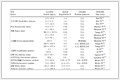
Table 1.
Crystal data and structure refinement for compound 1


Recently, bistable materials with two switchable states in a certain range of external stimuli, including spin crossover (SCO) materials[1-2], single-molecule magnets (SMMs)[3-4], and organic radicals[5-6], have been extensively studied due to their potential applications on switches, sensors, memory devices and other fields[7]. Among them, the SCO compounds, usually octahedral Mn, Fe, and Co compounds with d4 to d7 electron configurations, can switch between high spin (HS) and low spin (LS) states in an external stimulus, such as temperature, light, and pressure. This change modifies their structure features and physical properties including the magnetism, optics, conductivity and so on[1]. For more practical applications, researchers in the field are devoted to SCO compounds with wide thermal hysteresis loops at near room temperature[8].
Although Fe(Ⅱ) SCO compounds have been studied the most by far, Fe(Ⅲ) SCO compounds also have a broad prospect in future applications because of their higher air stability compared to the Fe(Ⅱ) compounds[9-10]. Up to now, many hysteretic Fe(Ⅲ) SCO compounds have been reported and the Fe(Ⅲ)centers are coordinated by a wide variety of donor sets, including the N4O2, N2O2S2, N3O2S and N5O. For the organic ligands, most of the Fe(Ⅲ) SCO compounds were synthesized using tridentate Schiff bases like Hqsal (Hqsal=N-(8-quinolyl)salicylaldimine) and its deriva-tives[9]. When it comes to tetradentate ligands, less than a dozen compounds have been reported and they are based on a salen-type N2O2 tetradentate ligand including salen, hapen, and acacen ligands (salen=N, N′-bis(salicylidene)ethylenediaminato, hapen=N, N′- bis(2-hydroxyacetophenylidene)ethylenediamine), and acacen=N, N′-bis(acetylacetone)ethylenediamine)[11-16]. Furthermore, although Matsumoto′s group has reported a series of [FeⅢ(Him)2(hapen)]Y·solvent compounds with different anions and solvents, few of them have distinct thermal hysteresis loops with transition temp-erature (T1/2) higher than 100 K[11]. The design and even the control of the SCO behavior in these salen-type Fe(Ⅲ) complexes are still challenging.
Hydrogen bond (H-bond) is one of the most important supramolecular interactions and is believed to be able to increase remarkably the cooperativity of the SCO compounds. With strong H-bonds, wide hysteresis loops are anticipated[5-6]. For example, Weber et al. reported in 2008 a Fe(Ⅱ) SCO compound with a 70 K wide hysteresis loop at around room temperature. Strong H-bonds between the Fe(Ⅱ) coordination spheres are responsible for the strong cooperativity in this compound[17]. Inspired by these considerations, our group has been interested in the design of SCO compounds where the H-bonds were introduced deliberately by using different organosulfonate anions, hoping to gain more control over their H-bonded frameworks and SCO properties[18]. Our work confirmed that both the shapes and the sizes of the organodisul-fonates were correlated to the SCO properties, such as the transition temperatures and the abruptness of the transition[19].
Following these studies, we utilized the CH3SO3- as the counter anion in the [FeⅢ(Him)2(hapen)]+ system, hoping to tune the property of this SCO system. Compared with the strong electron withdrawing -CF3 group in CF3SO3-, the electron donating -CH3 group in CH3SO3- can increase the electron density in the O atoms of the anion, which might lead to stronger H-bonds with the imidazole(Him) molecules. We report here the synthesis and characterization of such a new Fe(Ⅲ) compound, [FeⅢ(Him)2(4-MeOhapen)](CH3SO3) (1, H2(4-MeOhapen)=N, N′ -bis(4-methoxy-2-hydroxya-cetophenylidene) ethylenediamine), which is an SCO compound with a 4 K thermal hysteresis loop at above 160 K. Compared with the reported compound with the CF3SO3- anion[11], the different H-bond strength and bridging patterns should be responsible for the their different SCO properties.
All chemicals were purchased commercially and used without further purification. Elemental analyses for C, H, and N were measured on an Elementar Vario MICRO analyzer. Thermal Gravimetric Analysis (TGA) was measured in a Al2O3 crucible using a PerkinElmer TGA instrument in the temperature range of 20~700 ℃ under a N2 flow at a heating rate of 20 ℃·min-1. Magnetic measurement was measured under a dc field of 1 kOe with a Quantum Design VSM magnetometer. The experimental data were corrected for the diamag-netic contribution by means of Pascal′s constants.
Compound 1 was prepared according to the synthetic procedure applied for compound [Fe(Him)2(4-MeOhapen)]·PF6[13]. The ligand H2(4-MeOhapen) was prepared according to the general synthetic procedure of salen-type Schiff-base ligand. To a solution of 4-methoxy-2-hydroxyacetophenone (0.1 mol, 16.62 g) in 50 mL of methanol was added a solution of ethylenediamine (0.05 mol, 3.01 g) in 50 mL of methanol. The mixture was stirred and refluxed for 30 min. After it was cooled to room temperature, yellow crystals precipitated. They were collected by suction filtration, washed with a small amount of methanol and diethyl ether, and dried in vacuo. The precursor Fe(Ⅲ) compound [FeCl(4-MeOhapen)]·H2O was obtained as powders by mixing the ligand H2(4-MeOhapen), iron(Ⅲ) chloride anhydrate, and trime-thylamine in a 1:1:2 molar ratio in methanol. To a suspension of [FeCl(4-MeOhapen)]·H2O (0.5 mmol, 0.22 g) in 10 mL of methanol, an excess of imidazole (5 mmol, 0.34 g) was added, and the mixture was stirred for 30 min on a hot-plate at 65 ℃. A solution of Ag(CH3SO3) (0.5 mmol, 0.09 g) in 5 mL of methanol was added to the solution, and the resulting solution was stirred for 15 min before filtered. The filtrate was then added to a test tube, and diethyl ether vapor was allowed to diffuse into the test tube. Black block single crystals formed in the tube in 2 days. The crystals were then removed from the test tube and washed with a small amount of methanol. Yield: 0.21 g, 66%. Anal. Calcd. for C27H33FeN6O7S(%): C, 50.55; H, 5.18; N, 13.10. Found(%): C, 50.91; H, 5.22; N, 12.54. IR (KBr, cm-1): 3 132(s), 3 051(s), 3 014(s), 1 578(s), 1 531(s), 1 437(s), 1 240(s), 1 163(s), 1 028(s), 841(s), 752(s), 619(s).
Single crystal X-ray diffraction data were collected on a Bruker D8 Venture diffractometer with a CCD area detector (Ga Kα radiation, λ=0.134 139 nm) at 190 K. The APEXⅢ program was used to determine the unit cell parameters and for data collection. The data were integrated and corrected for Lorentz and polarization effects using SAINT[20]. Absorption correc-tions were applied with SADABS[21]. The structure was solved by direct methods and refined by full-matrix least-squares method on F2 using the SHELXTL crys-tallographic software package and OLEX 2[22-23]. All of the nonhydrogen atoms were refined anisotropically. Hydrogen atoms of the organic ligands were refined as riding on the corresponding non-hydrogen atoms. Additional details of the data collection and structural refinement parameters are provided in Table 1. The relevant coordination bond distances and angles are given in Table 2.
 下载:
导出CSV
| Empirical formula | C27H33FeN6O7S | Z | 2 | |
| Formula weight | 641.5 | Dc / (g·cm-3) | 1.443 | |
| Temperature / K | 190.06 | μ / mm-1 | 3.484 | |
| Crystal system | Triclinic | F(000) | 670 | |
| Space group | P1 | Index ranges | -11 ≤ h ≤ 11, -14 ≤ k ≤ 14, -16 ≤ l ≤ 15 | |
| a / nm | 0.972 15(4) | Reflection collected | 13 519 | |
| b / nm | 1.235 31(5) | Independent reflection | 5 156 (Rint=0.067 7, Rσ=0.079 5) | |
| c / nm | 1.374 92(5) | Data, restraint, parameter | 5 156, 0, 384 | |
| α / (°) | 79.059(2) | Goodness-of-fit on F2 | 1.1 | |
| β / (°) | 72.768(2) | Final R indexes [I≥2σ(I)] | R1=0.086 9, wR2=0.249 3 | |
| γ / (°) | 70.230(2) | Final R indexes (all data) | R1=0.099 7, wR2=0.262 7 | |
| V / nm3 | 1.476 69(10) |
下载:
导出CSV
| Fe(1)-N(1) | 0.210 3(4) | Fe(1)-N(3) | 0.214 9(4) | Fe(1)-O(1) | 0.189 0(3) |
| Fe(1)-N(2) | 0.210 5(4) | Fe(1)-N(5) | 0.215 9(4) | Fe(1)-O(2) | 0.189 1(3) |
| N(1)-Fe(1)-N(2) | 81.97(15) | N(3)-Fe(1)-N(5) | 174.47(15) | O(1)-Fe(1)-O(2) | 100.51(14) |
| N(1)-Fe(1)-N(3) | 86.66(15) | O(1)-Fe(1)-N(1) | 88.57(15) | O(2)-Fe(1)-N(1) | 170.90(15) |
| N(1)-Fe(1)-N(5) | 89.48(15) | O(1)-Fe(1)-N(2) | 170.54(13) | O(2)-Fe(1)-N(2) | 88.94(14) |
| N(2)-Fe(1)-N(3) | 88.93(16) | O(1)-Fe(1)-N(3) | 90.75(16) | O(2)-Fe(1)-N(3) | 93.55(15) |
| N(2)-Fe(1)-N(5) | 86.60(16) | O(1)-Fe(1)-N(5) | 93.13(15) | O(2)-Fe(1)-N(5) | 89.63(15) |
CCDC: 1985363.
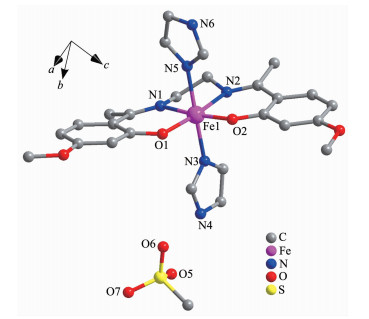
Compound 1 crystallizes in a triclinic space group P1. As we can see from its asymmetric unit shown in Fig. 1, compound 1 has one crystallographic unique [FeⅢ(Him)2(4-MeOhapen)]+ cation and one CH3SO3- anion. The six-coordinated Fe(Ⅲ) center adopts a distorted N4O2 octahedral geometry with the equatorial N2O2 donor atoms from the tetradentate 4-MeOhapen2- ligand and two N atoms from two axial coordinated imidazole molecules. Regarding its SCO property, the Fe-N bond lengths (0.210 3(4)~0.215 9(4) nm) and O1-Fe1-O2 bond angle (100.51(14)°) at 190 K are both in the range of those reported for HS Fe(Ⅲ) compounds with similar Schiff-base ligands[11-16], sugg-esting its HS state at 190 K. In addition, another structure parameter, namely the conformation of the five membered chelate ring involving ethylenediamine moiety defined by Fe1, N1, C1, C2 and N2 atoms, is also related to its SCO property. As has been proposed by Murray et al., the envelope conformation allows the spin transition, and the gauche or planar conformation locks the metal center in high spin state[24]. For 1 at 190 K, the conformation of this FeC2N2 ring is indeed an envelope conformation, which will allow the SCO transition in 1, as confirmed by the magnetic data below.
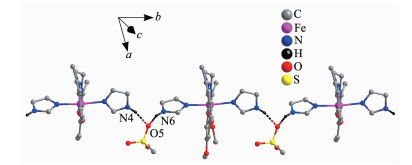
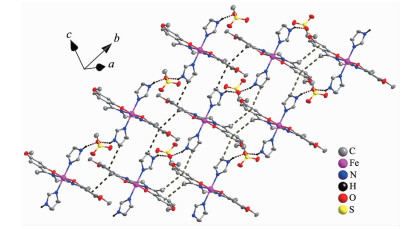
As designed, H-bonds are found in the structure between the imidazole molecules of the cationic motifs and the CH3SO3- anions. As shown in Fig. 2, we can see that one-dimensional (1D) H-bond connected chains along the b axis are formed for 1. Specifically, one CH3SO3- anion bridges two adjacent [FeⅢ(Him)2(4-MeOhapen)]+ cations by the N-H…O H-bonds between the O5 atom from the CH3SO3- anion and the N4-H4 and N6-H6 groups from the imidazole molecules. The details of these two H-bonds are listed in Table 3. We can see that these two H-bonds are of moderate strength with relatively short N…O distances (~0.28 nm). In addition, these 1D H-bonded chains are connected to each other with weak supramolecular interactions such as the weak N-H…π and C-H…π interactions with the N…π and C…π distances being around 0.36 to 0.38 nm (Fig. 3).
下载:
导出CSV
| D-H…A | d(D…A) / nm | d(H…A) / nm | ∠D-H…A / (°) |
| N(4)-H(4)…O(5) | 0.279 70(69) | 0.194 49(45) | 162.709(312) |
| N(6)-H(6)…O(5) | 0.280 87(58) | 0.200 77(35) | 150.669(331) |
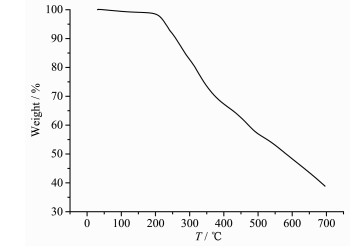
To determine the thermal stability of compound 1, its thermal behavior was investigated under nitrogen atmosphere by TGA. As shown in Fig. 4, the TGA curve of compound 1 revealed that 1 was stable up to about 200 ℃. After that, it decomposed upon further heating. This result confirmed the stability of 1 and is consistent with the fact that there is no crystallized solvent molecule in 1.
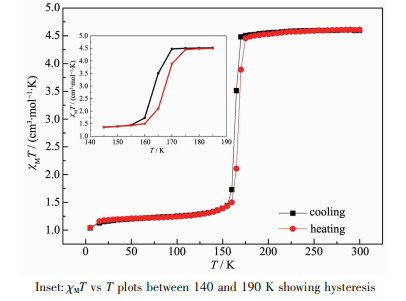
Temperature dependent molar magnetic suscepti-bility data ( χM) of 1 were measured on the grounded single crystals under an applied dc magnetic field of 1 000 Oe. The data were measured on lowering the temperature from 300 to 5 K at the first run and subsequently on elevating the temperature from 5 to 300 K at the second run with a temperature sweep rate of 5 K·min-1. As can be seen from the plot of χMT versus T given in Fig. 5, a complete abrupt spin transition between the HS (S=5/2) and LS(S=1/2) states occurs for 1. At 300 K, the χMT value was 4.60 cm3·mol-1·K, consistent with a HS Fe(Ⅲ) center with a g value of about 2.24[11, 13]. Upon cooling, the χMT value remained nearly constant until 170 K, where it decreased abruptly to 1.30 cm3·mol-1·K at 130 K, and finally reached 1.04 cm3·mol-1·K at 5 K. The transition temperature was T1/2↓=163 K. The low temperature value was significantly larger than 0.375 cm3·mol-1·K for a spin-only LS value. This observation might be due to the residue HS Fe(Ⅲ) centers at low temperature and is similar to the reported Fe(Ⅲ) SCO compounds[11, 13]. Upon heating, similar χMT versus T curve was observed with a slightly higher transition temperature of T1/2↑=167 K. Therefore, compound 1 undergoes an abrupt SCO transition with a thermal hysteresis loop of 4 K width.
Although compound 1 has the same [FeⅢ(Him)2(4-MeOhapen)]+ cation with the reported [FeⅢ(Him)2 (4-MeOhapen)]·PF6 and [FeⅢ(Him)2(4-MeOhapen)]·CF3SO3 compounds, their SCO properties are consi-derably different[11, 13]. While compound 1 has an abrupt spin transition with a thermal hysteresis loop, [FeⅢ(Him)2(4-MeOhapen)]·PF6 showed a gradual spin equilibrium between the HS and LS states; and [FeⅢ(Him)2(4-MeOhapen)]·CF3SO3 showed a spin-transition between 4HS and HS-HS-HS-LS states. They also have different transition temperatures. These differences should be originated from the different counter anions (CH3SO3-, CF3SO3- and PF6-) and the resulted H-bond patterns. Although all three compounds have similar chain structures constructed by H-bonds between the anions and axial imidazole molecules, the H-bond strengths and patterns are different between compound 1 and the other two compounds. The N…O distances in 1 are shorter compared to the N…O distances in [FeⅢ(Him)2(4-MeOhapen)]·CF3SO3 and N…F distances in [FeⅢ(Him)2(4-MeOhapen)]·PF6 just as anticipated (Table 4). More importantly, in 1, the H-bond between the imidazole and CH3SO3- anion along the chain has a much shorter [N-H…O…H-N] bridging pattern, while in the other two compounds, the H-bonds have longer patterns: [N-H…O-S-O…H-N] with CF3SO3- anion and [N-H…F-P-F…H-N] with PF6- anion. The shorter bridging pattern in 1 involving only one O atom is more rigid and more efficient to transfer the elastic interactions between the two [FeⅢ(Him)2(4-MeOhapen)]+ cations. We believe this is res-ponsible for the higher cooperativity in 1.
下载:
导出CSV
| [FeⅢ(Him)2(4-MeOhapen)]·CF3SO3 (150 K)* | ||||
| A | B | C | D | |
| N(4)…O(5) | 0.271 8(15) | 0.280 8(14) | 0.282 7(15) | 0.280 8(14) |
| N(6)…O(7) | 0.290 3(14) | 0.287 8(14) | 0.287 3(14) | 0.289 1(14) |
| [FeⅢ(Him)2(4-MeOhapen)]·PF6 (170 K) | ||||
| N(4)…F(1) | 0.292 1(6) | |||
| N(6)…F(3) | 0.304 7(6) | |||
In summary, we have successfully synthesized and characterized one new Fe(Ⅲ) SCO compound based on a tetradentate Schiff base ligand. Hydrogen-bonded chain structure was formed by the hydrogen bonds between the cations and the anions. This compound exhibits an abrupt spin transition with a 4 K thermal hysteresis at around 160 K. The hydrogen bonds between the cations and the anions are believed to be responsible for its abrupt SCO transition. New Fe(Ⅲ) SCO compounds with different organosulfonate anions and hydrogen bonds are pursued in our lab.
Gütlich P, Goodwin H A. Spin Crossover in Transition Metal Compounds: Vol.1/2/3. Berlin: Springer Verlag, 2004.
Halcrow M A. Spin Crossover Materials: Properties and Applications. New York: Wiley, 2013.
Gatteschi D, Sessoli R, Villain J. Molecular Nanomagnets. Oxford, U.K.: Oxford University Press, 2006.
Woodruff D N, Winpenny R E P, Layfield R A. Chem. Rev., 2013, 113:5110-5148 doi: 10.1021/cr400018q
Li T, Tan G W, Shao D, et al. J. Am. Chem. Soc., 2016, 138:10092-10095 doi: 10.1021/jacs.6b05863
Fujita W, Awaga K. Science, 1999, 286:261-262 doi: 10.1126/science.286.5438.261
Sato O. Nature Chemistry, 2016, 8:644-656 doi: 10.1038/nchem.2547
Brooker S. Chem. Soc. Rev., 2015, 44:2880-2892 doi: 10.1039/C4CS00376D
Harding D J, Harding P, Phonsri W. Coord. Chem. Rev., 2016, 313:38-61 doi: 10.1016/j.ccr.2016.01.006
Nihei M, Shiga T, Maeda Y, et al. Coord. Chem. Rev., 2007, 251:2606-2621 doi: 10.1016/j.ccr.2007.08.007
Miyano K, Nishida T, Ono H, et al. Inorg. Chim. Acta, 2016, 439:49-54 doi: 10.1016/j.ica.2015.09.031
Hanahara K, Ono H, Fujinami T, et al. Inorg. Chim. Acta, 2015, 429:93-98 doi: 10.1016/j.ica.2015.01.047
Fujinami T, Ikeda M, Koike M, et al. Inorg. Chim. Acta, 2015, 432:89-95 doi: 10.1016/j.ica.2015.03.034
Fujinami T, Hamada D, Matsumoto N, et al. Inorg. Chim. Acta, 2015, 430:239-244 doi: 10.1016/j.ica.2015.03.008
Fujinami T, Koike M, Matsumoto N, et al. Inorg. Chem., 2014, 53:2254-2259 doi: 10.1021/ic402947u
Koike M, Murakami K, Fujinami T, et al. Inorg. Chim. Acta, 2013, 399:185-192 doi: 10.1016/j.ica.2013.01.021
Weber B, Bauer W, Obel J. Angew. Chem. Int. Ed., 2008, 47:10098-10101 doi: 10.1002/anie.200802806
Zhao X H, Zhang S L, Shao D, et al. Inorg. Chem., 2015, 54:7857-7867 doi: 10.1021/acs.inorgchem.5b00870
Shen F X, Pi Q, Shi L, et al. Dalton Trans., 2019, 48:8815-8825 doi: 10.1039/C9DT01326A
SAINT, Ver. 7.68A, Bruker AXS, Inc., Madison, WI, 2009.
Sheldrick G M. SADABS, Ver.2008/1, Bruker AXS, Inc., Madison, WI, 2008.
Sheldrick G M. SHELXTL, Ver.6.14, Bruker AXS, Inc., Madison, WI, 2000~2003.
Dolomanov O V, Bourhis L J, Gildea R J, et al. J. Appl. Crystallogr., 2009, 42:339-341 doi: 10.1107/S0021889808042726
Kennedy B J, McGrath A C, Murray K S, et al. Inorg. Chem., 1987, 26:483-495 doi: 10.1021/ic00251a003

Figure 5 Temperature dependent χMT plots for compound 1 in the temperature region of 5 to 300 K
Table 1. Crystal data and structure refinement for compound 1
| Empirical formula | C27H33FeN6O7S | Z | 2 | |
| Formula weight | 641.5 | Dc / (g·cm-3) | 1.443 | |
| Temperature / K | 190.06 | μ / mm-1 | 3.484 | |
| Crystal system | Triclinic | F(000) | 670 | |
| Space group | P1 | Index ranges | -11 ≤ h ≤ 11, -14 ≤ k ≤ 14, -16 ≤ l ≤ 15 | |
| a / nm | 0.972 15(4) | Reflection collected | 13 519 | |
| b / nm | 1.235 31(5) | Independent reflection | 5 156 (Rint=0.067 7, Rσ=0.079 5) | |
| c / nm | 1.374 92(5) | Data, restraint, parameter | 5 156, 0, 384 | |
| α / (°) | 79.059(2) | Goodness-of-fit on F2 | 1.1 | |
| β / (°) | 72.768(2) | Final R indexes [I≥2σ(I)] | R1=0.086 9, wR2=0.249 3 | |
| γ / (°) | 70.230(2) | Final R indexes (all data) | R1=0.099 7, wR2=0.262 7 | |
| V / nm3 | 1.476 69(10) |
 下载: 导出CSV
Table 2. Selected bond distances (nm) and bond angles (°) for compound 1
| Fe(1)-N(1) | 0.210 3(4) | Fe(1)-N(3) | 0.214 9(4) | Fe(1)-O(1) | 0.189 0(3) |
| Fe(1)-N(2) | 0.210 5(4) | Fe(1)-N(5) | 0.215 9(4) | Fe(1)-O(2) | 0.189 1(3) |
| N(1)-Fe(1)-N(2) | 81.97(15) | N(3)-Fe(1)-N(5) | 174.47(15) | O(1)-Fe(1)-O(2) | 100.51(14) |
| N(1)-Fe(1)-N(3) | 86.66(15) | O(1)-Fe(1)-N(1) | 88.57(15) | O(2)-Fe(1)-N(1) | 170.90(15) |
| N(1)-Fe(1)-N(5) | 89.48(15) | O(1)-Fe(1)-N(2) | 170.54(13) | O(2)-Fe(1)-N(2) | 88.94(14) |
| N(2)-Fe(1)-N(3) | 88.93(16) | O(1)-Fe(1)-N(3) | 90.75(16) | O(2)-Fe(1)-N(3) | 93.55(15) |
| N(2)-Fe(1)-N(5) | 86.60(16) | O(1)-Fe(1)-N(5) | 93.13(15) | O(2)-Fe(1)-N(5) | 89.63(15) |
下载: 导出CSV
Table 3. Hydrogen bond parameters for compound 1
| D-H…A | d(D…A) / nm | d(H…A) / nm | ∠D-H…A / (°) |
| N(4)-H(4)…O(5) | 0.279 70(69) | 0.194 49(45) | 162.709(312) |
| N(6)-H(6)…O(5) | 0.280 87(58) | 0.200 77(35) | 150.669(331) |
下载: 导出CSV
Table 4. Hydrogen bond distances (nm) in [FeⅢ(Him)2 (4-MeOhapen)]·CF3SO3 and [FeⅢ(Him)2 (4-MeOhapen)]·PF6
| [FeⅢ(Him)2(4-MeOhapen)]·CF3SO3 (150 K)* | ||||
| A | B | C | D | |
| N(4)…O(5) | 0.271 8(15) | 0.280 8(14) | 0.282 7(15) | 0.280 8(14) |
| N(6)…O(7) | 0.290 3(14) | 0.287 8(14) | 0.287 3(14) | 0.289 1(14) |
| [FeⅢ(Him)2(4-MeOhapen)]·PF6 (170 K) | ||||
| N(4)…F(1) | 0.292 1(6) | |||
| N(6)…F(3) | 0.304 7(6) | |||
下载: 导出CSV

 扫一扫看文章


扫一扫关注我们