Table 1.
Crystallographic data for compounds 1 and 2

Synthesis and Characterization of Two Organic-Inorganic Hybrid Copper(Ⅱ) Compounds with the Reversible Thermochromism
Ming-Li LI , Xiu-Xiu ZHANG , Wen-Jun RAO , Zhen-Hong WEI , Ling-Yu WANG , Hu CAI


Thermochromism, the phenomenon of reversible change of color with change of temperature has been studied for decades due to their potential applications in the smart windows, temperature sensors, visual thermometers and solar control glazing[1-6]. In past years, immense efforts have been devoted to preparation an extensive range of novel thermochromic material classes, including the conventional inorganic solids like vanadium dioxide[7], hydrogels[8], polymers[9-10], syn-thetic dyes[11], organic crystals[12], coordination compl-exes[13-14], and organic-inorganic hybrid compounds[15-16].
Among these different kinds of thermochromic materials, organic-inorganic hybrid compounds have received extraordinary research attention because of their structural advantages[17-18]. In these hybrids, the presences of inorganic components supply excellent electronic properties and mechanical and thermal stability, and the organic components ensure structural flexibility and synthetic versatility[19-20]. Detailed studies on the reversible thermochromic properties of organic-inorganic hybrid compounds revealed the origins were most attributed to the change of coordination geometry, bond breakage/formation, dynamic structural change, charge transfer, and mode of coordinating ligand[21].
On the other hand, temperature-induced reversible phase transitions have been common observed in the copper(Ⅱ) organic-inorganic complexes[22-25], which were mostly caused by the change in coordination number and coordination geometry[26-28]. This is because that the color is limited by the energy of d-d electronic transitions of central Cu2+ ion in organic-inorganic Cu(Ⅱ) halide system, where the color change generally in the range from green to red, including green to yellow, yellow to brown and yellow to red[29-31]. For examples, the known organic-inorganic hybrid compounds [(C2H5)2 NH2]CuCl4[32], [(2-aminobenzothiazolium)2]CuCl4[33] and [DMe-DABCO]CuCl4 (N, N′-dimethyl-1, 4-diazoniabicy-clo[2.2.2]-octonium)[34] have been reported to exhibit reversible thermochromism.
In this paper, two spherical organic molecules 1-amino-1, 4-diazabicyclo[2.2.2]octane-1, 4-diium iodide ([2.2.2-NH2dabco]I) and N, N-dimethyl-1, 5-diazabicyclo[3.2.1]octane iodide ([3.2.1-Me2dabco]I2) were synthes-ized and chosen to react with CuCl2, and finally led to the formation of tetrahedrally coordinated organic-inorganic hybrid compounds [3.2.1-Me2dabco][CuCl4] (1) and [2.2.2-NH2dabco][CuCl4] (2). Herein, we report the crystal structure and reversible thermochromism of 1 and 2.
The starting materials anhydrous CuCl2, 1, 4-diazabicyclo[2.2.2]octane, 1, 5-diazabicyclo[3.2.1]octane and the concentrated hydrochloric acid are commercially available and used without further purification. 1-Amino-1, 4-diazabicyclo[2.2.2]octane-1, 4-diium iodide ([2.2.2-NH2dabco]I)[35] and N, N-dimethyl-1, 5-diazabicyclo[3.2.1]octane iodide ([3.2.1-Me2dabco]I2)[36] were synthesized according the reported literatures. Powder X-ray diffraction data of 1 and 2 were recorded on an X-ray powder diffractometer (Beijing Persee Instrument Co., Ltd. XD-3) with Cu Kα radiation (λ=0.154 06 nm) operating at 40 kV/15 mA with a Kβ foil filter at a speed of 2°·min-1 in a range of 5.00° ≤ 2θ ≤ 55.00°. Elemental analysis of C, H and N were conducted on a Vario EL III elemental analyzer.
To a 40 mL methanol solution of 1, 5-diazabicyclo[3.2.1]octane (4 g, 36 mmol) was dropwise added CH3I (76 mmol, 10.5 mL). After addition, the reaction was refluxing for 3.5 hours, and led to the formation of gray precipitate, which was isolated by filtration and washed with hot ethyl acetate, dried in vacuo. Yield: 1.6 g, 95%. 1H NMR (400 MHz, D2O): δ 5.35 (s, 2H), 4.45 (d, J=6.7 Hz, 2H), 4.24 (dd, J=16.1, 11.0 Hz, 2H), 4.10~3.85 (m, 4H), 3.55 (s, 6H), 2.79 (m, J=25.6, 19.3, 12.8, 6.5 Hz, 1H), 2.55 (d, J=16.4 Hz, 1H).
To an aqueous solution (20 mL) of 2.2.2-dabco (16.80 g, 150.0 mmol) was dropwise added an aqueous solution (10 mL) of H2NOSO3H (5.65 g, 50.0 mmol) at the temperature of 90 ℃ under the N2 atmosphere. After the mixture was cooled to room temperature, K2CO3 (6.90 g, 50.0 mmol) was added. The resulting mixture was stirring for 10 minutes, then the solvent was removed by vacuum-rotary evaporation, and the crude residue was washed by tetrahydrofuran (THF) for 3 times. The residue was collected and dissolved in 30 mL EtOH, and K2CO3 was removed by filtration. The filtrate was acidized by the addition of 7.0 mL hydriodic acid (11.0 g, 57%(w/w)). The reaction mixture was allowed to be stirring at -30 ℃ for 1 hour to give pale-yellow precipitates, which were filtered and washed with EtOH to afford the desired product as a white solid. Yield: 6.5 g, 34%. 1H NMR (400 MHz, D2O): δ 3.87~3.78 (m, 6H), 3.67~3.58 (m, 6H); 13C NMR (100 MHz, D2O): δ 56.4, 44.7.
To an aqueous solution of [3.2.1-Me2dabco]I2 (1.98 g, 5 mmol) was added Ag2CO3 (0.7 g, 2.54 mmol) solid. The mixture was kept stirring for 2 hours and filtered. The filtrate was acidized with 8 mL hydro-chloric acid (36%(w/w)), and anhydrous CuCl2 (0.67 g, 5 mmol) was added. The yellow block crystal was obtained by volatilizing the solution at 40 ℃ for three days. Yield: 2.69 g, 80%. Anal. Calcd. for C8H16N2 CuCl4(%): C, 27.81; H, 4.67; N, 8.11. Found(%): C, 28.12; H, 4.45; N, 8.28.
To a concentrated HCl aqueous solution (10 mL, 36%) was added [2.2.2-NH2dabco]I (2.55 g, 10.0 mmol) and anhydrous CuCl2 (1.35 g, 10.0 mmol). Evaporation of the solution gave the yellow rod-like crystals at room temperature in three days. The crystals were filtered and washed with ethanol and dried in vacuo. Yield: 2.51 g, 75%. Anal. Calcd. for C6H15N3CuCl4(%): C, 21.54; H, 4.52; N, 12.56. Found(%): C, 21.25; H, 4.32; N, 13.02.
Diffraction data of the single crystals with dimensions of 0.14 mm×0.18 mm×0.15 mm for 1 and 0.26 mm×0.10 mm×0.12 mm for 2 were collected on a Bruker SMART CCD area detector diffractometer with graphite monochromated Mo Kα radiation (λ=0.071 073 nm). The crystal structures were solved by direct methods using SHELXL[37]. Non-hydrogen atoms were first refined isotropically followed by anisotropic refinement by full matrix least-squares calculations based on F 2. Hydrogen atoms on carbon and nitrogen atoms were placed in idealized positions and treated as riding atoms. Crystal data and structure refinement results of compounds 1 and 2 were summarized in Table 1.
 下载:
导出CSV
| Compound | 1 | 2 |
| Formula | C8H16N2CuCl4 | C6H15N3CuCl4 |
| Formula weight | 345.58 | 334.56 |
| Crystal system | Monoclinic | Monoclinic |
| Space group | P21 | P21/c |
| a / nm | 0.730 21(7) | 0.847 21(10) |
| b / nm | 1.399 02(14) | 1.112 84(12) |
| c / nm | 0.755 73(7) | 1.337 36(16) |
| β / (°) | 115.626 0(10) | 92.399(2) |
| V / nm3 | 0.696 10(12) | 1.259 8(3) |
| Z | 2 | 4 |
| Dc / (g·cm-3) | 1.649 | 1.764 |
| F(000) | 350 | 676 |
| θmax | 26.66 | 27.51 |
| μ / mm-1 (Mo Kα) | 2.308 | 2.549 |
| Total reflections | 4 262 | 7 394 |
| Unique refections | 2 991 | 2 860 |
| No. of variables | 136 | 136 |
| R1, wR2 (observed data) | 0.029 0, 0.060 9 | 0.028 4, 0.069 5 |
| R1, wR2 (all data) | 0.034 3, 0.063 0 | 0.032 9, 0.072 1 |
| GOF | 0.958 | 1.105 |
CCDC: 1983284, 1; 1983282, 2.
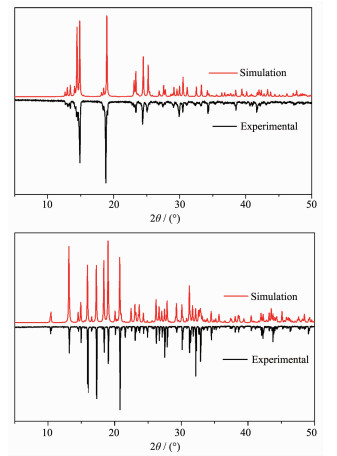
The two caged organic amines [3.2.1-Me2dabco]I2 and [2.2.2-NH2dabco]I were synthesized according to the literatures with little modifications[35-36], and their corresponding organic-inorganic hybrid copper(Ⅱ) compounds [3.2.1-Me2dabco][CuCl4] (1) and [2.2.2-NH2dabco][CuCl4] (2) were obtained by reactions with CuCl2 on the basis of molar ratio of 1:1 in concentrated hydrochloric acid. Their phase purities were verified using the elemental analysis (EA) and powder X-ray diffraction (PXRD) patterns. As shown in Fig. 1, the experimental PXRD curves of 1 and 2 were matched very well with the simulated ones in terms of the single-crystal X-ray data.
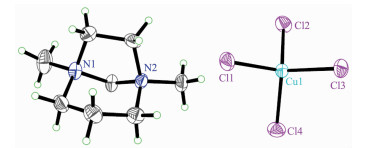
Compound 1 crystallizes in the monoclinic system with P21 space group, and the asymmetric unit contains one independent [CuCl4]2- anion and one [3.2.1-Me2dabco]2+ cation, as shown in Fig. 2. In the [3.2.1-Me2dabco]2+ cation, the two positive charges are supplied by two quaternary nitrogen atoms. In the [CuCl4]2- anion, the central Cu2+ ion adopts a tetrahedral geometry coordinated by four Cl- ions. As shown in Table 2, compound 1 has four independent Cu-Cl bond distances ranging from 0.221 62(17) to 0.223 05(11) nm and six independent bond angles ∠Cl-Cu-Cl varying from 100.28(4)° to 128.28(4)°, indicating a slightly distortion of the [CuCl4]2- tetra-hedron in 1.
 下载:
导出CSV
| 1 | |||||
| Cu1-Cl1 | 0.223 45(9) | Cu1-Cl3 | 0.223 37(9) | ||
| Cu1-Cl2 | 0.223 26(9) | Cu1-Cl4 | 0.224 84(9) | ||
| Cl2-Cu1-Cl3 | 100.28(4) | Cl3-Cu1-Cl1 | 128.23(4) | Cl3-Cu1-Cl4 | 102.01(4) |
| Cl2-Cu1-Cl1 | 101.43(4) | Cl2-Cu1-Cl4 | 128.28(4) | Cl1-Cu1-Cl4 | 100.18(4) |
| 2 | |||||
| Cu1-Cl1 | 0.223 28(6) | Cu1-Cl3 | 0.225 22(6) | ||
| Cu1-Cl2 | 0.226 13(6) | Cu1-Cl4 | 0.226 19(6) | ||
| Cl2-Cu1-Cl3 | 130.39(2) | Cl3-Cu1-Cl1 | 101.29(2) | Cl3-Cu1-Cl4 | 97.79(2) |
| Cl2-Cu1-Cl1 | 100.16(2) | Cl2-Cu1-Cl4 | 101.11(2) | Cl1-Cu1-Cl4 | 130.63(3) |
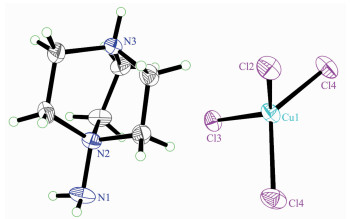
Compound 2 crystallizes in the monoclinic system with a space group of P21/c and the asymmetric unit contains one protonated [2.2.2-NH2dabco]2+ cation and one [CuCl4]2- anion, as shown in Fig. 3. In the [2.2.2-NH2dabco]2+ cation, only the tertiary amine nitrogen atom N(3) is protonated, and the primary amine nitrogen N(1) can′t be protonated. The two positive charges in [2.2.2-NH2dabco]2+ cation are expressed by one quaternary nitrogen atom N(2) and one tertiary protonated N(3) atom. Similar to compound 1, the metal center Cu2+ ion in the [CuCl4]2- anion is also tetrahed-rally coordinated by four Cl- ions. As shown in Table 2, the Cu-Cl bond lengths in compound 2 varied from 0.223 28(6) to 0.226 19(6) nm, and the bond angles ∠Cl-Cu-Cl range from 97.79(2)° to 130.63(3)°, which are larger than the corresponding ones in compound 1, revealing the [CuCl4]2- tetrahedron in compound 2 is slightly distorted than that in compound 1.
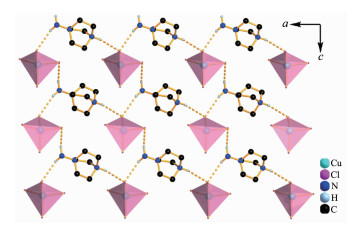
In compound 1, there is no hydrogen bond between the cation and the [CuCl4]2- anion, and the ∠Cl-Cu-Cl angles are less than 130°. While, in compound 2 the cations and anions are connected by three kinds of N-H…Cl hydrogen bonds extending indefinitely in the two-dimensional (2D) ac plane as shown in the Fig. 4. Due to the existing of N-H…Cl hydrogen bonding (Table 3), the maximum ∠Cl-Cu-Cl angle of 130.63(3)° in compound 2 is slightly larger than 130°.
下载:
导出CSV
| D-H…A | d(D-H) / nm | d(H…A) / nm | d(D…A) / nm | ∠DHA / (°) |
| N(1)ⅰ-H(1c)…Cl(4) | 0.095(3) | 0.267(3) | 0.355 6(2) | 155(3) |
| N(1)ⅱ-H(1e)…Cl(2) | 0.089(3) | 0.256(3) | 0.339 1(2) | 156(3) |
| N(3)ⅲ-H(3c)…Cl(2) | 0.091 | 0.258 | 0.329 80(17) | 136 |
| Symmetry codes: ⅰ 2-x, -1/2+y, 1/2-z; ⅱ 2-x, 1-y, 1-z; ⅲ 1-x, 1-y, 1-z | ||||
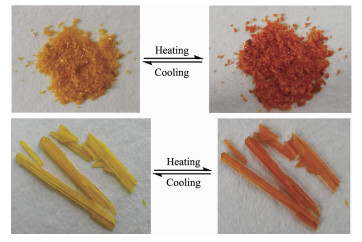
Interestingly, the crystals 1 and 2 both exhibited yellow color at room temperature. When the temperature exceeds 60 ℃, the yellow crystals 1 and 2 gradually changed from yellow into red. Conversely, the red crystals were reversed to yellow completely upon cooling to room temperature in just few minutes, exhibiting reversible thermochromism, in Fig. 4. To our best knowledge, thermochromism is commonly seen in other tetrahedrally coordinated Cu(Ⅱ) halides, where the Cu2+ ion has the 3d9 electronic configuration, and the d-level is not completely filled[38-39]. Consequently, there are d-d electronic transitions within the 3d9 electronic configuration. Since the position of the absorption maximum for the d-d transition is correlated with the coordination geometry of central Cu2+ ion, the deformation of Cu(Ⅱ) halide polyhedron in the structure will cause the shift of electronic absorption bands, which induces the color change of organic-inorganic Cu(Ⅱ) halides. Therefore, in 1 and 2, the remarkable deformation of [CuCl4]2- tetrahedron is responsible for the yellow-to-red color change.
In summary, reactions of N, N-dimethyl-1, 5-diazabicyclo[3.2.1]octane iodide ([3.2.1-Me2dabco]I2) and 1-amino-1, 4-diazabicyclo[2.2.2]octane iodide ([2.2.2-NH2dabco]I) with anhydrous CuCl2 led to two organic-inorganic hybrid compounds [3.2.1-Me2dabco][CuCl4] (1) and [2.2.2-NH2dabco][CuCl4] (2) which were characterized by element analysis, single X-ray diffraction and powder X-ray diffraction. Crystals 1 and 2 showed reversible thermochromism, and the deformation of [CuCl4]2- tetrahedron was responsible for the yellow to red color change.
Ma X H. Chin. J. Chem., 2019, 37:1287-1288 doi: 10.1002/cjoc.201900373
Pitchaimani J, Karthikeyan S, Lakshminarasimhan N, et al. ACS Omega, 2019, 4:13756-13761 doi: 10.1021/acsomega.9b01263
Sun B, Liu X F, Li X Y, et al. Angew. Chem. Int. Ed., 2020, 59:203-208 doi: 10.1002/anie.201910701
Yu T L, Guo Y M, Wu G X, et al. Coord. Chem. Rev., 2019, 397:91-111 doi: 10.1016/j.ccr.2019.06.006
Li G P, Hao P F, Shen J J, et al. Inorg. Chem., 2016, 55:11342-11347 doi: 10.1021/acs.inorgchem.6b01906
Sun B, Liu X F, Li X Y, et al. Angew. Chem. Int. Ed., 2020, 59:203-208 doi: 10.1002/anie.201910701
Guan S, Souquet-Basiege M, Toulemonde O, et al. Chem. Mater., 2019, 31:9819-9830 doi: 10.1021/acs.chemmater.9b03906
Nakamitsu M, Imai H, Oaki Y, et al. ACS Sensors, 2020, 5:133-139 doi: 10.1021/acssensors.9b01900
Soreno Z V, Puguan J M C, Kim H, et al. Mater. Chem. Phys., 2020, 240:122297 doi: 10.1016/j.matchemphys.2019.122297
Turchetti D A, Santana A J, Duarte L G T A, et al. Polymer, 2019, 177:65-72 doi: 10.1016/j.polymer.2019.05.069
Zhang W, Ji X, Peng B J, et al. Adv. Funct. Mater., 2020, 30:1906463 doi: 10.1002/adfm.201906463
Zhang W, Ji X, Chen K, et al. Prog. Org. Coat., 2019, 137:105280 doi: 10.1016/j.porgcoat.2019.105280
Liao W M, Li X N, Zeng Q, et al. J. Mater. Chem. C, 2019, 7:15136-15140 doi: 10.1039/C9TC05996B
Shakirova O, Protsenko A, Protsenko A, et al. Inorg. Chim. Acta, 2020, 500:119246 doi: 10.1016/j.ica.2019.119246
Ajeeb Y H, Minchenya A A, Klimovich P G, et al. J. Appl. Spectrosc., 2019, 86:788-794 doi: 10.1007/s10812-019-00894-2
Wang P, Chen Z R, Li H H, et al. Chinese J. Struct. Chem., 2019, 38:1485-1493
Hao P, Wang W, Shen J, et al. Dalton Trans., 2020, 49:1847-1853 doi: 10.1039/C9DT04818A
Liu G N, Xu R D, Zhao R Y, et al. ACS Sustainable Chem. Eng., 2019, 7:18863-18873 doi: 10.1021/acssuschemeng.9b03963
Taylor W V, Cammack C X, Shubert S A, et al. Inorg. Chem., 2019, 58:16330-16345 doi: 10.1021/acs.inorgchem.9b00229
Zhang Y, Tso C Y, Inigo J S, et al. Appl. Energy, 2019, 254:113690 doi: 10.1016/j.apenergy.2019.113690
Tom L, Kurup M R P. Dalton Trans., 2019, 48:16604-16614 doi: 10.1039/C9DT02820J
Jonane I, Anspoks A, Aquilanti G, et al. Acta Mater., 2019, 179:26-35 doi: 10.1016/j.actamat.2019.06.034
Mande H M, Ghalsasi P S, Navamoney A. Polyhedron, 2015, 91:141-149 doi: 10.1016/j.poly.2015.02.036
Troyano J, Zapata E, Perles J, et al. Inorg. Chem., 2019, 58:3290-3301 doi: 10.1021/acs.inorgchem.8b03364
Yang K, Li S L, Zhang F Q, et al. Inorg. Chem., 2016, 55:7323-7325 doi: 10.1021/acs.inorgchem.6b00922
Bloomquist D R, Willett R D. Coord. Chem. Rev., 1982, 47:125-164 doi: 10.1016/0010-8545(82)85012-1
Bloomquist Darrell R, Pressprich Mark R, Willett Roger D, et al. J. Am. Chem. Soc., 1988, 110:7391-7398 doi: 10.1021/ja00230a020
Fu Z X, Lin J, Wang L, et al. Cryst. Growth Des., 2016, 16:2322-2327 doi: 10.1021/acs.cgd.6b00114
Gupta S, Pandey T, Singh A K. Inorg. Chem., 2016, 55:6817-6824 doi: 10.1021/acs.inorgchem.6b01186
Huitorel B, El Moll H, Utrera-Melero R, et al. Inorg. Chem., 2018, 57:4328-4339 doi: 10.1021/acs.inorgchem.7b03160
Taylor W V, Cammack C X, Shubert S A, et al. Inorg. Chem., 2019, 58:16330-16345 doi: 10.1021/acs.inorgchem.9b00229
Landee C P, Roberts S A, Willett R D. J. Chem. Phys., 1978, 68:4574-4577 doi: 10.1063/1.435562
Vishwakarma A K, Kumari R, Ghalsasi P S, et al. J. Mol. Struct., 2017, 1141:93-98 doi: 10.1016/j.molstruc.2017.03.076
Liu J C, Liao W Q, Li P F, et al. Angew. Chem. Int. Ed., 2020, 59:3495-3499 doi: 10.1002/anie.201914193
Liu X X, Zhu Q, Chen D, et al. Angew. Chem. Int. Ed., 2020, 59:2745-2749 doi: 10.1002/anie.201913388
Anderson J E, Cai J Q, Davies A G. J. Chem. Soc., Perkin Trans. 2, 1997, 2:2633-2637
Sheldrick G M. Acta Crystallogr. Sect. C-Struct. Chem., 2015, 71:3-8 doi: 10.1107/S2053229614024218
Bloomquist D R, Willett R D. J. Am. Chem. Soc., 1981, 103:2615-2619 doi: 10.1021/ja00400a022
Mande H M, Ghalsasi P S, Navamoney A. Polyhedron, 2015, 91:141-149 doi: 10.1016/j.poly.2015.02.036

Figure 1 PXRD patterns of compounds 1 (above) and 2 (below) with the simulated one in red and the experimental one in black

Figure 2 Crystal structures of 1 in the asymmetric unit with the displacement ellipsoids drawn at the 50% probability level

Figure 3 Crystal structures of 2 in the asymmetric unit with the displacement ellipsoids drawn at the 50% probability level
Table 1. Crystallographic data for compounds 1 and 2
| Compound | 1 | 2 |
| Formula | C8H16N2CuCl4 | C6H15N3CuCl4 |
| Formula weight | 345.58 | 334.56 |
| Crystal system | Monoclinic | Monoclinic |
| Space group | P21 | P21/c |
| a / nm | 0.730 21(7) | 0.847 21(10) |
| b / nm | 1.399 02(14) | 1.112 84(12) |
| c / nm | 0.755 73(7) | 1.337 36(16) |
| β / (°) | 115.626 0(10) | 92.399(2) |
| V / nm3 | 0.696 10(12) | 1.259 8(3) |
| Z | 2 | 4 |
| Dc / (g·cm-3) | 1.649 | 1.764 |
| F(000) | 350 | 676 |
| θmax | 26.66 | 27.51 |
| μ / mm-1 (Mo Kα) | 2.308 | 2.549 |
| Total reflections | 4 262 | 7 394 |
| Unique refections | 2 991 | 2 860 |
| No. of variables | 136 | 136 |
| R1, wR2 (observed data) | 0.029 0, 0.060 9 | 0.028 4, 0.069 5 |
| R1, wR2 (all data) | 0.034 3, 0.063 0 | 0.032 9, 0.072 1 |
| GOF | 0.958 | 1.105 |
 下载: 导出CSV
Table 2. Selected bonds (nm) and angles (°) for 1 and 2
| 1 | |||||
| Cu1-Cl1 | 0.223 45(9) | Cu1-Cl3 | 0.223 37(9) | ||
| Cu1-Cl2 | 0.223 26(9) | Cu1-Cl4 | 0.224 84(9) | ||
| Cl2-Cu1-Cl3 | 100.28(4) | Cl3-Cu1-Cl1 | 128.23(4) | Cl3-Cu1-Cl4 | 102.01(4) |
| Cl2-Cu1-Cl1 | 101.43(4) | Cl2-Cu1-Cl4 | 128.28(4) | Cl1-Cu1-Cl4 | 100.18(4) |
| 2 | |||||
| Cu1-Cl1 | 0.223 28(6) | Cu1-Cl3 | 0.225 22(6) | ||
| Cu1-Cl2 | 0.226 13(6) | Cu1-Cl4 | 0.226 19(6) | ||
| Cl2-Cu1-Cl3 | 130.39(2) | Cl3-Cu1-Cl1 | 101.29(2) | Cl3-Cu1-Cl4 | 97.79(2) |
| Cl2-Cu1-Cl1 | 100.16(2) | Cl2-Cu1-Cl4 | 101.11(2) | Cl1-Cu1-Cl4 | 130.63(3) |
下载: 导出CSV
Table 3. Hydrogen bonds in compound 2
| D-H…A | d(D-H) / nm | d(H…A) / nm | d(D…A) / nm | ∠DHA / (°) |
| N(1)ⅰ-H(1c)…Cl(4) | 0.095(3) | 0.267(3) | 0.355 6(2) | 155(3) |
| N(1)ⅱ-H(1e)…Cl(2) | 0.089(3) | 0.256(3) | 0.339 1(2) | 156(3) |
| N(3)ⅲ-H(3c)…Cl(2) | 0.091 | 0.258 | 0.329 80(17) | 136 |
| Symmetry codes: ⅰ 2-x, -1/2+y, 1/2-z; ⅱ 2-x, 1-y, 1-z; ⅲ 1-x, 1-y, 1-z | ||||
下载: 导出CSV

 扫一扫看文章


扫一扫关注我们