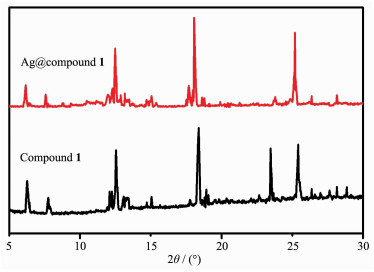
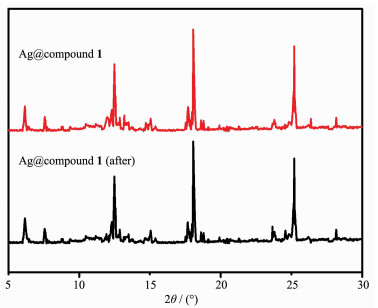
Figure 1.
PXRD Patterns of Ag@compound 1 and compound 1

Synthesis and Catalytic Properties of Co2+/Cd2+ Composite Materials
Dong-Ning LIU , Cui-Juan WANG , Yu-Mei XIAO , Cheng LIU , Dan LUO , Zi-Xin ZHU , Shuang CHEN , Yao-Yu WANG


Metal-organic frameworks (MOFs) have great potential in many applications[1-3], such as gas separa-tion and storage[4-9], sensing[10-13], adsorption[14-16], proton conduction[17-20] and drug delivery[21], due to their advantageous properties including structural diversity and large surface area[22-24]. MOFs have been used as carriers for metal nanoparticles for catalysis[25-28]. The use of MOFs as a carrier for noble metals generally increases the reaction rate[29-31]. However, the control of the reaction rate is often achieved by changing the catalyst loading, which may result in a lower utilization efficiency of the catalyst, resulting in waste of the precious metal catalyst. One of the strategies to overcome these shortcomings is to design a catalyst carrier that is similar in structure but functionally different, and the rate of reaction is regulated by the carrier.
The use of isomorphous metal doped MOFs can accomplish the above objectives[32]. MOFs doped or incorporated with another one or more metal centers have attracted much attention in recent years[33-35], because this kind of MOFs may enhance their particular activity[36-38]. However, few people have reported the effect of metal ions (Co2+/Cd2+) on the catalytic behavior of MOFs. Different central metal ions in MOFs play an important role in the catalytic reaction. In order to clarify the relationship, isomorphous metal doped MOFs with different central metal ions and different proportions of metal ions should be studied. In this way, the effects of the ligand can be easily eliminated. At the same time, it is convenient to find the relationship between the central metal ions and the corresponding effects of the reaction.
Here, we reported a series of MOFs doped as a catalyst carrier isomorphic metal, which were loaded into a Co2+/Cd2+ doped MOF by a simple immersion method. This process had been applied to five kinds of MOFs with different Co2+/Cd2+ ratios, and included five catalyst-loaded complexes (1~5). Powder diffraction showed no change in the crystal structure before and after catalyst loading. We showed that isomorphous metal doped MOF was a potential catalyst support that could be used to regulate the reaction rate of the system. We chose the reduction experiment of p-nitrophenol as the target reaction. The Ag@compound 1 catalyst with 14.2%(w/w) Ag had higher catalytic efficiency for the reaction, and the reaction rate decreased with the increased proportion of Co which even had a certain inhibitory effect. By increasing the loading of Ag from 14.2% to 47%(w/w)), the catalytic reaction rate can be greatly improved. Cyclic experiments and SEM showed that Ag@compound 1 had good cyclability, and still had 96% catalytic efficiency after 4 cycles of reaction with the structure of crystal unchanged.
Solvents, transition metal salts and ligand (Hpypymba=4-((3-(pyrazin-2-yl)-1H-pyrazol-1-yl)-methyl)benzoic acid) were of analytical grade. All chemicals were purchased from commercially available sources and used without further purification. The UV-Vis spectrum of the compounds were determined by UV-Vis spectroscopy (UV-1800). The powder X-ray diffraction (PXRD) measurements were obtained on D8 ADVANCE diffractometer using Cu Kα radiation (λ=0.154 18 nm), voltage of 40 kV, current of 40 mA, scanning range from 5° to 90°, step size of 0.02° and test speed of 0.1 s·step-1. The scanning electron microscope (SEM) were obtained on Hitachi S-4800 using acceleration voltage of 3 kV, and working distance of 8 mm.
Our previous work had successfully synthesized compounds 1~5, and it had been subjected to PXRD, scanning electron microscope (SEM), inductively coupled plasma (ICP) and thermogravimetric analysis (Fig.S1~S5), which proved that isomorphous metal doping compounds 1~5 had a similar structure and crystal form[39-40].
First, we added 25 mg of silver nitrate inorganic salt to a 5 mL aqueous solution to prepare a 5 mg·mL-1 silver nitrate aqueous solution, and then 10 mg of the synthesized MOFs were immersed in 3 mL aqueous solution of silver nitrate.
Second, the mixture was slowly stirred for 60 minutes, and then kept it stand for one day. After the MOFs were sufficiently contacted with the silver ions, they were centrifuged several times with pure aqueous solution to wash.
In the experiment, 4-NP was used as the catalyst to degrade the substrate. During the reaction, the change of the characteristic absorption peak of the reactants in the solution was observed to test the catalytic performance of Ag@compounds. The prepared Ag@compounds (5 mg) were added to 8 mL 1×10⁻⁴ mol·L-1 4-NP ethanol solution and 5 mg NaBH4, and the change in absorbance was monitored by UV-Vis. We studied the catalytic degradation of 4-NP by using catalyst-free and unsupported Ag ions as control experiment.
The prepared Ag@compound 1 was tested by PXRD (Fig. 1). The obtained PXRD pattern had a higher similarity to the pattern of compound 1, and the decrease of intensity at 22.5° may be related to the crystal lattice of Ag+. The prepared Ag@compound 1 had the same crystal structure as the initial one and had good chemical stability. The supernatant was collected and the sodium chloride solution was added dropwise thereto until the precipitate no longer increased. And we collected the resulting precipitate and calculated the loading of Ag. The newly prepared Ag@compounds were dried by low temperature to remove the aqueous solution.
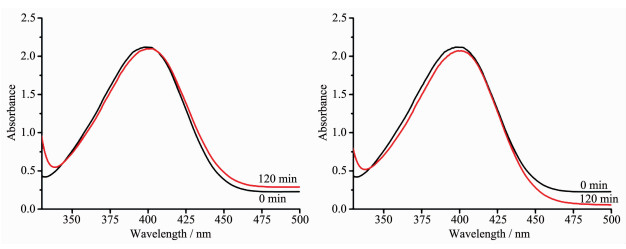
First, we studied the catalytic degradation of 4-NP by MOFs in the absence of any catalyst and without the inclusion of Ag+, respectively. The experi-mental results were shown in Fig. 2. The absorbance of the characteristic absorption peak of 4-NP before and after the reaction did not change significantly, indicating that the MOFs themselves had no catalytic degradation to 4-NP.
In addition to the inconsistencies in the central metal elements, complexes 1~5 had the same spatial structure, and they can be used as carriers for Ag+ to study the effect of the metal center of the complex on the catalysis.
According to the experimental protocol, a certain amount and concentration of 4-NP solution was added to monitor the change of absorbance. The UV-visible scan spectra of the supernatant were shown in Fig. 3. The catalytic reduction efficiency decreased gradually with the time. When Ag@compound 1(~14.2%(w/w)) was used as the catalyst, the intensity of the absorption peak at 400 nm was gradually reduced, and 60% of the substrate was reduced after 60 min (Fig. 3a). The catalytic effect of Ag@compound 1 was higher than other groups, but the reaction rate was significantly reduced, which may be related to the decrease of substrate concentration. After 120 min, the degradation of 4-NP was completed, which proved that Ag@compounds 1 had good catalytic degradation to 4-NP. At the same time, the degra-dation rate gradually decreased as the increase of Cd content in the structure. When Ag@compound 5 was used as the catalyst, 84% remained after 120 min (Fig. 3e). This further indicated that the Ag@compound 1 composite prepared by compound 1 and Ag+ had good catalytic degradation and showed that the composite had a high catalytic rate under low concentration of catalyst.
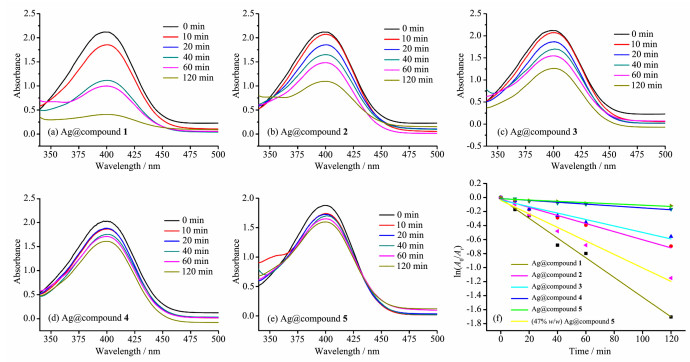
By comparison, it was found that the compound 1 was most suitable as a silver ion carrier when the silver ion loading was equivalent. In order to verify this inference, the silver ion loading of Ag@compounds was calculated by the precipitation method. The calculation results showed that the loading of compounds 1~5 on silver ions were basically the same (14.2%(w/w)).
Since the concentration of NaBH4 was much higher than the amount of the reaction substrate, the excess can be regarded as a constant amount, and the catalytic reaction can be regarded as a quasi-first-order reaction, and the expression for the reaction is (1):
|
$ \ln \left( {{A_t}/{A_0}} \right) = \ln \left( {{P_t}/{P_0}} \right) = - kt $ |
(1) |
Where k is the reaction rate constant, min-1; t is the catalytic reduction reaction time, min; P0 and Pt are the mass concentration of 4-NP at the initial reaction time and t, respectively; A0 and At are the absorbance of 4-NP at the initial reaction time and t, respectively.
Ag@compounds 1~5 had an Ag+ loading of 14.2% (w/w). The effect of different compounds excess on the catalytic reduction effect was shown in Fig. 3f. ln(At/A0) had a linear relationship with t in the case of equivalent silver ion loading in different MOFs materials, and the fitting degree was higher (0.98 or more); when the composite material was Ag@compound 1, the reaction rate constant was higher (0.014 min-1) compared with that of the Ag@compound 5 (0.000 9 min-1). The results showed that the catalytic effect of the complex of the central metal element being cobalt as the silver ion carrier on the degradation reaction was stronger than that of cadmium, which may be beneficial to the electron transfer in the reaction with the d-layer electron of the cobalt element.
The c omposite material with higher Ag+ loading obtained by treating MOFs with 3 mL of silver nitrate aqueous solution (10 mg·mL-1) was calculated to have a load of 47%(w/w) Ag+, and the composite was calculated as 47%(w/w) Ag@compounds 5. When the other catalytic conditions were the same, the catalytic reduction effect was shown in Fig. 3f. When the composite material was Ag@compounds 5, the reaction rate constant was 0.000 9 min-1, and after increasing the loading of Ag+ to 47%(w/w), the rate of catalytic reduction reached to 0.009 6 min-1, and the reaction rate increased significantly, indicating that increasing the loading of Ag+ was one of the ways to improve its catalytic efficiency. However, as the Ag+ loading increased, the composite material and the solution quickly turned black, affecting its recovery for recycling experiments. This indicated that it was advantageous to increase the loading of Ag+ within an appropriate range.
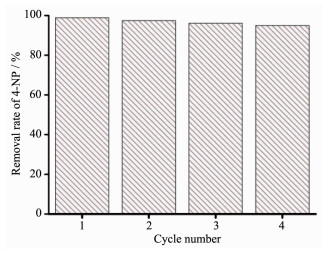
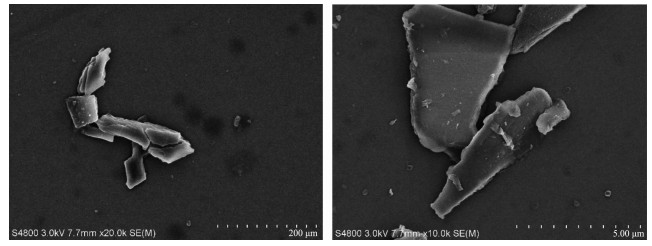
Since the precious metal was loaded in the composite material, the use of the material was lowered by considering its recycling. Ag+ without MOFs also had high catalytic efficiency, but a single silver ion cannot be recycled. After the reaction, the composite material was washed with ethanol and added to the solution as in the previous scheme to detect the change in the absorbance of p-nitrophenol, and the repeated use effect of the degradation reaction was shown in the Fig. 4. When used for the first time, the removal rate of 4-NP for Ag@compound 1 was 99.8%. After recycling 3 times, the catalytic efficiency was still 96% (Fig. 4). Although the activity of catalyst was stable, the weight loss during the collection of the complex was unavoidable as the number of cycles increased. The results showed that Ag@compounds 1 had high stability and can be used for multiple cycles. After recycling, the morphology of the composite did not change significantly (Fig. 5), indicating the stability of the structure (Fig. 6).
Although the composite material synthesized under this strategy took 2 hours to degrade 4-NP, which was longer than the complete reaction time of other studies[41], but the reaction time can be reduce by appropriately adding Ag+. The reaction time was reduced and the effect of metal center ions on the catalysis was investigated by isomorphic coordination. It had been shown that the prepared Ag@compound 1 with cyclic stability can be used as an excellent catalyst, and we can also control the rate of reaction by using different ratios of Co/Cd compounds.
The composite catalyst was prepared by adsorption method. When the Ag+ loading was 14.2%(w/w), the Ag@compound 1 had high catalytic activity in catalytic reduction of 4-NP by NaBH4, and the activity increased within a certain range as the increased Ag+ loading. The increase of Ag+ loading increased the reaction rate. Compared with the complex with the same structure, the catalytic effect of the central metal element Co was higher than that of Cd and the catalytic effect was proportional to the content of Co element. The composite has good stability and the catalytic efficiency was basically unchanged after repeated use for 4 times. It is proved that the reaction rate can be adjusted by the proportion of doping metal of MOFs, which provides a new idea for the preparation of new catalyst carriers.
Acknowledgments: This work was supported by the Fund of National Natural Science Foundation of China (Grant No.21401151), Science and Technology Support Program of Sichuan Province (Grant No.2015GZ0233), Science and Technology Huimin Program of Chengdu (Grant No.2015-HM01-00336-SF), Supported by the Innovative & Practice Project of Graduate School of Southwest Jiaotong University (Grant No.2018CYPY07).
Supporting information is available at http://www.wjhxxb.cn
Hiroyasu F, Cordova K E, Michael O K, et al. Cheminform, 2013, 341:974-976
Liang Z, Qu C, Guo W, et al. Adv. Mater., 2017, 30:1702891
Burtch N C, Heinen J, Bennett T D, et al. Adv. Mater., 2017, 30:1704124
Zhao Y, Wang L, Fan N N, et al. Cryst. Growth Des., 2018, 18:7114-7121 doi: 10.1021/acs.cgd.8b01290
Fu H R, Wang N, Qin J H, et al. Chem. Commun., 2018, 54:11645-11648 doi: 10.1039/C8CC05990J
Aisheng H, Wei D, Jürgen C. J. Am. Chem. Soc., 2010, 132:15562-15566 doi: 10.1021/ja108774v
Ibarra I A, González-Zamora E. Mater. Chem. Front., 2017, 1:1471-1484 doi: 10.1039/C6QM00301J
Li Y S, Helge B, Armin F, et al. Adv. Mater., 2010, 22:3322-3326 doi: 10.1002/adma.201000857
Peng Y, Li Y S, Ban Y J, et al. Science, 2014, 346:1356-1358 doi: 10.1126/science.1254227
Huang W H, Ren J, Yang Y H, et al. Inorg. Chem., 2019, 58:1481-1491 doi: 10.1021/acs.inorgchem.8b02994
Benjamin J D, Li J. Chem. Commun., 2014, 50:9636-9639 doi: 10.1039/C4CC01938E
Cui J S, Wong Y L, Zeller M, et al. Angew. Chem., 2015, 126:14666-14670
Hao J N, Yan B. Chem. Commun., 2015, 51:14509-14512 doi: 10.1039/C5CC05219J
Begum S, Horike S, Kitagawa S, et al. Dalton Trans., 2015, 44:18727-18730 doi: 10.1039/C5DT02651B
Wang C, Liu X, Chen J P, et al. Sci. Rep., 2015, 5:16613 doi: 10.1038/srep16613
Yang C, Kaipa U, Mather Q Z, et al. J. Am. Chem. Soc., 2011, 133:18094-18097 doi: 10.1021/ja208408n
Ramaswamy P, Norman E W, Benjamin S G, et al. J. Am. Chem. Soc., 2015, 137:7640-7643 doi: 10.1021/jacs.5b04399
Phang W J, Jo H, Lee W R, et al. Angew. Chem., 2015, 54:5142-5146 doi: 10.1002/anie.201411703
Phang W J, Lee W R, Yoo K, et al. Angew. Chem., 2014, 126:8523-8527 doi: 10.1002/ange.201404164
Shimizu G K H, Taylor J M, Kim S R. Science, 2013, 341:354-355 doi: 10.1126/science.1239872
Zheng H, Zhang Y, Liu L, et al. J. Am. Chem. Soc., 2016, 138:962-968 doi: 10.1021/jacs.5b11720
Shuai Y, Liang F, Wang K C, et al. Adv. Mater., 2018, 30:1870277 doi: 10.1002/adma.201870277
Li D S, Wu Y P, Zhao J, et al. Cheminform, 2014, 261:1-27
Xu G W, Wu Y P, Dong W W, et al. Small, 2017, 13:1602996 doi: 10.1002/smll.201602996
Qin J S, Du D Y, Guan W, et al. J. Am. Chem. Soc., 2015, 137:7169-7177 doi: 10.1021/jacs.5b02688
Mondloch J E, Katz M J, Isley Iii W C, et al. Nat. Mater., 2015, 14:512-516 doi: 10.1038/nmat4238
Moon S Y, Liu Y Y, Joseph T H, et al. Angew. Chem., 2015, 127:6899-6903 doi: 10.1002/ange.201502155
Wang X K, Liu J, Zhang L, et al. ACS Catal., 2019, 9:1726-1732 doi: 10.1021/acscatal.8b04887
Lin F H, Doong R. J. Phys. Chem. C, 2011, 115:6591-6598 doi: 10.1021/jp110956k
Sun Q, Liu M, Li K, et al. Inorg. Chem. Front., 2017, 4:144-153 doi: 10.1039/C6QI00441E
Wu Y P, Zhou W, Zhao J, et al. Angew. Chem. Int. Ed., 2017, 56:13001-13005 doi: 10.1002/anie.201707238
Yu X, Cohen S M. Chem. Commun., 2015, 51:9880-9883 doi: 10.1039/C5CC01697E
Anand P, Hooman Y A, Amitava C. Inorg. Chem., 2016, 55:9250-9257 doi: 10.1021/acs.inorgchem.6b01288
Wang L, Wu Y, Cao R, et al. ACS Appl. Mater. Interfaces, 2016, 8:16736-16743 doi: 10.1021/acsami.6b05375
Zhou W, Huang D D, Wu Y P, et al. Angew. Chem. Int. Ed., 2019, 58:4227-4231 doi: 10.1002/anie.201813634
Wang C C, Li J R, Lv X L, et al. Energy Environ. Sci., 2014, 7:2831-2867 doi: 10.1039/C4EE01299B
Hou W, Yuan X, Yan W, et al. Appl. Catal. B, 2015, 174-175:445-454 doi: 10.1016/j.apcatb.2015.03.037
Zhou J J, Wang R, Liu X L, et al. Appl. Surf. Sci., 2015, 346:278-283 doi: 10.1016/j.apsusc.2015.03.210
Chen S, Wang C J, Liu D N, et al. J. Solid State Chem., 2019, 270:180-186 doi: 10.1016/j.jssc.2018.10.042
Dai H Y, Tang Y Y, Wang C J, et al. J. Solid State Chem., 2017, 256:130-140 doi: 10.1016/j.jssc.2017.07.020
Wu Y P, Xu G W, Dong W W, et al. Inorg. Chem., 2017, 56:1402-1411 doi: 10.1021/acs.inorgchem.6b02476

Figure 3 Degradation of 4-NP with catalyst Ag@compound 1~5(a~e), and effect of Ag+ loading on catalytic degradation performance (f)

 扫一扫看文章


扫一扫关注我们
 下载:
下载:

 下载:
下载:


