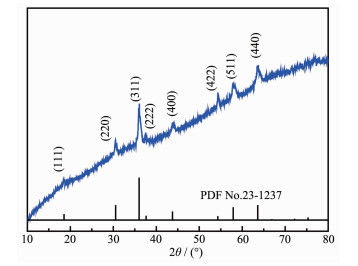
Figure 1.
XRD pattern of the sample


Styrene oxide is an important intermediate for the formation of various products such as styrene glycol, surface coating, and cosmetics and so on[1-3]. Traditionally, it could be obtained by catalytic epoxidation of styrene with oxidants. It is well known that the type of oxidant in the styrene oxidation reaction has a great influence on the selectivity of the epoxidation products[4]. According to literature reports, it is evident that tert-butyl hydro- peroxide (TBHP) is one of the most widely used oxidants in olefin epoxidation because of its low cost and high selectivity to epoxy compound[5]. So far, various kinds of catalysts, such as CeO2[6], Mn3O4[1], NiO[7] and CexCo1-x Fe2O4[5] have been used in the styrene epoxidation due to their low cost and earth abundance. However, there are many problems in this series of catalysts, such as low styrene conversion rate, poor selectivity to styrene oxide, poor stability and difficulty in separation. Therefore, it is of great importance to explore novel catalysts with strong stability, excellent styrene conversion and high selectivity to styrene oxide.
Recently, cobalt oxide (Co3O4) is widely used in environmental chemistry and catalytic materials due to their stable chemical properties and good catalytic properties[8]. However, the toxicity and high cost of cobalt oxide limit its application in some aspects. Therefore, it is meaningful to partial substitution of Co in Co3O4 with Mn to reduce the amount of toxic Co (cobalt manganese ternary oxides, CoxMn3-xO4, x=1, 2) because manganese is cheap, rich in nature and chemically stable[9]. In addition, the complex chemical composition and synergistic effects between Co and Mn also lead to excellent catalytic activity[10]. Therefore, the bimetallic cobalt-manganese oxide (MnCo2O4) has been extensively studied by researchers. As we know, apart from the composition, the morphology and pore structure could also affect the catalytic performance to some extent[11]. In particular, the special morphology may provide more exposed active sites and affect the external diffusion effect, while the mesoporous channels may promote the transport/diffusion of the reactant and product molecules during the heterogeneous catalytic reaction process[12]. So far, the MnCo2O4 catalysts with different morphologies and struc-tures, such as multiporous microspheres[13], microbars[14] and 3D nanosphere[15] have been synthesized via different methods. And the general method for synthesizing mesoporous MnCo2O4 was template-assisted method[16]. However, the removal of templating agents during the synthesis process leads to more complicated operations and high cost. Therefore, it is necessary to synthesize MnCo2O4 catalysts with special morphology and better pore structure via a facile method. Moreover, to the best of our knowledge, the MnCo2O4 catalysts with rod-like morphology are rarely reported, and as a heterogeneous catalyst, it is seldom used in the styrene epoxidation reaction.
Herein, we report a facile template-free hydrothermal method to synthesize the mesoporous rod-like MnCo2O4 with a defined pore size distribution, and styrene epoxidation reaction was selected as the target reaction to assess the catalytic performance of mesoporous rod-like MnCo2O4.
In this experiment, cobalt nitrate hexahydrate (Co(NO3)2·6H2O, analytical grade) and hexamethylenete-tramine (HMT) were purchased from West Long Chemical Co., Ltd. Manganese nitrate tetrahydrate (Mn(NO3)2·4H2O, analytical grade) was purchased from Sinopharm Group Chemical Reagent Co., Ltd. Ammonium fluoride (NH4F) was purchased from Nanjing Chemical Reagent Co., Ltd. tert-butyl hydroperoxide (TBHP), acetonitrile and styrene were purchased from Sinopharm Chemical Reagent Co., Ltd. All chemicals were used as received without further purification.
In a typical synthesis, 2 mmol (Co(NO3)2·6H2O, 1 mmol Mn(NO3)2·4H2O, 20 mmol HMT, 15 mmol NH4F were dissolved in 30 mL deionized water under magnetic stirring. Then, the homogeneous solution was transferred into a Teflon-lined stainless steel autoclave, and heated at 120 ℃ for 6 h. The obtained pink powders were washed with deionized water and ethyl alcohol three times, respectively. Then the sample was dried at 60 ℃ for 24 h. Finally the precursor was calcined at 600 ℃ for 4 h to obtain the final product MnCo2O4. For comparison, the Co3O4 and MnOx were synthesized under similar conditions, except that Mn(NO3)2·4H2O and (Co(NO3)2·6H2O were absent in the reaction solution.
X-ray diffraction (XRD) patterns were recorded using a Smartlab TM 9 KW (Rigaku Corporation, Tokyo, Japan) equipped with a rotating anode and Cu Kα radiation (λ=0.154 178 nm), and operated at 40 kV and 100 mA in a range of 10°~80°. The N2 adsorption-desorption measurements were carried out in the relative pressure (P/P0) range from 0.01 to 0.99 under (77.4 K), and the specific surface areas and distribution of pore size were calculated using the Brunauer-Emmet-Teller (BET) and Barrett-Joyner-Halenda (BJH) methods, respectively. Field emission scanning electron microscopy (FE-SEM) was performed on a Hitachi S4800 Field Emission Scanning Electron Microscopy and operated at 5 kV and 10 μA. Transmission electron microscopy (TEM) images were recorded on a JEM-2010 EX microscope with the accelerating voltage at 200 kV. Hydrogen temperature programmed reduction (H2-TPR) measurements were performed utilizing a fixed-bed reactor under a flow of 10%(V/V) H2/Ar gas mixture and a heating rate of 10 ℃·min-1 from room temperature to 700 ℃. Before the TPR analysis, the carbonates and hydrates impurities were removed by flowing argon over the catalyst at a flow rate of 30 mL·min-1 at 300 ℃ for 1 h, then cooled to room temperature. The X-ray photoelectron spectra (XPS) were measured on a PHI 5000 Versa Probe X-ray photoelectron spectrometer (Thermo Scientific Escalab 250Xi) equipped with Al Kα radiation (1 486.6 eV). The C1s peak at 284.8 eV was used as the reference for binding energies.
The catalytic reaction was carried out in a 25 mL three-necked round bottom flask fitted with a reflux condenser. Typically, 10 mL acetonitrile, 1 mmol styrene, and 10 mg catalyst were mixed within the flask. Then, 3 mmol TBHP was added to the mixture solution under stirring. The reaction was maintained at 80 ℃ for 10 h. The catalytic conversion rate of styrene and selectivity were determined using GC-3900 gas chromatograph.
Fig. 1 shows the XRD pattern of the sample, all the diffraction peaks could be indexed to the MnCo2O4 (PDF No.23-1237) with spinel structure, the peaks at ca. 18.5°, 30.5°, 36°, 37.6°, 43.8°, 54.3°, 58°, and 63.6° can be ascribed to the (111), (220), (311), (222), (400), (422), (511), and (440) crystal planes, respectively. Meanwhile, there was no other impurity diffraction peak appeared, indicating the high purity of the as-prepared sample.
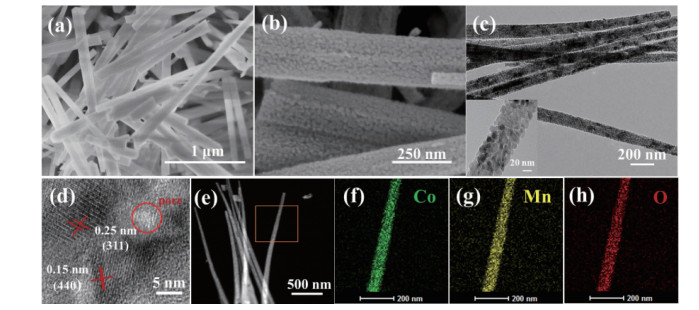
The morphology of the obtained sample was investigated by SEM and TEM techniques. As shown in Fig. 2a, the precursor exhibit significant rod-like morphology with the diameter of 100~200 nm while the length was up to 2~3 μm. It can be seen from Fig. 2b, after calcination, this rod-like morphology was still maintained in the final product of MnCo2O4, only with much rougher surface. This phenomenon could be due to the gas and steam released from the rod-like precursor during the heat treatment process, which made a lot of mesopores appear. This is further verified from the high resolution TEM (HR-TEM) result in Fig. 2c, it can be clearly seen that the rod structure was composed of many nanoparticles with diameters of 6~14 nm. In Fig. 2d, the lattice fringe spacing of 0.25 and 0.15 nm corresponded to the (311) and (440) planes of MnCo2O4, respectively. As shown in Fig. 2(f~h), the elemental mapping images demonstrate that the Co, Mn, O were uniformly dispersed throughout the mesoporous rod-like MnCo2O4 structure.
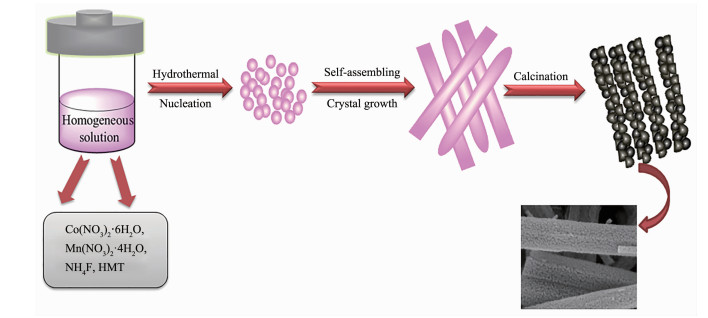
It is necessary to give a reasonable explanation for the roles of HMT and NH4F in the formation of meso-porous rod-like MnCo2O4. HMT is used as a precipitant, which can decompose to produce ammonia at tempera-tures above 70 ℃, and ammonia dissolves in water to produce OH-. In the early stage of hydrothermal, the nucleation rate of the particles is slow, with the increase of hydrothermal time, the particles tend to form rod-like morphology through an anisotropic growth process[17]. However, we can see from Fig. 3(a, b), when HMT was replaced with ammonia and NaOH, no rod-like structure was formed. Since ammonia or NaOH was rapidly hydro-lyze to form OH- when added to the solution, and the metal ions Co2+ and Mn2+ reacted with OH- immediately to form metal hydroxide precursor. In this process, the nucleation rate of particles was very fast. Thus, other morphology of precursors are formed instead of rod-like structure[18-19]. Wang et al.[20] reported that the F- with small radius may promote the formation of α-MnO2 nanowires via a rolling process. In order to confirm the role of F-, we replaced F- with SO42- and PO43- while keeping other conditions unchanged. As shown in Fig. 3(c, d), we only got some urchin-like and plate-like structure instead of rod-like structure. This phenomenon can be ascribed to that the SO42- and PO43- anions with larger radius, which may prevent or slow down the rolling process[21-22]. Based on these, a possible mechanism is proposed as follows: During the hydrothermal process, HMT is gradually decomposed into formaldehyde and ammonia, and the ammonia is reacted with H2O to produce OH-. Then, these produced OH- reacts with Co2+ and Mn2+ to form Co-Mn hydroxide nanoparticles under the hydrothermal condition[23]. At this stage, in order to reduce the surface energy, the irregular nanoparticles with high surface energy are randomly aggregated and self-assembling under van der Waals force and crystal surface attraction, leading to the formation of rod-like morphology [24]. Xia et al.[25] reported that the F- has strong coordination ability, therefore, the Co2+ and Mn2+ also tend to coordinate with F-. Therefore, we conclude that the presence of F- may regulate the reaction rate and contribute to the formation of the final rod morphology via a rolling process[26-27]. Finally, the mesoporous rod-like MnCo2O4 was obtained after a calcination process, the formation of pore structure can be attributed to the release of the gas from the decomposition of rod-like precursors[28-29]. The formation process is shown in Fig. 4.
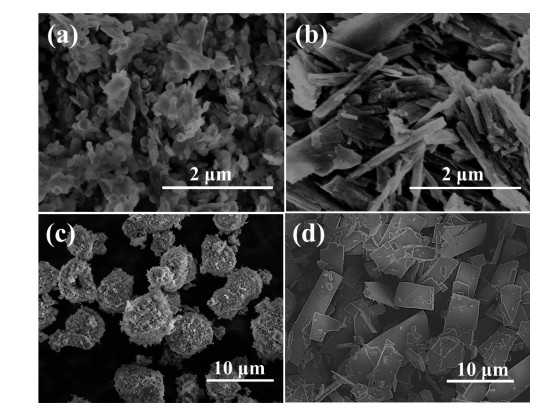
(a) 20 mmol NH3·H2O, (b) 20 mmol NaOH, (c) 7.5 mmol (NH4)2SO4 and (d) 5 mmol (NH4)3PO4·3H2O
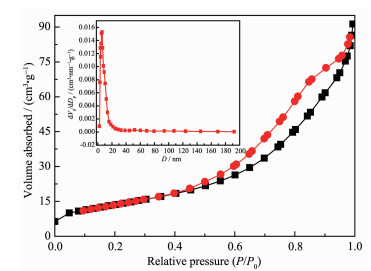
The specific surface area and pore size distribution were measured by N2 adsorption-desorption test. As shown in Fig. 5, the curve of the rod-like MnCo2O4 displayed type-Ⅳ isotherm with H3 hysteresis loop, suggesting the existence of well-defined mesoporous structure. The specific surface area (SBET) of MnCo2O4 was calculated to be 65 m2·g-1 and the pore size distribution (inset) exhibited one dominant peak centered at 6 nm, indicating the well-formed mesoporous structure with a defined pore size distribution in the target sample. This is consistent with the SEM and TEM results.
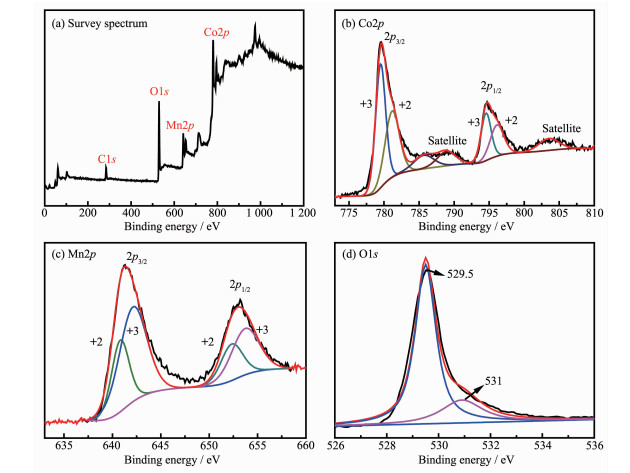
The composition and valence states of the as-synthesized mesoporous rod-like MnCo2O4 were studied by XPS. As shown in Fig. 6a, the survey spectrum demonstrated the presence of Co, Mn, O and C, where the C derived from the reference. It can be clearly seen from Fig. 6b, the two peaks located at 779.7 and 795.0 eV were the characteristic peaks of Co2p3/2 and Co2p1/2, respectively, and two obvious satellite peaks were observed, indicating the co-existence of Co2+ and Co3+ in mesoporous rod-like MnCo2O4. Moreover, the Co2p spectrum was fitted well to two spin-orbit doublets characteristic of Co2+ and Co3+, the peaks located at 781.2 and 796.1 eV were ascribed to the Co2+, and the peaks at 779.5 and 794.6 eV were attribute to the Co3+ [30-31]. The Mn2p spectrum (Fig. 6c) was divided into four peaks by using a Gaussian fitting method. The peaks at around 640.7 and 652.6 eV can be assigned to the Mn2+, the other two peaks located at 642.8 and 654.2 eV can be ascribed to the Mn3+ [32]. Therefore, it can be concluded that Mn2+/Mn3+ and Co2+/Co3+ coexist in the mesoporous rod-like MnCo2O4, which is consistent with the literature reported[33-34]. Fig. 6d shows the O1s spectrum, the peaks at around 529.5 and 531 eV could be attributed to the lattice oxygen and hydroxyl oxygen species, respe- ctively[35].
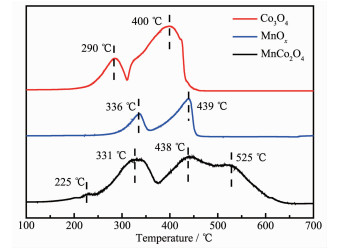
Normally, the catalytic activity of the redox reaction is mainly related with the reducibility of the metal active sites in the catalyst. Herein, the H2-TPR experiments were carried out and the results are shown in Fig. 7. In addition, two pristine samples of Co3O4 and MnOx were prepared for comparison. As we can see, two reduction peaks at about 290 and 400 ℃ for Co3O4 could be ascribed to the stepwise reduction of Co3O4→CoO→Co[8], while the peaks at about 336 and 439 ℃ observed in MnOx were due to the transformation of MnOx→Mn3O4→MnO[16]. For mesoporous rod-like MnCo2O4, the peaks at about 331 and 438 ℃ were attributed to the stepwise reduction of MnCo2O4, whereas the peak at lower temperature (225 ℃) should be ascribed to the reduction of surface oxygen species. Moreover, it should be noted that a new peak at extremely high temperature (525 ℃) was appeared in the MnCo2O4 sample, therefore, it is inferred from this phenomenon that there was a strong interaction between manganese oxide and cobalt oxide in MnCo2O4, which would play a synergistic role to increase the catalytic activity[16, 36].
The catalytic activity of mesoporous rod-like MnCo2O4 was evaluated by catalyzing epoxidation of styrene. For comparison, the catalytic performance of hybrid MnO2-Co3O4, Co-based and Mn-based catalysts are also listed in Table 1. It can be seen that, compared with MnO2-Co3O4, mesoporous MnO2 and mesoporous Co3O4 catalysts, the mesoporous rod-like MnCo2O4 showed extremely high catalytic performance, the conversion rate of styrene was 95.8%, and the selectivity of styrene oxide was 58.2%. This could be due to the large surface area in the mesoporous rod-like MnCo2O4, making more active sites exposed and available in the catalytic reaction. In addition, the mesoporous channels are also facilitate to the diffusion/transport of the reactant and product molecules during the catalytic reaction process. However, compared with the catalysts of Co-MCM-41 and Mn/SBA-15, the catalyst of the mesoporous rod-like MnCo2O4 showed much better catalytic properties, even with lower surface area. To explain this, it should be noted that there is a synergistic effect between Co and Mn species, in which the Co species play as the main active sites, and Mn species are mainly responsible for promoting the transfer of electrons during the reaction process because of their high conductivity[37]. Based on these, the catalyst of mesoporous rod-like MnCo2O4 could be chosen as the best candidate for the epoxidation of styrene.

 下载:
导出CSV
下载:
导出CSV
| Sample | SBET /(m2·g-1) | Oxidant | Temperature /℃ | Conversion rate/% | Selectivity(SOa)/% | Yield of SO/% | Reference |
| Mesoporous rod-like MnCo2O4 | 65 | TBHP | 80 | 95.8 | 58.2 | 55.8 | This work |
| MnO2-Co3O4 | 18 | TBHP | 80 | 19.3 | 28.1 | 5.4 | [38] |
| Mesoporous MnO2 | 27 | TBHP | 80 | 78.3 | 25.1 | 19.7 | [38] |
| Mesoporous Co3O4 sheets | 11.7 | TBHP | 80 | 53.4 | 62.2 | 33.2 | [39] |
| Co-MCM-41 | 1 143 | TBHP | 100 | 79 | 6.9 | 5.5 | [40] |
| Mn/SBA-15 | 157 | TBHP | 80 | 90 | 26 | 23.4 | [41] |
| Reaction conditions: 10 mL acetonitrile, 1 mmol styrene, 10 mg catalyst, 3 mmol TBHP, 80 ℃, 10 h, reflux; aSO: styrene oxide. | |||||||
It is well known that the reaction conditions have a great influence on the conversion rate of styrene and the selectivity of styrene oxide. Therefore, the main reaction parameters, such as reaction time, reaction temperature and molar radio of styrene to TBHP were investigated. It can be clearly seen from Fig. 8a, with the extension of time, the styrene conversion rate and the selectivity to styrene oxide were increased. Upon to 10 h, the styrene conversion was reached to 95.8%, however, there was a slight decrease in the selectivity for styrene oxide compared with 8 h. This phenomenon could be ascribed to the over- oxidation and hydrolysis of styrene oxide to form other by-products. As shown in Fig. 8b, when the temperature of the catalytic reaction increased, the conversion rate of styrene and the selectivity of styrene oxide were increased, and the best catalytic performance was achieved at the temperature of 80 ℃. This can be attributed to the high temperature causing an increase in the collision of the reactants with the catalyst, thus an increase in the conversion rate of styrene was observed. However, further increasing the reaction temperature may result in decomposition of the oxidant TBHP and decreased the conversion rate. As shown in Fig. 8c, the conversion rate of styrene and the selectivity to styrene oxide increased gradually as the molar ratio of styrene to TBHP decreased from 1/2 to 1/3. However, when the molar ratio of styrene to TBHP continued to decreased, the conversion rate and selectivity to styrene oxide decreased. This demonstrates that low concentration of TBHP caused a slow reaction while high TBHP concentration may compete with the styrene to occupy the active sites on the catalyst surface and slow down the reaction. Therefore, the optimal reaction conditions were as follows: reaction time of 10 h, reaction temperature of 80 ℃, and styrene/TBHP ratio of 1:3.
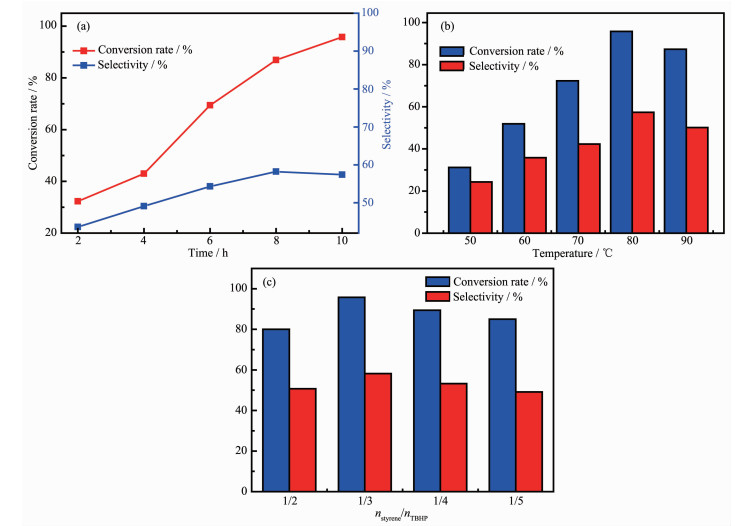
Reaction conditions: (a) 10 mL acetonitrile, 1 mmol styrene, 10 mg catalyst, 3 mmol TBHP, 80 ℃; (b) 10 mL acetonitrile, 1 mmol styrene, 10 mg catalyst, 3 mmol TBHP, 10 h; (c) 10 mL acetonitrile, 1 mmol styrene, 10 mg catalyst, 80 ℃, 10 h
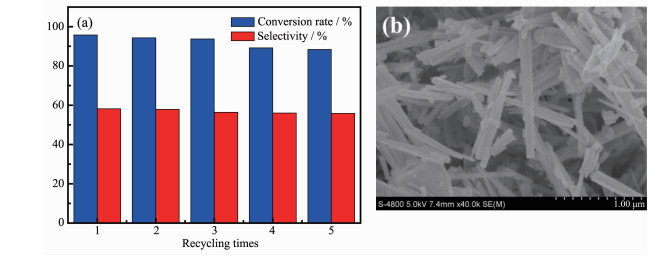
A series of experiments were conducted under the same conditions to evaluate the stability of the mesoporous rod-like MnCo2O4. As shown in Fig. 9a, the mesoporous rod-like MnCo2O4 still exhibited high conversion rate and selectivity after five successive recycle tests, and the reused sample also displayed the typical rod morphology (Fig. 9b), verifying the high reusability and potential practical application ability.
In summary, the rod-like MnCo2O4 with mesoporous structure was successfully synthesized via a facile template-free hydrothermal method and subsequent calcination process. Such rod-like structure was composed of many nanoparticles with diameters of 6~14 nm. The target mesoporous rod-like MnCo2O4 sample showed higher surface area and better pore size distribution. In addition, it exhibited excellent catalytic activity and cycling performance in the styrene epoxidation reaction. We conclude that the superior catalytic performance can be ascribed to the synergistic effects between Co species and Mn species of MnCo2O4 and the mesoporous structures. We believe that the facile strategy can be extended to synthesize other mesoporous spinel-type binary metal oxides (AB2O4) with excellent catalytic performance. In addition, the mesoporous rod-like MnCo2O4 could be chosen as the best candidate for the epoxidation of styrene.
Askarinejad A, Bagherzadeh M, Morsali A. Appl. Surf. Sci., 2010, 256(22):6678-6682 doi: 10.1016/j.apsusc.2010.04.069
Liu J Y, Chen T T, Jian P M, et al. J. Colloid Interface Sci., 2018, 526:295-301 doi: 10.1016/j.jcis.2018.05.001
Masunga N, Doyle B P, Carleschi E, et al. Appl. Catal. A, 2018, 559:175-186 doi: 10.1016/j.apcata.2018.04.027
Yang F, Zhou S J, Gao S Y, et al. Microporous Mesoporous Mater., 2017, 238:69-77 doi: 10.1016/j.micromeso.2016.03.007
Tong J H, Li W Y, Bo L L, et al. J. Catal., 2016, 344:474-481 doi: 10.1016/j.jcat.2016.10.003
Pal P, Pahari S K, Sinhamahapatra A, et al. RSC Adv., 2013, 3(27):10837-10847 doi: 10.1039/c3ra23485a
Choudhary V R, Jha R, Jana P. Catal. Commun., 2008, 10(2):205-207 doi: 10.1016/j.catcom.2008.08.020
Teng F, Chen M D, Li G Q, et al. Appl. Catal. B, 2011, 110:133-140 doi: 10.1016/j.apcatb.2011.08.035
Yao Y J, Cai Y M, Wu G D, et al. J. Hazard. Mater., 2015, 296:128-137 doi: 10.1016/j.jhazmat.2015.04.014
Yang F, Ding Y, Tang J J, et al. Mol. Catal., 2017, 435:144-155 doi: 10.1016/j.mcat.2017.03.034
Wang H Q, Gao S Y, Du J, et al. Appl. Catal. A, 2015, 504:228-237 doi: 10.1016/j.apcata.2014.12.040
Liu P, Hao Q L, Xia X F, et al. J. Phys. Chem. C, 2015, 119(16):8537-8546 doi: 10.1021/acs.jpcc.5b01315
Ma S C, Sun L Q, Cong L N, et al. J. Phys. Chem. C, 2013, 117:25890-25897 doi: 10.1021/jp407576q
Wang L J, Liu B, Ran S H, et al. J. Mater. Chem. A, 2013, 1:2139-2143 doi: 10.1039/C2TA00125J
Hu X N, Huang L, Zhang J P, et al. J. Mater. Chem. A, 2018, 6(7):2952-2963 doi: 10.1039/C7TA08000J
Qiu M Y, Zhan S H, Yu H B, et al. Nanoscale, 2015, 7(6):2568-2577 doi: 10.1039/C4NR06451H
Hu X L, Huang H H, Zhang J B, et al. RSC Adv., 2015, 5:99899-99906 doi: 10.1039/C5RA19789A
Zhang Y Q, Li L, Shi S J, et al. J. Power Sources, 2014, 256:200-205 doi: 10.1016/j.jpowsour.2014.01.073
Jia B R, Qin M L, Li S M, et al. ACS Appl. Mater. Interfaces, 2016, 8:15582-15590 doi: 10.1021/acsami.6b02768
Wang X H, Ni S B, Zhou G, et al. Mater. Lett., 2010, 64(13):1496-1498 doi: 10.1016/j.matlet.2010.04.002
Gao Y Q, Wang Z H, Wan J X, et al. J. Cryst. Growth, 2005, 279:415-419 doi: 10.1016/j.jcrysgro.2005.02.052
Wang X, Li Y D. Chem. Eur. J., 2003, 9(1):300-306 doi: 10.1002/chem.v9:1
Liu T, Liu J Y, Liu Q, et al. Nanoscale, 2015, 7(46):19714-19721 doi: 10.1039/C5NR05761B
Liu T, Liu J Y, Liu Q, et al. Sens. Actuators B, 2017, 250:111-120 doi: 10.1016/j.snb.2017.04.163
Xia X H, Tu J P, Zhang Y Q, et al. ACS Nano., 2012, 6:5531-5538 doi: 10.1021/nn301454q
Liu S M, Zhang W Q, Chen N, et al. ChemElectroChem, 2018, 5(16):2181-2185 doi: 10.1002/celc.201800426
Long H W, Liu T M, Zeng W, et al. Mater. Lett., 2018, 214:127-129 doi: 10.1016/j.matlet.2017.11.103
Shu Z, Huang W M, Hua Z L, et al. J. Mater. Chem. A, 2013, 1(35):10218-10227 doi: 10.1039/c3ta10971b
Zhang G J, Shen Z R, Liu M, et al. J. Phys. Chem. B, 2006, 110:25782-25790 doi: 10.1021/jp0648285
Liao F, Han X R, Zhang Y F, et al. Ceram. Int., 2018, 44:22622-22631 doi: 10.1016/j.ceramint.2018.09.038
Li G D, Xu L Q, Zhai Y J, et al. J. Mater. Chem. A, 2015, 3:14298-14306 doi: 10.1039/C5TA03145A
Kong X Z, Zhu T, Cheng F Y, et al. ACS Appl. Mater. Interfaces, 2018, 10(10):8730-8738 doi: 10.1021/acsami.7b19719
Xu J S, Sun Y D J, Lu M, et al. Acta Mater., 2018, 152:162-174 doi: 10.1016/j.actamat.2018.04.025
冯艳, 吴剑波, 张晓玲, 等.无机化学学报, 2019, 35(4):569-579 http://www.wjhxxb.cn/wjhxxbcn/ch/reader/view_abstract.aspx?file_no=20190401&flag=1FENG Yan, WU Jian-Bo, ZHANG Xiao-Ling, et al. Chinese J. Inorg. Chem., 2019, 35(4):569-579 http://www.wjhxxb.cn/wjhxxbcn/ch/reader/view_abstract.aspx?file_no=20190401&flag=1
Yao L L, Zhang L L, Liu Y X, et al. CrystEngComm, 2016, 18:8887-8897 doi: 10.1039/C6CE01905F
Wang Y, Guo L M, Chen M Q, et al. Catal. Sci. Technol., 2018, 8(2):459-471 doi: 10.1039/C7CY01867C
Kuang L P, Ji F Z, Pan X X, et al. Chem. Eng. J., 2017, 315:491-499 doi: 10.1016/j.cej.2017.01.025
Masunga N, Tito G S, Meijboom R. Appl. Catal. A, 2018, 552:154-167 doi: 10.1016/j.apcata.2017.12.010
Liu J Y, Chen T T, Yan X D, et al. Catal. Commun., 2018, 109:71-75 doi: 10.1016/j.catcom.2018.02.023
Tang Q H, Zhang Q H, Wu H L, et al. J. Catal., 2005, 230(2):384-397 doi: 10.1016/j.jcat.2004.12.017
Sweta V C. Chin. J. Chem. Eng., 2018, 26(6):1300-1306 doi: 10.1016/j.cjche.2018.01.025

Figure 2 SEM images of (a) precursor and (b) final product MnCo2O4; (c, d) TEM and HR-TEM images of mesoporous rod-like MnCo2O4; (f~h) Elemental mapping of Co, Mn, and O of mesoporous rod-like MnCo2O4 in (e)

Figure 3 SEM images of Co-Mn hydroxide precursors at different conditions
(a) 20 mmol NH3·H2O, (b) 20 mmol NaOH, (c) 7.5 mmol (NH4)2SO4 and (d) 5 mmol (NH4)3PO4·3H2O

Figure 4 Schematic illustration of the preparation process of the mesoporous rod-like MnCo2O4

Figure 5 N2 adsorption-desorption isotherm and pore size distribution curve of the meosporous rod-like MnCo2O4

Figure 8 Effects of (a) reaction time, (b) reaction temperature and (c) molar ratio of styrene to TBHP on the catalytic performance of the mesoporous rod-like MnCo2O4
Reaction conditions: (a) 10 mL acetonitrile, 1 mmol styrene, 10 mg catalyst, 3 mmol TBHP, 80 ℃; (b) 10 mL acetonitrile, 1 mmol styrene, 10 mg catalyst, 3 mmol TBHP, 10 h; (c) 10 mL acetonitrile, 1 mmol styrene, 10 mg catalyst, 80 ℃, 10 h

Figure 9 (a) Stability test of the MnCo2O4 catalyst and (b) SEM images of MnCo2O4 catalyst after the recycling experiments
Table 1. Catalytic performance of different samples in the epoxidation of styrene
| Sample | SBET /(m2·g-1) | Oxidant | Temperature /℃ | Conversion rate/% | Selectivity(SOa)/% | Yield of SO/% | Reference |
| Mesoporous rod-like MnCo2O4 | 65 | TBHP | 80 | 95.8 | 58.2 | 55.8 | This work |
| MnO2-Co3O4 | 18 | TBHP | 80 | 19.3 | 28.1 | 5.4 | [38] |
| Mesoporous MnO2 | 27 | TBHP | 80 | 78.3 | 25.1 | 19.7 | [38] |
| Mesoporous Co3O4 sheets | 11.7 | TBHP | 80 | 53.4 | 62.2 | 33.2 | [39] |
| Co-MCM-41 | 1 143 | TBHP | 100 | 79 | 6.9 | 5.5 | [40] |
| Mn/SBA-15 | 157 | TBHP | 80 | 90 | 26 | 23.4 | [41] |
| Reaction conditions: 10 mL acetonitrile, 1 mmol styrene, 10 mg catalyst, 3 mmol TBHP, 80 ℃, 10 h, reflux; aSO: styrene oxide. | |||||||
 下载: 导出CSV

 扫一扫看文章


扫一扫关注我们