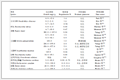
Table 1.
Crystal data for compounds 1~4

Syntheses, Crystal Structures, Luminescent and Magnetic Properties of Nickel(Ⅱ) and Zinc(Ⅱ) Coordination Polymers Constructed from 5-Chloronicotinic Acid
Jin-Wei CHEN , Yu LI , Xun-Zhong ZOU , Wen-Da QIU , Xiao-Ling CHENG


The design and hydrothermal syntheses of metal-organic coordination polymers have attracted great interest in the field of coordination chemistry and organic chemistry owing to their intriguing architec-tures and topologies, as well as potential applications in catalysis, magnetism, luminescence and gas absorp-tion[1-6]. There are many factors, such as the coordination geometry of the metal centers, type and connectivity of organic ligands, stoichiometry, reaction conditions, template effect, presence of auxiliary ligands, and pH values influencing the structures of target coordination polymers during self-assembly[7-12]. Among these factors, organic ligands play a very important role in constructing coordination polymers.
As we known, the carboxylate ligands have been certified to be of great significance as constructors due to their abundant coordination modes, which could satisfy different geometric requirements of metal centers[13-18]. Apart from carboxylate ligands, 1, 10-phenanthroline (phen) and 2, 2′-biimidazole (H2biim) have often been used as secondary N, N-donor building blocks to construct and stabilize new structures, on account of their effective π…π stacking and/or weak H-bonding interactions[15-18]. As a continuation of our research in this field, we have tested the hydrothermal self-assembly reactions of nickel and zinc chlorides with 5-chloronicotinic acid (5-Clnic) as a main building block and 1, 10-phenanthroline or 2, 2′-biimidazole as N, N-donor anxiliary ligands in view of the following considerations: (A) an availability of pyridyl N and carboxylate O atoms for the coordination to a metal center, (B) the presence of Cl-functionality that is capable of taking part in Cl…Cl interaction, (C) facilitating the crystallization of compounds and stabilization of their structures by the introduction of phen and H2biim ligands.
Taking into consideration the above discussion, we herein report the syntheses, crystal structures, magnetic and luminescent properties of four Ni(Ⅱ) and Zinc(Ⅱ) coordination polymers constructed from 5-chloronicotinic acid ligand.
All chemicals and solvents were of AR grade and used without further purification. Carbon, hydrogen and nitrogen were determined using an Elementar Vario EL elemental analyzer. IR spectra were recorded using KBr pellets and a Bruker EQUINOX 55 spectrometer. Thermogravimetric analysis (TGA) data were collected on a LINSEIS STA PT1600 thermal analyzer with a heating rate of 10 ℃·min-1. Magnetic susceptibility data were collected in a temperature range of 2~300 K with a Quantum Design SQUID Magnetometer MPMS XL-7 with a field of 0.1 T. A correction was made for the diamagnetic contribution prior to data analysis. Excitation and emission spectra were recorded for the solid samples on an Edinburgh FLS920 fluorescence spectrometer at room temperature.
A mixture of NiCl2·6H2O (0.025 g, 0.10 mmol), 5-ClnicH (0.032 g, 0.20 mmol), NaOH (0.008 g, 0.20 mmol), and H2O (10 mL) was stirred at room tempera-ture for 15 min, and then sealed in a 25 mL Teflon-lined stainless steel vessel, and heated at 160 ℃ for 3 days, followed by cooling to room temperature at a rate of 10 ℃·h-1. Green block-shaped crystals of 1 were isolated manually, and washed with distilled water. Yield: 71% (based on 5-ClnicH). Anal. Calcd. for C12H10Cl2NiN2O6(%): C 35.34, H 2.47, N 6.87; Found(%): C 35.22, H 2.46, N 6.91. IR (KBr, cm-1): 3 434w, 3 125w, 1 632m, 1 562 w, 1 528w, 1 457w, 1 394s, 1 289w, 1 236w, 1 131w, 1 097w, 1 026w, 909w, 782w, 746m, 688w, 589w.
The synthesis of complex 2 is same to 1 except that H2biim (0.014 g, 0.1 mmol) is added. Blue block-shaped crystals of 2 were isolated manually, and washed with distilled water. Yield: 62% (based on 5-ClnicH). Anal. Calcd. for C18H12Cl2NiN6O4(%): C 42.73, H 2.39, N 16.61; Found(%): C 42.61, H 2.41, N 16.85. IR (KBr, cm-1): 1 609s, 1 551w, 1 452w, 1 388s, 1 370m, 1 335w, 1 277w, 1 189w, 1 125m, 1 026w, 991w, 927w, 898w, 782m, 752w, 688w, 595w.
Synthesis of 3 was similar to 2 except using ZnCl2 (0.014 g, 0.10 mmol) instead of NiCl2·6H2O. Colorless block-shaped crystals of 3 were isolated manually, and washed with distilled water. Yield 55% (based on Zn). Colorless block-shaped crystals of 3 were isolated manually, and washed with distilled water. Yield: 65% (based on 5-ClnicH). Anal. Calcd. for C18H12Cl2ZnN6O4(%): C 42.17, H 2.36, N 16.39; Found(%): C 42.34, H 2.37, N 16.53. IR (KBr, cm-1): 1 609s, 1 556w, 1 440w, 1 394s, 1 370s, 1 329w, 1 283w, 1 189w, 1 125m, 1 032 w, 991w, 898w, 782m, 752w, 729w, 688w.
Synthesis of 4 was similar to 3 except using phen (0.020 g, 0.10 mmol) instead of H2biim. Colorless block-shaped crystals of 4 were isolated manually, and washed with distilled water. Yield: 60% (based on 5-ClnicH). Anal. Calcd. for C24H18Cl2ZnN4O6(%): C 48.47, H 3.05, N 9.42; Found(%): C 48.35, H 3.07, N 9.50. IR (KBr, cm-1): 3 438w, 3 097w, 1 628s, 1 561m, 1 510w, 1 423w, 1 393s, 1 291w, 1 225w, 1 184w, 1 133w, 1 102 w, 1 026w, 898w, 847w, 786w, 750w, 724m, 684w, 638w. The compounds are insoluble in water and common organic solvents, such as methanol, ethanol, acetone, and DMF.
Four single crystals with dimensions of 0.26 mm×0.21 mm×0.20 mm (1), 0.28 mm×0.26 mm×0.25 mm (2), 0.27 mm×0.23 mm×0.22 mm (3), and 0.25 mm×0.23 mm×0.21 mm (4) were collected at 293(2) K on a Bruker SMART APEX Ⅱ CCD diffractometer with Mo Kα radiation (λ=0.071 073 nm). The structures were solved by direct methods and refined by full matrix least-square on F2 using the SHELXTL-2014 program[19]. All non-hydrogen atoms were refined anisotropically. All the hydrogen atoms were positioned geometrically and refined using a riding model. Some lattice solvent molecules in 1 are highly disordered and were removed using the SQUEEZE routine in PLATON[20]. The number of solvent H2O molecules was obtained on the basis of elemental and thermogravimetric analyses. A summary of the crystallography data and structure refinements for 1~4 is given in Table 1. The selected bond lengths and angles for compounds 1~4 are listed in Table 2. Hydrogen bond parameters of compounds 1~4 are given in Table 3.
 下载:
导出CSV
下载:
导出CSV
| Compound | 1 | 2 | 3 | 4 |
| Chemical formula | C12H10Cl2NiN2O6 | C18H12Cl2NiN6O4 | C18H12Cl2ZnN6O4 | C24H18Cl2ZnN4O6 |
| Molecular weight | 407.81 | 505.95 | 512.61 | 594.69 |
| Crystal system | Monoclinic | Orthorhombic | Orthorhombic | Triclinic |
| Space group | I2/a | Pbcn | Pbcn | P1 |
| a / nm | 1.432 71(16) | 0.778 75(3) | 0.779 11(3) | 0.771 48(8) |
| b / nm | 1.672 20(16) | 1.804 37(7) | 1.827 48(8) | 1.264 3(2) |
| c / nm | 1.462 59(17) | 2.758 83(11) | 2.777 68(13) | 1.328 8(2) |
| α / (°) | 106.443(16) | |||
| β / (°) | 118.373(14) | 90.973(11) | ||
| γ / (°) | 90.282(12) | |||
| V / nm3 | 3.083 1(7) | 3.876 6(3) | 3.954 9(3) | 1.242 8(4) |
| Z | 8 | 8 | 8 | 2 |
| F(000) | 1 528 | 2 048 | 2 064 | 604 |
| θ range for data collection / (°) | 3.673~25.049 | 3.534~25.047 | 3.514~25.046 | 3.280~25.049 |
| Limiting indices | -16 ≤ h ≤ 17, | -9 ≤ h ≤ 9, | -9 ≤ h ≤ 8, | -8 ≤ h ≤ 9, |
| -19≤ k ≤ 16, | -20 ≤ k ≤ 21, | -21 ≤ k ≤ 19, | -15 ≤ k ≤ 9, | |
| -17 ≤ l ≤ 14 | -32 ≤ l ≤ 18 | -31 ≤ l ≤ 33 | -13 ≤ l ≤ 15 | |
| Reflection collected, unique (Rint) | 5 459, 2 730 (0.052 0) | 13 122, 3 432 (0.059 8) | 13 633, 3 495 (0.063 9) | 7 527, 4 396 (0.070 9) |
| Dc / (g·cm-3) | 1.641 | 1.734 | 1.722 | 1.589 |
| μ / mm-1 | 1.623 | 1.318 | 1.553 | 1.251 |
| Data, restraint, parameter | 2 730, 0, 195 | 3 432, 0, 280 | 3 495, 0, 284 | 4 396, 0, 334 |
| Goodness-of-fit on F2 | 1.029 | 1.032 | 1.052 | 1.012 |
| Final R indices [I≥2σ(I)] R1, wR2 | 0.052 8, 0.100 0 | 0.040 5, 0.085 6 | 0.044 3, 0.086 0 | 0.073 2, 0.141 0 |
| R indices (all data) R1, wR2 | 0.079 2, 0.112 4 | 0.065 0, 0.102 2 | 0.069 6, 0.101 7 | 0.133 7, 0.183 6 |
| Largest diff. peak and hole / (e·nm-3) | 811 and -566 | 411 and -436 | 478 and -437 | 490 and -712 |
下载:
导出CSV
| 1 | |||||
| Ni(1)-O(1)A | 0.212 5(3) | Ni(1)-O(3) | 0.206 0(3) | Ni(1)-O(4)B | 0.205 8(3) |
| Ni(1)-O(5) | 0.208 6(2) | Ni(1)-N(1) | 0.210 4(4) | Ni(1)-N(2)C | 0.208 1(4) |
| O(4)B-Ni(1)-O(3) | 96.65(13) | O(4)B-Ni(1)-N(2)C | 91.38(14) | O(3)-Ni(1)-N(2)C | 84.76(14) |
| O(4)B-Ni(1)-O(5) | 87.91(10) | O(3)-Ni(1)-O(5) | 91.24(12) | O(5)-Ni(1)-N(2)C | 175.83(15) |
| O(4)B-Ni(1)-N(1) | 88.96(14) | O(3)-Ni(1)-N(1) | 170.91(13) | N(1)-Ni(1)-N(2)C | 87.98(15) |
| O(5)-Ni(1)-N(1) | 96.12(14) | O(4)B-Ni(1)-O(1)A | 177.41(12) | O(3)-Ni(1)-O(1)A | 83.90(13) |
| N(2)C-Ni(1)-O(1)A | 91.19(14) | O(5)-Ni(1)-O(1)A | 89.54(10) | N(1)-Ni(1)-O(1)A | 90.82(14) |
| Ni(1)-O(5)-Ni(1)B | 113.9(2) | ||||
| 2 | |||||
| Ni(1)-O(3)A | 0.218 1(2) | Ni(1)-O(4)A | 0.212 0(2) | Ni(1)-N(1) | 0.209 7(3) |
| Ni(1)-N(2) | 0.210 7(3) | Ni(1)-N(3) | 0.208 5(3) | Ni(1)-N(6) | 0.205 1(3) |
| N(6)-Ni(1)-N(3) | 80.37(12) | N(6)-Ni(1)-N(1) | 90.67(12) | N(3)-Ni(1)-N(1) | 170.17(12) |
| N(6)-Ni(1)-N(2) | 97.36(11) | N(3)-Ni(1)-N(2) | 89.95(12) | N(2)-Ni(1)-N(1) | 95.24(11) |
| N(6)-Ni(1)-O(4)A | 168.24(11) | N(3)-Ni(1)-O(4)A | 95.20(11) | N(1)-Ni(1)-O(4)A | 92.82(11) |
| N(2)-Ni(1)-O(4)A | 93.50(10) | N(6)-Ni(1)-O(3)A | 107.57(11) | N(3)-Ni(1)-O(3)A | 92.45(11) |
| N(1)-Ni(1)-O(3)A | 86.37(10) | N(2)-Ni(1)-O(3)A | 155.01(11) | O(3)A-Ni(1)-O(4)A | 61.51(9) |
| 3 | |||||
| Zn(1)-O(3)A | 0.218 2(3) | Zn(1)-O(4)A | 0.225 6(3) | Zn(1)-N(1) | 0.216 6(3) |
| Zn(1)-N(2) | 0.216 9(3) | Zn(1)-N(3) | 0.208 0(3) | Zn(1)-N(6) | 0.213 6(3) |
| N(3)-Zn(1)-N(6) | 79.81(13) | N(3)-Zn(1)-N(1) | 90.70(13) | N(6)-Zn(1)-N(1) | 170.13(14) |
| N(3)-Zn(1)-N(2) | 101.00(12) | N(6)-Zn(1)-N(2) | 90.43(13) | N(1)-Zn(1)-N(2) | 94.07(12) |
| N(3)-Zn(1)-O(3)A | 110.92(12) | N(6)-Zn(1)-O(3)A | 94.21(11) | N(1)-Zn(1)-O(3)A | 86.60(11) |
| N(2)-Zn(1)-O(3)A | 148.06(12) | N(3)-Zn(1)-O(4)A | 169.12(12) | N(6)-Zn(1)-O(4)A | 95.64(12) |
| N(1)-Zn(1)-O(4)A | 93.23(12) | N(2)-Zn(1)-O(4)A | 88.85(11) | O(3)A-Zn(1)-O(4)A | 59.27(10) |
| 4 | |||||
| Zn(1)-O(1) | 0.212 8(5) | Zn(1)-O(2) | 0.238 4(6) | Zn(1)-O(3) | 0.205 4(5) |
| Zn(1)-N(1)A | 0.212 5(5) | Zn(1)-N(3) | 0.223 8(6) | Zn(1)-N(4) | 0.212 7(6) |
| O(3)-Zn(1)-N(1)A | 92.6(2) | O(3)-Zn(1)-N(4) | 89.3(2) | N(1)A-Zn(1)-N(4) | 108.1(2) |
| O(3)-Zn(1)-O(1) | 94.72(19) | N(1)A-Zn(1)-O(1) | 144.4(2) | N(4)-Zn(1)-O(1) | 106.8(2) |
| O(3)-Zn(1)-N(3) | 165.3(2) | N(1)-Zn(1)-N(3) | 88.2(2) | N(4)-Zn(1)-N(3) | 76.5(2) |
| O(1)-Zn(1)-N(3) | 93.21(19) | O(3)-Zn(1)-O(2) | 112.1(2) | N(1)-Zn(1)-O(2) | 86.7(2) |
| N(4)-Zn(1)-O(2) | 153.7(2) | O(2)-Zn(1)-O(1) | 58.30(19) | N(3)-Zn(1)-O(2) | 82.6(2) |
| Symmetry codes: A: x, -y+1/2, z-1/2; B: -x+1/2, y, -z; C: -x+1, -y+1, -z for 1; A: x+1, y, z for 2; A: x+1, y, z for 3; A: x-1, y, z for 4 | |||||
下载:
导出CSV
| Compound | D-H…A | d(D-H) / nm | d(H…A) / nm | d(D…A) / nm | ∠DHA / (°) |
| 1 | O(5)-H(1W)…O(2)A | 0.085 | 0.166 | 0.251 4 | 179.7 |
| O(5)-H(2W)…O(2)B | 0.085 | 0.166 | 0.251 4 | 179.7 | |
| 2 | N(4)-H(1)…O(2)A | 0.086 | 0.185 | 0.270 9 | 172.6 |
| N(5)-H(2)…O(1)A | 0.086 | 0.180 | 0.265 4 | 175.2 | |
| 3 | N(4)-H(1)…O(1)A | 0.086 | 0.178 | 0.263 6 | 174.1 |
| N(5)-H(2)…O(2)A | 0.085 | 0.185 | 0.270 0 | 170.9 | |
| 4 | O(5)-H(1W)…O(4)A | 0.085 | 0.196 | 0.281 1 | 179.3 |
| O(5)-H(2W)…N(2)B | 0.085 | 0.202 | 0.286 9 | 173.1 | |
| O(6)-H(3W)…O(5)C | 0.085 | 0.208 | 0.293 1 | 179.0 | |
| Symmetry codes: A: -x+1/2, -y+1/2, -z+1/2; B: x, -y+1/2, -z+1/2 for 1; A: x-1/2, y+1/2, -z+3/2 for 2. | |||||
CCDC: 1859598, 1; 1859599, 2; 1859600, 3; 1859601, 4.
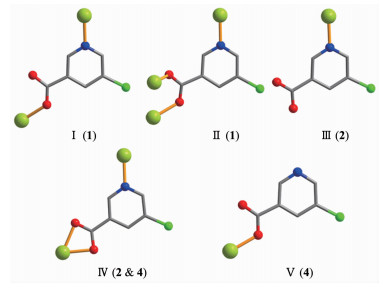
Compound 1 has a 3D metal-organic framework structure. The asymmetric unit of 1 (Fig. 1) comprises one Ni(Ⅱ) ion, two μ-5-Clnic- and μ3-5-Clnic- ligands, and a half of H2O ligand that is positioned on a 2-fold rotation axis. The six-coordinated Ni1 ion is surrounded by three O atoms of three different 5-Clnic- blocks, one O atom of H2O ligand, and two N atoms of two individual 5-Clnic- moieties, constructing a slightly distorted {NiN2O4} octahedral geometry. The Ni-O (0.205 8(3)~0.212 5(3) nm) and Ni-N (0.208 1(4)~0.210 4(4) nm) bond lengths are in good agreement with those observed in some other Ni(Ⅱ) compounds[17-18, 21]. In 1, the 5-Clnic- blocks take μ- and μ3-coordination modes (modes Ⅰ and Ⅱ, Scheme 1), in which the carboxylate groups act in η1:η0 monodentate and μ2-η1:η1 bidentate modes, respectively. Two Ni1 centers are bridged by two carboxylate groups and one μ-H2O ligand, giving rise to a binuclear Ni2 unit (Fig. 2) with a Ni…Ni separation of 0.349 7(4) nm and a Ni-Owater-Ni angle of 113.9(2)°. The adjacent Ni2 units are multiply interlinked by the 5-Clnic- blocks to form an intricate 3D framework (Fig. 3). Interestingly, in the MOF 1 the distance between the adjacent Cl atoms is 0.342 4(4) nm, which is shorter than the sum of the van der Waals radii of the two Cl atoms (ca. 0.350 nm)[22], thus indicating the existence of the Cl…Cl interactions (Fig. 3).
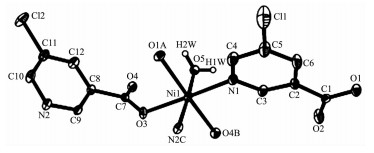
H atoms and lattice water molecules were omitted for clarity except H of H2O ligand; Symmetry codes: A: x, -x+1/2, z-1/2; B: -x+1/2, x, -z; C: -x+1, -x+1, -z
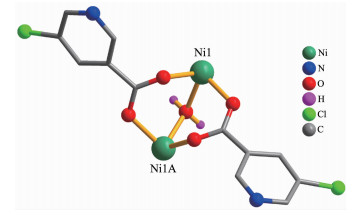
Symmetry codes: A: -x+1/2, y, -z
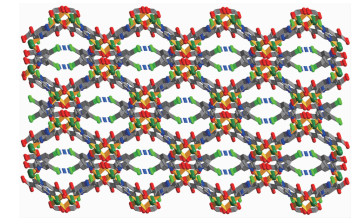
Dashed lines: Cl…Cl interactions
Compounds 2 and 3 are isostructural and feature a 1D metal-organic chain. As a representative example, the structure of 2 is described in detail (Fig. 4). The asymmetric unit of compound 2 contains one crystallo-graphically unique Ni(Ⅱ) ion, two distinct 5-Clnic- and μ-5-Clnic- ligands, and one H2biim moiety. As depicted in Fig. 4, each Ni(Ⅱ) ion is six-coordinated and adopts a distorted octahedral {NiN4O2} geometry formed by two carboxylate O atoms of one μ-5-Clnic- block, two N atoms of two different 5-Clnic- and μ-5-Clnic- ligands as well as two N atoms of one H2biim moiety. The Ni-O (0.212 0(2)~0.218 1(2) nm) and Ni-N (0.205 1(3)~0.210 7(3) nm) bond lengths are comparable to the literature data[15, 17, 21]. In 2, the 5-Clnic- ligands exhibit two different terminal and μ-coordination modes (modes Ⅲ and Ⅳ, Scheme 1), in which the carboxylate group either shows a η1:η1 bidentate mode or remains uncoor-dinated. The H2biim ligand acts in a bidentate chelating mode; the dihedral angle of two imidazole groups is 1.17°. The μ-5-Clnic- moieties alternatively link the adjacent Ni(Ⅱ) centers to form a linear 1D metal-organic chain with the Ni…Ni separation of 0.778 7(3) nm (Fig. 5). The neighboring chains are assembled into 2D supramolecular sheet motifs through the N-H…O hydrogen bonds (Fig. 6).
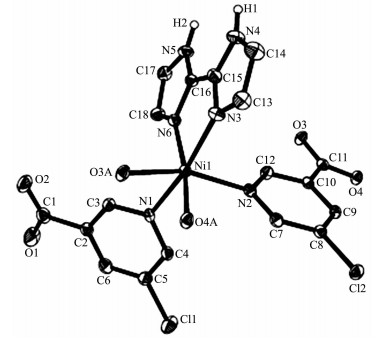
H atoms were omitted for clarity except those bonded to N atoms; Symmetry codes: A: x+1, y, z
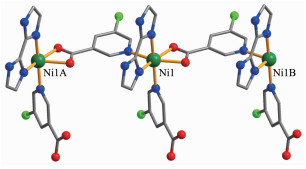
Symmetry codes: A: x-1, y, z; B: x+1, y, z
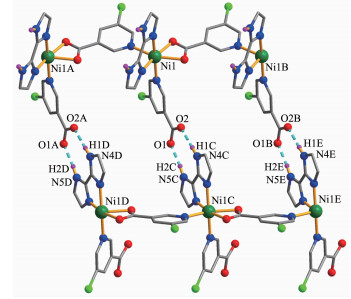
Dashed lines: H-bonds; Symmetry codes: A: x-1, y, z; B: x+1, y, z; C: x+1/2, y-1/2, -z+3/2; D: x-1/2, y-1/2, -z+3/2; E: x+3/2, y-1/2, -z+3/2
The compound 4 crystallizes in the triclinic space group P1 and also shows a linear 1D metal-organic chain structure. The asymmetric unit bears one crystallographically independent Zn(Ⅱ) ion, one terminal 5-Clnic- and one μ-5-Clnic- block, one phen ligand, and two lattice water molecules. As depicted in Fig. 7, the six-coordinated Zn(Ⅱ) ion adopts a distorted octahedral {ZnN3O3} geometry taken by three O atoms from the two distinct 5-Clnic- moieties and three N atoms from one 5-Clnic- and one phen ligand. The Zn-O and Zn-N bond distances are in ranges of 0.205 4(5)~0.238 4(6) nm and 0.212 5(5)~0.223 8(6) nm, which are within typical values for the Zn(Ⅱ)derivatives[16, 23-24]. In 4, the 5-Clnic- ligands show two different coordina-tion modes (modes Ⅳ and Ⅴ, Scheme 1), in which the carboxylate groups are either η1:η0 monodentate or η1:η1 bidentate. It should be mentioned that the N atom of 5-Clnic- remains uncoordinated in the mode Ⅴ. The μ-5-Clnic- moieties alternately bridge the adjacent Zn(Ⅱ) centers to form a linear 1D metal-organic chain (Fig. 8). The neighboring chains are sewed up into 3D supramolecular framework through Cl…Cl (0.331 6(5) nm) interactions and O-H…O hydrogen bonds involving lattice water molecules (Fig. 9).
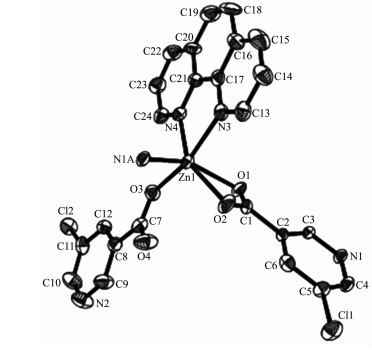
H atoms were omitted for clarity; Symmetry codes: A: x-1, y, z
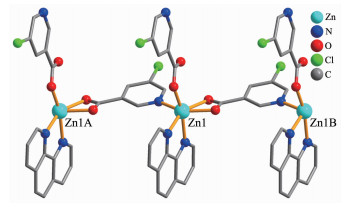
Symmetry codes: A: x-1, y, z; B: x+1, y, z
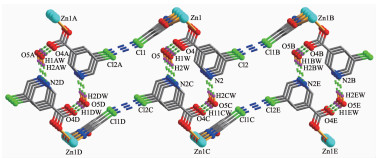
Phen ligands are omitted for clarity; Blue and green dashed lines represent Cl…Cl interactions and H-bonded, respectively; Symmetry codes: A: x+1, y, z-1; B: x-1, y, z+1; C: -x+1, -y+1, -z+1; D: -x+2, -y+1, -z; E: -x+1, -y+1, -z+2
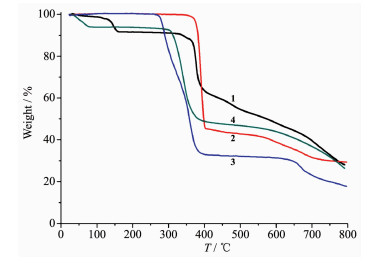
To determine the thermal stability of compounds 1~4, their thermal behaviors were investigated under nitrogen atmosphere by thermogravimetric analysis (TGA). As shown in Fig. 10, polymer 1 lost its one and a half of lattice water molecules as well as a half of one H2O ligand from 30 to 160 ℃ (Obsd. 8.7%; Calcd. 8.8%), followed by the decomposition at 329 ℃. For polymers 2 and 3, the TGA curves revealed that their samples were stable up to 348 ℃ and 260 ℃, respec-tively, followed by a decomposition on further heating. The TGA curve of 4 showed that two lattice water molecules were released from 29 to 79 ℃ (Obsd. 5.8%; Calcd. 6.0%), and the dehydrated solid began to decompose at 278 ℃.
Variable-temperature magnetic susceptibility studies were carried out on powder samples of 1 and 2 in a temperature range of 2~300 K. For the Ni(Ⅱ) MOF 1, the χMT value at 300 K was 1.16 cm3·mol-1·K, which was higher than the spin only value of 1.00 cm3·mol-1·K for one magnetically isolated Ni(Ⅱ) center (SNi=1, g=2.0). Upon cooling, the χMT value droped down very slowly from 1.16 cm3·mol-1·K at 300 K to 1.12 cm3·mol-1·K at 37 K and then decreased steeply to 0.26 cm3·mol-1·K at 2 K (Fig. 11). The χM-1 vs T plot for 1 in the 3~300 K interval obeyed the Curie-Weiss law with a Weiss constant θ of -10.32 K and a Curie constant C of 1.19 cm3·mol-1·K, suggesting a weak antiferromagnetic interaction between the Ni(Ⅱ) ions. Because of the long separation between the adjacent Ni2 units, only the coupling interactions within the di-nickel(Ⅱ) blocks were considered.
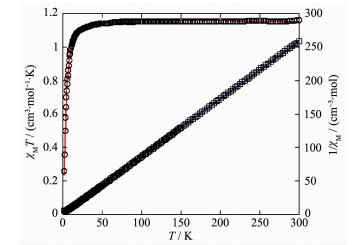
Red line represents the best fit to the equations in the text; Blue line shows the Curie-Weiss fitting
We tried to fit the magnetic data of 1 using the following expression[25] for a dinuclear Ni(Ⅱ) unit:
|
$ \begin{array}{*{20}{l}} {H = - J{S_1}{S_2}}\\ {{\chi _{M'}} = \frac{{N{\beta ^2}{g^2}}}{{3k\left( {T - \theta } \right)}}\frac{{\sum {S'\left( {S' + 1} \right)\left( {2S' + 1} \right)_{\rm{e}}^{ - {E_S}I\left( {KT} \right)}} }}{{\sum {\left( {2S' + 1} \right)_{\rm{e}}^{ - {E_S}I\left( {KT} \right)}} }}}\\ {{\chi _M} = {\chi _{M'}}\left( {1 - \rho } \right) + \frac{{4S\left( {S + 1} \right)N{\beta ^2}{g^2}\rho }}{{3kT}} + {\rm{TIP}}} \end{array} $ |
where ρ is a paramagnetic impurity fraction and TIP is temperature independent paramagnetism. Using this model, the susceptibility for 1 above 2.0 K was simul-ated, leading to the values of J=-2.53 cm-1, g=2.11, ρ=0.005, and TIP=9.04×10⁻⁶ cm3·mol-1, with the agree-ment factor R=9.38×10⁻⁴ (R=∑(Tobs-Tcalc)2/∑(Tobs)2). The negative J parameter confirms that a weak antiferro-magnetic exchange coupling exists between the adjacent Ni(Ⅱ) centers, which is in agreement with a negative θ value. In the structure of 1 (Fig. 2), there are two types of magnetic exchange pathways within the dinuclear units, namely via the μ-H2O and μ-η1:η1-carboxylate (syn-syn) bridges. According to previous studies, the magnetic interaction is highly sensitive to the value of the Ni-O-Ni bridging angle, showing the domination of the Ni-Ni ferromagnetic coupling when the Ni-O-Ni angles are (90±14)°[26]. The larger Ni-O-Ni angles in the Ni2 unit (113.9(2)°) might suggest that the O bridges could be responsible for an antiferro-magnetic exchange component. Meanwhile, the syn-syn carboxylate group bridging is likely to have a dominant antiferromagnetic effect. Hence, the small -J value observed for 1 (-2.53 cm-1) could well be a result of two compatible exchange effects.
For 2, the room temperature value of χMT, 1.10 cm3·mol-1·K, was close to that of 1.00 cm3·mol-1·K expected for one magnetically isolated high-spin Ni(Ⅱ) ion (S=1, g=2.0). Upon cooling, the χMT value droped down very slowly from 1.10 cm3·mol-1·K at 300 K to 1.07 cm3·mol-1·K at 45 K and then decreased steeply to 0.53 cm3·mol-1·K at 2 K (Fig. 12). Between 2 and 300 K, the magnetic susceptibilities can be fitted to the Curie-Weiss law with C=1.12 cm3·mol-1·K and θ=-9.14 K. These results indicate an antiferromagnetic interaction between the adjacent Ni(Ⅱ) centers in compound 2. An empirical (Weng′s) formula can be applied to analyze the 1D systems with S=1, using numerical procedures[27-28]:
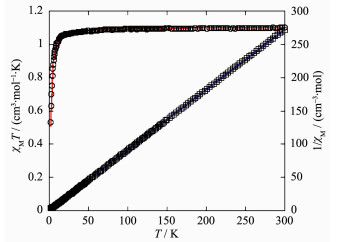
Red line represents the best fit to the equations in the text; Blue line shows the Curie-Weiss fitting
|
$ \begin{array}{*{20}{l}} {H = - J{S_i}{S_j}}\\ {{\chi _M} = \frac{{N{\beta ^2}{g^2}}}{{kT}}\frac{A}{B}}\\ {A = 2.0 + 0.019\;4x + 0.777{x^2}}\\ {B = 3.0 + 4.346x + 3.232{x^2} + 5.834{x^2}}\\ {{\rm{with}}\;x = \left| J \right|/\left( {kT} \right)} \end{array} $ |
Using this method, the best-fit parameters for 2 were obtained: J=-1.91 cm-1, g=2.05 and R=3.37×10⁻⁵. A negative J parameter indicates a weak antiferroma-gnetic exchange coupling between the adjacent Ni(Ⅱ) centers in 2, which is in agreement with a negative θ value.
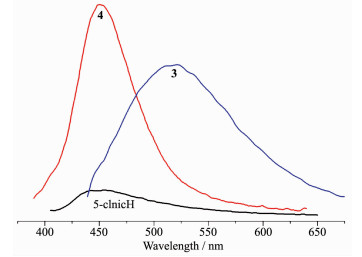
The emission spectra of 5-ClnicH and compounds 3 and 4 were measured in the solid state at room temperature, as depicted in Fig. 13. The free 5-ClnicH ligand displayed a weak photoluminescence with an emission maximum at 452 nm. For compounds 3 and 4, more intense emission bands are observed with maximum at 522 nm for 3 and 451 nm for 4 (λex=305 nm in all cases). All bands can be assigned to an intraligand (π*→n or π*→π) emission[11-13].
In this work, we applied an aqueous medium self-assembly method for the hydrothermal generation of four new coordination polymers derived from 5-chloronicotinic acid as a main building block. The obtained compounds were fully characterized and their structures range from 3D metal-organic framework (1) to 1D chain (2~4). The low dimensionality of 2~4 arises from the introduction of 2, 2′-biimidazole and 1, 10-phenanthroline as auxiliary ligands. Besides, the magnetic (for 1 and 2) and Luminescent (for 3 and 4) properties were also investigated and discussed. The results show that such simple, low-cost, and water-soluble carboxylic acid can be used as a versatile multifunctional building block toward the generation of new coordination polymers.
Lu W G, Su C Y, Jiang L, et al. J. Am. Chem. Soc., 2006, 128:34-35 doi: 10.1021/ja0567337
Zheng X D, Lu T B. CrystEngComm, 2010, 12:324-336 doi: 10.1039/B911991D
Lee J Y, Farha O K, Roberts J, et al. Chem. Soc. Rev., 2009, 38:1450-1459 doi: 10.1039/b807080f
Cui Y J, Yue Y F, Chen B L. Chem. Rev., 2012, 112:1126-1162 doi: 10.1021/cr200101d
Li J R, Kuppler R J, Zhou H C. Chem. Soc. Rev., 2009, 38:1477-1504 doi: 10.1039/b802426j
Zhou Y L, Wu M C, Zeng M H, et al. Inorg. Chem., 2009, 48:10146-10150 doi: 10.1021/ic901085p
Zhang L N, Zhang C, Zhang B, et al. CrystEngComm, 2015, 17:2837-2846 doi: 10.1039/C5CE00263J
Du M, Li C P, Liu C S, et al. Coord. Chem. Rev., 2013, 257:1282-1305 doi: 10.1016/j.ccr.2012.10.002
Chen X M, Tong M L. Acc. Chem. Res., 2007, 40:162-170 doi: 10.1021/ar068084p
Singh R, Bharatdwaj P K. Cryst. Growth Des., 2013, 13:3722-3733 doi: 10.1021/cg400756z
Gu J Z, Gao Z Q, Tang Y. Cryst. Growth Des., 2012, 12:3312-3323 doi: 10.1021/cg300442b
Gu J Z, Cui Y H, Liang X X, et al. Cryst. Growth Des., 2016, 16:4658-4670 doi: 10.1021/acs.cgd.6b00735
Gu J Z, Kirillov A M, Wu J, et al. CrystEngComm, 2013, 15:10287-10303 doi: 10.1039/c3ce41457d
Wu Y P, Wu X Q, Wang J F, et al. Cryst. Growth Des., 2016, 16:2309-2316 doi: 10.1021/acs.cgd.6b00093
Shao Y L, Cui Y H, Gu J Z, et al. CrystEngComm, 2016, 18:765-7783 doi: 10.1039/C5CE02254A
Gao Z Q, Li H J, Gu J Z, et al. J. Solid State Chem., 2016, 241:121-130 doi: 10.1016/j.jssc.2016.05.034
Cui Y H, Wu J, Kirillov A M, et al. RSC Adv., 2015, 5:10400-10411 doi: 10.1039/C4RA14534H
Gu J Z, Cai Y, Liang X X, et al. CrystEngComm, 2018, 20:906-916 doi: 10.1039/C7CE02009K
Spek A L. Acta Crystallogr. Sect. C:Struct. Chem., 2015, 71:9-18 doi: 10.1107/S2053229614024929
Van de Sluis P, Spek A L. Acta Crystallogr. Sect. A:Found. Crystallogr., 1990, A46:194-201 http://cn.bing.com/academic/profile?id=e33810f77aeefcb1c7b41e7a6790a891&encoded=0&v=paper_preview&mkt=zh-cn
梁丽丽, 刘从森, 宗智慧, 等.无机化学学报, 2018, 34(7):1365-1372 http://www.wjhxxb.cn/wjhxxbcn/ch/reader/view_abstract.aspx?flag=1&file_no=20180719&journal_id=wjhxxbcnLIANG Li-Li, LIU Cong-Sen, ZONG Zhi-Hui, et al. Chinese J. Inorg. Chem., 2018, 34(7):1365-1372 http://www.wjhxxb.cn/wjhxxbcn/ch/reader/view_abstract.aspx?flag=1&file_no=20180719&journal_id=wjhxxbcn
Bertani R, Sgarbossa P, Venzo A, et al. Coord. Chem. Rev., 2010, 254:677-695 doi: 10.1016/j.ccr.2009.09.035
严世承, 武大令, 张敏芝, 等.无机化学学报, 2018, 34(6):1110-1120 http://www.wjhxxb.cn/wjhxxbcn/ch/reader/view_abstract.aspx?flag=1&file_no=20180614&journal_id=wjhxxbcnYAN Shi-Cheng, WU Da-Ling, ZHANG Min-Zhi, et al. Chinese J. Inorg. Chem., 2018, 34(6):1110-1120 http://www.wjhxxb.cn/wjhxxbcn/ch/reader/view_abstract.aspx?flag=1&file_no=20180614&journal_id=wjhxxbcn
杨诗吟, 才华, 张琦.无机化学学报, 2018, 34(1):179-186 http://www.wjhxxb.cn/wjhxxbcn/ch/reader/view_abstract.aspx?flag=1&file_no=20180121&journal_id=wjhxxbcnYANG Shi-Ying, CAI Hua, ZHANG Qi. Chinese J. Inorg. Chem., 2018, 34(1):179-186 http://www.wjhxxb.cn/wjhxxbcn/ch/reader/view_abstract.aspx?flag=1&file_no=20180121&journal_id=wjhxxbcn
Thompson L K, Niel V, Grove H, et al. Polyhedron, 2004, 23:1175-1184 doi: 10.1016/j.poly.2004.01.022
Mahata P, Natarajan S, Panissod P, et al. J. Am. Chem. Soc., 2009, 131:10140-10150 doi: 10.1021/ja9017539
Kahn O. Molecular Magnetism. New York:VCH Publishers, 1993.
Weng C H. Thesis for the Doctorate of Carnegie-Mellon University. 1968.

Figure 1 Drawing of asymmetric unit of compound 1 with 30% probability thermal ellipsoids
H atoms and lattice water molecules were omitted for clarity except H of H2O ligand; Symmetry codes: A: x, -x+1/2, z-1/2; B: -x+1/2, x, -z; C: -x+1, -x+1, -z

Figure 2 Di-nickel(Ⅱ) unit of 1 Dashed lines: Cl…Cl interactions
Symmetry codes: A: -x+1/2, y, -z

Figure 3 Perspective of a 3D framework of 1 parallel to bc plane
Dashed lines: Cl…Cl interactions

Figure 4 Drawing of asymmetric unit of compound 2 with 30% probability thermal ellipsoids
H atoms were omitted for clarity except those bonded to N atoms; Symmetry codes: A: x+1, y, z

Figure 5 Perspective view of 1D chain along c axis
Symmetry codes: A: x-1, y, z; B: x+1, y, z

Figure 6 Perspective of a 2D supramolecular network along a axis
Dashed lines: H-bonds; Symmetry codes: A: x-1, y, z; B: x+1, y, z; C: x+1/2, y-1/2, -z+3/2; D: x-1/2, y-1/2, -z+3/2; E: x+3/2, y-1/2, -z+3/2

Figure 7 Drawing of asymmetric unit of compound 4 with 30% probability thermal ellipsoids
H atoms were omitted for clarity; Symmetry codes: A: x-1, y, z

Figure 8 One dimensional chain in compound 4
Symmetry codes: A: x-1, y, z; B: x+1, y, z

Figure 9 Perspective of a 3D supramolecular framework along a axis
Phen ligands are omitted for clarity; Blue and green dashed lines represent Cl…Cl interactions and H-bonded, respectively; Symmetry codes: A: x+1, y, z-1; B: x-1, y, z+1; C: -x+1, -y+1, -z+1; D: -x+2, -y+1, -z; E: -x+1, -y+1, -z+2

Figure 11 Temperature dependence of χMT (○) and 1/χM (□) vs T for compound 1
Red line represents the best fit to the equations in the text; Blue line shows the Curie-Weiss fitting

Figure 12 Temperature dependence of χMT (○) and 1/χM (□) vs T for compound 2
Red line represents the best fit to the equations in the text; Blue line shows the Curie-Weiss fitting
Table 1. Crystal data for compounds 1~4
| Compound | 1 | 2 | 3 | 4 |
| Chemical formula | C12H10Cl2NiN2O6 | C18H12Cl2NiN6O4 | C18H12Cl2ZnN6O4 | C24H18Cl2ZnN4O6 |
| Molecular weight | 407.81 | 505.95 | 512.61 | 594.69 |
| Crystal system | Monoclinic | Orthorhombic | Orthorhombic | Triclinic |
| Space group | I2/a | Pbcn | Pbcn | P1 |
| a / nm | 1.432 71(16) | 0.778 75(3) | 0.779 11(3) | 0.771 48(8) |
| b / nm | 1.672 20(16) | 1.804 37(7) | 1.827 48(8) | 1.264 3(2) |
| c / nm | 1.462 59(17) | 2.758 83(11) | 2.777 68(13) | 1.328 8(2) |
| α / (°) | 106.443(16) | |||
| β / (°) | 118.373(14) | 90.973(11) | ||
| γ / (°) | 90.282(12) | |||
| V / nm3 | 3.083 1(7) | 3.876 6(3) | 3.954 9(3) | 1.242 8(4) |
| Z | 8 | 8 | 8 | 2 |
| F(000) | 1 528 | 2 048 | 2 064 | 604 |
| θ range for data collection / (°) | 3.673~25.049 | 3.534~25.047 | 3.514~25.046 | 3.280~25.049 |
| Limiting indices | -16 ≤ h ≤ 17, | -9 ≤ h ≤ 9, | -9 ≤ h ≤ 8, | -8 ≤ h ≤ 9, |
| -19≤ k ≤ 16, | -20 ≤ k ≤ 21, | -21 ≤ k ≤ 19, | -15 ≤ k ≤ 9, | |
| -17 ≤ l ≤ 14 | -32 ≤ l ≤ 18 | -31 ≤ l ≤ 33 | -13 ≤ l ≤ 15 | |
| Reflection collected, unique (Rint) | 5 459, 2 730 (0.052 0) | 13 122, 3 432 (0.059 8) | 13 633, 3 495 (0.063 9) | 7 527, 4 396 (0.070 9) |
| Dc / (g·cm-3) | 1.641 | 1.734 | 1.722 | 1.589 |
| μ / mm-1 | 1.623 | 1.318 | 1.553 | 1.251 |
| Data, restraint, parameter | 2 730, 0, 195 | 3 432, 0, 280 | 3 495, 0, 284 | 4 396, 0, 334 |
| Goodness-of-fit on F2 | 1.029 | 1.032 | 1.052 | 1.012 |
| Final R indices [I≥2σ(I)] R1, wR2 | 0.052 8, 0.100 0 | 0.040 5, 0.085 6 | 0.044 3, 0.086 0 | 0.073 2, 0.141 0 |
| R indices (all data) R1, wR2 | 0.079 2, 0.112 4 | 0.065 0, 0.102 2 | 0.069 6, 0.101 7 | 0.133 7, 0.183 6 |
| Largest diff. peak and hole / (e·nm-3) | 811 and -566 | 411 and -436 | 478 and -437 | 490 and -712 |
 下载: 导出CSV
Table 2. Selected bond distances (nm) and bond angles (°) for compounds 1~4
| 1 | |||||
| Ni(1)-O(1)A | 0.212 5(3) | Ni(1)-O(3) | 0.206 0(3) | Ni(1)-O(4)B | 0.205 8(3) |
| Ni(1)-O(5) | 0.208 6(2) | Ni(1)-N(1) | 0.210 4(4) | Ni(1)-N(2)C | 0.208 1(4) |
| O(4)B-Ni(1)-O(3) | 96.65(13) | O(4)B-Ni(1)-N(2)C | 91.38(14) | O(3)-Ni(1)-N(2)C | 84.76(14) |
| O(4)B-Ni(1)-O(5) | 87.91(10) | O(3)-Ni(1)-O(5) | 91.24(12) | O(5)-Ni(1)-N(2)C | 175.83(15) |
| O(4)B-Ni(1)-N(1) | 88.96(14) | O(3)-Ni(1)-N(1) | 170.91(13) | N(1)-Ni(1)-N(2)C | 87.98(15) |
| O(5)-Ni(1)-N(1) | 96.12(14) | O(4)B-Ni(1)-O(1)A | 177.41(12) | O(3)-Ni(1)-O(1)A | 83.90(13) |
| N(2)C-Ni(1)-O(1)A | 91.19(14) | O(5)-Ni(1)-O(1)A | 89.54(10) | N(1)-Ni(1)-O(1)A | 90.82(14) |
| Ni(1)-O(5)-Ni(1)B | 113.9(2) | ||||
| 2 | |||||
| Ni(1)-O(3)A | 0.218 1(2) | Ni(1)-O(4)A | 0.212 0(2) | Ni(1)-N(1) | 0.209 7(3) |
| Ni(1)-N(2) | 0.210 7(3) | Ni(1)-N(3) | 0.208 5(3) | Ni(1)-N(6) | 0.205 1(3) |
| N(6)-Ni(1)-N(3) | 80.37(12) | N(6)-Ni(1)-N(1) | 90.67(12) | N(3)-Ni(1)-N(1) | 170.17(12) |
| N(6)-Ni(1)-N(2) | 97.36(11) | N(3)-Ni(1)-N(2) | 89.95(12) | N(2)-Ni(1)-N(1) | 95.24(11) |
| N(6)-Ni(1)-O(4)A | 168.24(11) | N(3)-Ni(1)-O(4)A | 95.20(11) | N(1)-Ni(1)-O(4)A | 92.82(11) |
| N(2)-Ni(1)-O(4)A | 93.50(10) | N(6)-Ni(1)-O(3)A | 107.57(11) | N(3)-Ni(1)-O(3)A | 92.45(11) |
| N(1)-Ni(1)-O(3)A | 86.37(10) | N(2)-Ni(1)-O(3)A | 155.01(11) | O(3)A-Ni(1)-O(4)A | 61.51(9) |
| 3 | |||||
| Zn(1)-O(3)A | 0.218 2(3) | Zn(1)-O(4)A | 0.225 6(3) | Zn(1)-N(1) | 0.216 6(3) |
| Zn(1)-N(2) | 0.216 9(3) | Zn(1)-N(3) | 0.208 0(3) | Zn(1)-N(6) | 0.213 6(3) |
| N(3)-Zn(1)-N(6) | 79.81(13) | N(3)-Zn(1)-N(1) | 90.70(13) | N(6)-Zn(1)-N(1) | 170.13(14) |
| N(3)-Zn(1)-N(2) | 101.00(12) | N(6)-Zn(1)-N(2) | 90.43(13) | N(1)-Zn(1)-N(2) | 94.07(12) |
| N(3)-Zn(1)-O(3)A | 110.92(12) | N(6)-Zn(1)-O(3)A | 94.21(11) | N(1)-Zn(1)-O(3)A | 86.60(11) |
| N(2)-Zn(1)-O(3)A | 148.06(12) | N(3)-Zn(1)-O(4)A | 169.12(12) | N(6)-Zn(1)-O(4)A | 95.64(12) |
| N(1)-Zn(1)-O(4)A | 93.23(12) | N(2)-Zn(1)-O(4)A | 88.85(11) | O(3)A-Zn(1)-O(4)A | 59.27(10) |
| 4 | |||||
| Zn(1)-O(1) | 0.212 8(5) | Zn(1)-O(2) | 0.238 4(6) | Zn(1)-O(3) | 0.205 4(5) |
| Zn(1)-N(1)A | 0.212 5(5) | Zn(1)-N(3) | 0.223 8(6) | Zn(1)-N(4) | 0.212 7(6) |
| O(3)-Zn(1)-N(1)A | 92.6(2) | O(3)-Zn(1)-N(4) | 89.3(2) | N(1)A-Zn(1)-N(4) | 108.1(2) |
| O(3)-Zn(1)-O(1) | 94.72(19) | N(1)A-Zn(1)-O(1) | 144.4(2) | N(4)-Zn(1)-O(1) | 106.8(2) |
| O(3)-Zn(1)-N(3) | 165.3(2) | N(1)-Zn(1)-N(3) | 88.2(2) | N(4)-Zn(1)-N(3) | 76.5(2) |
| O(1)-Zn(1)-N(3) | 93.21(19) | O(3)-Zn(1)-O(2) | 112.1(2) | N(1)-Zn(1)-O(2) | 86.7(2) |
| N(4)-Zn(1)-O(2) | 153.7(2) | O(2)-Zn(1)-O(1) | 58.30(19) | N(3)-Zn(1)-O(2) | 82.6(2) |
| Symmetry codes: A: x, -y+1/2, z-1/2; B: -x+1/2, y, -z; C: -x+1, -y+1, -z for 1; A: x+1, y, z for 2; A: x+1, y, z for 3; A: x-1, y, z for 4 | |||||
下载: 导出CSV
Table 3. Hydrogen bond lengths (nm) and angles (°) of compounds 1 and 2
| Compound | D-H…A | d(D-H) / nm | d(H…A) / nm | d(D…A) / nm | ∠DHA / (°) |
| 1 | O(5)-H(1W)…O(2)A | 0.085 | 0.166 | 0.251 4 | 179.7 |
| O(5)-H(2W)…O(2)B | 0.085 | 0.166 | 0.251 4 | 179.7 | |
| 2 | N(4)-H(1)…O(2)A | 0.086 | 0.185 | 0.270 9 | 172.6 |
| N(5)-H(2)…O(1)A | 0.086 | 0.180 | 0.265 4 | 175.2 | |
| 3 | N(4)-H(1)…O(1)A | 0.086 | 0.178 | 0.263 6 | 174.1 |
| N(5)-H(2)…O(2)A | 0.085 | 0.185 | 0.270 0 | 170.9 | |
| 4 | O(5)-H(1W)…O(4)A | 0.085 | 0.196 | 0.281 1 | 179.3 |
| O(5)-H(2W)…N(2)B | 0.085 | 0.202 | 0.286 9 | 173.1 | |
| O(6)-H(3W)…O(5)C | 0.085 | 0.208 | 0.293 1 | 179.0 | |
| Symmetry codes: A: -x+1/2, -y+1/2, -z+1/2; B: x, -y+1/2, -z+1/2 for 1; A: x-1/2, y+1/2, -z+3/2 for 2. | |||||
下载: 导出CSV

 扫一扫看文章


扫一扫关注我们