表 1
Crystallographic data of complexes 1 and 2
Table 1.
Crystallographic data of complexes 1 and 2

Syntheses, Crystal Structures and Luminescence Properties of Nd Complexes with β-Diketonate and Triphenylphosphine Oxide
Qiang LIU , Shuai ZHANG , Kai DU , Qiang YIN , Wa LI , Pei-Jun CAI


Lanthanide complexes based on β-diketonate as ligands have attracted much attention over the past decades due to their unusual luminescence properties and potential applications in light-emitting diodes[1-5], catalytic actions[6-9] and magnetic materials[10-13], etc.As generally known, lanthanide ions have excellent luminescent properties arising from their filling mode of the 4f orbitals.The characterizations of lanthanide ions luminescence, such as sharp emission and high color purity, originate from f-f electron transitions.However, these transitions are difficult because of the shielding by 5s and 5p shells which are filled by electrons.The β-diketonate molecules are the most effective ligands to increase the electron transitions of center lanthanide ions by constructing coordination geometry.In order to explore the connections between structural and physic-chemical properties, we have synthesized two neodymium complexes with 4, 4, 4-trifl-uoro-1-(2-thienyl)-1, 3-butanedione(TTA), 4, 4, 4-trifl-uoro-1-phenyL-1, 3-butanedione(BFA) and triphenylph-osphineoxide(TPPO) as ligands, namely [Nd(TTA)3(TPPO)2] (1) and [Nd(BFA)3(TPPO)2] (2), under mild condition.In this report we described the syntheses, structural characterizations and properties of the two Nd ternary complexes.
All reagents and solvents employed were used as commercial sources without further purification.Elemental analyses (C, H) were performed on a Perkin-Elmer 240 CHN elemental analyzer.Infrared spectra were recorded on a Nicolet 6700 FTIR spectrometer with KBr disks in the range of 4 000~400 cm-1.Thermogravimetric analyses (TGA) were performed on a TGA Pyris 1 PE instrument heating from room temperature to 800 ℃ under a flow of N2 with a heating rate of 10 ℃·min-1.Solid-state excitation and fluorescence spectra for crystals were recorded at room temperature on a Fluorolog-3 spectrofluorometer (Horiba Jobin Yvon) with a 450W Xenon Lamp as the excitation source and a PMT (H10330-75, Hama-matsu) as the detector.
β-diketonate ligand (1.5 mmol) was dissolved in 10 mL ethanol, and aqueous solution of neodymium acetate monohydrate (1 mL, 0.5 mmol) was added dropwise into the β-diketonate ligand solution.The mixtures were stirred for 4 h at room temperature, and then followed by the addition of triphenylphosphine oxide (TPPO) ethanol solution (5 mL, 1.0 mmol).After stirring overnight, crystalline precipitates were formed.The products were filtered and washed several times with ethanol, then dried under vacuum at 70 ℃ for 24 h.The complexes were dissolved in ethyl acetate/ethanol (1:1, V/V) and stilled several days. Pink crystals were obtained in the form of single crystals which are suitable for X-ray measurements.The obtained crystals are hardly soluble in water or ethanol but soluble in ethyl acetate, DMF, THF and DMSO.
Nd(TTA)3(TPPO)2] (1):Yield:92.5% based on the Nd.Main IR bands (cm-1):1 625(s), 1 535(m), 1 502(m), 1 472(w), 1 438(w), 1 415(m), 1 297(s), 1 236(w), 1 168(s), 1127(s), 783(w), 721(m), 693(w), 541(m).Anal. Calcd. for C60H42F9NdO8P2S3(%):C, 52.82;H, 3.10.Found(%):C, 52.42;H, 3.01.
[Nd(BFA)3(TPPO)2] (2):Yield:86.6% based on the Nd.Main IR bands (cm-1):1 625(s), 1 579(m), 1 532(m), 1 486(m), 1 438(m), 1 314(m), 1 297(s), 1 240(w), 1 170(s), 1 128(s), 760(w), 723(m), 695(m), 541(m).Anal.Calcd.for C66H48F9NdO8P2(%):C, 58.88;H, 3.59.Found(%):C, 58.30;H, 3.35.
The single-crystal diffraction measurements for complexes were performed on a Xcalibur Eos four-circle diffractometer with monochromatic Mo Kα radia-tion source (λ=0.071 073 nm) at 143 K.The structures were solved by a direct method using the program SHELXS-2013 and refined anisotropically by the full-matrix least squares on F2 using the SHELXL-2013 crystallographic software package to the non-hydrogen atoms[14-15]. Hydrogen atoms based on carbon were generated geometrically and refined using the riding model.The summary of crystal data and refinement details are listed in Table 1, and the selected bond lengths and bond angles are given in Table 2.
 下载:
导出CSV
下载:
导出CSV
| Empirical formula | C60H42F9NdO8P2S3 | C66H48F9NdO8P2 |
| Formula weight | 1 364.29 | 1 346.22 |
| Crystal system | Triclinic | Triclinic |
| Space group | P1 | P1 |
| a/nm | 1.117 01(5) | 1.123 44(4) |
| b/nm | 1.212 22(4) | 1.227 63(3) |
| c/nm | 2.351 37(7) | 2.369 10(8) |
| α/(°) | 80.094(3) | 79.778(3) |
| β/(°) | 76.759(3) | 76.477(3) |
| γ/(°) | 70.521(4) | 71.603(3) |
| V/nm3 | 2.905 9(18) | 2.995 33(19) |
| Z | 2 | 2 |
| Dc/(g·c'-3) | 1.559 | 1.493 |
| Crystal size/mm | 0.35×0.35×0.30 | 0.40×0.35×0.30 |
| Absorption coefficient/mm-1 | 1.139 | 1.004 |
| F(000) | 1 370 | 1 358 |
| θ range/(°) | 3.021~26.372 | 2.975~26.371 |
| Reflection collected, unique (Rint) | 23 442, 11 S52 (0.026 4) | 25 676, 12 229 (0.033 4) |
| Goodness of fit on F2 | 1.036 | 1.042 |
| Final R indices [I≥2σ(I)] | R1=0.035 7, wR2=0.076 7 | )R1=0.037 4, wR2=0.081 6 |
| Largest diff. peak and hole/(e·nm-3) | 670 and -490 | 490 and -450 |
下载:
导出CSV
| 1 | |||||
| Nd1-O1 | 0.240 39(19) | Nd1-O2 | 0.241 91(19) | Nd1-O3 | 0.248 59(18) |
| Nd1-O4 | 0.240 9(2) | Nd1-O5 | 0.248 2(19) | Nd1-O6 | 0.239 7(2) |
| Nd1-O7 | 0.248 8(2) | Nd1-O8 | 0.240 6(2) | ||
| O1-Nd1-O2 | 145.02(7) | O3-Nd1-O4 | 69.96(7) | O5-Nd1-O6 | 70.68(7) |
| O7-Nd1-O8 | 69.11(7) | O1-Nd1-O3 | 75.53(7) | O1-Nd1-O4 | 87.46(7) |
| O1-Nd1-O5 | 78.80(7) | O1-Nd1-O6 | 143.77(7) | O1-Nd1-O7 | 79.92(7) |
| O1-Nd1-O8 | 83.44(7) | O2-Nd1-O3 | 71.76(7) | O2-Nd1-O4 | 84.83(7) |
| O2-Nd1-O5 | 129.70(7) | O2-Nd1-O6 | 71.21(7) | O2-Nd1-O7 | 125.06(7) |
| O2-Nd1-O8 | 84.15(7) | O3-Nd1-O5 | 132.63(7) | O3-Nd1-O6 | 142.40(7) |
| O3-Nd1-O7 | 138.08(7) | O3-Nd1-O8 | 76.03(7) | O4-Nd1-O5 | 71.15(7) |
| O4-Nd1-O6 | 100.32(8) | O4-Nd1-O7 | 141.02(7) | O4-Nd1-O8 | 145.99(7) |
| O5-Nd1-O7 | 70.26(7) | O5-Nd1-O8 | 137.81(7) | O6-Nd1-O7 | 71.83(7) |
| O6-Nd1-O8 | 106.32(8) | ||||
| 2 | |||||
| Nd1-O1 | 0.247 66(19) | Nd1-O2 | 0.241 3(2) | Nd1-O3 | 0.249 9(2) |
| Nd1-O4 | 0.239 6(2) | Nd1-O5 | 0.244 57(19) | Nd1-O6 | 0.241 9(2) |
| Nd1-O7 | 0.242 3(2) | Nd1-O8 | 0.240 58(19) | ||
| O1-Nd1-O2 | 69.54(7) | O3-Nd1-O4 | 69.07(7) | O5-Nd1-O6 | 70.06(7) |
| O7-Nd1-O8 | 146.54(7) | O1-Nd1-O3 | 136.25(7) | O1-Nd1-O4 | 75.66(7) |
| O1-Nd1-O5 | 130.94(7) | O1-Nd1-O6 | 144.98(7) | O1-Nd1-O7 | 73.46(7) |
| O1-Nd1-O8 | 73.28(7) | O2-Nd1-O3 | 142.84(7) | O2-Nd1-O4 | 144.98(7) |
| O2-Nd1-O5 | 70.86(7) | O2-Nd1-O6 | 100.43(7) | O2-Nd1-O7 | 82.33(8) |
| O2-Nd1-O8 | 89.49(7) | O3-Nd1-O5 | 72.39(7) | O3-Nd1-O6 | 71.61(7) |
| O3-Nd1-O7 | 125.85(7) | O3-Nd1-O8 | 78.11(7) | O4-Nd1-O5 | 140.22(7) |
| O4-Nd1-O6 | 105.84(7) | O4-Nd1-O7 | 84.22(8) | O4-Nd1-O8 | 84.20(7) |
| O5-Nd1-O7 | 127.70(7) | O5-Nd1-O8 | 78.62(7) | O6-Nd1-O7 | 71.93(7) |
| O6-Nd1-O8 | 141.52(7) | ||||
CCDC:1558841, 1;1558842, 2.
IR spectra of the two complexes were similar at main bands depending on their similar structures.The strong IR band of 1 625 cm-1 is attributed to the stretching vibrations of C=C-C=O conjugate system in Nd complexes.Other same groups, such as C-O, P=O and CF3, have strong bands in the range from 1 350 to 1 100 cm-1.In these IR spectra, strong bands at 1 297, 1 168 and 1 127 cm-1 probably belong to aforesaid groups.
The slight differentia between each other are the middling bands at 1 502 and 1 415 cm-1 (for complex 1) owing to the thienyl in 4, 4, 4-trifluoro-1-(2-thienyl)-1, 3-butanedione ligands, as well as the band of 1 579 cm-1 (for complex 2) owing to the phenyl in 4, 4, 4-trifluoro-1-phenyL-1, 3-butanedione ligands.
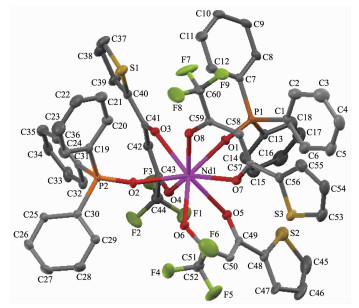
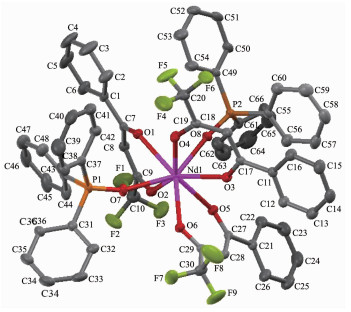
The crystal system and unit cell of complexes were determined by single-crystal X-ray diffraction analysis.The results reveal that the two complexes both crystallize in triclinic symmetry with P1 space group, which are shown in Fig. 1 and 2.
The complexes of 1 and 2 have eight-coordinated Nd ions with six O atoms (O3, O4, O5, O6, O7, O8 for 1; O1, O2, O3, O4, O5, O6 for 2) from the three β-diketonate ligand molecules and the other two O atoms (O1, O2 for 1; O7, O8 in for 2) afforded by two triphenylphosphineoxide molecules.In addition, no solvent molecules participate in the crystal structure of complexes.The Nd-OTTA distances range from 0.239 7 to 0.248 8 nm, Nd-OBFA distances from 0.239 6 to 0.249 9 nm and the Nd-OTPPO distances from 0.240 4 to 0.242 3 nm.All the bond lengths are within the range of those found in the other analogical Nd complexes[16-18].The O-Nd-O bond angles in the comp-lexes range from 69.07° to 146.54° (Table 2).
The complexes of 1 and 2 possess 3D structures with analogical mode.The crystallographic description will be focused on complex 1 (Fig. 1).Single-crystal X-ray diffraction analysis reveals that the bond lengths based on center Nd ion and O atoms (O4, O6, O8) which are near by the trifluoromethyl group are longer than the others based on center ion and O atoms (O3, O5, O7) which are near by the thienyl group.It should be attributed to the strong action of attracting electron with trifluoromethyl group of the ligand, which results in adding electron cloud density of O atoms and enhancing its ability of coordination with Nd ion.Three TTA ligands distribute on an approximate plane including the center Nd ion.And two TPPO ligands lie in the opposite positions of this plane with OTPPO-Nd-OTPPO bond angle of 145.01°, which results in reducing the repulsion to each other.
Owing to the absence of solvate molecules and additional hydrogen bonds, the crystal lattices of complexes are dominated by van der Waals forces.In addition, it was found that a weak interaction (π-π stacking interaction) exists in crystal units of complexes.As shown in Fig. 3a, in complex 1, the face to face π-π stacking interactions occur between the two benzene rings (from C19 to C24 for each benzene ring) by the different TPPO ligands contained in the two adjacent molecules.The centroid-to-centroid distance of 0.390 7 nm and the dihedral angle of 0.007° belong to effective π-π stacking interactions.Similar structures are also found in complex 2 (Fig. 3b).Two benzene rings (from C37 to C42 for each benzene ring) form face to face π-π stacking interactions with the centroid-to-centroid distance of 0.406 3 nm and the dihedral angle of 0°.More units connect each other via these weak π-π interaction and van der Waals forces, thus, three-dimensional coordination frameworks are constructed.
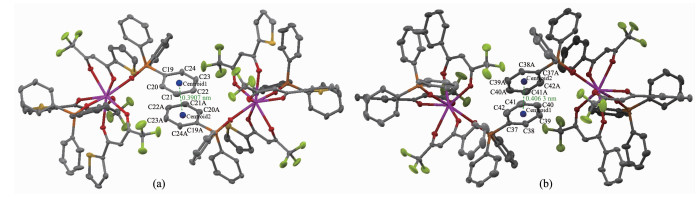
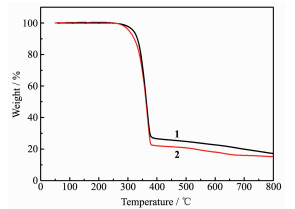
Fig. 4 shows the results of thermal stability of the complexes, which were investigated by thermal gravimetric analyses (TGA) at a heating rate of 10 ℃·min-1 under flowing N2 gas.The TG curves of both complexes show only one sharp weight loss step that occur in the range from 280 to 380 ℃ by weight loss of 82.86% and 84.85%, respectively.It demonstrates that the complexes decomposed by the escaping of β-diketonate and TPPO ligands without difference owing to that all the Nd-O bands (such as Nd-OTTA, Nd-OBFA and Nd-OTPPO) have the approximate bond energy.The quite high decomposition temperatures mean that the obtained complexes have the favorable thermal stabilities.
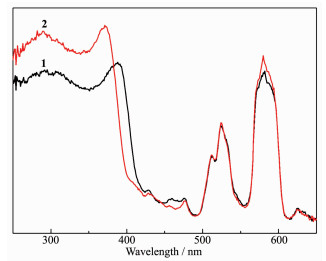
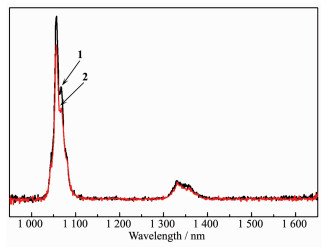
The luminescent properties in near-infrared region of complexes were investigated with solid state at room temperature.In the excitation spectra (Fig. 5), there are three main peaks in each complex.Two peaks are almost in the same wavelengths at 524 and 582 nm for complexes 1 and 2, while the third peak is visibly different for the two complexes at 388 and 371 nm, respectively.The results are similar to the UV absorption spectra of Nd ion but red-shifted about 30, 2 and 8 nm[19], respectively, attributed to the energy transfer from ligands to the center Nd ions.The emission spectra are shown in Fig. 6.With excitation at 360 nm, the complexes show same emission bands at 1 057 and 1 329 nm which are the characteristic emissions of Nd ion.The strongest band at about 1 057 nm is applicable for laser emission.
Two neodymium ternary complexes involving β-diketonate and triphenylphosphineoxide as ligands have been synthesized by mild conditions.The complexes have good thermal stabilities and typical near infrared fluorescence properties.The absences of coordinated water molecules in their frameworks avoid the high frequency vibration of the OH groups in water molecules, which prevents the energy losing.So, the Nd complexes possess remarkable fluorescence properties.
Xin H, Li F Y, Shi M, et al. J. Am. Chem. Soc., 2003, 125:7166-7167 doi: 10.1021/ja034087a
Allendorf M D, Bauer C A, Bhakta R K, et al. Chem. Soc. Rev., 2009, 38:1330-1352 doi: 10.1039/b802352m
Kido J, Okamoto Y. Chem. Rev., 2002, 102:2357-2368 doi: 10.1021/cr010448y
Katkova M A, Bochkarev M N. Dalton Trans., 2010, 39:6599-6612 doi: 10.1039/c001152e
Chen X Y, Yang X, Holliday B J. J. Am. Chem. Soc., 2008, 130:1546-1547 doi: 10.1021/ja077626a
Carlucci L, Ciani G, Proserpio D M. Coord. Chem. Rev., 2003, 246:247-289 doi: 10.1016/S0010-8545(03)00126-7
Férey G. Chem. Soc. Rev., 2008, 37:191-214 doi: 10.1039/B618320B
Zhang X M, Hao Z M, Zhang W X, et al. Angew. Chem. Int. Ed., 2007, 46:3456-3459 doi: 10.1002/(ISSN)1521-3773
Eugen S A, Nicolas G, Daniel I. Inorg. Chem., 2013, 52:14382-14390 doi: 10.1021/ic402523v
Zhang N, Liu Q Y, Wang Y L, et al. Inorg. Chem. Commun., 2012, 20:299-302 doi: 10.1016/j.inoche.2012.03.033
Xie W P, Wang N, Long Y, et al. Inorg. Chem. Commun., 2014, 40:151-156 doi: 10.1016/j.inoche.2013.11.029
Song X Q, Lei Y K, Wang X R, et al. Solid State Chem., 2014, 218:202-212 doi: 10.1016/j.jssc.2014.06.025
Liu Y T, Du Y Q, Wu X, et al. CrystEngComm, 2014, 16:6797-6802 doi: 10.1039/c4ce00417e
Sheldrick G M. SHELXS-2013, Program for Crystal Structure Solution, University of Göttingen, Germany, 2013.
Sheldrick G M. SHELXL-2013, Program for Crystal Structure Refinement, University of Göttingen, Germany, 2013.
陈满生, 许金生, 邓奕芳, 等.无机化学学报, 2013, 29(12):2673-2677 http://www.wjhxxb.cn/wjhxxbcn/ch/reader/view_abstract.aspx?flag=1&file_no=20131227&journal_id=wjhxxbcnCHEN Man-Sheng, XU Jin-Sheng, DENG Yi-Fang, et al. Chinese J. Inorg. Chem., 2013, 29(12):2673-2677 http://www.wjhxxb.cn/wjhxxbcn/ch/reader/view_abstract.aspx?flag=1&file_no=20131227&journal_id=wjhxxbcn
Hou H, Li G, Li L, et al. Inorg. Chem., 2003, 42:428-435 doi: 10.1021/ic025753w
Evans W J, Giarikos D G, Ziller J W. Organometallics, 2001, 20:5751-5758 doi: 10.1021/om010887n
洪广言.稀土化学导论. Beijing:Science Press, 2014.HONG Guang-Yan. Introduction to Rare Earth Chemistry. Beijing:Science Press, 2014.

Figure 1 Molecular structure of complex 1
Thermal ellipsoids are drawn at 30% probability level; All H atoms are omitted for clarity

Figure 2 Molecular structure of complex 2
Thermal ellipsoids are drawn at 30% probability level; All H atoms are omitted for clarity

Figure 3 π-π interactions of crystal units in complexes 1 (a) and 2 (b)
Symmetry codes:A:1-x, 1-y, 1-z
Table 1. Crystallographic data of complexes 1 and 2
| Empirical formula | C60H42F9NdO8P2S3 | C66H48F9NdO8P2 |
| Formula weight | 1 364.29 | 1 346.22 |
| Crystal system | Triclinic | Triclinic |
| Space group | P1 | P1 |
| a/nm | 1.117 01(5) | 1.123 44(4) |
| b/nm | 1.212 22(4) | 1.227 63(3) |
| c/nm | 2.351 37(7) | 2.369 10(8) |
| α/(°) | 80.094(3) | 79.778(3) |
| β/(°) | 76.759(3) | 76.477(3) |
| γ/(°) | 70.521(4) | 71.603(3) |
| V/nm3 | 2.905 9(18) | 2.995 33(19) |
| Z | 2 | 2 |
| Dc/(g·c'-3) | 1.559 | 1.493 |
| Crystal size/mm | 0.35×0.35×0.30 | 0.40×0.35×0.30 |
| Absorption coefficient/mm-1 | 1.139 | 1.004 |
| F(000) | 1 370 | 1 358 |
| θ range/(°) | 3.021~26.372 | 2.975~26.371 |
| Reflection collected, unique (Rint) | 23 442, 11 S52 (0.026 4) | 25 676, 12 229 (0.033 4) |
| Goodness of fit on F2 | 1.036 | 1.042 |
| Final R indices [I≥2σ(I)] | R1=0.035 7, wR2=0.076 7 | )R1=0.037 4, wR2=0.081 6 |
| Largest diff. peak and hole/(e·nm-3) | 670 and -490 | 490 and -450 |
 下载: 导出CSV
Table 2. Selected bond lengths (nm) and bond angle (°) of complexes 1 and 2
| 1 | |||||
| Nd1-O1 | 0.240 39(19) | Nd1-O2 | 0.241 91(19) | Nd1-O3 | 0.248 59(18) |
| Nd1-O4 | 0.240 9(2) | Nd1-O5 | 0.248 2(19) | Nd1-O6 | 0.239 7(2) |
| Nd1-O7 | 0.248 8(2) | Nd1-O8 | 0.240 6(2) | ||
| O1-Nd1-O2 | 145.02(7) | O3-Nd1-O4 | 69.96(7) | O5-Nd1-O6 | 70.68(7) |
| O7-Nd1-O8 | 69.11(7) | O1-Nd1-O3 | 75.53(7) | O1-Nd1-O4 | 87.46(7) |
| O1-Nd1-O5 | 78.80(7) | O1-Nd1-O6 | 143.77(7) | O1-Nd1-O7 | 79.92(7) |
| O1-Nd1-O8 | 83.44(7) | O2-Nd1-O3 | 71.76(7) | O2-Nd1-O4 | 84.83(7) |
| O2-Nd1-O5 | 129.70(7) | O2-Nd1-O6 | 71.21(7) | O2-Nd1-O7 | 125.06(7) |
| O2-Nd1-O8 | 84.15(7) | O3-Nd1-O5 | 132.63(7) | O3-Nd1-O6 | 142.40(7) |
| O3-Nd1-O7 | 138.08(7) | O3-Nd1-O8 | 76.03(7) | O4-Nd1-O5 | 71.15(7) |
| O4-Nd1-O6 | 100.32(8) | O4-Nd1-O7 | 141.02(7) | O4-Nd1-O8 | 145.99(7) |
| O5-Nd1-O7 | 70.26(7) | O5-Nd1-O8 | 137.81(7) | O6-Nd1-O7 | 71.83(7) |
| O6-Nd1-O8 | 106.32(8) | ||||
| 2 | |||||
| Nd1-O1 | 0.247 66(19) | Nd1-O2 | 0.241 3(2) | Nd1-O3 | 0.249 9(2) |
| Nd1-O4 | 0.239 6(2) | Nd1-O5 | 0.244 57(19) | Nd1-O6 | 0.241 9(2) |
| Nd1-O7 | 0.242 3(2) | Nd1-O8 | 0.240 58(19) | ||
| O1-Nd1-O2 | 69.54(7) | O3-Nd1-O4 | 69.07(7) | O5-Nd1-O6 | 70.06(7) |
| O7-Nd1-O8 | 146.54(7) | O1-Nd1-O3 | 136.25(7) | O1-Nd1-O4 | 75.66(7) |
| O1-Nd1-O5 | 130.94(7) | O1-Nd1-O6 | 144.98(7) | O1-Nd1-O7 | 73.46(7) |
| O1-Nd1-O8 | 73.28(7) | O2-Nd1-O3 | 142.84(7) | O2-Nd1-O4 | 144.98(7) |
| O2-Nd1-O5 | 70.86(7) | O2-Nd1-O6 | 100.43(7) | O2-Nd1-O7 | 82.33(8) |
| O2-Nd1-O8 | 89.49(7) | O3-Nd1-O5 | 72.39(7) | O3-Nd1-O6 | 71.61(7) |
| O3-Nd1-O7 | 125.85(7) | O3-Nd1-O8 | 78.11(7) | O4-Nd1-O5 | 140.22(7) |
| O4-Nd1-O6 | 105.84(7) | O4-Nd1-O7 | 84.22(8) | O4-Nd1-O8 | 84.20(7) |
| O5-Nd1-O7 | 127.70(7) | O5-Nd1-O8 | 78.62(7) | O6-Nd1-O7 | 71.93(7) |
| O6-Nd1-O8 | 141.52(7) | ||||
下载: 导出CSV

 扫一扫看文章


扫一扫关注我们