Received Date:
11 January 2018 Revised Date:
31 January 2018 Available Online:
10 June 2018
Abstract:
Two new chiral Cu(Ⅱ) coordination polymers, {[Cu((1R, 2R)-3-bcpb)]Cl2}n (1) and {[Cu((1R, 2R)-3-bcpb)2](ClO4)2·2H2O·2CH3OH}n (2) ((1R, 2R)-3-bcpb=N, N'-((1R, 2R)-cyclohexane-1, 2-diyl)bis(N-(pyridin-3-ylmethyl)benz-amide)), have been assembled with a chiral V-shaped bidentate ligand and different Cu(Ⅱ) salts, in which 1 is a 1D linear chain, while 2 displays a 2D (4, 4) topology. 1 can be directly transformed to 2 by the introduction of AgClO4, and 2 can also be directly converted to 1 by the addition of NaCl in methanol under solvothermal conditions. CD spectra and SHG response of the complexes confirm that their bulk samples are both of structural chirality.
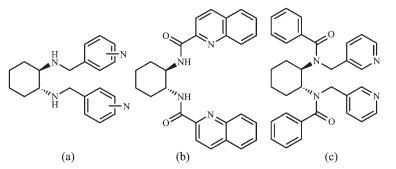
Chiral coordination polymers (CCPs) have been investigated enthusiastically during the last few decades because of their versatile structures and potential applications[1-5]. They can usually be synthes-ized by the use of chiral ligands or via spontaneous resolution from achiral raw materials with/without any chiral auxiliaries (such as chiral templates, chiral physical environments)[6-11], in which the introduction of chiral ligands will ensure the chirality of the obtained structures. Meanwhile, chiral 1, 2-diaminocy-clohexane derivatives have been considered as a promising class of chiral ligands owing that their complexes have fascinating potential uses in biosi-mulation, asymmetric catalysis, magnetic and optical switching, and molecular magnets[12-24]. Recently, our interest has been focused on the construction of CCPs by designing a series of (1R, 2R)-N1, N2-bis(pyridinyl-methyl)cyclohexane-1, 2-diamine derivatives as the chiral ligands (Scheme 1a and 1b)[15-24].
Scheme 1
图 Scheme 1
Structures of (1R, 2R)-N1, N2-bis(pyridinyl-methyl)cyclohexane-1, 2-diamine derivatives (a, b) and (1R, 2R)-3-bcpb (c)
Scheme 1.
Structures of (1R, 2R)-N1, N2-bis(pyridinyl-methyl)cyclohexane-1, 2-diamine derivatives (a, b) and (1R, 2R)-3-bcpb (c)
On the other hand, anions play an important role in the controllable construction of coordination polymers (CPs) because they can be directly coordinated to the metal ions or only act as templates[22, 25-27]. Among the anions, we focus our interests on the effects of the Cl- and ClO4- anions on the obtained structures of CCPs under the following considerations: (1) they are both monovalent anions, but have different geometries with typical monatomic sphere and tetrahedron, respecti-vely; (2) they are preferable hydrogen bond acceptors but can form different numbers and directions of hydrogen bonds; and (3) usually, Cl- is easy to be coordinated to metal ions as a terminal or bridging ligand, while ClO4- has very weak coordination ability.
Recently, crystal to crystal transformation of CPs have attracted considerable attention because it can make us gain better understanding of crystal nucleation and growth[28-29]. To our knowledge, the crystal transfor-mations involving the single-crystal-to-single-crystal (SC to SC) process have been widely studied. In contrast, only limited examples with structural trans-formation through the solvent-mediated process are available[22, 30-62]. Solvent-mediated structural transforma-tion usually takes place under mild conditions as a result of external stimuli, such as light, heat, anions, metal cations and solvent molecules[30-62]. It is worth noting that in the reported solvent-mediated anion-induced crystal transformations, the external stimulus was just one type of anion; while the reversible trans-formation driven by two types of anions is still rather rare[60-62].
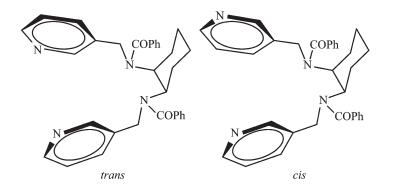
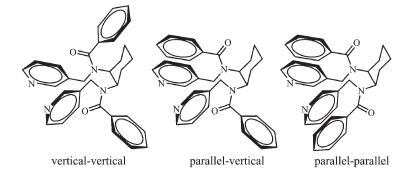
Our group has designed a new chiral ligand N, N′-((1R, 2R)-cyclohexane-1, 2-diyl)bis(N-(pyridin-3-ylmet-hyl)benzamide) ((1R, 2R)-3-bcpb), as a member of chiral diamine derivatives, which has the following unique features (Scheme 1c): (1) the ligand is neutral, helpful to investigate the influence of anions on the resultant network structures of CCPs; (2) the ligand is a simple V-shaped bidentate ligand and easy to coordinate with two adjacent metal ions; (3) the ligand has versatile configurations, including the cis- and trans- isomers based on the N-positions of the two pyridyl rings (Scheme 2), and other isomers on the basis of the relationship between the phenyl and pyridyl rings of two arms (Scheme 3), which helps to investigate the effect of anions on the configurations of the ligand and the networks of the final CCPs. We have obtained one pair of chiral Ag(Ⅰ) coordination polymers with zigzag and helical chains with the same materials at 25 and 90 ℃, respectively, based on (1R, 2R)-3-bcpb and Ag(Ⅰ), in which the zigzag chains can be directly transformed to the helical chains by heating in methanol, while the reverse operations failed[22]. During this irreversible solvent-mediated temperature-induced crystal transfor-mation, the configurations of the ligand were also changed[22]. Compared with Ag(Ⅰ) ion, Cu(Ⅱ) ion has different coordination modes and geometries, as well as different physical and chemical functions. Thus, as part of our ongoing study of CCPs by using (1R, 2R)-N1, N2-bis(pyridinylmethyl)cyclohexane-1, 2-diamine deriv-atives as the ligands, here we reported two chiral Cu(Ⅱ) coordination polymers, {[Cu((1R, 2R)-3-bcpb)]Cl2}n (1) and {[Cu((1R, 2R)-3-bcpb)2](ClO4)2·2H2O·2CH3OH}n (2), by use of different anions, in which 1 is a one-dimensional (1D) linear chain, while 2 displays a two-dimensional (2D) (4, 4) topology. Most importantly, 1 can be transformed to 2 by use of AgClO4 in methanol, and 2 can also be converted to 1 by adding NaCl into the suspend of 1 in methanol under solvothermal conditions.
Scheme 2
图 Scheme 2
Structures of trans- and cis- isomers of(1R, 2R)-3-bcpb
Scheme 2.
Structures of trans- and cis- isomers of(1R, 2R)-3-bcpb
(1R, 2R)-3-bcpb was synthesized according to a reported method[22]. Other chemicals were commercially available and used without further purification.
The IR spectra (KBr pellets) were recorded on a Nicolet FT-IR 200 spectrophotometer Infrared in the mid-IR region. C, H and N microanalyses were deter-mined on a Perkin-Elmer 1400C analyzer. Circular dichroism (CD) spectra were made with a JASCO J-810 spectrophotometer at room temperature under air (KBr pellets). Powder X-ray diffraction (XRD) intens-ities were carried out on a Rigaku D/max-ⅢA diffra-tometer (Cu Kα, λ=0.154 056 nm; U=36 kV, I=30 mA) with a scan rate of 1°·min-1 in the range of 3°~60°. Kurtz powder method was used to test the second-harmonic generation (SHG) efficiency of the new complexes.
1.2
Syntheses
1.2.1
Synthesis of {[Cu((1R, 2R)-3-bcpb)]Cl2}n (1)
A mixture of (1R, 2R)-3-bcpb (50 mg, 0.1 mmol), CuCl2·2H2O (17 mg, 0.1 mmol) and CH3OH (8 mL) were heated in a 15 mL Teflon-lined stainless-steel vessel at 90 ℃ for 3 days, followed by slow cooling (5 ℃·h-1) to room temperature. After filtration, blue block crystals were collected and dried in air (17 mg, Yield: 53% based on (1R, 2R)-3-bcpb). Anal. Calcd. for C32H32Cl2CuN4O2(%): C 60.14, H 5.05, N 8.77; Found(%): C 60.10, H 5.08, N 8.80. FT-IR (KBr, cm-1): 3 044 (m), 2 943 (s), 2 882 (m), 1 626 (s), 1 575 (w), 1 482 (w), 1 433 (m), 1 403 (s), 1 358 (w), 1 307 (m), 1 258 (w), 1 159 (m), 1 107 (w), 1 062 (w), 983 (w), 928 (w), 896 (w), 846 (w), 800 (m), 754 (w), 720 (m), 702 (m), 658 (w), 572 (w), 522 (w), 495 (w), 446 (w).
1.2.2
Synthesis of {[Cu((1R, 2R)-3-bcpb)2](ClO4)2·2H2O·2CH3OH}n (2)
1.2.3
Solvent-mediated reversible structural transformations between 1 and 2
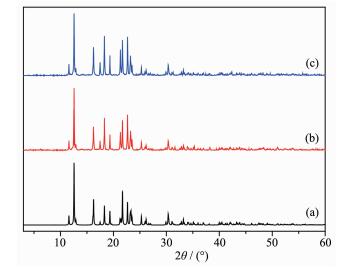
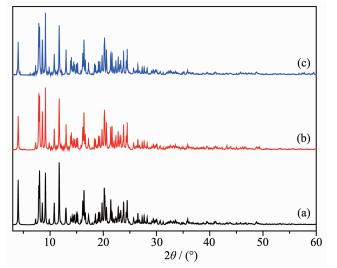
The crystals of 1 were ground and the resulting powder (32.0 mg, 0.05 mmol) was immersed in 8 mL CH3OH, and 20.7 mg AgClO4 (0.1 mmol) was added. The resulting mixture was stirred for 4 h in air under dark and then filtered. The filter was transferred into a 15 mL Teflon-lined vessel and kept at 90 ℃ for 3 days, and then cooled to room temperature with a rate of 5 ℃·h-1. After filtration and washing with CH3OH, blue microcrystals of 2 were collected and dried in air (12 mg, Yield: 35% based on (1R, 2R)-3-bcpb). PXRD patterns were used to check the phase and the purity of the resultant microcrystals (Fig. 1).
图 1
图 1
XRD patterns of 1, simulated from X-ray single crystal data (a), polycrystalline as newly synthesized (b) and polycrystalline as newly transformed by 2 (c)
Figure 1.
XRD patterns of 1, simulated from X-ray single crystal data (a), polycrystalline as newly synthesized (b) and polycrystalline as newly transformed by 2 (c)
A mixture of 2 (69 mg, 0.05 mmol), NaCl (29 mg, 0.05 mmol) and CH3OH (8 mL) were heated in a 15 mL Teflon-lined vessel at 90 ℃ for 3 days, followed by slow cooling (5 ℃·h-1) to room temperature. After filtration and washing with CH3OH, blue microcrystals of 1 were collected and dried in air (13 mg, yield 41% based on Cu(Ⅱ)). PXRD patterns were used to check the phase and the purity of the resultant microcrystals (Fig. 2).
图 2
图 2
XRD patterns of 2, simulated from X-ray single crystal data (a), polycrystalline as newly synthesized (b) and polycrystalline as newly transformed by 1 (c)
Figure 2.
XRD patterns of 2, simulated from X-ray single crystal data (a), polycrystalline as newly synthesized (b) and polycrystalline as newly transformed by 1 (c)
Diffraction intensities for 1 and 2 were performed on a Bruker Apex CCD area-detector diffractometer with graphite-monochromated Mo Kα radiation (λ=0.071 073 nm). Absorption corrections were applied by using multiscan propram SADABS[63]. The structures were solved with direct methods and refined by full-matrix least-squares technique using the SHELXTL program package[64]. All non-hydrogen atoms were refined isotropically initially and subsequently treated anisotropically (with the exception of the disordered atoms). The organic hydrogen atoms were generated geometrically. The assignment of the absolute structures for 1 and 2 was confirmed by the refinement of Flack enantiopole parameter to values of -0.007(17) and -0.01(4), respectively[65]. The perchlorates in 2 were badly disordered. Cl-O bond lengths and O-Cl-O bond angles of disordered perchlorates were restrained to chemically reasonable using the DFIX commands on SHELXL. Three phenyl and two pyridyl rings of the two (1R, 2R)-3-bcpb ligands are also badly disor-dered, and the corresponding C-C and C-N bond lengths, as well as C-C-C, C-C-N and C-N-C bond angles of disordered phenyl and pyridyl rings were restrained to chemically reasonable using the DFIX commands on SHELXL. Meanwhile, the six atoms of each disordered hexatomic ring were restrained to a plane using the FLAT commands on SHELXL-97. Crystal data as well as details of data collection and refinements for the complexes are summarized in Table 1. Selected bond distances and bond angles are listed in Table 2, and hydrogen bonding parameters are given in Table 3.
表 1
表 1
Crystal data and structure refinements for 1 and 2
Table 1.
Crystal data and structure refinements for 1 and 2
Symmetry codes: ⅱ 1/2-x, 1/2+y, 1-z for 1; ⅲ 3/2-x, -1/2+y, 1-z for 2.
CCDC: 1423032, 1; 1423033, 2.
2.
Results and discussion
2.1
Synthesis and infrared spectra
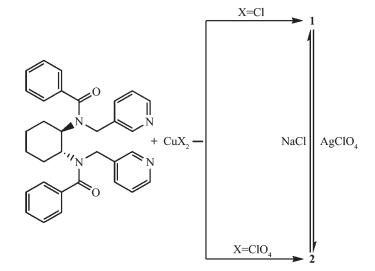
The synthesis is summarized in Scheme 4. The introduction of two formyl groups on the N atoms of chiral 1, 2-diaminocyclohexane section of the ligand may decrease the coordination ability of the diaminocyclohexane, leading that the ligand becomes a chiral V-shaped bidentate bridging ligand. This design of the ligand can reduce its coordination number and simplify its coordination modes. Mean-while, the flexible (1R, 2R)-3-bcpb ligand can show anti- or syn-conformation as a result of the free rotation of (O=)C-N bonds and the coordination of the 3-pyridyl rings (Scheme 2), and can also present different configurations such as vertical-vertical, parallel-vertical and parallel-parallel, with respect to the relative positions between the phenyl and pyridyl rings on the two arms of the ligand (Scheme 3). Two typical anions with completely different coordination ability, Cl- and ClO4-, were used to easily produce different CCPs, which is helpful to investigate the influence of the anions on the structural frameworks of the resultant products. On the other hand, the strong coordination ability of Cl- makes it easily replace very weakly coordinated ClO4-, while the strong binding ability of Cl- and Ag+ promotes it easily replaced by ClO4- with the addition of AgClO4 into the reaction system. These unique features of Cl- help to construct an interesting system of reversible solvent-mediated anion-induced crystal transformations. As expected, when the strong coordinated Cl- was used, the synth-esized CCP was found to be a chiral 1D chain, in which Cl- anions are ligated to Cu2+ centers; while when weak coordinated ClO4- was used, a 2D (4, 4) network was obtained, in which uncoordinated ClO4- anions are filled in the holes of the 3D supramolecular packing only as templates. Most interestingly, 1 can be directly transformed to 2, respectively, by the introduction of AgClO4 at 90 ℃ in methanol, and the reverse transformation also achieved success by the addition of NaCl.
Infrared spectra of the complexes display the strong broad absorption band at 1 626 cm-1 for 1 and 1 620 cm-1 for 2, which is in accordance with the vibration of C=O groups in the complexes[22]. Mean-while, the strong peaks of 2 943 and 2 882 cm-1 for 1, and 2 937 and 2 861 cm-1 for 2, can be ascribed to the C-H stretching vibration[15-24]. The strong bands in the 1307~1576 cm-1 region are consistent with the pyridyl skeletal vibrations of the complexes[15-24]. For 2, the strong absorption band at 1 106 cm-1 can be attributed to the vibration of perchlorates[16].
2.2
Description of the crystal structures
2.2.1
Description of the crystal structure of {[Cu((1R, 2R)-3-bcpb)]Cl2}n (1)
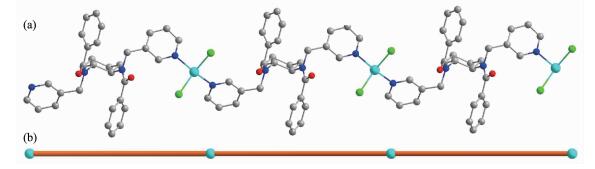
Single-crystal XRD study revealed that complex 1 crystallizes in the space group C2 with the asymmetric unit containing half of one Cu(Ⅱ) ion, half of one (1R, 2R)-3-bcpb ligand and one Cl-. Each Cu(Ⅱ) ion in 1 is located on the crystallographic 21 axis and displays a distorted tetrahedral geometry, being surro-unded by two pyridyl nitrogen atoms of two adjacent ligands and two terminal chlorine anions with the Cu-N distance of 0.203 6(3) nm and Cu-Cl distance of 0.220 83(14) nm. Meanover, each (1R, 2R)-3-bcpb ligand has a bidentate mode in 1 and bridges two adjacent Cu(Ⅱ) ions to form a chain running along the crystallographic [101] direction with the shortest intrachain Cu…Cu distance of 1.433 6(2) nm (Fig. 3a). The 1D chain can be regarded as a linear chain by considering each Cu(Ⅱ) ion as a two-connecting node and each ligand as a two-connecting linker (Fig. 3b).
图 3
图 3
Structure of the 1D chiral linear chain of 1 (a) and topology of 1 (b)
Figure 3.
Structure of the 1D chiral linear chain of 1 (a) and topology of 1 (b)
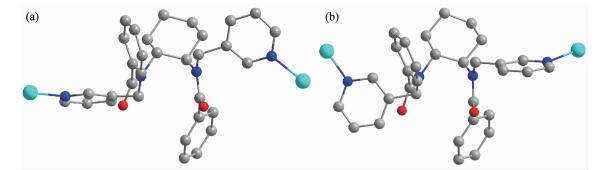
It is worth noting that each (1R, 2R)-3-bcpb ligand in 1 adopts a trans- coordination mode to link two Cu(Ⅱ) (Fig. 4a), and two pairs of pyridyl and phenyl rings on the same sides of the ligand are inclined to mutual perpendicularity with the angle of 73.69(2)°, being a little like that in {[Ag((1R, 2R)-3-bcpb)]X·H2O·CH3OH}n (X=NO3, ClO4) reported[21]. The two pyridyl rings and the two phenyl rings are, respectively, inclined to mutual perpendicularity with the angles between them of 56.56(1)° and 58.12° (Fig. 4a), being a little different from that in {[Ag((1R, 2R)-3-bcpb)]NO3·H2O·CH3OH}n[21], in which the correspon-ding angles are 20.24(1)° and 57.80(2)°, respectively.
图 4
图 4Trans- (a) and cis- (b) coordination modes of (1R, 2R)-3-bcpb ligand in 1 and 2, respectively
Figure 4.Trans- (a) and cis- (b) coordination modes of (1R, 2R)-3-bcpb ligand in 1 and 2, respectively
The 1D chains are further assembled into a 3D supramolecular network via weak interchain C-H…O and C-H…Cl hydrogen bonds between the oxygen atoms of C=O and the carbon atoms on the pyridyl rings with the C…O distances of 0.315 3(5) and 0.329 2(5) nm, as well as the terminal chlorine anions and the carbon atoms of the diaminocyclohexane sections with the C…Cl distance of 0.327 0(5) nm (Fig.S1).
2.2.2
Description of the crystal structure of {[Cu((1R, 2R)-3-bcpb)2](ClO4)2·2H2O·2CH3OH}n (2)
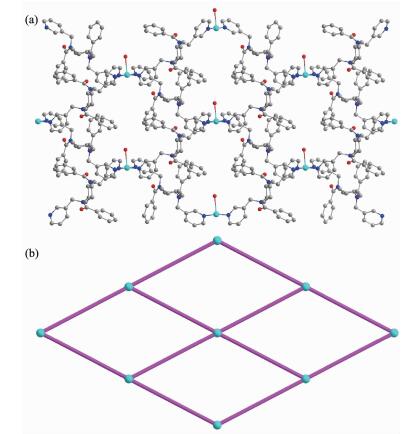
Complex 2 also crystallizes in a monoclinic system of chiral space group C2, consisting of one Cu(Ⅱ) ion, two (1R, 2R)-3-bcpb ligands, two uncoordinated perch-lorates, two free methanol molecules, one weakly coor-dinated and one lattice water molecules in an asymm-etric unit. In contrast to the Cu(Ⅱ) ions in 1, each Cu(Ⅱ) ion in 2 is square pyramidal with the base of the pyramid defined by four pyridyl nitrogen atoms from four individual (1R, 2R)-3-bcpb ligands. The apical is occupied by one weakly coordinated water molecule with the Cu-O distance of 0.247 2(8) nm. Each (1R, 2R)-3-bcpb ligand also acts in a bidentate mode in 2 and bridges two adjacent Cu(Ⅱ) ions in the cis-fashion (Fig. 4b) to build a 2D lattice-type network parallel to the bc plane (Fig. 5a). In each rhombic lattice, four Cu(Ⅱ) ions are positioned at the four vertices and coplanar. The Cu…Cu distances in each lattice, separated by the ligands, are 1.383 4(3) nm. From the topological view, each Cu(Ⅱ) can be considered as a four-connecting node, which is connected by the bridging ligands as two-connecting linkers. Conse-quently, the 2D network can be regarded as a uninodal four-connected (4, 4) topology (Fig. 5b).
图 5
图 5
Two dimensional lattice-type network (a) and its(4, 4) topology (b) of 2
Figure 5.
Two dimensional lattice-type network (a) and its(4, 4) topology (b) of 2
Despite of the different cis-/trans- configuration of the (1R, 2R)-3-bcpb ligand in 1 and 2, the relationship of two pairs of pyridyl and phenyl rings on the same arms of the ligand in 2 are similar to that in 1: in each arm, the pyridyl ring is inclined to be perpendicular to the phenyl ring with the angles between them are 58.26(2)°~79.99(1)°. The two pyridyl rings and the two phenyl rings are, respectively, inclined to mutual perpendicularity with the angles between them of 73.46(3)° and 78.92(2)°, as well as 49.54(1)° and 68.02(1)°. To our knowledge, this kind of configurations of the (1R, 2R)-3-bcpb ligand hasn′t been reported so far.
The 2D networks are further assembled into a 3D supramolecular structure by the weak C-H…O hydrogen bonds, which involves the carbon atoms from the phenyl rings and the oxygen atoms of C=O groups (C42…O3h 0.340 6(11) nm; Symmetry codes: h: 3/2-x, -1/2+y, 1-z) (Fig.S2). The perchlorates and free solvent molecules are located in the voids of the supramolecular network.
The crystals of 1 (0.1 mol) were ground and the resulting blue powder was immersed in CH3OH. AgClO4 (0.2 mol) was then added to the suspension and the mixture was stirred for 4 hours, the blue precipitate disappeared and the white one appeared, which indicated the generation of AgCl. After filtration and solvothermal reaction for 3 days, an interesting structural transformation took place in which 1 was transformed into complex 2, which is further indicated by PXRD (Fig. 1). The successful transformation can be attributed to the removal of Cl- from the reaction system by the introduction of Ag+. The mechanism of such transformation can be described as follows: under the influence of Ag+, the coordinated Cl- of 1 is removed by the information of AgCl, leading to the dissolution of the polymer 1 and the formation of the mixture of the (1R, 2R)-3-bcpb ligand and Cu(ClO4)2, which are just the synthetic raw materials of 2 besides solvents. In a subsequent step, the solvothermal reaction of the ligand, Cu(ClO4)2 and methanol leads to the generation of 2.
The transformation procedure from 2 to 1 is much simple. The mixture of 2, NaCl and methanol was heated at 90 ℃ for 3 days under solvothermal conditions, resulting in the formation of 1, because Cl- has much stronger coordination ability than ClO4- and easier to ligate Cu(Ⅱ) ions to produce 1. The mech-anism of the transformation from 2 to 1 can also be described as follows: under the solvothermal condi-tions, the framework of 2 slowly dissociates to release free (1R, 2R)-3-bcpb ligand, Cu(Ⅱ) and ClO4-; then the reconstruction of the chiral ligand, Cu(Ⅱ) and Cl- results in the formation of 1. Thus, the successful transformation from 2 to 1 also indicates that 1 is the kinetically favored product with the existence of the ligand, Cu(ClO4)2, NaCl and methanol under solvother-mal conditions.
2.4
Circular dichroism spectra and second-harmonic generation
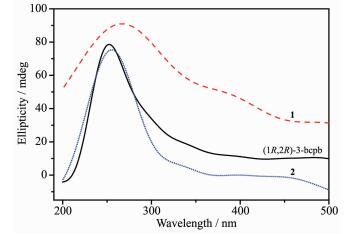
Circular dichroism (CD) spectroscopy has been proved to be a powerful tool to study the enantiomeric optical activity of the crystals[15-24]. Powdered bulk samples of (1R, 2R)-3-bcpb, 1 and 2 were used to confirm their chiral nature in a KBr matrix between 200 and 500 nm at room temperature, as shown in Fig. 6. The ligand, 1 and 2 display similar dichroic signals in the CD spectra, with one positive Cotton effect at the 255, 267 and 353 nm frequency, respe-ctively, which confirms the chirality of the bulk crystals.
图 6
图 6
CD spectra of the ligand, 1 and 2 in the solid state at room temperature
Figure 6.
CD spectra of the ligand, 1 and 2 in the solid state at room temperature
Second harmonic generation (SHG) active coor-dination polymers have gain a bourgeoning interest due to their potential applications in information stor-age, light modulators and electric-optical devices[66-67]. The second-order NLO properties of 1 and 2 are worth studying because they are both chiral coordination polymers with noncentrosymmetric space groups. Here, we ascertained the polar ordering of 1 and 2 by performing SHG experiments using Kurtz and Perry method[69]. The results show that 1 and 2 display SHG efficiencies, with approximately 0.25 and 0.32 times as big as that of KDP, respectively, which exhibits that they may have potential application as second-order nonlinear optical materials.
3.
Conclusions
In summary, two chiral Cu(Ⅱ) coordination poly-mers with the structures of 1D linear chain and 2D (4, 4) network have been synthesized, respectively, by the use of different anions (Cl- and ClO4-) and a chiral V-shaped bidentate ligand with the diversity of the configurations. Meanwhile, upon solvent-mediated anion exchange under solvothermal conditions, rever-sible structural transformations between 1 and 2 have been achieved, based on the different coordination ability of Cl- and ClO4-, and the strong binding ability of Cl- and Ag+. 1 can be directly converted to 2, by the introduction of AgClO4, and 2 can also be directly transformed to 1 by the addition of NaCl. CD spectra and SHG efficiency measurement showed that 1 and 2 are of structual chirality in the bulk materials. Such a synthetic strategy of reversible solvent-mediated anion-induced structural transformations maybe offers valuable information for engineering solid materials with desired topologies and specific properties.
Figure 1
XRD patterns of 1, simulated from X-ray single crystal data (a), polycrystalline as newly synthesized (b) and polycrystalline as newly transformed by 2 (c)
Figure 2
XRD patterns of 2, simulated from X-ray single crystal data (a), polycrystalline as newly synthesized (b) and polycrystalline as newly transformed by 1 (c)



 下载:
下载:


 下载:
下载:



