

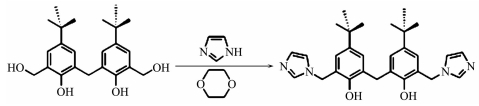
 Figure Scheme 1.
Synthetic process of L
Citation:
ZHANG Xia, XUE Jun-Ru, HE Zhan, ZHANG Shu-Fang, LIANG Yue, QIN Da-Bin, JING Lin-Hai. Syntheses and Characterization of Metal Hybrid Calix[4]arene Coordination Polymers[J]. Chinese Journal of Inorganic Chemistry,
2017, 33(4): 673-678.
doi:
10.11862/CJIC.2017.070

杂金属杯[4]配位聚合物的合成与表征
摘要:
合成了4个杂金属杯[4]配位聚合物{[Cd (L)(tpa)]·3H2O}n(1), {[Zn2(L)2(tpa)2]·3H2O}n(2), {[Co (L)(oba)]·2DMA·0.5H2O}n(3) 和{[Zn (L)(oba)]·DMA}n(4)(L=2-(1H-咪唑基-甲基)-6-(3-(1H-咪唑基-甲基)-5-叔丁基-2-羟基) 苄基-4-叔丁基苯酚, H2tpa=对苯二甲酸, H2oba=4, 4'-二苯醚二甲酸), 并通过元素分析、热重、红外光谱、固态紫外、单晶X射线衍射和粉末X射线衍射对其进行了表征.单晶结构分析表明晶体1是单斜晶系, P21/n空间群, 而晶体2, 3和4均为三斜晶系, P1空间群.化合物1, 2, 3和4是由0维[M (N4O2C29H36)](M=Zn, Co, Cd) 的杂金属杯[4]与配体对苯二甲酸和4, 4'-二苯醚二甲酸形成的一维配位聚合物.
English
Syntheses and Characterization of Metal Hybrid Calix[4]arene Coordination Polymers
Abstract:
Four metal hybrid calix[4]arene coordination polymers:{[Cd (L)(tpa)]·3H2O}n (1), {[Zn2(L)2(tpa)2]·3H2O}n (2), {[Co (L)(oba)]·2DMA·0.5H2O}n (3) and {[Zn (L)(oba)]·DMA}n (4) (L=2-((1H-imidazol-1-yl) methyl)-6-(3-((1H-imidazol-1-yl) methyl)-5-tert-butyl-2-hydroxybenzyl)-4-tert-butylphenol, H2tpa=terephthalic acid, H2oba=4, 4'-oxy-bisbenzoic acid) have been successfully synthesized and characterized by elemental analysis, thermogravimetry, IR, the solid-sate UV-Vis spectra, single-crystal X-ray diffraction and PXRD. The single-crystal X-ray diffraction analysis reveals that complex 1 crystallizes in the monoclinic system, space group P21/n while complexes 2, 3 and 4 crystallize in the triclinic, space group P1. Complexes 1, 2, 3 and 4 are one-dimensional coordination polymers, which are formed through 0D[M (N4O2C29H36)] (M=Zn, Co, Cd) metal hybrid calix[4]arene bridged H2tpa and H2oba ligands.
-
Key words:
- metal calixarene
- / coordination polymers
- / hydrothermal synthesis
-
0 Introduction
Coordination polymers have drawn much attention over the past decades, not only for their fascinating structures, but also for their underlying application in sensors[1-2], catalysis[3-6], magnetism[7-9], adsorption[10-12] and luminescence[13-15]. Therefore, further synthetic coor-dination polymers with specific structure and function have very important meaning and value. As we all know, ligands including imidazole rings play an important role in the process of synthesis of coor-dination polymers. The nitrogen atoms of imidazole rings are used to coordinate with a series of transition metals forming different coordination polymers[16-18]. Moreover, the OH groups are widely employed in construction of coordination polymers, because they can further coordinate with metal ions and form hydrogen bonds[19-20]. It has been reported that ligands of calix [4]arene containing imidazole rings and OH groups were applied to fluorescent sensor, biologically active and catalysts, etc[21-22], but metal hybrid calix [4]arene has scarcely been reported[23-24].
So, we have designed and prepared a bidentate imidazole ligand 2-((1H-imidazol-1-yl) methyl)-6-(3-((1H-imidazol-1-yl) methyl)-5-tert-butyl-2-hydroxylbenzyl)-4-tert-butylphenol (L). Then four coordination polymers, namely {[Cd (L)(tpa)]·3H2O}n (1), {[Zn2(L)2(tpa)2]·3H2O}n (2), {[Co (L)(oba)]·2DMA·0.5H2O}n (3) and {[Zn (L)(oba)]·DMA}n (4) containing dicarboxylates and metal hybrid calix [4]arene, have been synthesized by hydrothermal synthesis.
1 Experimental
1.1 Reagents and physical measurements
All solvents were purified by standard proce-dures. All the reagents for synthesis and analyses were of analytical grade and without further purification. Elemental analyses were determined with a Perkin-Elmer 240 elemental analyzer. Thermal analysis were performed on a Netzsch STA 449 F3 from room temperature to 800 ℃ with a heating rate of 20 ℃·min-1 under N2 atmosphere. IR spectra (KBr pellets) were measured on a Nicolet 6700 in the range of 4 000~400 cm-1. The solid-state UV-Vis spectra were obtained on a Shimadzu UV3600 by using BaSO4 as a standard. Powder X-ray diffraction were collected with a Rigaku D/max-3B diffractometer using Cu Kα radia-tion (λ=0.154 06 nm, 40 kV, 30 mA, 2θ=5°~80°). Mass spectrum was measured on Bruker microTOF-QⅡ electrospray ionization instrument and NMR (1H and 13C) were acquired by a Bruker SF-400 spectrometer.
1.2 Synthesis of the ligand L
The synthetic method of ligand L was shown in Scheme 1. 2-(5-tert-butyl-2-hydroxy-3-(hydroxymethyl) benzyl)-4-tert-butyl-6(hydroxymethyl) phenol (1.0 g, 3 mmol), imidazole (0.4 g, 6 mmol), 1, 4-dioxane (10 mL) were added to a 50 mL round-bottom flask. The mixture was refluxed for 24 h after stirred 8 h, and then the solvent was evaporated. Pure white ligand L was obtained on a silica-gel column with dichloro-methane and petroleum as eluent. Yield: 50%. m.p. 123~125 ℃. Anal. Calcd. for C29H36N4O2(%): C, 73.68; H, 7.68; N, 11.86; Found (%): C, 73.65; H, 7.72; N, 11.89. 1H NMR (400 MHz, CDCl3): δ 1.12~1.13 (d, 18H), 3.90 (s, 2H), 5.13 (s, 4H), 6.86(s, 2H), 6.95~6.96 (d, 2H), 6.98~6.99 (d, 2H), 7.14 (s, 2H), 7.68 (s, 2H). 13C NMR (100 MHz, CDCl3): δ 31.52, 33.02, 34.04, 47.69, 119.50, 123.59, 125.16, 127.53, 127.95, 129.72, 137.09, 143.35, 150.58. ESI-MS: m/z=473.294 2 [M+H]+.
Figure Scheme 1.
Synthetic process of L
1.3 Preparation of the complexes
Complex 1: A mixture of ligand L (13 mg, 0.03 mmol), H2tpa (10 mg, 0.06 mmol) and Cd (NO3)2·4H2O (15 mg, 0.05 mmol) were dissolved in 5 mL of DMF/H2O (3:2, V/V) in a 10 mL Teflon-lined stainless steel reactor and then heated to 160 ℃ for 96 h. The colorless block crystals were collected. Yield: 58.3%. Anal. Calcd. for C37H46CdN4O9(%): C, 55.33; H, 5.77; N, 6.98. Found (%): C, 55.16; H, 5.77; N, 6.85. IR (cm-1): 3 839(w), 3 714(w), 3 442(s), 2 958(m), 1 557(w), 1 516(w), 1 485(w), 1 390(m), 1 293(w), 1 232(w), 1 087(w), 841(w), 748(m).
Complex 2: The preparation of 2 was similar to that of 1 except that Zn (NO3)2·6H2O (15 mg, 0.05 mmol) was used instead of Cd (NO3)2·4H2O. The colorless crystals were collected. Yield: 50.6%. Anal. Calcd. for C74H86N8O15Zn2(%): C, 60.90; H, 5.90; N, 7.68. Found (%): C, 60.95; H, 5.93; N, 7.69.IR (cm-1): 3 439(s), 2 958(m), 1 618(m), 1 524(w), 1 482(w), 1 386(m), 1 296(w), 1 092(m), 952(w), 825(m), 749(m), 658(w).
Complex 3: A mixture of ligand L (23 mg, 0.05 mmol), H2oba (25.8 mg, 0.1 mmol) and Co (NO3)2·6H2O (33.2 mg, 0.11 mmol) in 13 mL of DMA/H2O (8:5, V/V) was sealed in a 20 mL Teflon-lined stainless steel reactor and then heated to 160 ℃ for 96 h. After cooled to room temperature, the red rod crystals were collected. Yield: 30.6%. Anal. Calcd. for C51H63CoN6O9.5(%): C, 63.03; H, 6.49; N, 8.65. Found (%): C, 63.34; H, 6.01; N, 7.85.IR (cm-1): 3 420(w), 3 134(w), 2 958(m), 1 599(s), 1 553(w), 1 389(s), 1 296(w), 1 238(s), 1 160(m), 1 090(m), 877(m), 782(m), 658(m).
Complex 4: The preparation of 4 was similar to that of 3 except that Zn (NO3)2·6H2O (36.3 mg, 0.12 mmol) was used instead of Co (NO3)2·4H2O. The colorless block crystals were collected. Yield: 60.7%. Anal. Calcd. for C47H53N5O8Zn (%): C, 63.99; H, 6.01; N, 7.94. Found (%): C, 62.76; H, 6.17; N, 7.79. IR (cm-1): 3 422(w), 3 134(w), 2 958(m), 1 601(s), 1 563(w), 1 525(w), 1 490(w), 1 383(s), 1 283(s), 877(w), 782(w), 656(w).
1.4 Crystal structure determination
The crystal data of 1, 2, 3 and 4 were collected with a Bruker SMART APEX-Ⅱ CCD diffractometer with graphite monochromatic Mo Kα radiation (λ=0.071 073 nm) at room temperature (Table 1). The structures of four coordination polymers were solved by direct methods and refined with the full-matrix least-squares procedures on F2 using the SHELXS-97[25] and SHELXL-97 programs[26], respectively. All hydrogen atoms were placed at idealized positions except for water H atoms, which were directly found from Fourier map. The selected bond lengths and angles for complexes 1, 2, 3 and 4 are summarized in Table 2.
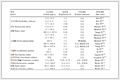 Table 1.
Crystal data and structure refinement data for complexes 1, 2, 3 and 4
 Table 1. Crystal data and structure refinement data for complexes 1, 2, 3 and 4
Table 2.
Selected bond lengths (nm) and angles (°) for complexes 1, 2, 3 and 4
 Table 2. Selected bond lengths (nm) and angles (°) for complexes 1, 2, 3 and 4
CCDC: 1028976, 1; 1028977, 2; 1028978, 3; 1028979, 4.
2 Results and discussion
2.1 Crystal structures of 1, 2
As shown in Fig. 1a, the Cd(Ⅱ) center is octah-edral coordinated by two nitrogen atoms from L ligand and four oxygen atoms from two tpa2-. The asymmetric unit contains one Cd(Ⅱ) ion, one L ligand, one tpa2- and three water molecules. The L ligand coordinates one Cd(Ⅱ) ion to construct 0 D metal hybrid calix[4]arene which is cone conformation and has a cavity containing a stronger O1-H1…O2 hydrogen bond (0.194 64(21) nm) (Fig. 1b). A μ2-coordinated tpa2- ion connected two adjacent Cd(Ⅱ) ions of metal hybrid calix[4] arene forming a trans-configuration zigzag structure. Neighboring zigzag structures were further connected by tpa2- ions to form infinite trans-config-uration chains through weak interchain C-H…π interactions (distance of C-H…Cg 0.303 97(6)~ 0.368 33(6) nm) between H2tpa and hydrogen atoms of C14, C2, C3 (Fig. 1c and Fig. 1d).
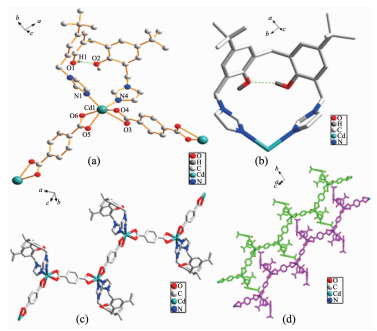 Figure 1.
(a) Coordination environment of Cd(Ⅱ) ions in 1;
(b) Cd(Ⅱ) hybrid calix[4]arene; (c) Schematic view of a chain of 1; (d) View of two neighbouring chains of 1
Because the structure of complex 2 (Fig. 2) is similar to complex 1, complex 2 will not be discussed in detail.
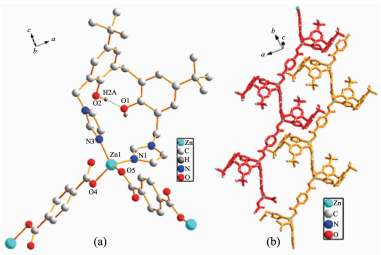 Figure 2.
(a) Structure of 2; (b) Schematic representation of two adjacent chains of 2
2.2 Crystal structures of 3, 4
Complexes 3 and 4 are isostructural, hence, only the structure of 3 is discussed here. There are one Co(Ⅱ) ion, one L ligand and one oba2-, two DMA molecules and half of lattice water in the asymmetric unit of 3. The Co(Ⅱ) cation is four-coordinated by two oxygen atoms from two oba2- and two nitrogen atoms from L ligand. C25/C25A, C26/C26A, C27/C27A, C36/C36A, C37/C37A and C38/C38A in complex 3 are disordered. Moreover, intramolecular O-H…O (O6-H6…O7) and intermolecular C-H…O (C47-H47A…O5) can be discovered (Fig. 3a). Similar to complex 1, complex 3 contains a Co(Ⅱ) metal hybrid calix[4]arene including the cavity with a hydrogen bond (O6-H6…O7 0.186 06(66) nm) (Fig. 3b).
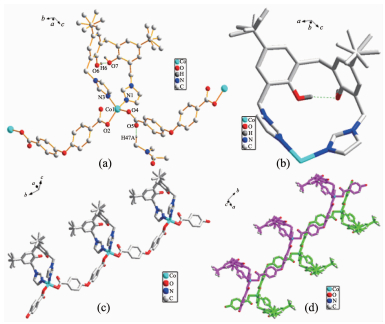 Figure 3.
(a) View of the coordination environment of Co(Ⅱ) centers in 3; (b) Co(Ⅱ) hybrid calix[4]arene;
(c) View of a 1D chain of 3; (d) View of two contiguous chains structure of 3
Two adjacent hybrid calix[4]arene of complex 3 were linked by a μ2-oba2- ion to formed the zigzag cis-vconfiguration chain (Fig. 3c). Because of steric effects, two adjacent chains were trans-configuration (Fig. 3d). Furthermore the solvent accessible volume of complex 4 is 20.96% which was found by Platon analysis.
2.3 Thermal gravimetric analysis and PXRD patterns
The thermal stability of 1, 2, 3 and 4 was investigated by TGA and the results are shown in Fig. 4. Complexes 1 and 2 lost solvent molecules in the ranges of 30~222 ℃ (Obsd. 6.19% and Calcd. 6.72% for 1) and 30~213 ℃ (Obsd. 3.61% and Calcd. 3.70% for 2), respectively. Frameworks of complexes 1 and 2 are stable up to 342 ℃ and 368 ℃, respectively, and then frameworks begin to collapse. The complex 3 has two different process of weight loss: an initial weight loss of 0.80% corresponds to the loss of lattice water molecules (Calcd. 0.92%); the removal of DMA mole-cules occurs in the range of 139~324 ℃ (Obsd. 17.99%, Calcd. 17.94%). Framework can stable up to 534 ℃ and then begins to collapse. Complex 4 shows a weight loss of 9.88% in the temperature range of 41~169 ℃, which is attributed to the loss of DMA molecules from the frameworks (Calcd. 9.89%), then it decomposes at 392 ℃. The experimental and simulated PXRD patterns of 1~4 were shown in Fig.S1~S4. Their experimental and simulated peaks are in good agreement, implying the phase purity of these samples are good.
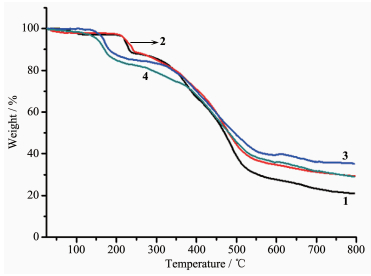 Figure 4.
TGA curves for complexes 1, 2, 3 and 4
2.4 UV-Vis spectrum
As shown in Fig.S5, complexes 3 and 4 show wide absorption peaks at 240~260 nm, which should be considered as π-π* transition of the ligands. The lower energy bands of 3 and 4 are at 200~220 nm, which can be attributed to metal-to-ligand charge-transfer transitions[27-28].
3 Conclusions
In conclusion, we have successfully synthesized four one-dimensional coordination polymers, which concluded metal hybrid calix[4]arene and dicarbox-mlates. The better thermal stability of four complexes was demonstrated by thermal gravimetric analysis. Further experiments exploring the property and potential applications are underway in our laboratory.
Supporting information is available at http://www.wjhxxb.cn
-
-
[1]
Tang Q, Zhou Z, Chen Z F. J. Phys. Chem. C, 2012, 116(6):4119-4125 doi: 10.1021/jp211779w
-
[2]
Fermi A, Bergamini G, Roy M, et al. J. Am. Chem. Soc., 2014, 136(17):6395-6400 doi: 10.1021/ja501458s
-
[3]
Hasegawa S, Horike S, Matsuda R, et al. J. Am. Chem. Soc., 2007, 129(9):2607-2614 doi: 10.1021/ja067374y
-
[4]
Huang Y B, Wang Q, Liang J, et al. J. Am. Chem. Soc., 2016, 138(32):10104-10107 doi: 10.1021/jacs.6b06185
-
[5]
Zhang Y J, Liu T, Kanegawa S, et al. J. Am. Chem. Soc., 2010, 132(3):912-913 doi: 10.1021/ja908670u
-
[6]
Agarwal R A, Mukherjee S, Sañudo E A, et al. Cryst. Growth Des., 2014, 14(11):5585-5592 doi: 10.1021/cg500833s
-
[7]
Risset O N, Brinzari T V, Meisel M W, et al. Chem. Mater., 2015, 27(18):6185-6188 doi: 10.1021/acs.chemmater.5b02785
-
[8]
Yoshida Y, Inoue K, Kurmoo M. Inorg. Chem., 2009, 48(22):10726-10736 doi: 10.1021/ic901615e
-
[9]
Zhang W X, Xue W, Chen X M. Inorg. Chem., 2011, 50(1):309-316 doi: 10.1021/ic101948q
-
[10]
Dey A, Konavarapu S K, Sasmal H S, et al. Cryst. Growth Des., 2016, 16(10):5976-5984 doi: 10.1021/acs.cgd.6b01028
-
[11]
Xin Z F, Bai J F, Shen Y M, et al. Cryst. Growth Des., 2010, 10(6):2451-2454 doi: 10.1021/cg901520r
-
[12]
Chandrasekhar V, Mohapatra C, Banerjee R, et al. Inorg. Chem., 2013, 52(7):3579-3581 doi: 10.1021/ic302528b
-
[13]
Singh R, Mrozinski J, Bharadwaj P K. Cryst. Growth Des., 2014, 14(7):3623-3633 doi: 10.1021/cg5005775
-
[14]
Bazaga-García M, Angeli G K, Papathanasiou K E, et al. Inorg. Chem., 2016, 55(15):7414-7424 doi: 10.1021/acs.inorgchem.6b00570
-
[15]
Decadt R, Hecke K V, Depla D, et al. Inorg. Chem., 2012, 51(21):11623-11634 doi: 10.1021/ic301544q
-
[16]
Martin N P, Falaise C, Volkringer C, et al. Inorg. Chem., 2016, 55(17):8697-8705 doi: 10.1021/acs.inorgchem.6b01232
-
[17]
Wu H, Yang J, Su Z M, et al. J. Am. Chem. Soc., 2011, 133(30):11406-11409 doi: 10.1021/ja202303b
-
[18]
Fu H R, Kang Y, Zhang J. Inorg. Chem., 2014, 53(8):4209-4214 doi: 10.1021/ic5003226
-
[19]
熊芳, 张淑芳, 何站, 等.无机化学学报, 2014, 30(11):2584-2590 http://en.cnki.com.cn/Article_en/CJFDTotal-WJHX201411019.htmXIONG Fang, ZHANG Shu-Fang, HE Zhan, et al. Chinese J. Inorg. Chem., 2014, 30(11):2584-2590 http://en.cnki.com.cn/Article_en/CJFDTotal-WJHX201411019.htm
-
[20]
Sun X H, Li W Y, Xia P F, et al. J. Org. Chem., 2007, 72(7):2419-2426 doi: 10.1021/jo062258z
-
[21]
Paquet V, Zumbuehl A, Garreira E M. Bioconjugate Chem., 2006, 17(6):1460-1463 doi: 10.1021/bc060205i
-
[22]
Nandi P, Solovyov A, Okrut A, et al. ACS Catal., 2014, 4(8):2492-2495 doi: 10.1021/cs5001976
-
[23]
Qin D B, Zeng X S, Li Q S, et al. Chem. Commun., 2007:147-149 http://www.ncbi.nlm.nih.gov/pubmed/17180228/
-
[24]
Meninno S, Parrella A, Brancatelli G, et al. Org. Lett., 2015, 17(20):5100-5103 doi: 10.1021/acs.orglett.5b02607
-
[25]
Sheldrick G M. SHELXS-97, Program for the Solution of Crystal Structure, University of Göttingen, Germany, 1997.
-
[26]
Sheldrick G M. SHELXL-97, Program for the Refinement of Crystal Structures, University of Göttingen, Germany, 1997.
-
[27]
马宁, 宋会花, 于海涛.无机化学学报, 2016, 32(6):1078-1088 doi: 10.1007%2Fs11224-016-0907-6MA Ning, SONG Hui-Hua, YU Hai-Tao. Chinese J. Inorg. Chem., 2016, 32(6):1078-1088 doi: 10.1007%2Fs11224-016-0907-6
-
[28]
Jeremić D A, Kaluđerović G N, Gćmez-Ruiz S, et al. Cryst. Growth Des., 2010, 10:559-563 doi: 10.1021/cg9009288
-
[1]
-

Figure 1 (a) Coordination environment of Cd(Ⅱ) ions in 1; (b) Cd(Ⅱ) hybrid calix[4]arene; (c) Schematic view of a chain of 1; (d) View of two neighbouring chains of 1
Some hydrogen atoms are omitted for clarity, all solvent molecules are omitted for clarity

Figure 3 (a) View of the coordination environment of Co(Ⅱ) centers in 3; (b) Co(Ⅱ) hybrid calix[4]arene; (c) View of a 1D chain of 3; (d) View of two contiguous chains structure of 3
Some hydrogen atoms and solvent molecules are omitted for clarity
-


 下载:


 扫一扫看文章
计量
- PDF下载量: 5
- 文章访问数: 1985
- HTML全文浏览量: 296
 下载: