

 Figure 1.
Reaction process and the crystal structure of BiVO4 and BiPO4
Figure 1.
Reaction process and the crystal structure of BiVO4 and BiPO4
Citation:
YIN Yan-Feng, ZHOU Feng, ZHAN Su, YANG Yi-Fan, LIU Yu-Jun. Preparation of BiVO4/BiPO4 Composites With Enhanced Visible-Light-Driven Photocatalytic Properties[J]. Chinese Journal of Inorganic Chemistry,
2016, 32(3): 483-490.
doi:
10.11862/CJIC.2016.065

BiVO4 /BiPO4复合物的制备及可见光催化性能
摘要:
采用水热法合成出具有不同V、P物质的量之比的BiVO4/BiPO4复合物.nV/nP分别为: 0.1/9.9、0.5/9.5、1/9、3/7、5/5.采用XRD、FE-SEM、EDS、拉曼、可见光光度计、漫反射以及电化学等测试手段对BiVO4/BiPO4复合物进行表征.在可见光条件下降解亚甲基蓝来评价BiVO4/BiPO4复合物的光催化活性.结果显示, 当nV/nP < 3/7的时候, BiVO4/BiPO4复合物的光催化活性随着BiVO4含量的增加而增加, 当nV/nP=3/7的时候, 复合物具有最佳的光催化性能, 反应速率常数k为0.005 1 min-1, 是纯BiPO4的23.2倍.BiVO4/BiPO4复合物的光催化机制主要是由于BiVO4的加入, 提高了电子-空穴的分离率, 进而提高了光催化活性.
English
Preparation of BiVO4/BiPO4 Composites With Enhanced Visible-Light-Driven Photocatalytic Properties
Abstract:
BiVO4/BiPO4 composites with different nV/nP molar ratios were synthesized by a simple one-pot hydrothermal method. The nV/nP molar ratios were 0.1/9.9, 0.5/9.5, 1/9, 3/7, and 5/5, respectively. The BiVO4/BiPO4 composites were characterized by X-ray diffraction, field emission scanning electron microscope, energy-dispersive spectroscopy, Raman spectrum, UV-Vis spectrophotometer, UV-Vis diffuse reflectance spectroscopy, and electrochemical impedance spectra. The photocatalytic activities of BiVO4/BiPO4 composites were evaluated by the degradation of methylene blue (MB) under visible light irradiation (λ>420 nm). When the ratios of the BiVO4/BiPO4 composites were less than 3/7, the photocatalytic activities of BiVO4/BiPO4 composites were enhanced with an increasing amount of BiVO4. The result showed that the BiVO4/BiPO4 composite ratio for nV/nP=3/7 possessed the highest photocatalytic activity. The BiVO4/BiPO4 composite ratio for nV/nP=3/7 possessed the maximal k value of 0.005 1 min-1. It is 23.2 times of the pure BiPO4. The photocatalytic mechanism of the BiVO4/BiPO4 composites could be mainly ascribed to the existence of BiVO4 which could accelerate the separation and migration efficiency of photogenerated carriers.
-
Key words:
- hydrothermal
- / BiVO4
- / BiPO4
- / photocatalytic activity
- / electron-hole pairs
-
0 Introduction
Since the new century, environmental pollution became one of the toughest issues, and human beings need to face it. Photocatalysts can replace the traditional pollutant control technology because of full use of sunlight, complete degradation without secondary pollution and other advantages. At present, TiO2 was the most widely studied photocatalysts. Because of their outstanding photocatalytic activity[1-4], TiO2-based photocatalysts had been proven to be one of the promising photocatalysts. But TiO2-based photocatalysts were hard to overcome the issue of high recombination rates of photogenerated electron-hole pairs. Therefore, how to carry out efficient photocatalytic materials had become an important issue of photocatalysts.
Currently, inorganic bismuth compounds (eg BiOX[5], BiVO4[6-8], Bi2WO6[9-10], Bi2MoO6[11-12] and BiPO4[13-14]) were widespread concerned because of their high electron-holes separation rate. BiPO4 was a new type of photocatalysts. BiPO4 had been reported that had excellent photocatalytic activity under UV light than TiO2 (P25) for the degradation of methylene blue (MB)[15]. Zhu et al. reported PO43-was favorable for the separation of photo-induced e-/h+ and PO43- can improve the photocatalytic activity of BiPO4[16]. Due to the wide band gap, BiPO4 had no visible light response. It must be the largest hindrance for the further applications of BiPO4. Thus, it was an important mission to broaden the visible light absorption region of BiPO4. Up to now, for obtaining visible light induced, much work had been done for BiPO4, including C3N4/BiPO4[17], AgPO4/BiPO4[18-19], BiOI/BiPO4[20], and Bi2MoO6/BiPO4[21]. BiVO4 had a narrow gap-band energy (~2.4 eV) and had been considered to be one of the most promising photocatalysts. BiVO4 was usually selected as a sensitizer photocatalyst because of its high visible-light response. BiVO4 could degrade pollutants and evolve H2 and O2 under visible light (λ>420 nm). However, as stated previously, the poor separation of photoinduced e-/h+ had a restriction on the photocata-lytic activity of pure BiVO4. Therefore, we envisaged that constructing BiVO4/BiPO4 heterostructured photo-catalysts[22-23], which could be a promising method to improve the photocatalytic performance and broaden the visible light absorption region of BiPO4. However, until now, there were few reports about BiVO4/BiPO4 composites photocatalysts.
In this study, BiVO4/BiPO4 composites photoca-talysts were synthesized by hydrothermal method. The photocatalytic activities of BiVO4/BiPO4 composites were evaluated by the degradation of methylene blue (MB) under visible light (λ>420 nm). Besides, detailed photocatalytic mechanism of the BiVO4/BiPO4 Composites had been discussed.
1 Experimental
1.1 Experimental drugs and equipment required for the experiment
All chemicals were analytical purity and were used without further purification. Bismuth nitrate pentahydrate (Bi (NO3)3·5H2O) was obtained from Tianjin Kermel Chemical Reagent Co., Ltd. Risodium phosphate dodecahydrate (Na3PO4·12H2O) was obtained from Shenyang Federal Reagent Factory and ammonium metavanadate (NaVO3) was obtained from Sinopharm Chemical Reagent Co., Ltd. Methylene blue (C6H18ClN3S·3H2O) was obtained from Tianjin Bodi Chemical Co., Ltd. Deionized water was used in all experiments.
The purity and crystallinity of pure BiPO4, pure BiVO4 and BiVO4/BiPO4 composites were characterized by X-ray diffraction (XRD) on Rigaku DMAX- Ultima+ diffractometer with Cu Kα radiation (λ=0.154 06 nm). Raman spectrum was excited with the 514 nm line of an Ar+ laser at an incident power of 20 mW. The morphologies of the samples were examined by a field emission scanning electron microscope (FE-SEM) with SUPRA 55 SAPPHHIRE. UV-Vis diffuse reflectance spectroscopy (DRS) measurements were measured using a TU-1901 UV-Vis spectrophotometer equipped with an integrating sphere attachment. The analysis range was from 200 to 800 nm, and BaSO4 was used as a reflectance standard. Electrochemical experiments were performed in a flat cell having 0.1 mol·L-1 Na2SO4 solution by a remote controlled potentiostat/galvanostat (VMP3 EG & G Princeton Research).
1.2 Preparation of photocatalysts
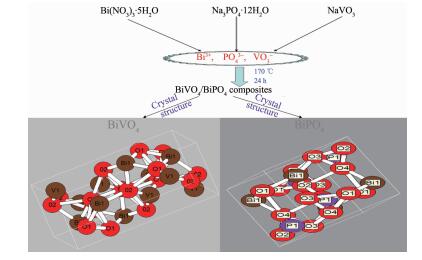
The BiVO4/BiPO4 composites with different BiVO4 contents were synthesized by hydrothermal method. In a typical process, the precursor solution was prepared by dissolving 2 mmol Bi (NO3)3·5H2O with 0.02 mmol NaVO3, 1.98 mmol Na3PO4·12H2O; 0.1 mmol NaVO3, 1.9 mmol Na3PO4·12H2O; 0.2 mmol NaVO3, 1.8 mmol Na3PO4·12H2O; 0.6 mmol NaVO3, 1.4 mmol Na3PO4·12H2O and 1 mmol NaVO3, 1 mmol Na3PO4·12H2O, respectively. Then the precursor solution was putted in 35 mL of distilled water. After stirring for 30 min, the resultant precursor solution was transferred into a 50 mL teflon-lined stainless steel autoclave. The autoclave was sealed and heated to 170 ℃ for 24 h and allowed to cool down to room temperature naturally. The precipitate was washed with absolute ethanol and distilled water for many times, respectively, and dried at 70 ℃ in air. In order to facilitate the expression, the composite ratios were named for nV/nP=0.1/9.9, 0.5/9.5, 1/9, 3/7, 5/5 as 0.1VP, 0.5VP, 1VP, 3VP, 5VP, respectively. For comparison, pure BiPO4 sample was synthesized by adopting the method. BiPO4 was synthesized by 2 mmol Bi (NO3)3·5H2O and 2 mmol Na3PO4·12H2O. The reaction process could be simply expressed as shown in Fig. 1.
Figure 1.
Reaction process and the crystal structure of BiVO4 and BiPO4
1.3 Photocatalytic activity tests
To carry out the photocatalytic activity of pure BiPO4 and BiVO4/BiPO4 composites, the sample of 50 mg was suspended in a MB dye aqueous solution (100 mL, 10-5 mg·L-1). After stirring for 30 min to reach an equilibrium adsorption state in the dark, the solution was irradiated with a 500 W Xe arc lamp. The lamp provided visible light (λ>420 nm) with a cut off filter. At given time intervals, the solution (4 mL) was sampled and centrifuged. Then, the filtrates were analyzed by recording variations of the absorption band maximum (664 nm) in a UV-Vis spectra of MB by using a TU-1901 UV-Vis spectrophotometer.
The degradation efficiency was calculated as follows[24]:
Where C0 was the absorbance of original methylene blue (MB) solution and C was the absorbance of the methylene blue (MB) solution after visible light irradiation for 180 min. According to the Langmuir-Hinshelwood kinetics model, the photocatalytic process of methylene blue (MB) could be expressed as the following apparent pseudo-first-order kinetics equation:
Where k was the apparent pseudo-first-order rate constant, C0 was the original methylene blue (MB) concentration and C was methylene blue (MB) concentration in aqueous solution at time.
2 Results and discussion
2.1 Photocatalytic activity
The photocatalytic activities of the BiVO4/BiPO4 samples were measured on the degradation of methylene blue (MB) in deionized water under visible light irradiation (λ>420 nm) in Fig. 2. It can be seen that pure BiPO4 had less visible light photocatalytic activity for methylene blue (MB) degradation, due to the wide band gap (300 nm) of BiPO4. After the depositing of BiVO4, BiPO4 can degrade methylene blue (MB) under visible light, which showed that BiVO4 was a good visible light sensitizer to BiPO4. The efficient visible light absorption abilities of BiVO4/BiPO4 composites ensured that the BiVO4/BiPO4 composites generated sufficient electron-hole pairs under visible irradiation. In particularly, 3VP displayed the best photocatalytic activity. Fig. 2a showed the degradation efficiency of BiVO4/BiPO4 composites and the rate constant k. It could be seen that 3VP could degrade 60.2% methylene blue (MB) by 3 h illumination. It was calculated that 3VP possessed the maximal k value of 0.005 1 min-1 which was 23.2 times of the pure BiPO4 in Fig. 2b.
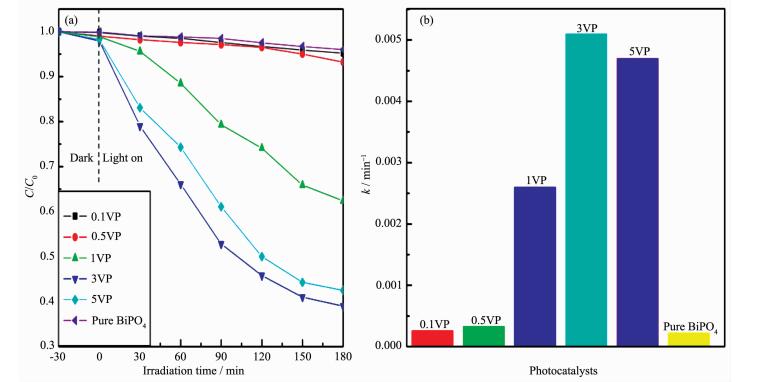 Figure 2.
(a) Photodegradation efficiencies of MB as a function of irradiation time for different samples;
(b) Rate constant k of MB degradation for the as-prepared samples
Figure 2.
(a) Photodegradation efficiencies of MB as a function of irradiation time for different samples;
(b) Rate constant k of MB degradation for the as-prepared samples
As reported in the previous literature[25-29], generally, there was an optimal ratio of the two components in composite photocatalysts. When the component ratio of BiVO4/BiPO4 composites was changed that not only mainly affected the number of effective heterojunctions and also influenced the separation efficiency of BiVO4/BiPO4 composites. In case of the optimal content of 3VP, the most appropriate BiVO4/BiPO4 heterojunction was formed. The BiVO4/BiPO4 heterojunction could facilitate the high efficient separation of photoinduced electrons and holes, and endow the BiVO4/BiPO4 composite with higher photocatalytic activity under visible light irradiation (λ>420 nm).
2.2 Structural characterization
The purity and crystallinity of the BiVO4/BiPO4 composites were characterized by XRD. The Fig. 3 showed the XRD patterns of the as-prepared BiPO4, BiVO4 and BiVO4/BiPO4 composites. The BiVO4/BiPO4 composites exhibited a coexistence of both BiPO4 and BiVO4 phase. All the peaks for the samples were readily indexed to the monoclinic structure of BiPO4 (JCPDS No.15-0767). As it could be seen in the pattern of BiVO4 sample, the diffraction peaks could be perfectly indexed to BiVO4 phase (JCPDS No.21-0121). For the BiVO4/BiPO4 composites, all diffraction peaks of BiPO4 were clearly observed, indicating that the solvothermal did not influence the crystal structure of BiPO4. When the nV/nP was 3/7, the strong characteristic diffraction peaks of sample BiPO4 and monoclinic BiVO4 were simultaneously found. With an increasing amount of BiVO4, more BiVO4 diffraction peaks appeared.
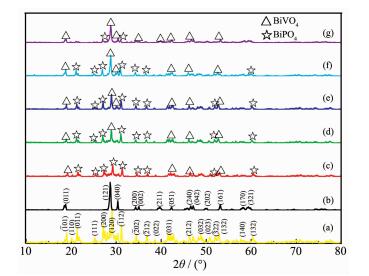 Figure 3.
XRD patterns of the as-prepared samples
Figure 3.
XRD patterns of the as-prepared samples
To investigate the chemical bonding of the BiVO4/BiPO4 composites, Raman spectra were obtained and shown in Fig. 4. The 3VP was selected for the study. In the Raman spectra, the observed intense band at 206 cm-1 corresponded to the Bi-O stretching vibration[30]. The band at 825 cm-1 could be assigned to the symmetric vibration of V-O and the band at 323 cm-1 could be assigned to the asymmetric stretching of VO43-[31]. The v2 vibration of the PO43- occurred at 362 cm-1[30].
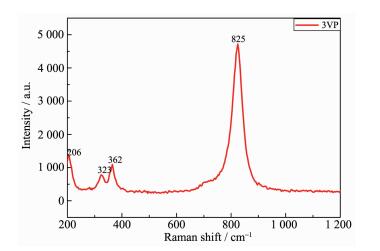 Figure 4.
Raman spectrum of the as-prepared 3VP composite
Figure 4.
Raman spectrum of the as-prepared 3VP composite
Combined with XRD results, all the evidences revealed the coexistence of both BiPO4 and BiVO4 phase.
2.3 Morphological analysis
The morphology and microstructure of the BiVO4/BiPO4 composites were characterized by FE-SEM. The FE-SEM images of the as-synthesized samples were given in Fig. 5. The FE-SEM image (Fig. 5a) of pure BiPO4 showed that pure BiPO4 had regular nanorods and had a clean surface. The nanorods had a length about 700 nm. After checking the relevant literature, pure BiVO4 exhibited an irregular decahedron shape[6-8]. Many irregular particles or particle aggregates of BiVO4 were observed to adhere to BiPO4 (Fig. 5b, c, d, e, f). In Fig. 5, it can be seen that with the increasing of the content of BiVO4, the bulk morphology of the composite were increased, and the shape nanorods of the composite were decreased. When the nV/nP was 3/7, the composite had the best performance.
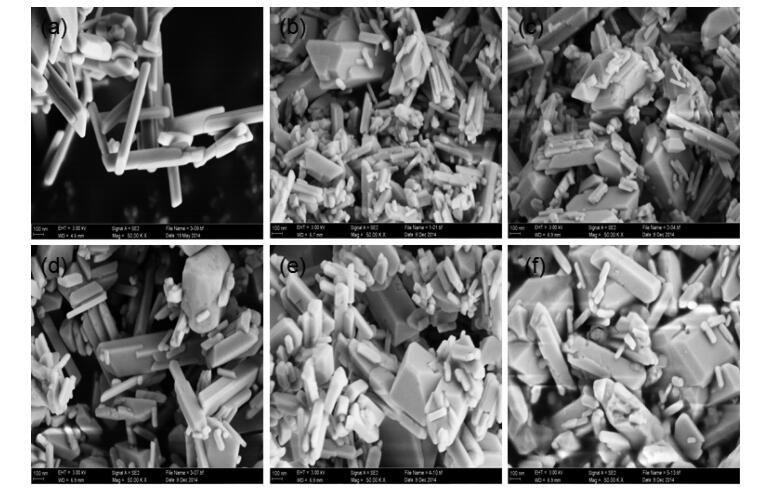 Figure 5.
FE-SEM images of the as-prepared samples
Figure 5.
FE-SEM images of the as-prepared samples
To determine the exact ratio of nV/nP, EDS was carried out to further identify the elemental composition of 0.1VP, 0.5VP, 1VP, 3VP and 5VP in Table 1. For example, the EDS pattern of the 3VP clearly indicated that, besides the V, Bi and O diffraction peaks corresponding to BiVO4, the P, Bi and O diffraction peaks coming from BiPO4 were also observed, confirming that the samples were composed of both BiVO4 and BiPO4. Meanwhile the molar ratio of nV/nP was 0.439, which was matched the ratio of the value of 3/7. The exact ratio of nV/nP was more or less the same as the one calculated from the preparation process.
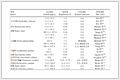 Table 1.
Characterization of the ratio of V/P
Table 1.
Characterization of the ratio of V/P
Sample nv/nP (preparation process) nV/nP (exact) 0.1VP 0.01 0 0.5VP 0.05 0.04 1VP 0.11 0.09 3VP 0.43 0.439 5VP 1 1.14 2.4 Optical characterization
The optical absorption properties played a critical role in determining the photocatalytic perfor-mance of BiVO4/BiPO4 composites. The optical prop-erties of pure BiPO4 and 3VP were measured by UV-Vis diffuse reflectance spectra (DRS) in Fig. 6. It could be clearly seen that BiPO4 could merely respond to the UV light. The absorption band edge of BiPO4 was around 300 nm. After the depositing of BiVO4, the light absorption of 3VP was significantly broadened to the visible light range around 460 nm. Compared with the pure BiPO4, 3VP photocatalyst showed a notable red-shift in the the absorption edge. This phenomenon may be due to the interaction between BiVO4 and BiPO4, which subsequently resulted in a higher photocatalytic activity under visible light irradiation.
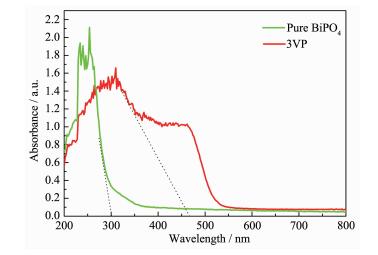 Figure 6.
UV-Vis DRS of the as-prepared samples: pure BiPO4, 3VP
Figure 6.
UV-Vis DRS of the as-prepared samples: pure BiPO4, 3VP
2.5 Electrochemical analysis
Electrochemical impedance spectra (EIS) meas-urements were conducted to investigate the separation efficiency of the photoinduced charge carriers and the charge transfer resistance. Fig. 7 showed the EIS Nyquist plots of 3VP and pure BiPO4. It was known that when the diameter for arc radius was smaller, the charge transfer efficiency was higher[32]. The diameter for arc radius of 3VP lighting was smaller than that of without lighting, which indicated a decrease in the charge-transfer resistance and leaded an effective electronhole pair separation. The radius of 3VP was smaller than that of pure BiPO4 of lighting, implying that the charge transfer efficiency of 3VP was higher than that of pure BiPO4. Therefore, it could be concluded that the existence of BiVO4 could accel-erate the separation efficiency of photogenerated carriers of BiVO4/BiPO4 composites.
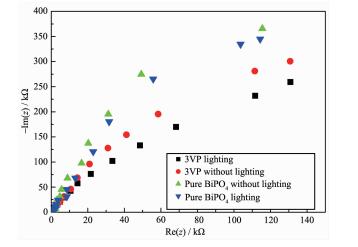 Figure 7.
Nyquist plots for pure BiPO4, 3VP composite
Figure 7.
Nyquist plots for pure BiPO4, 3VP composite
2.6 Photocatalytic mechanism of BiVO4/BiPO4 composites
The enhancement of photocatalytic activity of BiVO4/BiPO4 composites was mainly due to the higher separation efficiency induced by the hybrid effect of BiVO4 and BiPO4. A proposed schematic mechanism of the BiVO4/BiPO4 composites was shown in Fig. 8. Through experiments, it was known that BiPO4 had no or less visible light photocatalytic activity for MB degradation, which means that the electrons at the valence band (VB) of BiPO4 could not inject into the conduction band (CB) of BiPO4 under visible-light irradiation. After the depositing of BiVO4, at the beginning of the reaction, photogenerated electron-hole pairs were formed on BiVO4, under visible light irradiation (λ>420 nm). The electrons at the VB of BiVO4, not only could inject into the CB of BiVO4, but also the CB of BiPO4. The electrons injected into the CB of BiPO4 not only revealed that BiPO4 took part in the degradation of MB reaction under visible light irradiation and also leaded to a much reduced electron-hole recombination and improved the photo-catalytic efficiency of the BiVO4/BiPO4 composites for MB degradation. The whole process was described as follows:
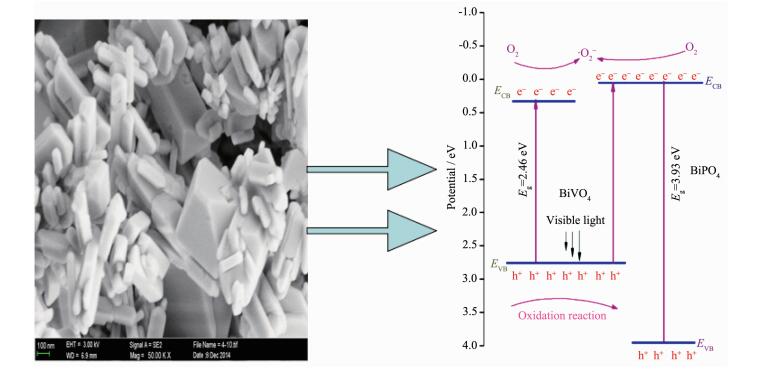 Figure 8.
Schematic diagram of the separation and transfer of photogenerated charges in the BiVO4/BiPO4 composites under visible light irradiation
Figure 8.
Schematic diagram of the separation and transfer of photogenerated charges in the BiVO4/BiPO4 composites under visible light irradiation
3 Conclusions
By the hydrothermal method, a series of BiVO4/BiPO4 were synthesized with different nV/nP. UV-Vis diffuse reflectance spectra could demonstrate that all the composites exhibited broad absorption in the visible region. The optimal nV/nP was 3/7. The k value was 0.005 1 min-1 which was 23.2 times of the pure BiPO4. The heterojunction structure of BiVO4/BiPO4 facilitated the efficient separation of photogenerated electron-hole pairs, greatly improving the photocata-lytic efficiency of BiPO4. The synthesized of BiVO4/BiPO4 composites provided a guideline for BiPO4 transferred to visible light, increasing the utilization of sunlight.
-
-
[1]
Rauf M, Ashraf S.. Chem. Eng. J., 2009, 151(1/2/3):10-18 http://www.sciencedirect.com/science/article/pii/S1385894709001454
-
[2]
Natarajan T S, Thomas M, Natarajan K, et al. Chem. Eng. J., 2011, 169(1/2/3):126-134 http://www.sciencedirect.com/science/article/pii/S1385894711002750
-
[3]
Li Q Y, Xing Y Y, Li R, et al. RSC Adv., 2012, 2(26):9781-9785 doi: 10.1039/c2ra21355a
-
[4]
Virkutyte J, Varma R S.. RSC Adv., 2012, 2(4):1533-1539 doi: 10.1039/C1RA00990G
-
[5]
Zhang X, Ai Z H, Jia F L, et al. J. Phys. Chem. C, 2008, 112 (3):747-753 doi: 10.1021/jp077471t
-
[6]
Wang A L, Shen S, Zhao Y B, et al. J. Colloid Interface Sci., 2015, 445:330-336 doi: 10.1016/j.jcis.2015.01.017
-
[7]
Ma W Q, Li Z L, Liu W.. Ceram. Int., 2015, 41(3):4343-4347 http://www.sciencedirect.com/science/article/pii/S0272884214018884
-
[8]
高善民, 乔青安, 赵培培, 等.无机化学学报, 2007, 23(7):1153-1158 http://www.wjhxxb.cn/wjhxxbcn/ch/reader/view_abstract.aspx?flag=1&file_no=20070705&journal_id=wjhxxbcnGAO Shan-Min, QIAO Qing-An, ZHAO Pei-Pei, et al. Chinese J. Inorg. Chem., 2007, 23(7):1153-1158 http://www.wjhxxb.cn/wjhxxbcn/ch/reader/view_abstract.aspx?flag=1&file_no=20070705&journal_id=wjhxxbcn
-
[9]
Chen Y F, Fang J Z, Lu S Y, et al. J. Chem. Technol. Biotechnol., 2015, 90(5):4340-4347
-
[10]
桂明生, 王鹏飞, 袁东, 等.无机化学学报, 2013, 29(10):2057-2064 http://www.wjhxxb.cn/wjhxxbcn/ch/reader/view_abstract.aspx?flag=1&file_no=20131006&journal_id=wjhxxbcnGUI Ming-Sheng, WANG Peng-Fei, YUAN Dong, et al. Chinese J. Inorg. Chem., 2013, 29(10):2057-2064 http://www.wjhxxb.cn/wjhxxbcn/ch/reader/view_abstract.aspx?flag=1&file_no=20131006&journal_id=wjhxxbcn
-
[11]
Shi X L, Liu Y, Zhang J, et al. Ceram. Int., 2015, 41(2): 3162-3168 doi: 10.1016/j.ceramint.2014.10.164
-
[12]
李红花, 李坤威, 汪浩. 无机化学学报, 2009, 25 (3):512-516 http://www.wjhxxb.cn/wjhxxbcn/ch/reader/view_abstract.aspx?flag=1&file_no=20090325&journal_id=wjhxxbcnLI Hong-Hua, LI Kun-Wei, WANG Hao. Chinese J. Inorg. Chem., 2009, 25 (3):512-516 http://www.wjhxxb.cn/wjhxxbcn/ch/reader/view_abstract.aspx?flag=1&file_no=20090325&journal_id=wjhxxbcn
-
[13]
Yan S Q. Mater. Manuf. Processes, 2015, 30(5):591-594 doi: 10.1080/10426914.2014.994777
-
[14]
Nithya V D, Hanitha B, Surendran S, et al. Ultrasom Sonochem., 2015, 22:300-310 doi: 10.1016/j.ultsonch.2014.06.014
-
[15]
Pan C S, Zhu Y F.. Environ. Sci. Technol., 2010, 44(14): 5570-5574 doi: 10.1021/es101223n
-
[16]
Pan C S, Li D, Ma X G, et al. Catal. Sci. Technol., 2011, 1 (8):1399-1405 doi: 10.1039/c1cy00261a
-
[17]
Li Z S, Yang S Y, Zhou J M, et al. Chem. Eng. J., 2014, 241:344-351 doi: 10.1016/j.cej.2013.10.076
-
[18]
Mohaghegh N, Tasviri M, Rahimi E.. RSC Adv., 2015, 5(17): 12944-12955 doi: 10.1039/C4RA14294B
-
[19]
Wu S Y, Zheng H, Wu Y Y, et al. Ceram. Int., 2014, 40(9): 14613-14620 doi: 10.1016/j.ceramint.2014.06.047
-
[20]
Cao J, Xu B Y, Lin H L, et al. Chem. Eng. J., 2013, 228: 482-488 doi: 10.1016/j.cej.2013.05.008
-
[21]
Lin X, Liu D, Sun N, et al. J. Phys. Chem. Solids, 2015, 76: 170-177 doi: 10.1016/j.jpcs.2014.09.002
-
[22]
Wu S Y, Zheng H, Lian Y W, et al. Mater. Res. Bull., 2013, 48(8):2901-2907 doi: 10.1016/j.materresbull.2013.04.041
-
[23]
Lin H L, Ye H F, Chen S F, et al. RSC Adv., 2014, 4(21): 10968-10974 doi: 10.1039/c3ra45288c
-
[24]
Zhang A P, Zhang J Z.. J. Mater. Sci., 2010, 45(15):4040-4045 doi: 10.1007/s10853-010-4486-4
-
[25]
Cui W Q, Liu L, Liang Y H, et al. Appl. Surf. Sci., 2013, 276:823-831 doi: 10.1016/j.apsusc.2013.03.177
-
[26]
Cui W Q, Wang H, Liang Y H, et al. Chem. Eng. J., 2013, 230:10-18 doi: 10.1016/j.cej.2013.03.091
-
[27]
Cui W Q, Ma S S, Liu L, et al. Appl. Surf. Sci., 2013, 230: 171-181 http://www.sciencedirect.com/science/article/pii/S0169433213002250
-
[28]
Cui W Q, Wang H, Liang Y H, et al. Catal. Commum., 2013, 36:71-74 doi: 10.1016/j.catcom.2013.03.011
-
[29]
He P Z, Song L M, Zhang S J, et al. Mater. Res. Bull., 2014, 51:432-437 doi: 10.1016/j.materresbull.2013.12.064
-
[30]
Liu Y F, Lü Y H, Zhu Y Y, et al. Appl. Catal. B, 2014, 147: 851-857 doi: 10.1016/j.apcatb.2013.09.050
-
[31]
Galembeck A, Alves O L.. Thin Solid Films, 2000, 365(1):90-93 doi: 10.1016/S0040-6090(99)01079-2
-
[32]
Liu Y F, Yao W Q, Liu D, et al. Appl. Catal. B: Environ., 2015, 163:547-553 doi: 10.1016/j.apcatb.2014.08.039
-
[1]
-

Figure 2 (a) Photodegradation efficiencies of MB as a function of irradiation time for different samples; (b) Rate constant k of MB degradation for the as-prepared samples

Figure 3 XRD patterns of the as-prepared samples
(a) pure BiPO4; (b) pure BiVO4; (c) 0.1VP; (d) 0.5VP; (e) 1VP; (f) 3VP; (g) 5VP

Figure 5 FE-SEM images of the as-prepared samples
(a) Pure BiPO4; (b) 0.1VP; (c) 0.5VP; (d) 1VP; (e) 3VP; (f) 5VP

Figure 8 Schematic diagram of the separation and transfer of photogenerated charges in the BiVO4/BiPO4 composites under visible light irradiation
Table 1. Characterization of the ratio of V/P
Sample nv/nP (preparation process) nV/nP (exact) 0.1VP 0.01 0 0.5VP 0.05 0.04 1VP 0.11 0.09 3VP 0.43 0.439 5VP 1 1.14  下载: 导出CSV
-


 扫一扫看文章
计量
- PDF下载量: 0
- 文章访问数: 1204
- HTML全文浏览量: 157
 下载:
下载:

