

 Table 1.
Details of the data collection and refinement parameters for 1·H2O·3CH3CN
Table 1.
Details of the data collection and refinement parameters for 1·H2O·3CH3CN
Citation:
WANG Hui-Sheng, YUE Lin, PAN Min, ZHONG Wen-Da, TU Wei, PAN Zhi-Quan. Synthesis, Crystal Structure and Magnetic Properties of a Heptanuclear Mn Complex with 2-(Hydroxymethyl) pyridine and 1, 1, 1-Tris (hydroxymethyl) ethane Mixed-Ligands[J]. Chinese Journal of Inorganic Chemistry,
2016, 32(1): 153-160.
doi:
10.11862/CJIC.2016.012

2-吡啶甲醇和1, 1, 1-三羟甲基乙烷混合配体七核锰配合物的合成、晶体结构与磁性
摘要:
四水合氯化锰、2-吡啶甲醇和1, 1, 1-三羟甲基乙烷在乙腈里反应合成出一个七核Mn簇合物[Mn3ⅡMn4Ⅲ(Cl)6(hmp)6(thme)2]·H2O·3CH3CN (1·H2O·3CH3CN, hmpH为2-吡啶甲醇, thmeH3为三羟甲基乙烷), 并对该化合物进行X射线衍射单晶结构分析、元素分析、红外光谱和磁性研究.1·H2O·3CH3CN属于单斜晶系I2/a空间群, 配合物核骨架可看成由交替的MnⅡ和MnⅢ离子形成一个六边形, 而这个六边形又围绕在1个MnⅢ离子的周围, 这种结构类型的配合物以前并没有报道过.磁性研究表明, 化合物1·H2O中MnⅢ与MnⅡ或MnⅢ与MnⅢ离子之间总体是铁磁性耦合的, 交流磁化率研究发现该化合物有弱的频率依赖现象.
English
Synthesis, Crystal Structure and Magnetic Properties of a Heptanuclear Mn Complex with 2-(Hydroxymethyl) pyridine and 1, 1, 1-Tris (hydroxymethyl) ethane Mixed-Ligands
Abstract:
One heptanuclear Mn cluster [Mn3ⅡMn4Ⅲ(Cl)6(hmp)6(thme)2]·H2O·3CH3CN (1·H2O·3CH3CN, hmpH=2-(hydroxymethyl) pyridine and thmeH3=1, 1, 1-tris (hydroxymethyl) ethane) has been synthesized by the reaction of MnCl2·4H2O, hmpH and thmeH3 in MeCN. The complex was characterized by single crystal X-ray diffraction, elemental analyses, IR and magnetic investigation. Complex 1·H2O·3CH3CN crystallizes in the monoclinic space group I2/a and its core can be viewed as a Mn6 hexagon of alternating MnⅡ and MnⅢ ions surrounding a central MnⅢ ion, which has previously not been seen for this topology. Magnetic studies reveal that overall ferromagnetic coupling between MnⅢ and MnⅡ or MnⅢ ions within 1·H2O are present and weak frequency dependence of the ac-susceptibility was found. CCDC: 1045766.
-
Since the discovery of slow magnetization relaxa-tion for [Mn12O12(O2CMe)16(H2O)4] in 1993, single molecule magnets (SMMs) have received great attention in the field of coordination chemistry because of their unique and intriguing properties and their potential applications in high-density information storage, quantum computing and molecular spintronics [1-2]. Up to date, polynuclear 3d transition metal complexes (especially polynuclear Mn clusters) [3-4], 3d-4f mixed-metal complexes [5-6], polynuclear pure lanthanide clusters [7] and mononuclear f-based (including acitinide) or 3d transition metal compounds [8-10] have been repo-rted by scientists all over the world. Nonetheless, we consider that the polynuclear 3d clusters, especially polynuclear Mn clusters, should not be ignored because it is important for better understanding of magnetic interactions between paramagnetic ions, the quantum tunneling of the magnetization and the mechanisms for slow magnetic relaxation.
Choosing appropriate multidentate chelating ligands is vitally important for obtaining the above types of SMMs. At early stage, carboxylate ligands have been widely used in the construction of 3d clusters. However, in recently years, non-carboxylate ligands have been received more attention. These non-carbo-xylate ligands mainly include [11]: (ⅰ) alcohol/alkoxide-based chelating ligands, such as 2-(hydroxymethyl) pyridine (hmpH) [12], 2, 6-pyridinedimethanol (pdmH2) [13], the gem-diolate form of di-2-pyridyl ketone (dpkd2-) [14], 1, 1, 1-tris (hydroxymethyl) ethane (thmeH3) [15]; (ⅱ) poly-dentate Schiff-base ligands, such as N, N′-2, 2-dimeth-ylpropylenedi (3-methoxysalicylideneiminato) [16], (E)-2, 2′-(2-hydroxy-3-((2-hydroxyphenylimino) methyl)-5-methylbenzylazanediyl)-diethanol [17]; (ⅲ) other N-and O-based chelating ligands, such as methyl-2-pyridyl ketone (mpkoH) [18], 2, 6-diacetylpyridine dioxime (dapdoH2) [19], salicylaldoxime and its derivatives (H2salox and R-H2salox) [20]. By detailed investigation on these multidentate chelating ligands, we found that their symmetry are different, for example, pdmH2 and thmeH3 possess C2 and C3 symmetry axes, respectively, while hmpH, mpkoH and others have no symmetry axes. Additionally, the coordinate modes of these multidentate chelating ligands are different from each other. Therefore, novel structural complexes with distinctive magnetic properties compared with complexes containing single multidentate chelating ligand may be obtained by mixing two or more kinds of ligands possessing different symmetry in a solution containing magnetic spin carrier salts. Actually, we have obtained [Mn4], [Mn13] and [Mn16] clusters containing mixed chelating ligands [21-22]. We have also found that the core structures of the tetranuclear Ni clusters can be transformed from a defect dicubane-like core to a cubane-like core by adding of auxiliary multidentate chelating ligand of 2-(hydroxymethyl) pyridine ligands [23]. As a part of our continuing studies on the synthesis and magnetic properties of SMMs clusters containing mixed multidentate chelating ligands, we report herein a heptanuclear Mn cluster, namely [Mn3ⅡMn4Ⅲ(Cl)6(hmp)6(thme)2]·H2O·3CH3CN (1·H2O·3CH3CN). Magnetic studies reveal that overall ferromagnetic coupling between MnⅢ and MnⅡ or MnⅢ ions within complex 1·H2O are present and weak frequency dependence of the ac-susceptibility was found.
1 Experimental
1.1 Materials and measurements
All the starting materials for synthesis were commercially available and used as received. Elemental analyses for C, H and N were carried out using an Elementar Vario Perkin-Elmer 240C analyzer. IR spectra were obtained at room temperature using KBr pellets in the range of 4 000~400 cm-1 on a VECTOR 22 spectrometer. Magnetic measurements on crystalline samples were performed on a Quantum Design MPMS-XL7 superconducting quantum interfe-rence device (SQUID) magnetometer. The direct current (dc) measurements were collected at an applied field of 2 kOe and from 1.8 to 300 K, and the alternating-current (ac) measurements were carried out in a 5.0 Oe ac field oscillating at various frequencies from 1 to 1 500 Hz and without dc field. The diama-gnetic corrections for the compounds were estimated using Pascal′s constants, and magnetic data were corrected for diamagnetic contributions of the sample holder.
1.2 Preparation of [Mn3ⅡMn4Ⅲ(Cl)6(hmp)6(thme)2]·H2O·3CH3CN (1·H2O·3CH3CN)
A mixture of MnCl2·4H2O (0.082 5 g, 0.4 mmol), 1, 1, 1-tris (hydroxymethyl) ethane (0.049 4 g, 0.4 mmol), 2-pyridinemethanol (0.045 5 g, 0.4 mmol), triethyla-mine (0.126 g, 1.2 mmol) in a molar ratio of 2: 1: 2: 2: 6 in CH3CN was stirred at room temperature for half an hour, forming a red-orange solution from which brown crystals of the compounds 1·H2O·3CH3CN were formed after several days. Yield: 0.032 5 g (38% based on Mn). It should be noted that, for complex 1·H2O·3CH3CN, vacuum-drying has resulted in three MeCN solvent molecules free. Anal. Calcd. for 1·H2O (C46H56 Cl6Mn7N6O13, %): C, 36.88; H, 3.77; N, 5.61. Found (%): C, 36.78; H, 3.68; N, 5.57. IR (KBr, cm-1): 3 422 (s), 2 872 (m), 1 605 (m), 1 522 (m), 1 460 (m), 1 384 (m), 1 122 (w), 1 047 (s), 915 (w), 763 (w), 582 (m).
1.3 X-ray crystallography
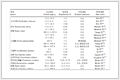
For compound 1·H2O·3CH3CN, the framework of single crystal samples was collapsed in the air a few minutes later, so the suitable single crystal of 1·H2O·3CH3CN was located in a silica tube to collect crystallographic data. Diffraction data were collected on a Bruker Smart CCD area-detector diffractometer with Mo Kα radiation (λ=0.071 073 nm) by ω-scan mode operating at room temperature. The collected data were reduced with SAINT [24], and semi-empirical absorption correction was applied to the intensity data using the SADABS program [25]. The structure was solved by direct methods, and all non hydrogen atoms were refined anisotropically by least squares on F2 using the SHELXTL program [26]. Hydrogen atoms were placed in calculated positions and refined isotropically using the riding model. Unit cell data and structure refinement details are listed in Table 1.
Table 1.
Details of the data collection and refinement parameters for 1·H2O·3CH3CN
 Table 1. Details of the data collection and refinement parameters for 1·H2O·3CH3CN
CCDC: 1045766.
2 Results and discussion
2.1 Crystal structure description
Single-crystal X-ray diffraction analysis revealed that complex 1·H2O·3CH3CN crystallizes in mono-clinic space group I2/a. The crystal structure of complex 1·H2O·3CH3CN is shown in Fig. 1. Selected bond lengths and angles are given in Table 2. As can be seen from Fig. 1, complex 1·H2O·3CH3CN has seven manganese atoms that are roughly in the same plane. It consists of a central MnⅢ ion which is encircled by six Mn ions that form a roughly dislike heptanuclear Mn clusters. The outer six Mn atoms are connected with the central Mn through six μ3-O atoms (O7, O8, O9 and O10, O11, O12) which are from thme3- ligands located above and below the molecular plane, respectively. As can be seen from Fig. 1, 1·H2O·3CH3CN contains six hmp- ligands, two thme3- ligands and six Cl-terminal ligands. Each of the hmp- ligands simultaneously binds two Mn atoms in a μ2-η1: η2 fashion. Each hydroxyl O from thme3- coordinates with three Mn ions, and the thme3- ligand binds seven Mn ions in a η3: η3: η3, μ7-fashion. Oxidation-state deter-minations based on charge considerations and crystall-ographic evidences for Jahn-Teller elongated axes. It is concluded that Mn1, Mn3, Mn5, Mn7 are MnⅢ, Mn2, Mn4, Mn6 are MnⅡ. All the Mn atoms are six-coordinated with distorted octahedral geometry. For four MnⅢ ions, each of them clearly possesses a Jahn-Teller distortion in the form of axis elongation along N2-Mn1-O7, N3-Mn3-O10, N5-Mn5-O12 and O8-Mn7-O11 (black lines in Fig. 2), in which Jahn-Teller axes for Mn1, Mn3 Mn7 are roughly parallel while these are vertical to that of Mn5. Besides, the O-Mn7-O is almost linear, with O11-Mn7-O8, O12-Mn7-O7 and O9-Mn7-O10 being 175.780°, 177.41° and 176.32°, respectively. For Mn2, Mn4 and Mn6 ions, the bond lengths of Mn-O and Mn-Cl are in the range of 0.208 3~0.287 7 nm (Mn4-O12 0.267 4 nm, Mn6-O9 0.287 7 nm) and 0.238 4~0.243 9 nm, respectively, which meet the feature of MnⅡ ions [27].
Table 2.
Selected bond lengths (nm) and bond angles (°) for 1·H2O·3CH3CN
 Table 2. Selected bond lengths (nm) and bond angles (°) for 1·H2O·3CH3CN
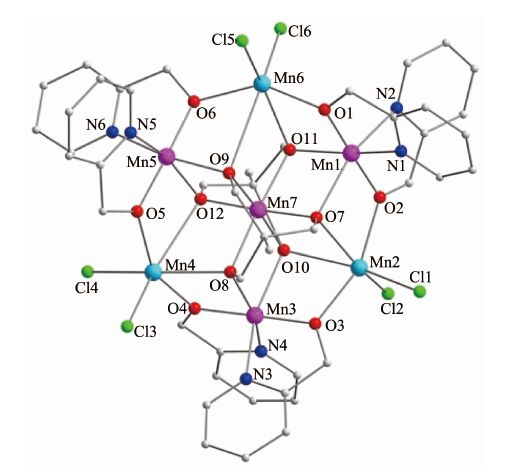 Figure 1.
Molecular structure of complex 1·H2O·3CH3CN
Figure 1.
Molecular structure of complex 1·H2O·3CH3CN
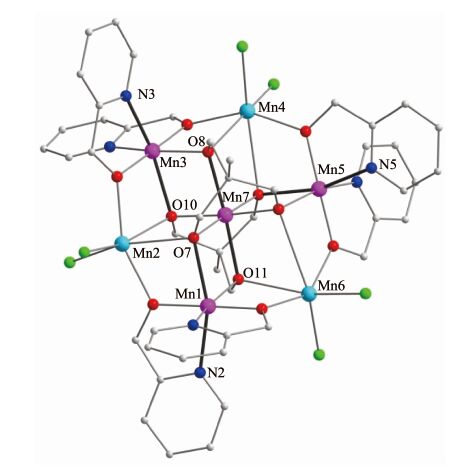 Figure 2.
Black lines showing Jahn-Teller axes of MnⅢ ions in the complex 1·H2O·3CH3CN
Figure 2.
Black lines showing Jahn-Teller axes of MnⅢ ions in the complex 1·H2O·3CH3CN
2.2 Magnetic properties
The direct-current (dc) magnetic susceptibility measurements for polycrystalline samples of 1·H2O were performed between 1.8 and 300 K under an applied dc field of 2 000 Oe. The χMT versus T plot for 1·H2O was shown in Fig. 3. At room temperature, the χMT value is 26.07 cm3·K·mol-1, which is slightly higher than the spin-only values of 25.13 cm3·K·mol-1 expected for three MnⅡ and four MnⅢ non-interacting ions. As the temperature is reduced to 30 K, the χMT product steadily increases to 32.46 cm3·K·mol-1 and then drops to a value of 16.12 cm3·K·mol-1 at 1.8 K. The χM values above 50 K obey the Curie-Weiss law (χM=C/(T-θ)) with C=24.99 cm3·K·mol-1 and θ=13.65 K. The positive θ value and the increase in χMT on lowering the temperature show that the overall ferromagnetic coupling interactions between Mn ions within the cluster are present.
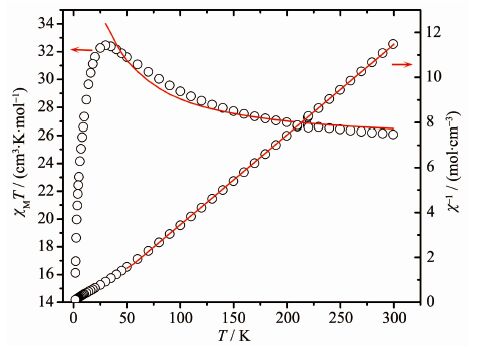 Figure 3.
Temperature dependence of χMT for 1·H2O
Figure 3.
Temperature dependence of χMT for 1·H2O
To obtain the sign and magnitude of the magnetic exchange interactions between Mn ions within the molecule of 1·H2O, fitting of the magnetic suscepti-bility data was carried out. Due to no symmetry in the complex, each distance between MnⅡ/MnⅢ and MnⅢ is different, so a precise fitting of the magnetic data require too many exchange constants. However, from the crystal structure, the alternative MnⅡ and MnⅢ atoms in the Mn6 ring are linked by one hydroxyl group O atom of an hmp- and one O atom of a thme3-, and each of MnⅡ or MnⅢ in the Mn6 ring is connected to the central Mn7 by two O atoms of two different thme3- ligands. Therefore, it is instructive to employ a simplified three-J model (Fig. 4), which leads to the following Heisenberg Hamiltonian:
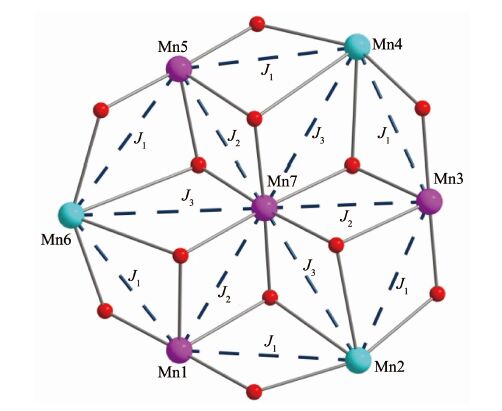 Figure 4.
Model for fitting the magnetic data of 1·H2O
Figure 4.
Model for fitting the magnetic data of 1·H2O
It should be noted that the above Heisenberg Hamiltonian based on the magnetic isotropic parame-ters, due to the dimension of full energy matrix being 135 000 for [Mn3ⅡMn4Ⅲ] if the magnetic anisotropic parameters were employed, which goes beyond the operating limit of our computer. The magnetic data above 30 K have been fitted by MAGPACK program [28], with the best parameters being: J1=-0.6 cm-1, J2=4.1 cm-1, J3=0.75 cm-1, g=2.0 and R=4.15×10⁻⁴ (R=∑[(χMT)obs-(χMT)calc]2/∑(χMT)obs2). The signs of the coupling constants show that the antiferromagnetically coupling interactions are present in the Mn6 ring, in which MnⅡ and MnⅢ are further antiferromagnetically and ferromagnetically coupled to the central MnⅢ ion, respectively.
To obtain the ground-state S, g and the magnitude of the zero-field splitting (ZFS) parameter (D), magnet-ization data were collected in the range of 1~7 T and 1.8~5.0 K. The plot of the reduced magnetization M versus H/T shows that the curves are not superposed (Fig. 5), giving an indication of the presence of magnetic anisotropy and/or the low-lying excited states. The magnetization data were fitted using the program ANISOFIT 2.0 [29], by matrix diagonalization to a model with axial ZFS (DSz2) and isotropic Zeeman interactions, assuming only the ground state is populated. However, an acceptable fit could not be obtained using the data collected over the whole field range. This problem widely exits in high-nuclear clusters containing Mn2+ ions [30], which is caused by low-lying excited states, especially if some have an S value greater than that of the ground state (in other words, these excited states are populated even at low temperatures and at low magnetic fields). This conclusion is supported by the M versus H plot (Fig. 6), in which the magnetization steadily increases upon increasing magnetic field (H) and does not show saturation.
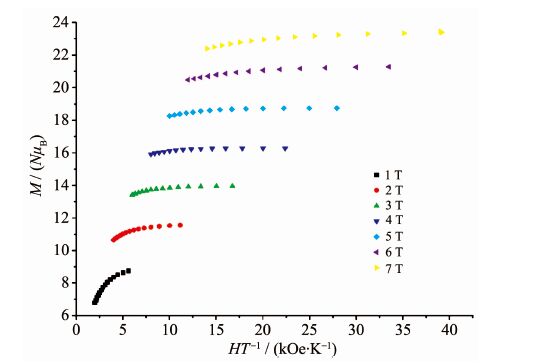 Figure 5.
Plots of reduced magnetization M vs H/T for 1·H2O
Figure 5.
Plots of reduced magnetization M vs H/T for 1·H2O
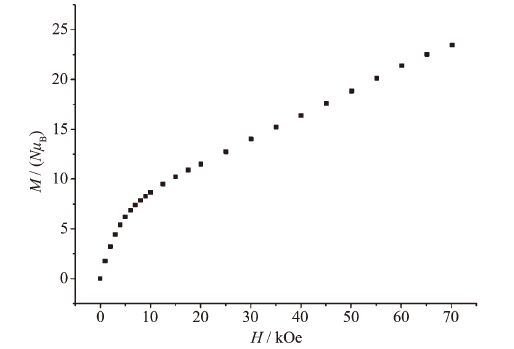 Figure 6.
Plots of magnetization M vs H for 1·H2O
Figure 6.
Plots of magnetization M vs H for 1·H2O
To probe the magnetization relaxation dynamics of 1·H2O, alternating current (ac) magnetic susce-ptibility data were collected in a zero-applied dc field with a 5.0 Oe ac field oscillating at frequencies in the range of 1~1488 Hz and in the temperature range of 1.8~10 K. The in-phase (χM′, plotted as χM′T) and out-of-phase (χM″) ac susceptibility signals are shown in Fig. 7. The rapid decrease of χM′T with temperatures decreasing also supports a population of low-lying excited states with larger S compared to the ground-state S. Extrapolation of χM′T data down to 0 K gives~22.5 cm3·K·mol-1 [31], obtaining a ground state of S≈6.5 (Fig. 8). At lower temperatures (below 2.8 K), the frequency-dependent χM″ signals appear (Fig. 7), indi-cating slow relaxation of the SMMs behavior. However, the peak maxima may lie at temperature below 1.8 K, which goes beyond the operating limit of our instrument. Therefore, we cannot calculate the effective energy barrier (Ueff) by the Arrhenius law.
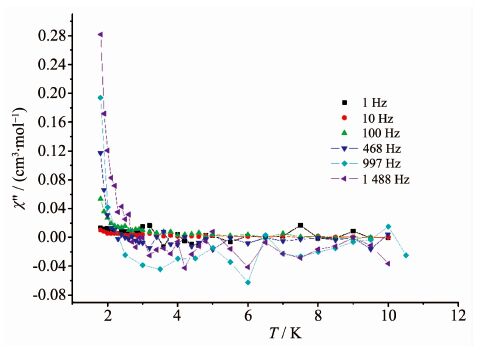 Figure 7.
Plot of the temperature dependence of the out-of-phase (χM″) ac susceptibility signals for 1·H2O at the indicated frequencies
Figure 7.
Plot of the temperature dependence of the out-of-phase (χM″) ac susceptibility signals for 1·H2O at the indicated frequencies
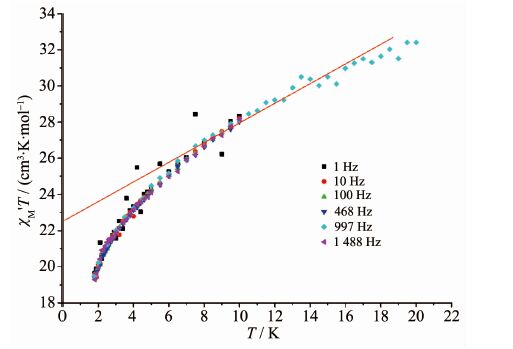 Figure 8.
χM′T vs T plot for 1·H2O
Figure 8.
χM′T vs T plot for 1·H2O
2.3 Compared with other [Mn7] clusters
It should be noted that, in the literature, there are 14 reported dislike heptanuclear Mn clusters [32], which can be classified into four categories according to their oxidation states and their distribution of the Mn ions. The first class is Mn4ⅡMn3Ⅲ, in which alter-nating MnⅡ and MnⅢ ions consist of a six-member ring (Mn6 ring) that encircles the central MnⅡ ions. The distribution of Mn ions of the second series Mn7Ⅱ and the third class Mn6ⅢMnⅡ (only one compound was reported), are the same as the above class, except all MnⅢ for the former series replaced by MnⅡ ions and MnⅡ ions on the Mn6 ring for the later class replaced by MnⅢ ion, respectively. However, for the last category Mn3ⅡMn4Ⅲ, the distribution of Mn ions is entirely different from the above three class, in this category, three MnⅡ ions consist of a linear, with its either side located by two MnⅢ ions. For 1·H2O·3CH3CN, alternating MnⅡ and MnⅢ ions form a Mn6 ring that encircles the central MnⅢ, which is similar to that of the first class mentioned above, except the different oxidation state of the central Mn. Therefore, complex 1·H2O·3CH3CN represents an unprecedented oxidation state configuration, which has previously not been seen for this topology. For 1·H2O·3CH3CN, the central Mn is coordinated to six O atoms from two thme3- ligands, so the change of central Mn compared to the first class may be due to the charge considera-tions and constraints imposed by multidentate chela-ting ligand thme3-. Therefore, this paper provides a chance for changing structural configuration and/or oxidation state of polynuclear magnetic clusters by mixing two or more multidentate chelating ligands with different symmetry. Finally, it also should be noted that only a few of dislike heptanuclear Mn clusters show SMMs behaviors and 1·H2O·3CH3CN showing this magnetic behavior may be due to the very subtle changes of oxidation state of the central Mn.
3 Conclusions
In summary, a complex containing mixed multidentate chelating ligands with different symmetry, i.e. [Mn3ⅡMn4Ⅲ(Cl)6(hmp)6(thme)2]·H2O·3CH3CN (1·H2O·3CH3CN), has been synthesized by the reactions of MnCl2·4H2O, hmpH and thmeH3 in MeCN. For 1·H2O·3CH3CN, alternating MnⅡ and MnⅢ ions form a Mn6 ring that encircles the central MnⅢ, and this structural topology has previously not been seen. This structural change may be due to the charge considerations and constraints imposed by multidentate chelating ligand thme3-. Magnetic studies reveal that the overall ferromagnetic interactions between neigh-boring Mn atoms within 1·H2O are present, and weak frequency dependence of the ac-susceptibility was found, which represents a few of examples with SMMs behavior in dislike Mn7 clusters. Finally, this work provides a chance for changing structural configura-tion and/or oxidation state of polynuclear magnetic clusters by mixing two or more multidentate chelating ligands with different symmetry.
-
-
[1]
Bagai R, Christou G. Chem. Soc. Rev., 2009, 38:1011-1026 doi: 10.1039/b811963e
-
[2]
Milios C J, Inglis R, Vinslava A, et al. J. Am. Chem. Soc., 2007, 129:12505-12511 doi: 10.1021/ja0736616
-
[3]
Coronado E, Forment-Aliaga A, Gaita-Arino A, et al. Angew. Chem., Int. Ed., 2004, 45:6152-6156
-
[4]
Nicholas C H, Milissa A B, Wolfgang W, et al. Inorg. Chem., 2003, 42:7067-7076 doi: 10.1021/ic0348906
-
[5]
Saha A, Thompson M, Abboud K A, et al. Inorg. Chem., 2011, 50:10476-10485 doi: 10.1021/ic201683p
-
[6]
Schray D, Abbas G, Lan Y, et al. Angew. Chem., Int. Ed., 2010, 49:5185-5188 doi: 10.1002/anie.201001110
-
[7]
Blagg R J, Ungur L, Tuna F, et al. Nat. Chem., 2013, 5:673-678 doi: 10.1038/nchem.1707
-
[8]
张璐, 曾涑源, 刘涛.无机化学学报, 2015, 31(9): 1761-1773 http://www.wjhxxb.cn/wjhxxbcn/ch/reader/view_abstract.aspx?file_no=20150910&flag=1ZHANG Lu, ZENG Su-Yuan, LIU Tao, et al. Chinese J. Inorg. Chem., 2015, 31(9): 1761-1773 http://www.wjhxxb.cn/wjhxxbcn/ch/reader/view_abstract.aspx?file_no=20150910&flag=1
-
[9]
Le Roy J J, Ungur L, Korobkov I, et al. J. Am. Chem. Soc., 2014, 136:8003-8010 doi: 10.1021/ja5022552
-
[10]
Zhu Y Y, Cui C, Zhang Y Q, et al. Chem. Sci., 2013, 4:1802-1806
-
[11]
Stamatatos T C, Christou G. Inorg. Chem., 2009, 48:3308-3322 doi: 10.1021/ic801217j
-
[12]
Stamatatos T C, Poole K M, Abboud K A, et al. Inorg. Chem., 2008, 47:5006-5021 doi: 10.1021/ic800268z
-
[13]
Stamatatos T C, Foguet-Albiol D, Poole K M, et al. Inorg. Chem., 2009, 48:9831-9845 doi: 10.1021/ic901393m
-
[14]
Zaleski C M, Depperman E C, Dendrinou-Samara C, et al. J. Am. Chem. Soc., 2005, 127:12862-12872 doi: 10.1021/ja050951i
-
[15]
Brechin E K, Soler M, Christou G, et al. Chem. Commun., 2003:1276-1277
-
[16]
Colacio E, Ruiz J, Mota A J, et al. Inorg. Chem., 2012, 51: 5857-5868 doi: 10.1021/ic3004596
-
[17]
Chandrasekhar V, Bag P, Kroener W, et al. Inorg. Chem., 2013, 52:13078-13086 doi: 10.1021/ic4019025
-
[18]
Stamatatos T C, Foguet-Albiol D, Lee S C, et al. J. Am. Chem. Soc., 2007, 129:9484-9499 doi: 10.1021/ja072194p
-
[19]
Stamatatos T C, Luisi B S, Moulton B, et al. Inorg. Chem., 2008, 47:1134-1144 doi: 10.1021/ic7020269
-
[20]
Milios C J, Vinslava A, Whittaker A G, et al. Inorg. Chem., 2006, 45:5272-5274 doi: 10.1021/ic0606678
-
[21]
Wang H S, Zhang Z C, Song X J, et al. Dalton Trans., 2011, 40:2703-2706 doi: 10.1039/c0dt01588a
-
[22]
王会生.无机化学学报, 2014, 30(3):522-528 http://www.wjhxxb.cn/wjhxxbcn/ch/reader/view_abstract.aspx?file_no=20140309&flag=1WANG Hui-Sheng. Chinese J. Inorg. Chem., 2014, 30(3):522-528 http://www.wjhxxb.cn/wjhxxbcn/ch/reader/view_abstract.aspx?file_no=20140309&flag=1
-
[23]
Wang H S, Song Y. Inorg. Chem. Commun., 2013, 35:86-88 doi: 10.1016/j.inoche.2013.05.016
-
[24]
SAINT-Plus, Version 6.02, Bruker Analytical X-ray System: Madison, WI, 1999.
-
[25]
Sheldrick G M. SADABS: An Empirical Absorption Correction Program, Bruker Analytica X-ray Systems: Madison, WI, 1996.
-
[26]
Sheldrick G M. SHELXTL-97, University of G?ttingen, Göttingen, Germany, 1997.
-
[27]
Zhang Z M, Yao S, Li Y G, et al. Chem. Commun., 2013, 49: 2515-2517 doi: 10.1039/c3cc38981b
-
[28]
Borrás-Almenar J J, Clemente-Juan J M, Coronado E, et al. Inorg. Chem., 1999, 38:6081-6088 doi: 10.1021/ic990915i
-
[29]
Shores M P, Sokol J J, Long J R. J. Am. Chem. Soc., 2002, 124:2279-2292 doi: 10.1021/ja011645h
-
[30]
Scott R T W, Parsons S, Murugesu M, et al. Angew. Chem., Int. Ed., 2005, 44:6540-6543 doi: 10.1002/(ISSN)1521-3773
-
[31]
Murugesu M, Habrych M, Wernsdorfer W, et al. J. Am. Chem. Soc., 2004, 126:4766-4767 doi: 10.1021/ja0316824
-
[32]
Chen S Y, Beedle C C, Gan P R, et al. Inorg. Chem., 2012, 51:4448-4457 doi: 10.1021/ic2019154
-
[1]
-

Figure 1 Molecular structure of complex 1·H2O·3CH3CN
Hydrogen atoms and solvated molecules have been omitted for clarity

Figure 3 Temperature dependence of χMT for 1·H2O
Solid lines represent the fitted results by Curie-Weiss law or by MAGPACK program[28]

Figure 7 Plot of the temperature dependence of the out-of-phase (χM″) ac susceptibility signals for 1·H2O at the indicated frequencies
-


 下载:
下载:


 扫一扫看文章
计量
- PDF下载量: 0
- 文章访问数: 1357
- HTML全文浏览量: 69
 下载:
下载:

