Login In

2026 Volume 37 Issue 11
2026, 37(11): 111505
doi: 10.1016/j.cclet.2025.111505
Abstract:
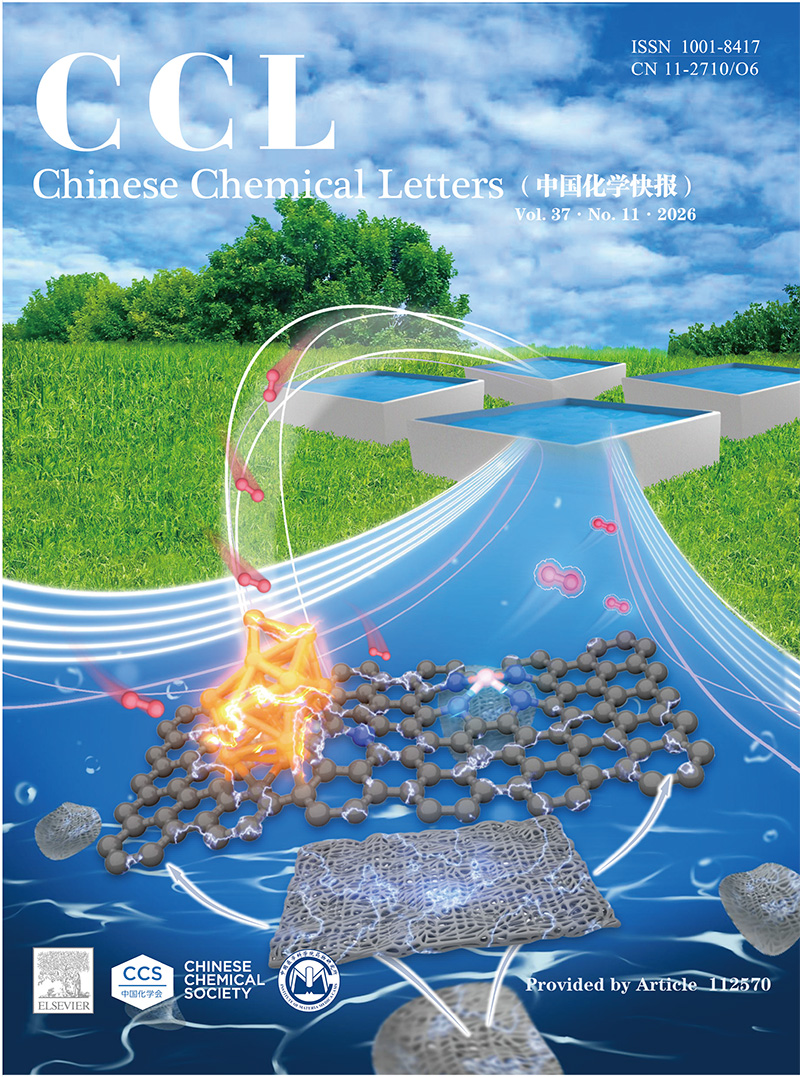
Strong metal-support interaction (SMSI) offers innovative strategies for designing efficient oxygen reduction reaction (ORR) synergetic catalysts. Herein, an ultrafine platinum (Pt) cluster (∼2.2 nm) catalyst encapsulated with Pyri-N-rich graphene (Pt UC@NG-800) is developed within the angstrom-level (Å) interlayer cavities to improve the exposure and stabilization of Pt active sites as well as promote the O2 adsorption and transfer. Consequently, Pt UC@NG-800 shows superior 4e- ORR activity with half-wave potentials (E1/2) of 0.99 V and 0.93 V (vs. RHE), which are enhanced by 110 mV and 80 mV compared to commercial Pt/C (20%) (0.88 V and 0.85 V) in alkaline and acidic media, respectively. Furthermore, the mass activity (MA) of Pt UC@NG-800 are 49.6 and 51.1 times higher than that of Pt/C in both media, respectively. After 50,000 accelerated durability tests and 120 h of long-term operation, Pt UC@NG-800 displays negligible degradation with ∆E1/2 of 5 mV (alkaline) or 10 mV (acid) and little current fading in both alkaline and acid media, respectively, implying superior durability with enhanced resistance to Pt dissolution and carbon corrosion. This work presents a novel framework and practical approach for developing ultrafine cluster catalysts with highly stable and exposed active sites for superior ORR performance.
Strong metal-support interaction (SMSI) offers innovative strategies for designing efficient oxygen reduction reaction (ORR) synergetic catalysts. Herein, an ultrafine platinum (Pt) cluster (∼2.2 nm) catalyst encapsulated with Pyri-N-rich graphene (Pt UC@NG-800) is developed within the angstrom-level (Å) interlayer cavities to improve the exposure and stabilization of Pt active sites as well as promote the O2 adsorption and transfer. Consequently, Pt UC@NG-800 shows superior 4e- ORR activity with half-wave potentials (E1/2) of 0.99 V and 0.93 V (vs. RHE), which are enhanced by 110 mV and 80 mV compared to commercial Pt/C (20%) (0.88 V and 0.85 V) in alkaline and acidic media, respectively. Furthermore, the mass activity (MA) of Pt UC@NG-800 are 49.6 and 51.1 times higher than that of Pt/C in both media, respectively. After 50,000 accelerated durability tests and 120 h of long-term operation, Pt UC@NG-800 displays negligible degradation with ∆E1/2 of 5 mV (alkaline) or 10 mV (acid) and little current fading in both alkaline and acid media, respectively, implying superior durability with enhanced resistance to Pt dissolution and carbon corrosion. This work presents a novel framework and practical approach for developing ultrafine cluster catalysts with highly stable and exposed active sites for superior ORR performance.
2026, 37(11): 111643
doi: 10.1016/j.cclet.2025.111643
Abstract:
High sensitivity, accuracy, stability, and convenience are desirable features for the development of glucose sensors. Here we present a simple, wafer-scale strategy for engineering optical glucose sensors by self-assembling pH-responsive block-copolymer films and glucose oxidase (GOx) inside Fabry–Pérot (F–P) TiO2 nanotube interferometers. The resulting hybrid membranes combine the nanoconfinement of TiO2 tubes with the reversible swelling of poly(4-vinylpyridine) domains, transducing enzymatically generated pH shifts into large, reproducible shifts of the effective optical thickness (EOT) that are directly read in situ by reflective interferometric Fourier-transform spectroscopy (RIFTS). A cascade reaction—Prussian blue-catalysed oxidation of 4–chloro-1-naphthol by H2O2—precipitates 4–chloro-1,2-naphthoquinone within the tubes, amplifying the refractive index change and boosting sensitivity. The as-formed chips quantify glucose from 1 µmol/L to 10 mmol/L with two linear regimes (1–100 µmol/L, 0.1–10 mmol/L) and achieve a 0.9 µmol/L limit of detection, outperforming previously reported F–P and colorimetric platforms while retaining full functionality after multiple sensing/rinsing cycles. Owing to the excellent pH-responsive ability of BCP and the high sensitivity of RIFTS to EOT changes, the proposed F–P interferometer represents a promising device for the simulation and in situ investigation of enzymatic reactions in biochannels.
High sensitivity, accuracy, stability, and convenience are desirable features for the development of glucose sensors. Here we present a simple, wafer-scale strategy for engineering optical glucose sensors by self-assembling pH-responsive block-copolymer films and glucose oxidase (GOx) inside Fabry–Pérot (F–P) TiO2 nanotube interferometers. The resulting hybrid membranes combine the nanoconfinement of TiO2 tubes with the reversible swelling of poly(4-vinylpyridine) domains, transducing enzymatically generated pH shifts into large, reproducible shifts of the effective optical thickness (EOT) that are directly read in situ by reflective interferometric Fourier-transform spectroscopy (RIFTS). A cascade reaction—Prussian blue-catalysed oxidation of 4–chloro-1-naphthol by H2O2—precipitates 4–chloro-1,2-naphthoquinone within the tubes, amplifying the refractive index change and boosting sensitivity. The as-formed chips quantify glucose from 1 µmol/L to 10 mmol/L with two linear regimes (1–100 µmol/L, 0.1–10 mmol/L) and achieve a 0.9 µmol/L limit of detection, outperforming previously reported F–P and colorimetric platforms while retaining full functionality after multiple sensing/rinsing cycles. Owing to the excellent pH-responsive ability of BCP and the high sensitivity of RIFTS to EOT changes, the proposed F–P interferometer represents a promising device for the simulation and in situ investigation of enzymatic reactions in biochannels.
2026, 37(11): 111665
doi: 10.1016/j.cclet.2025.111665
Abstract:
Flame-assisted spray pyrolysis (FASP) is a promising manufacturing technology for preparing LiNi1-x-yCoxMnyO2 (NCM) cathode materials for lithium-ion batteries, which involves four metal elements: Li, Ni, Co, and Mn. The transformation routes of inorganic salts associated with these elements during FASP, leading to the synthesis of NCM cathode materials, are complex and remains unclear. In the present study, theoretical thermodynamic calculations and experimental thermogravimetric analysis were employed. Results show that LiNO3 begins to decompose at 660 ℃, significantly higher than the decomposition temperatures of Ni, Co, and Mn nitrates (below 300 ℃). Therefore, the thermal decomposition routes of the four nitrates can be categorized into two groups: Ni, Co, and Mn nitrates decompose into non-reactive stable oxides, while LiNO3 is converted to the reactive Li2O, ultimately forming LiOH and Li2CO3 in the presence of CO2 and H2O. The above finding greatly simplifies and enhances the understanding of fundamental mechanism governing the complex FASP preparation process for NCM cathode materials. Furthermore, to reveal the effect of the Li element on NCM cathode materials properties, a two-step FASP approach was proposed for preparing LiNi1/3Co1/3Mn1/3O2 (NCM111) using three lithium salts: LiNO3, Li2CO3, and LiOH·H2O. Results indicate that the lithium salts significantly influence NCM cathode material structure and electrochemical performance, with NCM111 prepared using LiOH·H2O exhibiting the optimal structure and electrochemical performance.
Flame-assisted spray pyrolysis (FASP) is a promising manufacturing technology for preparing LiNi1-x-yCoxMnyO2 (NCM) cathode materials for lithium-ion batteries, which involves four metal elements: Li, Ni, Co, and Mn. The transformation routes of inorganic salts associated with these elements during FASP, leading to the synthesis of NCM cathode materials, are complex and remains unclear. In the present study, theoretical thermodynamic calculations and experimental thermogravimetric analysis were employed. Results show that LiNO3 begins to decompose at 660 ℃, significantly higher than the decomposition temperatures of Ni, Co, and Mn nitrates (below 300 ℃). Therefore, the thermal decomposition routes of the four nitrates can be categorized into two groups: Ni, Co, and Mn nitrates decompose into non-reactive stable oxides, while LiNO3 is converted to the reactive Li2O, ultimately forming LiOH and Li2CO3 in the presence of CO2 and H2O. The above finding greatly simplifies and enhances the understanding of fundamental mechanism governing the complex FASP preparation process for NCM cathode materials. Furthermore, to reveal the effect of the Li element on NCM cathode materials properties, a two-step FASP approach was proposed for preparing LiNi1/3Co1/3Mn1/3O2 (NCM111) using three lithium salts: LiNO3, Li2CO3, and LiOH·H2O. Results indicate that the lithium salts significantly influence NCM cathode material structure and electrochemical performance, with NCM111 prepared using LiOH·H2O exhibiting the optimal structure and electrochemical performance.
2026, 37(11): 111697
doi: 10.1016/j.cclet.2025.111697
Abstract:
Atomically precise metal nanoclusters stabilised by organic ligands represent a distinct class of catalyst materials. However, the synthesis of efficient ligated cluster catalysts and understanding how they work, especially under the full exposure of surface ligands, remains challenging. In this study, we describe a stable ligand-protected [Au5Cu2(dppm)2(C7H7S)6]+ (dppm is bis(diphenylphosphino)methane, and RSH is 4-methylbenzenethiol) cluster that exhibits exceptional activity in the electrocatalytic hydrogen evolution (HER) reaction. The cluster demonstrates HER activity comparable to commercial Pt/C in acidic media and retains its performance over extended operation. Mechanism studies using theoretical computations reveal that the thiolate ligands in the cluster undergo protonation-induced removal and reconstruction. These atomically dynamic surfaces transiently expose active metal sites, leading to a substantial enhancement in HER activity. The dynamic catalysis mechanism of the cluster has also been validated by X-ray absorption near-edge structure (XANES) and extended X-ray absorption fine structure (EXAFS) experiments. This study not only rationalises the controversial issue of how ligated metal clusters drive chemical transformations with high activity but also highlights the importance of surface dynamics in governing the catalysis of metal nanoclusters.
Atomically precise metal nanoclusters stabilised by organic ligands represent a distinct class of catalyst materials. However, the synthesis of efficient ligated cluster catalysts and understanding how they work, especially under the full exposure of surface ligands, remains challenging. In this study, we describe a stable ligand-protected [Au5Cu2(dppm)2(C7H7S)6]+ (dppm is bis(diphenylphosphino)methane, and RSH is 4-methylbenzenethiol) cluster that exhibits exceptional activity in the electrocatalytic hydrogen evolution (HER) reaction. The cluster demonstrates HER activity comparable to commercial Pt/C in acidic media and retains its performance over extended operation. Mechanism studies using theoretical computations reveal that the thiolate ligands in the cluster undergo protonation-induced removal and reconstruction. These atomically dynamic surfaces transiently expose active metal sites, leading to a substantial enhancement in HER activity. The dynamic catalysis mechanism of the cluster has also been validated by X-ray absorption near-edge structure (XANES) and extended X-ray absorption fine structure (EXAFS) experiments. This study not only rationalises the controversial issue of how ligated metal clusters drive chemical transformations with high activity but also highlights the importance of surface dynamics in governing the catalysis of metal nanoclusters.
2026, 37(11): 111698
doi: 10.1016/j.cclet.2025.111698
Abstract:
As an important branch of polyoxometalates (POMs), polyoxothiometalates (POTMs) exhibit significant proton enrichment capabilities due to their high negative charge density and strong hydrophilicity. Their oxygen-rich surfaces provide an ideal platform for constructing long-range ordered hydrogen-bond networks, demonstrating unique advantages in proton conductor design. In this work, two novel POTM clusters based on [Mo2O2S2]2+ building blocks were synthesized via an in situ strategy. Ligand and anionic template coordination modes critically direct structural assembly. Utilizing the AsO43- template, with glyphosine (Gly) and 4,4′-sulfonyldibenzoic acid (H2SDB) serving as bridging ligands to form dimeric structures: H11K4[(Co3(AsO4)2(Mo2O2S2)6(OH)6O3(Gly)3(H2O)5]·35H2O (compound 1) and H16K4[(AsO4)4(Mo2O2S2)12(OH)12O4(H2SDB)6(H2O)2]·36H2O (compound 2), with the latter exhibiting an edge-interlocking polyhedral architecture. Crystallography studies have shown that the rigid ligand H2SDB in compound 2 significantly expands the framework porosity by geometrically fitting the {AsMo6} unit, which has an inherent bending angle. To release the structural stress, two dimer construction units are vertically cross-linked after being rotated 180°, forming a unique edge-interlocking structure. Proton conduction measurements demonstrated that under conditions of 85 °C and 80% relative humidity, Compounds 1 and 2 exhibit proton conductivities of 9.64 × 10⁻³ and 2.18 × 10⁻² S/cm, respectively, highlighting their significant potential as proton-conductive materials. This work provides a new strategy for the structure-oriented design of POM-based proton conductors.
As an important branch of polyoxometalates (POMs), polyoxothiometalates (POTMs) exhibit significant proton enrichment capabilities due to their high negative charge density and strong hydrophilicity. Their oxygen-rich surfaces provide an ideal platform for constructing long-range ordered hydrogen-bond networks, demonstrating unique advantages in proton conductor design. In this work, two novel POTM clusters based on [Mo2O2S2]2+ building blocks were synthesized via an in situ strategy. Ligand and anionic template coordination modes critically direct structural assembly. Utilizing the AsO43- template, with glyphosine (Gly) and 4,4′-sulfonyldibenzoic acid (H2SDB) serving as bridging ligands to form dimeric structures: H11K4[(Co3(AsO4)2(Mo2O2S2)6(OH)6O3(Gly)3(H2O)5]·35H2O (compound 1) and H16K4[(AsO4)4(Mo2O2S2)12(OH)12O4(H2SDB)6(H2O)2]·36H2O (compound 2), with the latter exhibiting an edge-interlocking polyhedral architecture. Crystallography studies have shown that the rigid ligand H2SDB in compound 2 significantly expands the framework porosity by geometrically fitting the {AsMo6} unit, which has an inherent bending angle. To release the structural stress, two dimer construction units are vertically cross-linked after being rotated 180°, forming a unique edge-interlocking structure. Proton conduction measurements demonstrated that under conditions of 85 °C and 80% relative humidity, Compounds 1 and 2 exhibit proton conductivities of 9.64 × 10⁻³ and 2.18 × 10⁻² S/cm, respectively, highlighting their significant potential as proton-conductive materials. This work provides a new strategy for the structure-oriented design of POM-based proton conductors.
2026, 37(11): 111699
doi: 10.1016/j.cclet.2025.111699
Abstract:
Owing to the structural and compositional flexibility feature, antiperovskites have garnered widespread attention, and been regarded as promising catalysts. However, their intrinsic sluggish kinetics impede their practical applications. Herein, a CoN0.73Co3@CoFeN(OH)x is constructed by a developed oxidation technology, endowing exceptional performance toward hydrogen evolution reaction (HER) and oxygen evolution reaction (OER) at ampere-level current densities. The advanced nature of our as-prepared antiperovskite could be further evidenced by an assembled alkaline electrolyzer (CoN0.73Co3@CoFeN(OH)xCoN0.73Co3@CoFeN(OH)x), yielding a current density of 1000 mA/cm2 with 1.89 V, and stable working for over 100 h. Operando characterizations clarify that iron atoms in the antiperovskite skin promote the generation of CoOOH active species. Theoretical calculations are referred to understand the decent catalytic activity, which reveals that Fe atoms are responsible for the favorable adsorption of the OOH oxygen intermediate and modulate the hydrogen adsorption strength. This work paves a solid way for engineering the antiperovskites for green hydrogen generation applications.
Owing to the structural and compositional flexibility feature, antiperovskites have garnered widespread attention, and been regarded as promising catalysts. However, their intrinsic sluggish kinetics impede their practical applications. Herein, a CoN0.73Co3@CoFeN(OH)x is constructed by a developed oxidation technology, endowing exceptional performance toward hydrogen evolution reaction (HER) and oxygen evolution reaction (OER) at ampere-level current densities. The advanced nature of our as-prepared antiperovskite could be further evidenced by an assembled alkaline electrolyzer (CoN0.73Co3@CoFeN(OH)xCoN0.73Co3@CoFeN(OH)x), yielding a current density of 1000 mA/cm2 with 1.89 V, and stable working for over 100 h. Operando characterizations clarify that iron atoms in the antiperovskite skin promote the generation of CoOOH active species. Theoretical calculations are referred to understand the decent catalytic activity, which reveals that Fe atoms are responsible for the favorable adsorption of the OOH oxygen intermediate and modulate the hydrogen adsorption strength. This work paves a solid way for engineering the antiperovskites for green hydrogen generation applications.
2026, 37(11): 111701
doi: 10.1016/j.cclet.2025.111701
Abstract:
Solar-driven hydrogen peroxide (H2O2) production offers a sustainable alternative to the energy-intensive anthraquinone process, yet conventional photocatalysts suffer from poor selectivity and uncontrollable reaction pathways. Inspired by catechol oxidase enzymes, we design dopamine-grafted lipoic acid-protected gold nanoclusters (DA-LA-Au NCs) that shift photocatalytic active sites from the metal core to redox-active ligands. This ligand-centric architecture leverages dopamine’s reversible catechol/quinone interconversion to gate a biomimetic proton-coupled electron transfer (PCET) pathway, enabling exclusive 2e- oxygen reduction with near-100% H2O2 selectivity while completely suppressing superoxide radical (·O2-) generation. Transient absorption spectroscopy and molecular dynamics confirm enhanced electron transfer kinetics and O2 enrichment at ligand sites. Encapsulation in ZIF-8 stabilizes the system, achieving a record H2O2 yield of 1198 µmol/L under visible light without sacrificial agents and a 0.39% solar-to-chemical conversion efficiency, surpassing most reported photocatalysts. This "ligand-as-catalyst" strategy merges enzymatic precision with nanocluster functionality for sustainable oxidant synthesis.
Solar-driven hydrogen peroxide (H2O2) production offers a sustainable alternative to the energy-intensive anthraquinone process, yet conventional photocatalysts suffer from poor selectivity and uncontrollable reaction pathways. Inspired by catechol oxidase enzymes, we design dopamine-grafted lipoic acid-protected gold nanoclusters (DA-LA-Au NCs) that shift photocatalytic active sites from the metal core to redox-active ligands. This ligand-centric architecture leverages dopamine’s reversible catechol/quinone interconversion to gate a biomimetic proton-coupled electron transfer (PCET) pathway, enabling exclusive 2e- oxygen reduction with near-100% H2O2 selectivity while completely suppressing superoxide radical (·O2-) generation. Transient absorption spectroscopy and molecular dynamics confirm enhanced electron transfer kinetics and O2 enrichment at ligand sites. Encapsulation in ZIF-8 stabilizes the system, achieving a record H2O2 yield of 1198 µmol/L under visible light without sacrificial agents and a 0.39% solar-to-chemical conversion efficiency, surpassing most reported photocatalysts. This "ligand-as-catalyst" strategy merges enzymatic precision with nanocluster functionality for sustainable oxidant synthesis.
2026, 37(11): 111702
doi: 10.1016/j.cclet.2025.111702
Abstract:
Stable radicals have applications in numerous fields, yet their generation and stabilization remain methodologically challenging, with current achievements primarily limited to metal-organic frameworks (MOFs). In this work, we report the stabilization of radicals within metal-oxo clusters (MOCs) through an acidity modulation method, resulting in two thorium-oxo nanoclusters with identical structures but distinct photophysical properties. Under high-acidity conditions, yellow single crystals of Th-aca-Y, containing highly stable radical species, are obtained in situ, whereas lower acidity leads to the formation of Th-aca-C, a colorless and radical-free counterpart. Remarkably, the radical formed through acid modulation in Th-aca-Y exhibits unique UV-vis absorbance properties and considerably enhanced stability compared to the Xe light-induced radicals in Th-aca-C-Xe. Fourier-transform infrared (FTIR) spectroscopy, nuclear magnetic resonance (NMR) spectroscopy, X-ray photoelectron spectroscopy (XPS), and photoluminescence characterization further confirmed the fundamentally different nature of the in situ generated radicals in Th-aca-Y compared to the light-induced radicals in Th-aca-C-Xe. In addition, these clusters display multi-stimuli-responsive properties, including photochromism, photothermal conversion, and notably, mechanochromic luminescence, which represents the first such instance in actinide-based materials.
Stable radicals have applications in numerous fields, yet their generation and stabilization remain methodologically challenging, with current achievements primarily limited to metal-organic frameworks (MOFs). In this work, we report the stabilization of radicals within metal-oxo clusters (MOCs) through an acidity modulation method, resulting in two thorium-oxo nanoclusters with identical structures but distinct photophysical properties. Under high-acidity conditions, yellow single crystals of Th-aca-Y, containing highly stable radical species, are obtained in situ, whereas lower acidity leads to the formation of Th-aca-C, a colorless and radical-free counterpart. Remarkably, the radical formed through acid modulation in Th-aca-Y exhibits unique UV-vis absorbance properties and considerably enhanced stability compared to the Xe light-induced radicals in Th-aca-C-Xe. Fourier-transform infrared (FTIR) spectroscopy, nuclear magnetic resonance (NMR) spectroscopy, X-ray photoelectron spectroscopy (XPS), and photoluminescence characterization further confirmed the fundamentally different nature of the in situ generated radicals in Th-aca-Y compared to the light-induced radicals in Th-aca-C-Xe. In addition, these clusters display multi-stimuli-responsive properties, including photochromism, photothermal conversion, and notably, mechanochromic luminescence, which represents the first such instance in actinide-based materials.
2026, 37(11): 111726
doi: 10.1016/j.cclet.2025.111726
Abstract:
Strong interfacial coupling between a semiconductor photocatalyst and a cocatalyst is crucial for enhancing photocatalytic hydrogen production. This study employs an anion exchange strategy to construct atomically thin two-dimensional MoSe2 nanosheets on one-dimensional CdS nanorods, achieving strong interfacial coupling for effective hydrogen production. Consequently, the CdS@MoSe2 heterojunctions exhibits a high H2 evolution rate of 15 mmol h−1 g−1 and an apparent quantum yield of 65% at 420 nm. This remarkable performance is attributed to the well-defined interface structure, in which chemical bonds are formed via strain-driven atomic substitution. The detailed interface structure between CdS and MoSe2 is clearly revealed through experimental characterizations, while the substitution process is thoroughly explained using theoretical methods. This work introduces a novel approach for optimizing the structure and quality of nanohybrid interfaces via strain-driven atomic substitution.
Strong interfacial coupling between a semiconductor photocatalyst and a cocatalyst is crucial for enhancing photocatalytic hydrogen production. This study employs an anion exchange strategy to construct atomically thin two-dimensional MoSe2 nanosheets on one-dimensional CdS nanorods, achieving strong interfacial coupling for effective hydrogen production. Consequently, the CdS@MoSe2 heterojunctions exhibits a high H2 evolution rate of 15 mmol h−1 g−1 and an apparent quantum yield of 65% at 420 nm. This remarkable performance is attributed to the well-defined interface structure, in which chemical bonds are formed via strain-driven atomic substitution. The detailed interface structure between CdS and MoSe2 is clearly revealed through experimental characterizations, while the substitution process is thoroughly explained using theoretical methods. This work introduces a novel approach for optimizing the structure and quality of nanohybrid interfaces via strain-driven atomic substitution.
2026, 37(11): 111730
doi: 10.1016/j.cclet.2025.111730
Abstract:
Endless semiconductor sensitive materials have emerged and exhibited unprecedented application prospects in chemiresistive gas sensors, including clinical diagnosis, environmental monitoring, industrial production, aerospace and other fields. To satisfy the demands of integrated and miniaturized devices, efficient gas sensors with low power consumption have become a new research hotspot and highly potential direction. Herein, a facile and general in-situ domain-confined growth strategy was proposed to elaborately tailoring the versatile Co3O4 nanocrystals (NCs)-decorated reduced graphene oxide nanosheets (Co3O4-rGO), and the microstructure (e.g., size, dispersibility) of anchored Co3O4 NCs could be precisely controlled via adjusting the content of solution (i.e., water and ethanol). The rationally designed Co3O4-rGO composites showed the superior selectivity and high sensitivity towards formaldehyde molecules at low working temperature (ca. 78 °C). Among them, the ultra-small Co3O4 NCs (ca. 3 nm) decorated 5% rGO nanosheets exhibited the optimal formaldehyde sensing performance, such as low detection limit (100 ppb), high stability and excellent anti-humidity. Such an excellent performance was attributed to the high catalytic activity of crystalline Co3O4 NCs and abundant oxygen-containing groups of rGO. This work provides a new concept of “nanocrystals catalysis-sensing” to guide the low-temperature formaldehyde monitoring.
Endless semiconductor sensitive materials have emerged and exhibited unprecedented application prospects in chemiresistive gas sensors, including clinical diagnosis, environmental monitoring, industrial production, aerospace and other fields. To satisfy the demands of integrated and miniaturized devices, efficient gas sensors with low power consumption have become a new research hotspot and highly potential direction. Herein, a facile and general in-situ domain-confined growth strategy was proposed to elaborately tailoring the versatile Co3O4 nanocrystals (NCs)-decorated reduced graphene oxide nanosheets (Co3O4-rGO), and the microstructure (e.g., size, dispersibility) of anchored Co3O4 NCs could be precisely controlled via adjusting the content of solution (i.e., water and ethanol). The rationally designed Co3O4-rGO composites showed the superior selectivity and high sensitivity towards formaldehyde molecules at low working temperature (ca. 78 °C). Among them, the ultra-small Co3O4 NCs (ca. 3 nm) decorated 5% rGO nanosheets exhibited the optimal formaldehyde sensing performance, such as low detection limit (100 ppb), high stability and excellent anti-humidity. Such an excellent performance was attributed to the high catalytic activity of crystalline Co3O4 NCs and abundant oxygen-containing groups of rGO. This work provides a new concept of “nanocrystals catalysis-sensing” to guide the low-temperature formaldehyde monitoring.
2026, 37(11): 111752
doi: 10.1016/j.cclet.2025.111752
Abstract:
This work presents the design and synthesis of a novel class of ether-free poly(dibenzothiophene methylimidazole oxindole) membranes via a one-step, superacid-catalyzed polycondensation using highly reactive monomers, denoted as P(DBT-Melmx-OxI1 - x), to meet the rising demand for high temperature polymer electrolyte membrane fuel cells (HT-PEMFCs). The incorporation of π-conjugated dibenzothiophene units imparts structural rigidity by limiting rotational freedom, thereby disrupting dense chain packing and generating a twisted architecture with ample free volume. These structural features, along with additional hydrogen-bonding sites, create efficient pathways for proton transport. Simultaneously, oxindole units contribute to enhanced mechanical and dimensional stability. Among the series, the P(DBT-Melm0.5-OxI0.5)/190%PA membrane exhibits the highest performance, achieving a peak power density of 893 mW/cm2 at 180 °C under dry H2/O2 conditions without backpressure. These results highlight the potential of P(DBT-Melmx-OxI1 - x) membranes as high-performance, structurally robust alternatives for next-generation HT-PEMFCs.
This work presents the design and synthesis of a novel class of ether-free poly(dibenzothiophene methylimidazole oxindole) membranes via a one-step, superacid-catalyzed polycondensation using highly reactive monomers, denoted as P(DBT-Melmx-OxI1 - x), to meet the rising demand for high temperature polymer electrolyte membrane fuel cells (HT-PEMFCs). The incorporation of π-conjugated dibenzothiophene units imparts structural rigidity by limiting rotational freedom, thereby disrupting dense chain packing and generating a twisted architecture with ample free volume. These structural features, along with additional hydrogen-bonding sites, create efficient pathways for proton transport. Simultaneously, oxindole units contribute to enhanced mechanical and dimensional stability. Among the series, the P(DBT-Melm0.5-OxI0.5)/190%PA membrane exhibits the highest performance, achieving a peak power density of 893 mW/cm2 at 180 °C under dry H2/O2 conditions without backpressure. These results highlight the potential of P(DBT-Melmx-OxI1 - x) membranes as high-performance, structurally robust alternatives for next-generation HT-PEMFCs.
2026, 37(11): 111753
doi: 10.1016/j.cclet.2025.111753
Abstract:
During the sintering process of Ni-rich cathode materials, the ultimate morphology of grains significantly impact capacity and cycling performance. However, revealing the quantified morphology variation of grains during the sintering process is challenging. Therefore, this paper proposes a modeling method for dynamic grain morphology evolution of Ni-rich cathode materials and analyzes the morphology-performance relationships. First, based on the morphological evolution laws, an indicator reflecting the degree to which the grain tends to become circle is designed to quantitatively describe the grain morphology, named roundness. Evolution models of grain roundness are established separately according to the characteristics of thermodynamics and microstructural evolution in each stage of sintering. During the heating stage, the mixture density network estimates grain size and roundness distributions, which are then used to generate initial grain distribution images for constant temperature stage modeling. For the constant temperature stage, a cellular automata based on grain growth mechanisms is proposed to simulate dynamic morphological changes in grains. Building upon the above framework, this study constructs a predictive relationship between grain roundness and specific surface area, then investigates the correlation mechanism between grain roundness distribution and electrochemical performance. Simulation results indicate that this method can accurately predict morphological changes during grain growth and provide theoretical guidance for cathode material preparation.
During the sintering process of Ni-rich cathode materials, the ultimate morphology of grains significantly impact capacity and cycling performance. However, revealing the quantified morphology variation of grains during the sintering process is challenging. Therefore, this paper proposes a modeling method for dynamic grain morphology evolution of Ni-rich cathode materials and analyzes the morphology-performance relationships. First, based on the morphological evolution laws, an indicator reflecting the degree to which the grain tends to become circle is designed to quantitatively describe the grain morphology, named roundness. Evolution models of grain roundness are established separately according to the characteristics of thermodynamics and microstructural evolution in each stage of sintering. During the heating stage, the mixture density network estimates grain size and roundness distributions, which are then used to generate initial grain distribution images for constant temperature stage modeling. For the constant temperature stage, a cellular automata based on grain growth mechanisms is proposed to simulate dynamic morphological changes in grains. Building upon the above framework, this study constructs a predictive relationship between grain roundness and specific surface area, then investigates the correlation mechanism between grain roundness distribution and electrochemical performance. Simulation results indicate that this method can accurately predict morphological changes during grain growth and provide theoretical guidance for cathode material preparation.
2026, 37(11): 111755
doi: 10.1016/j.cclet.2025.111755
Abstract:
The rational synthesis of structurally novel metal oxo clusters remains pivotal for advancing materials chemistry and catalysis. Herein, we report four unprecedented iron oxo clusters, featuring groundbreaking structural motifs and exceptional catalytic activity. The heptanuclear clusters [Fe7O2(SO4)2(CH3O)10Cl6]·3(C5H6N)·5(H2O) (abbreviated as Fe7(SO4)2) and [Fe7O2(SeO4)2(CH3O)10Cl6]·3(C5H6N)·6(H2O) (abbreviated as Fe7(SeO4)2) represent not only the first iron clusters but also rare homometallic clusters that exhibit β-Anderson-type structures. Strikingly, substituting pyridine with 3-methylpyridine in solvothermal synthesis reactions results in the formation of two tetranuclear iron clusters, [Fe4O(SO4)2(CH3O)5Cl4]·3(C6H8N) (abbreviated as Fe4(SO4)2) and [Fe4O(SeO4)2(CH3O)5Cl4]·3(C6H8N)·(CH3OH)·9(H2O) (abbreviated as Fe4(SeO4)2), which exhibit unusual structures with half β-Anderson configuration. These results demonstrate the critical role of organic amines in directing the formation and nuclearity of iron oxo clusters. All clusters exhibit similar antiferromagnetic behaviors and ultraviolet-visible (UV-vis) adsorption spectra arising from the ligand-to-metal charge transfer. Most importantly, they show excellent Lewis acid catalytic activities and stabilities in the cyanosilylation reaction of aldehydes, highlighting the promising applications of iron oxo clusters as a sustainable, high-performance catalysis. This work establishes an organic amine-guided strategy for designing polynuclear iron architectures with combined structural novelty and catalytic prowess.
The rational synthesis of structurally novel metal oxo clusters remains pivotal for advancing materials chemistry and catalysis. Herein, we report four unprecedented iron oxo clusters, featuring groundbreaking structural motifs and exceptional catalytic activity. The heptanuclear clusters [Fe7O2(SO4)2(CH3O)10Cl6]·3(C5H6N)·5(H2O) (abbreviated as Fe7(SO4)2) and [Fe7O2(SeO4)2(CH3O)10Cl6]·3(C5H6N)·6(H2O) (abbreviated as Fe7(SeO4)2) represent not only the first iron clusters but also rare homometallic clusters that exhibit β-Anderson-type structures. Strikingly, substituting pyridine with 3-methylpyridine in solvothermal synthesis reactions results in the formation of two tetranuclear iron clusters, [Fe4O(SO4)2(CH3O)5Cl4]·3(C6H8N) (abbreviated as Fe4(SO4)2) and [Fe4O(SeO4)2(CH3O)5Cl4]·3(C6H8N)·(CH3OH)·9(H2O) (abbreviated as Fe4(SeO4)2), which exhibit unusual structures with half β-Anderson configuration. These results demonstrate the critical role of organic amines in directing the formation and nuclearity of iron oxo clusters. All clusters exhibit similar antiferromagnetic behaviors and ultraviolet-visible (UV-vis) adsorption spectra arising from the ligand-to-metal charge transfer. Most importantly, they show excellent Lewis acid catalytic activities and stabilities in the cyanosilylation reaction of aldehydes, highlighting the promising applications of iron oxo clusters as a sustainable, high-performance catalysis. This work establishes an organic amine-guided strategy for designing polynuclear iron architectures with combined structural novelty and catalytic prowess.
2026, 37(11): 111774
doi: 10.1016/j.cclet.2025.111774
Abstract:
Due to the high cost and environmental concerns related to the use of cobalt in conventional layered cathode materials based on transition metals, such as NCM, high-nickel and cobalt-free layered oxides have emerged as promising candidates for lithium-ion batteries, offering potentially higher capacities and lower costs. However, the transition to these materials is not without its hurdles, as they typically exhibit poor cycling stability. In light of this, LiNiO2 (LNO), which serves as a prototype for high-nickel and cobalt-free materials, has been the subject of this investigation. Hereby, we have developed a one-step synthesis method for an Al-doped and La4NiLiO8-coated synergistically modified LNO (LA-LNO), involving in situ wet coating followed by high-temperature lithiation, demonstrating that this modification reduces the Ni2+ content in LA-LNO. These alterations effectively alleviate stress variations within the particles during cycling and prevent electrolyte attack on the bulk material in the event of particle fracturing. The La4NiLiO8 epitaxial coating acts as a protective interfacial barrier while also diminishing interface impedance due to its superior electronic and ionic conductivity. This highlights the substantial improvement in the electrochemical performance of LNO achieved through La/Al synergistic modification, providing a valuable benchmark for the synthesis of high-nickel and cobalt-free cathode materials.
Due to the high cost and environmental concerns related to the use of cobalt in conventional layered cathode materials based on transition metals, such as NCM, high-nickel and cobalt-free layered oxides have emerged as promising candidates for lithium-ion batteries, offering potentially higher capacities and lower costs. However, the transition to these materials is not without its hurdles, as they typically exhibit poor cycling stability. In light of this, LiNiO2 (LNO), which serves as a prototype for high-nickel and cobalt-free materials, has been the subject of this investigation. Hereby, we have developed a one-step synthesis method for an Al-doped and La4NiLiO8-coated synergistically modified LNO (LA-LNO), involving in situ wet coating followed by high-temperature lithiation, demonstrating that this modification reduces the Ni2+ content in LA-LNO. These alterations effectively alleviate stress variations within the particles during cycling and prevent electrolyte attack on the bulk material in the event of particle fracturing. The La4NiLiO8 epitaxial coating acts as a protective interfacial barrier while also diminishing interface impedance due to its superior electronic and ionic conductivity. This highlights the substantial improvement in the electrochemical performance of LNO achieved through La/Al synergistic modification, providing a valuable benchmark for the synthesis of high-nickel and cobalt-free cathode materials.
2026, 37(11): 111783
doi: 10.1016/j.cclet.2025.111783
Abstract:
As an anode material for sodium/potassium-ion batteries, Fe3O4 possesses advantages such as high theoretical capacity and abundant natural resources. However, its practical application is hindered by poor intrinsic conductivity and significant volume expansion. Herein, the P-doped and N-adsorbed hollow core-shell Fe3O4@carbon composite (PNHCS-Fe3O4@C) is successfully synthesized for the first time. Benefiting from the synergism of hollow core-shell structure design and N adsorption/P doping co-modification strategy, the PNHCS-Fe3O4@C anode achieves significantly enhanced sodium/potassium storage properties. Specifically, the PNHCS-Fe3O4@C electrode in sodium-ion batteries exhibits a high specific capacity of 256.7 mAh/g at 10,000 mA/g and splendid cycling stability with nearly 100% capacity retention after 500 cycles at 5000 mA/g. More impressively, the PNHCS-Fe3O4@C electrode in potassium-ion batteries delivers a high specific capacity of 116.7 mAh/g at 10,000 mA/g and outstanding cycling stability with approximately 100% capacity retention after 500 cycles at 1000 mA/g. Density functional theory (DFT) calculations confirm that N adsorption/P doping reduces the adsorption energy of Na+/K+ and accelerates the charge transfer kinetics, thereby significantly improving the electrochemical performance. This innovative synergistic modification strategy provides good guidance for developing high-performance anode materials for sodium/potassium-ion batteries.
As an anode material for sodium/potassium-ion batteries, Fe3O4 possesses advantages such as high theoretical capacity and abundant natural resources. However, its practical application is hindered by poor intrinsic conductivity and significant volume expansion. Herein, the P-doped and N-adsorbed hollow core-shell Fe3O4@carbon composite (PNHCS-Fe3O4@C) is successfully synthesized for the first time. Benefiting from the synergism of hollow core-shell structure design and N adsorption/P doping co-modification strategy, the PNHCS-Fe3O4@C anode achieves significantly enhanced sodium/potassium storage properties. Specifically, the PNHCS-Fe3O4@C electrode in sodium-ion batteries exhibits a high specific capacity of 256.7 mAh/g at 10,000 mA/g and splendid cycling stability with nearly 100% capacity retention after 500 cycles at 5000 mA/g. More impressively, the PNHCS-Fe3O4@C electrode in potassium-ion batteries delivers a high specific capacity of 116.7 mAh/g at 10,000 mA/g and outstanding cycling stability with approximately 100% capacity retention after 500 cycles at 1000 mA/g. Density functional theory (DFT) calculations confirm that N adsorption/P doping reduces the adsorption energy of Na+/K+ and accelerates the charge transfer kinetics, thereby significantly improving the electrochemical performance. This innovative synergistic modification strategy provides good guidance for developing high-performance anode materials for sodium/potassium-ion batteries.
2026, 37(11): 111802
doi: 10.1016/j.cclet.2025.111802
Abstract:
The capture of CO2 from flue gas is of utmost significance as it can significantly reduce the heavy emissions of CO2 from power plants. However, the efficient capture of CO2 from flue gas using porous materials remains a challenge under practical conditions. The adsorption sites may become inactive due to weaker interactions at high temperatures and/or coordination by water molecules in humid conditions. To address the issue, a stable hydrogen-bonded metal-complex framework (FJI-W35) stabilized by rarely seen charge-assisted C–H···O hydrogen bonds has been deliberately synthesized. In FJI-W35, positive charge sites are arranged in an orderly manner on the pore surfaces of the one-dimensional triangular channels. Single component gas isotherms exhibit that this porous framework can effectively capture CO2 from room temperature to 373 K but barely adsorb N2. Dynamic breakthrough experiments validate this material can selectively capture CO2 from flue gas over a wide range of temperature and humidity, which is of great significance in the practical CO2 capture process. Furthermore, CO2-loaded single-crystal structure verifies that the inherent charged sites contribute much to the excellent separation performance.
The capture of CO2 from flue gas is of utmost significance as it can significantly reduce the heavy emissions of CO2 from power plants. However, the efficient capture of CO2 from flue gas using porous materials remains a challenge under practical conditions. The adsorption sites may become inactive due to weaker interactions at high temperatures and/or coordination by water molecules in humid conditions. To address the issue, a stable hydrogen-bonded metal-complex framework (FJI-W35) stabilized by rarely seen charge-assisted C–H···O hydrogen bonds has been deliberately synthesized. In FJI-W35, positive charge sites are arranged in an orderly manner on the pore surfaces of the one-dimensional triangular channels. Single component gas isotherms exhibit that this porous framework can effectively capture CO2 from room temperature to 373 K but barely adsorb N2. Dynamic breakthrough experiments validate this material can selectively capture CO2 from flue gas over a wide range of temperature and humidity, which is of great significance in the practical CO2 capture process. Furthermore, CO2-loaded single-crystal structure verifies that the inherent charged sites contribute much to the excellent separation performance.
2026, 37(11): 111803
doi: 10.1016/j.cclet.2025.111803
Abstract:
Developing effective electrocatalytic materials to enhance the hydrogen evolution reaction (HER) is essential for advancing hydrogen economy. In this study, molybdenum boride (MoBx) electrocatalyst was successfully fabricated via the molten salt method, followed by Pt loading onto MoBx using the impregnation-adsorption method. The introduction of Pt significantly boosted the electrocatalytic performance. The optimal Pt-MoBx exhibited superior HER performance in 0.5 mol/L H2SO4, acquiring an overpotential of 49 mV at 10 mA/cm2. Additionally, the Pt-MoBx catalyst demonstrated exceptional stability in acidic medium, showing a negligible drop after 20 h of constant potential operation. The study presents a novel approach to design stable, high-efficiency HER electrocatalysts based on metal borides.
Developing effective electrocatalytic materials to enhance the hydrogen evolution reaction (HER) is essential for advancing hydrogen economy. In this study, molybdenum boride (MoBx) electrocatalyst was successfully fabricated via the molten salt method, followed by Pt loading onto MoBx using the impregnation-adsorption method. The introduction of Pt significantly boosted the electrocatalytic performance. The optimal Pt-MoBx exhibited superior HER performance in 0.5 mol/L H2SO4, acquiring an overpotential of 49 mV at 10 mA/cm2. Additionally, the Pt-MoBx catalyst demonstrated exceptional stability in acidic medium, showing a negligible drop after 20 h of constant potential operation. The study presents a novel approach to design stable, high-efficiency HER electrocatalysts based on metal borides.
2026, 37(11): 111807
doi: 10.1016/j.cclet.2025.111807
Abstract:
Achieving high negative Poisson’s ratios (NPR) in atomically thin materials remains a fundamental challenge, yet critical for next-generation impact-resistant metamaterials and flexible electronics. However, achieving high NPR values in two-dimensional (2D) systems remains fundamentally challenging. Herein, we report a systematic computational exploration of NPR phenomena in monolayer M2C MXenes (M = Sc, Ti, Zr, V, Nb, Ta, Mo), revealing an electronic hybridization-driven auxetic mechanism in Mo2C (υ = -0.11) distinct from geometric re-entrant paradigms. Through transition metal doping, we achieve unprecedented NPR enhancement, Re-doped Mo2C attains an ultrahigh υ = -0.59, representing a 5-fold improvement and setting a new benchmark for 2D auxetics. Crucially, these engineered systems concurrently exhibit exceptional hydrogen evolution reaction (HER) catalytic activity, with Ni-doped Mo2C (3.13%) achieving a near-ideal ΔG*H of -0.06 eV, surpassing platinum’s performance. Orbital reconstruction and electronic redistribution synergistically enable dual-functionality: NPR amplification and catalytic optimization within a single material platform. We propose doped MXenes as a universal design paradigm for multifunctional metamaterials, simultaneously addressing mechanical resilience and sustainable energy conversion.
Achieving high negative Poisson’s ratios (NPR) in atomically thin materials remains a fundamental challenge, yet critical for next-generation impact-resistant metamaterials and flexible electronics. However, achieving high NPR values in two-dimensional (2D) systems remains fundamentally challenging. Herein, we report a systematic computational exploration of NPR phenomena in monolayer M2C MXenes (M = Sc, Ti, Zr, V, Nb, Ta, Mo), revealing an electronic hybridization-driven auxetic mechanism in Mo2C (υ = -0.11) distinct from geometric re-entrant paradigms. Through transition metal doping, we achieve unprecedented NPR enhancement, Re-doped Mo2C attains an ultrahigh υ = -0.59, representing a 5-fold improvement and setting a new benchmark for 2D auxetics. Crucially, these engineered systems concurrently exhibit exceptional hydrogen evolution reaction (HER) catalytic activity, with Ni-doped Mo2C (3.13%) achieving a near-ideal ΔG*H of -0.06 eV, surpassing platinum’s performance. Orbital reconstruction and electronic redistribution synergistically enable dual-functionality: NPR amplification and catalytic optimization within a single material platform. We propose doped MXenes as a universal design paradigm for multifunctional metamaterials, simultaneously addressing mechanical resilience and sustainable energy conversion.
2026, 37(11): 111813
doi: 10.1016/j.cclet.2025.111813
Abstract:
The development of heterostructure catalysts has been deemed as an appropriate strategy for water splitting. Yet, their further advancement is hindered by limited intrinsic activity. Recently, single-atom catalysts have garnered significant attention due to its ultrahigh atomic utilization efficiency near 100%. Herein, we propose a cross-scale manipulation strategy to couple Ru single atoms with NiFe-LDH/MoNiS core-shell heterostructure. The surface of MoNiS nanorods is uniformly covered by NiFe-LDH ultrathin nanosheets, resulting in electron redistribution across the interface. Isolated Ru atoms are stabilized on NiFe-LDH to form Ru−O−Ni motifs, which activates the metal center and enables catalyst structure to a certain robustness. The optimum RuSA/NiFe-LDH/MoNiS delivers large current densities of 500 and 1000 mA/cm2 with ultralow overpotentials of 234 and 320 mV for hydrogen evolution reaction (HER) in 1 mol/L KOH. Moreover, the electrode shows remarkable durability over 1000 cycles and long-term stability over 200 h. The assembled water electrolyzer exhibits a low cell voltage of 1.85 V to attain 500 mA/cm2. In-situ spectroscopy and theoretical calculations demonstrate that the active Ru−O−Ni motifs accelerate the adsorption/dissociation of water molecules and balance the adsorption of *H, thus greatly improving the hydrogen generation.
The development of heterostructure catalysts has been deemed as an appropriate strategy for water splitting. Yet, their further advancement is hindered by limited intrinsic activity. Recently, single-atom catalysts have garnered significant attention due to its ultrahigh atomic utilization efficiency near 100%. Herein, we propose a cross-scale manipulation strategy to couple Ru single atoms with NiFe-LDH/MoNiS core-shell heterostructure. The surface of MoNiS nanorods is uniformly covered by NiFe-LDH ultrathin nanosheets, resulting in electron redistribution across the interface. Isolated Ru atoms are stabilized on NiFe-LDH to form Ru−O−Ni motifs, which activates the metal center and enables catalyst structure to a certain robustness. The optimum RuSA/NiFe-LDH/MoNiS delivers large current densities of 500 and 1000 mA/cm2 with ultralow overpotentials of 234 and 320 mV for hydrogen evolution reaction (HER) in 1 mol/L KOH. Moreover, the electrode shows remarkable durability over 1000 cycles and long-term stability over 200 h. The assembled water electrolyzer exhibits a low cell voltage of 1.85 V to attain 500 mA/cm2. In-situ spectroscopy and theoretical calculations demonstrate that the active Ru−O−Ni motifs accelerate the adsorption/dissociation of water molecules and balance the adsorption of *H, thus greatly improving the hydrogen generation.
2026, 37(11): 111814
doi: 10.1016/j.cclet.2025.111814
Abstract:
The design of an efficient catalyst is crucial for sulfur reduction reaction (SRR) in lean electrolyte lithium-sulfur (Li–S) batteries. However, most existing catalysts primarily focus on polysulfide-catalyst interactions and generally demonstrate high activity only with an excessive electrolyte. In this study, we propose high-entropy alloy (HEA) composite to enhance the SRR under lean-electrolyte conditions by optimizing the solvent-catalyst interaction. As evidenced by in situ spectroscopy, nuclear magnetic resonance (NMR), density functional theory (DFT) calculations, and experimental investigations, the strong interaction between the solvent and HEA catalysts enables the Li–S battery to achieve a high capacity of 1007.9 mAh/g with a low E/S ratio of 10 µL/mg, and capacity retention of 77% after 200 cycles at lower E/S ratio of 4.5 µL/mg. The enhanced SRR performance in lean electrolyte conditions is primarily attributed to d–d electron interactions among the constituent metals and the presence of multiple active sites with optimized energy barriers in the HEA catalysts. This work underscores the significance of solvent-catalyst interactions in regulating the SRR of lean electrolyte Li–S battery and offers insights into the rational design of HEA catalysts to advance Li−S batteries.
The design of an efficient catalyst is crucial for sulfur reduction reaction (SRR) in lean electrolyte lithium-sulfur (Li–S) batteries. However, most existing catalysts primarily focus on polysulfide-catalyst interactions and generally demonstrate high activity only with an excessive electrolyte. In this study, we propose high-entropy alloy (HEA) composite to enhance the SRR under lean-electrolyte conditions by optimizing the solvent-catalyst interaction. As evidenced by in situ spectroscopy, nuclear magnetic resonance (NMR), density functional theory (DFT) calculations, and experimental investigations, the strong interaction between the solvent and HEA catalysts enables the Li–S battery to achieve a high capacity of 1007.9 mAh/g with a low E/S ratio of 10 µL/mg, and capacity retention of 77% after 200 cycles at lower E/S ratio of 4.5 µL/mg. The enhanced SRR performance in lean electrolyte conditions is primarily attributed to d–d electron interactions among the constituent metals and the presence of multiple active sites with optimized energy barriers in the HEA catalysts. This work underscores the significance of solvent-catalyst interactions in regulating the SRR of lean electrolyte Li–S battery and offers insights into the rational design of HEA catalysts to advance Li−S batteries.
2026, 37(11): 111827
doi: 10.1016/j.cclet.2025.111827
Abstract:
Co-amorphous systems (CAMS) effectively enhance the solubility and dissolution of poorly soluble drugs and enable combined formulations with enhanced compatibility. Here, we report a novel ionic liquid intermediate (ILI) strategy for green CAMS preparation, which uses trace water to form an ionic liquid intermediate under mild heating, followed by dehydration to yield co-amorphous products. ILI was applied to produce co-amorphous of vildagliptin and valsartan (VV-ILI), compared to rotary evaporation (VV-RE) and ball milling (VV-BM) products. Characterization revealed three distinct polyamorphs with varied intermolecular interactions. Molecular electrostatic potential and the Artificial Bee Colony algorithm were employed to simulate possible hydrogen bonding modes. All co-amorphous systems decreased the solubility and dissolution rate of vildagliptin while greatly enhancing those of valsartan, with VV-ILI demonstrating the greatest modification. Besides, all systems exhibit well stability under accelerated conditions. Overall, the ILI strategy provides a green, mild, and energy-efficient approach for engineering co-amorphous systems with tailored physicochemical properties.
Co-amorphous systems (CAMS) effectively enhance the solubility and dissolution of poorly soluble drugs and enable combined formulations with enhanced compatibility. Here, we report a novel ionic liquid intermediate (ILI) strategy for green CAMS preparation, which uses trace water to form an ionic liquid intermediate under mild heating, followed by dehydration to yield co-amorphous products. ILI was applied to produce co-amorphous of vildagliptin and valsartan (VV-ILI), compared to rotary evaporation (VV-RE) and ball milling (VV-BM) products. Characterization revealed three distinct polyamorphs with varied intermolecular interactions. Molecular electrostatic potential and the Artificial Bee Colony algorithm were employed to simulate possible hydrogen bonding modes. All co-amorphous systems decreased the solubility and dissolution rate of vildagliptin while greatly enhancing those of valsartan, with VV-ILI demonstrating the greatest modification. Besides, all systems exhibit well stability under accelerated conditions. Overall, the ILI strategy provides a green, mild, and energy-efficient approach for engineering co-amorphous systems with tailored physicochemical properties.
2026, 37(11): 111832
doi: 10.1016/j.cclet.2025.111832
Abstract:
The electrocatalytic oxygen reduction reaction (ORR) holds significant importance in new energy conversion and storage technologies. Improving the activity of the ORR is vital for the practical applications of these technologies. Herein, we report on the construction of a dinuclear Co corrole complex 1 featuring a bimetallic active center and its electrocatalytic ORR features in acidic, neutral, and alkaline aqueous solutions. Experimental studies demonstrate that Co corrole 1 exhibits excellent electrocatalytic ORR activity for the four-electron reduction of O2 to water. In a 0.1 mol/L KOH solution, 1 achieves a half-wave potential (E1/2) of 0.88 V versus RHE, significantly outperforming its mononuclear analogue Co corrole 2 (0.75 V versus RHE). Importantly, complex 1 also exhibits large anodic shifts of 290 mV (in pH 7.0 phosphate buffer) and 150 mV (in 0.5 mol/L H2SO4) for the half-wave potential as compared to its mononuclear analogue 2. Moreover, the number of electrons transferred during the electrocatalytic ORR with dinuclear complex 1 is up to 3.86. These findings demonstrated that dinuclear Co corrole sites significantly facilitate the four-electron ORR. Therefore, this work is significant to present dinuclear Co corrole 1 as a highly active and selective electrocatalyst for the four-electron ORR and to demonstrate the crucial synergistic effect of well-designed bimetallic active sites for efficient electrocatalytic ORR.
The electrocatalytic oxygen reduction reaction (ORR) holds significant importance in new energy conversion and storage technologies. Improving the activity of the ORR is vital for the practical applications of these technologies. Herein, we report on the construction of a dinuclear Co corrole complex 1 featuring a bimetallic active center and its electrocatalytic ORR features in acidic, neutral, and alkaline aqueous solutions. Experimental studies demonstrate that Co corrole 1 exhibits excellent electrocatalytic ORR activity for the four-electron reduction of O2 to water. In a 0.1 mol/L KOH solution, 1 achieves a half-wave potential (E1/2) of 0.88 V versus RHE, significantly outperforming its mononuclear analogue Co corrole 2 (0.75 V versus RHE). Importantly, complex 1 also exhibits large anodic shifts of 290 mV (in pH 7.0 phosphate buffer) and 150 mV (in 0.5 mol/L H2SO4) for the half-wave potential as compared to its mononuclear analogue 2. Moreover, the number of electrons transferred during the electrocatalytic ORR with dinuclear complex 1 is up to 3.86. These findings demonstrated that dinuclear Co corrole sites significantly facilitate the four-electron ORR. Therefore, this work is significant to present dinuclear Co corrole 1 as a highly active and selective electrocatalyst for the four-electron ORR and to demonstrate the crucial synergistic effect of well-designed bimetallic active sites for efficient electrocatalytic ORR.
2026, 37(11): 111847
doi: 10.1016/j.cclet.2025.111847
Abstract:
Unravelling the mechanism of electronic state evolution is ultimately important when attempting to functionalize two dimensional (2D) materials through electronic state regulation. However, there is still a lack of understanding in how the individual local functionalized regions could influence the entire 2D-layered property. Herein, we report the observation of surface electronic behavior during these functionalization process when utilizing the electron-deficient aluminium ion (Al3+) to passivate 2D black phosphorus (BP). Interestingly, the local electron density change in response to a certain functionalization can induce the periodic electron density gradient via inductive integration effect and spread over the entire 2D surface layer. Such 2D coupling effect is evidently supported by the combined investigation of in-situ/ex-situ experimental analysis and theoretical calculation, upon the model Al3+-BP modulating process. This work discloses the electron-level relationship between the individual and the whole during the functionalization process and therefore provides a direction for precise manipulation of electronic behavior in functionalized 2D materials.
Unravelling the mechanism of electronic state evolution is ultimately important when attempting to functionalize two dimensional (2D) materials through electronic state regulation. However, there is still a lack of understanding in how the individual local functionalized regions could influence the entire 2D-layered property. Herein, we report the observation of surface electronic behavior during these functionalization process when utilizing the electron-deficient aluminium ion (Al3+) to passivate 2D black phosphorus (BP). Interestingly, the local electron density change in response to a certain functionalization can induce the periodic electron density gradient via inductive integration effect and spread over the entire 2D surface layer. Such 2D coupling effect is evidently supported by the combined investigation of in-situ/ex-situ experimental analysis and theoretical calculation, upon the model Al3+-BP modulating process. This work discloses the electron-level relationship between the individual and the whole during the functionalization process and therefore provides a direction for precise manipulation of electronic behavior in functionalized 2D materials.
Electroactive nitrogen–engineered MoN nanospheres for electrochemical uranium recovery from seawater
2026, 37(11): 111848
doi: 10.1016/j.cclet.2025.111848
Abstract:
The vast reserves of uranium in seawater offer a sustainable feedstock for nuclear energy, yet their exploitation is hindered by ultralow concentrations and a complex ionic milieu. We report a structurally engineered molybdenum nitride–carbon cloth (E-MoN/CC) electrode that combines high surface area (95.8 m2/g) with tailored electronic structure for highly efficient electrochemical uranium recovery. Nitrogen incorporation into MoN creates catalytically active sites that accelerate the reduction of uranyl species, while etching-induced hierarchical porosity enhances electron transport and facilitates ion diffusion. In uranium-spiked artificial seawater (10 ppm), E-MoN/CC delivers a capacity of 586 mg/g at −0.9 V vs. RHE, exceeding MoO3/CC by 1.2-fold, and achieves 99% removal within 1 h. The electrode sustains a record the maximum extraction capacity of 11,990 mg/g in uranium-spiked seawater, while maintaining negligible performance loss over seven cycles. This work establishes metal nitride architectures as robust, scalable platforms for green electrochemical uranium extraction from complex marine environments.
The vast reserves of uranium in seawater offer a sustainable feedstock for nuclear energy, yet their exploitation is hindered by ultralow concentrations and a complex ionic milieu. We report a structurally engineered molybdenum nitride–carbon cloth (E-MoN/CC) electrode that combines high surface area (95.8 m2/g) with tailored electronic structure for highly efficient electrochemical uranium recovery. Nitrogen incorporation into MoN creates catalytically active sites that accelerate the reduction of uranyl species, while etching-induced hierarchical porosity enhances electron transport and facilitates ion diffusion. In uranium-spiked artificial seawater (10 ppm), E-MoN/CC delivers a capacity of 586 mg/g at −0.9 V vs. RHE, exceeding MoO3/CC by 1.2-fold, and achieves 99% removal within 1 h. The electrode sustains a record the maximum extraction capacity of 11,990 mg/g in uranium-spiked seawater, while maintaining negligible performance loss over seven cycles. This work establishes metal nitride architectures as robust, scalable platforms for green electrochemical uranium extraction from complex marine environments.
2026, 37(11): 111854
doi: 10.1016/j.cclet.2025.111854
Abstract:
Bioinspired surfaces exhibiting superspreading properties have garnered notable attention for their potential in various applications, including heat management and water purification. However, achieving three-dimensional (3D) superspreading remains a challenge. Here, a helical leaves-stem array (HLSA) mimicking the moss Racomitrium canescens is fabricated, which enables 3D superspreading, a process that facilitates rapid multidirectional spreading, enhances water retention, and ensures efficient liquid distribution across the surface, ultimately supporting sustained evaporation. The wedge-shaped interfaces between the leaves and stem, along with the continuous 3D microchannels formed by the helical arrangement of the leaves, drive this phenomenon through enhanced capillary forces. Inspired by this 3D superspreading mechanism, HLSA-based evaporators demonstrate promising applications in both thermal management and solar desalination, achieving a temperature reduction of 8.3 °C in cooling systems and a seawater evaporation rate of 1.08 kg m⁻2 h⁻1. Notably, the seawater evaporation process features an autonomous salt crystal removal and exhibits multi-angle light absorption. These findings offer insights into bioinspired thermal dissipation and pave the way for advanced evaporative systems.
Bioinspired surfaces exhibiting superspreading properties have garnered notable attention for their potential in various applications, including heat management and water purification. However, achieving three-dimensional (3D) superspreading remains a challenge. Here, a helical leaves-stem array (HLSA) mimicking the moss Racomitrium canescens is fabricated, which enables 3D superspreading, a process that facilitates rapid multidirectional spreading, enhances water retention, and ensures efficient liquid distribution across the surface, ultimately supporting sustained evaporation. The wedge-shaped interfaces between the leaves and stem, along with the continuous 3D microchannels formed by the helical arrangement of the leaves, drive this phenomenon through enhanced capillary forces. Inspired by this 3D superspreading mechanism, HLSA-based evaporators demonstrate promising applications in both thermal management and solar desalination, achieving a temperature reduction of 8.3 °C in cooling systems and a seawater evaporation rate of 1.08 kg m⁻2 h⁻1. Notably, the seawater evaporation process features an autonomous salt crystal removal and exhibits multi-angle light absorption. These findings offer insights into bioinspired thermal dissipation and pave the way for advanced evaporative systems.
2026, 37(11): 111855
doi: 10.1016/j.cclet.2025.111855
Abstract:
Limited by the cobalt scarcity, price fluctuations, and toxicity, the next-generation lithium-ion batteries cathode materials tend to be nickel-rich and cobalt-free. However, the poor cycle stability of cobalt-free nickel-rich cathode material prevents its wide application. Element doping helps to improve the cycle stability of cathode materials, but the introduction of inactive elements usually leads to capacity decay. To address the above difficulties, the present study proposed a Mg/Mo co-doping strategy to simultaneously improve cycle stability and capacity, by developing the method of flame-assisted spray pyrolysis (FASP) for preparation of nanostructured materials in a one-step scheme. The effects of flame temperature on the structure, morphology and electrochemical performance of the material were investigated. Results showed that the doping of Mg-Mo dual-element effectively improved the electrochemical performance of the FASP prepared materials. On the one hand, the dual-element doping reduced the size of primary particles, which inhibited the generation and propagation of microcracks in the bulk and on the surface of the particles, thus helped to achieve long cycle. On the other hand, the dual-element doping expanded the thickness of the Li slab in the cathode material, which combined with smaller primary particles, was conducive to the rapid diffusion of Li+ and improved the specific capacity and rate performance. At the same time, the flame temperature was shown to impact the lithium volatilization and particle nucleation. Overall, the findings in the present study provided new ideas for the preparation of the next-generation high performance cobalt-free nickel-rich lithium-ion batteries cathode materials.
Limited by the cobalt scarcity, price fluctuations, and toxicity, the next-generation lithium-ion batteries cathode materials tend to be nickel-rich and cobalt-free. However, the poor cycle stability of cobalt-free nickel-rich cathode material prevents its wide application. Element doping helps to improve the cycle stability of cathode materials, but the introduction of inactive elements usually leads to capacity decay. To address the above difficulties, the present study proposed a Mg/Mo co-doping strategy to simultaneously improve cycle stability and capacity, by developing the method of flame-assisted spray pyrolysis (FASP) for preparation of nanostructured materials in a one-step scheme. The effects of flame temperature on the structure, morphology and electrochemical performance of the material were investigated. Results showed that the doping of Mg-Mo dual-element effectively improved the electrochemical performance of the FASP prepared materials. On the one hand, the dual-element doping reduced the size of primary particles, which inhibited the generation and propagation of microcracks in the bulk and on the surface of the particles, thus helped to achieve long cycle. On the other hand, the dual-element doping expanded the thickness of the Li slab in the cathode material, which combined with smaller primary particles, was conducive to the rapid diffusion of Li+ and improved the specific capacity and rate performance. At the same time, the flame temperature was shown to impact the lithium volatilization and particle nucleation. Overall, the findings in the present study provided new ideas for the preparation of the next-generation high performance cobalt-free nickel-rich lithium-ion batteries cathode materials.
2026, 37(11): 111856
doi: 10.1016/j.cclet.2025.111856
Abstract:
We present the first example of reversible polymorphism in 2D Ag cluster-based layered structures constructed from Cl@Ag16(tBuS)8(CF3COO)7 nodes (Ag16) connected by μ4-TPPE linkers. The two polymorphs (Ag16-TPPE-a & Ag16-TPPE-b) further individually adopt orthorhombic and monoclinic crystalline forms, which can also be reversibly transformed to each other by virtue of tuning inter-layer C−H···F interaction through altering solvent system. Correspondingly, inter-layer C−H···F forces and dense stacking arrangement in Ag16-TPPE-a substantially restricts the molecular rotations or vibrations of TPPE and thus considerably facilitates the radiative transitions in the crystalline state, leading to enhancement in photoluminescence intensity, PLQY, and lifetime. Notwithstanding, benefiting from the suppression of photoluminescence, Ag16-TPPE-b exhibits higher photothermal conversion efficiency. This work provides a valuable approach for layer-sliding-driven tailoring photoluminescence and photothermal conversion effect in 2D supramolecular polymorphic silver cluster assembled materials.
We present the first example of reversible polymorphism in 2D Ag cluster-based layered structures constructed from Cl@Ag16(tBuS)8(CF3COO)7 nodes (Ag16) connected by μ4-TPPE linkers. The two polymorphs (Ag16-TPPE-a & Ag16-TPPE-b) further individually adopt orthorhombic and monoclinic crystalline forms, which can also be reversibly transformed to each other by virtue of tuning inter-layer C−H···F interaction through altering solvent system. Correspondingly, inter-layer C−H···F forces and dense stacking arrangement in Ag16-TPPE-a substantially restricts the molecular rotations or vibrations of TPPE and thus considerably facilitates the radiative transitions in the crystalline state, leading to enhancement in photoluminescence intensity, PLQY, and lifetime. Notwithstanding, benefiting from the suppression of photoluminescence, Ag16-TPPE-b exhibits higher photothermal conversion efficiency. This work provides a valuable approach for layer-sliding-driven tailoring photoluminescence and photothermal conversion effect in 2D supramolecular polymorphic silver cluster assembled materials.
2026, 37(11): 111867
doi: 10.1016/j.cclet.2025.111867
Abstract:
The unsatisfied energy density and power density of zinc-ion capacitors necessitate the development of carbonaceous cathodes with both functional groups and abundant porosities. In this work, a carbonyl-enriched porous carbon nanomaterial is synthesized via Scholl coupling and dual molten salt treatment using p-benzoquinone as the precursor. Theoretical analysis indicates that appropriate pore size can enhance the transport capability of [Zn(H2O)6]2+, while a high carbonyl content strengthens the chemical interaction between [Zn(H2O)6]2+ and the electrode. Experimental results reveal that the pore structure and carbonyl content are influenced by zinc chloride and iron chloride molten salts, respectively, and the use of dual molten salts synergistically optimizes the formation of abundant pore structures with appropriate sizes and high carbonyl content. Consequently, the derived CPC-FeZn exhibits the highest effective specific surface area (SSAd > 0.86 nm, 1292 m2/g) and carbonyl content (3.01 at%), endowing CPC-FeZn with a specific capacitance of 256.1 F/g at 0.1 A/g, an excellent rate capability (66.7% capacitance retention at 20 A/g), and a high energy density of 91.1 Wh/kg at 80 W/kg. This work establishes CPC-FeZn as a high-performance cathode for zinc-ion capacitors, providing a design paradigm for sustainable energy storage technologies.
The unsatisfied energy density and power density of zinc-ion capacitors necessitate the development of carbonaceous cathodes with both functional groups and abundant porosities. In this work, a carbonyl-enriched porous carbon nanomaterial is synthesized via Scholl coupling and dual molten salt treatment using p-benzoquinone as the precursor. Theoretical analysis indicates that appropriate pore size can enhance the transport capability of [Zn(H2O)6]2+, while a high carbonyl content strengthens the chemical interaction between [Zn(H2O)6]2+ and the electrode. Experimental results reveal that the pore structure and carbonyl content are influenced by zinc chloride and iron chloride molten salts, respectively, and the use of dual molten salts synergistically optimizes the formation of abundant pore structures with appropriate sizes and high carbonyl content. Consequently, the derived CPC-FeZn exhibits the highest effective specific surface area (SSAd > 0.86 nm, 1292 m2/g) and carbonyl content (3.01 at%), endowing CPC-FeZn with a specific capacitance of 256.1 F/g at 0.1 A/g, an excellent rate capability (66.7% capacitance retention at 20 A/g), and a high energy density of 91.1 Wh/kg at 80 W/kg. This work establishes CPC-FeZn as a high-performance cathode for zinc-ion capacitors, providing a design paradigm for sustainable energy storage technologies.
2026, 37(11): 112173
doi: 10.1016/j.cclet.2025.112173
Abstract:
Existing therapies for diabetic wounds often deliver insufficient outcomes. Bacterial infection, oxidative stress, and deficient vascularization during tissue regeneration critically impede recovery. To address this substantial unmet clinical need, we developed an injectable hydrogel biomaterial, named QDP1, specifically engineered to accelerate tissue regeneration in diabetic wounds. This formulation integrates a polysaccharide matrix combining quaternized chitosan with dialdehyde pullulan, augmented by procyanidin/Fe3O4 nanoparticles. Following localized administration, QDP1 promptly forms a protective hydrogel barrier. The dressing exhibits powerful antibacterial properties alongside efficient scavenging of harmful oxidative molecules. Together, these effects shift the wound milieu from chronic inflammation towards a constructive proliferative phase. A key benefit involves the hydrogel's intrinsic biodegradability post-treatment, ensuring complete clearance once fulfilling its regenerative role. Results from both in vitro experiments and preclinical models demonstrate that QDP1 significantly accelerates wound repair. As a novel therapeutic platform, QDP1 presents a notably hopeful strategy for diabetic wound management, ultimately improving patient outcomes for this challenging condition.
Existing therapies for diabetic wounds often deliver insufficient outcomes. Bacterial infection, oxidative stress, and deficient vascularization during tissue regeneration critically impede recovery. To address this substantial unmet clinical need, we developed an injectable hydrogel biomaterial, named QDP1, specifically engineered to accelerate tissue regeneration in diabetic wounds. This formulation integrates a polysaccharide matrix combining quaternized chitosan with dialdehyde pullulan, augmented by procyanidin/Fe3O4 nanoparticles. Following localized administration, QDP1 promptly forms a protective hydrogel barrier. The dressing exhibits powerful antibacterial properties alongside efficient scavenging of harmful oxidative molecules. Together, these effects shift the wound milieu from chronic inflammation towards a constructive proliferative phase. A key benefit involves the hydrogel's intrinsic biodegradability post-treatment, ensuring complete clearance once fulfilling its regenerative role. Results from both in vitro experiments and preclinical models demonstrate that QDP1 significantly accelerates wound repair. As a novel therapeutic platform, QDP1 presents a notably hopeful strategy for diabetic wound management, ultimately improving patient outcomes for this challenging condition.
2026, 37(11): 112185
doi: 10.1016/j.cclet.2025.112185
Abstract:
Supramolecular nanoproteins based on host-guest interaction can integrate different therapeutic functions into a single nano delivery system to overcome chemoresistance in tumor therapy. In this work, the biohybrid supramolecular glycosyl-nanoproteins (Bio-WP5G-Avi) were constructed via self-assembly of biotinylated glycosyl-supramolecule complex (Bio-WP5G) with streptavidin (Avi), where Bio-WP5G has formed through host-guest interaction between biotinylated pillar[5]arene (Bio-WP5) and galactosamine derivative (G), which displays excellent GSH responsiveness, enhanced hepatoma-targetability, and efficient drug co-delivery. The host molecule Bio-WP5 contains disulfide bonds that respond to high concentrations of GSH in the tumor microenvironment, while the guest molecule G contains ammonium cations for loading of polyanionic siRNA by electrostatic interaction and galactose residues for targeting hepatoma cells by carbohydrate-lectin interactions. in vitro experiments, Bio-WP5G-Avi@DOX/siRNA not only significantly improved the transfection efficiency of siRNA and exhibited effective gene silencing ability but also enhanced the toxicity of drugs to HepG2/ADR cells. Furthermore, in vivo experiments with Bio-WP5G-Avi@DOX/siRNA using HepG2/ADR tumor-bearing nude mice model confirmed good biosafety, enrichment at tumors, and enhanced therapeutic efficacy. This work provides a unique strategy to construct a supramolecular glycosyl-nanoproteins delivery system for targeted co-delivery of drug/siRNA, which could pave a novel way for targeted and combination cancer therapy.
Supramolecular nanoproteins based on host-guest interaction can integrate different therapeutic functions into a single nano delivery system to overcome chemoresistance in tumor therapy. In this work, the biohybrid supramolecular glycosyl-nanoproteins (Bio-WP5G-Avi) were constructed via self-assembly of biotinylated glycosyl-supramolecule complex (Bio-WP5G) with streptavidin (Avi), where Bio-WP5G has formed through host-guest interaction between biotinylated pillar[5]arene (Bio-WP5) and galactosamine derivative (G), which displays excellent GSH responsiveness, enhanced hepatoma-targetability, and efficient drug co-delivery. The host molecule Bio-WP5 contains disulfide bonds that respond to high concentrations of GSH in the tumor microenvironment, while the guest molecule G contains ammonium cations for loading of polyanionic siRNA by electrostatic interaction and galactose residues for targeting hepatoma cells by carbohydrate-lectin interactions. in vitro experiments, Bio-WP5G-Avi@DOX/siRNA not only significantly improved the transfection efficiency of siRNA and exhibited effective gene silencing ability but also enhanced the toxicity of drugs to HepG2/ADR cells. Furthermore, in vivo experiments with Bio-WP5G-Avi@DOX/siRNA using HepG2/ADR tumor-bearing nude mice model confirmed good biosafety, enrichment at tumors, and enhanced therapeutic efficacy. This work provides a unique strategy to construct a supramolecular glycosyl-nanoproteins delivery system for targeted co-delivery of drug/siRNA, which could pave a novel way for targeted and combination cancer therapy.
2026, 37(11): 112186
doi: 10.1016/j.cclet.2025.112186
Abstract:
Four pairs of cadinane sesquiterpenoid dimers, distahlianoids A–D (1–4), featuring three distinct structural scaffolds, were isolated from the Dai medicinal plant Stahlianthus involucratus using a mass spectrometry (MS)-molecular networking (MN)-based activity-structure approach. Structurally, compound 1 exhibits a unique fused heptacyclic architecture comprising 5/6/6/6/6/6/5 ring system, characterized by a novel 9-methyl-2-oxabicyclo[3.3.1]nona-3,7‑dien-9-ol core structure. Compounds 2 and 3 feature unusual 5/6/6/5/6/6/5 and 5/6/6/5/6/6 polycyclic frameworks, respectively. Compound 4 is a skeleton-rearranged dimer containing a unique 2-methyl-[2,2′-bifuran]-3,5′(2H,2′H)‑dione motif. Given the enantiomeric nature of these compounds, their biosynthetic pathways were proposed, along with the stereoselective formation regularities. Compounds 1–4 significantly inhibited lipid accumulation in 3T3-L1 adipocytes, with (–)-4 showing the strongest effect (half maximal effective concentration (EC50) = 1.04 ± 0.34 μmol/L) and high selectivity (selectivity index (SI) > 96).
Four pairs of cadinane sesquiterpenoid dimers, distahlianoids A–D (1–4), featuring three distinct structural scaffolds, were isolated from the Dai medicinal plant Stahlianthus involucratus using a mass spectrometry (MS)-molecular networking (MN)-based activity-structure approach. Structurally, compound 1 exhibits a unique fused heptacyclic architecture comprising 5/6/6/6/6/6/5 ring system, characterized by a novel 9-methyl-2-oxabicyclo[3.3.1]nona-3,7‑dien-9-ol core structure. Compounds 2 and 3 feature unusual 5/6/6/5/6/6/5 and 5/6/6/5/6/6 polycyclic frameworks, respectively. Compound 4 is a skeleton-rearranged dimer containing a unique 2-methyl-[2,2′-bifuran]-3,5′(2H,2′H)‑dione motif. Given the enantiomeric nature of these compounds, their biosynthetic pathways were proposed, along with the stereoselective formation regularities. Compounds 1–4 significantly inhibited lipid accumulation in 3T3-L1 adipocytes, with (–)-4 showing the strongest effect (half maximal effective concentration (EC50) = 1.04 ± 0.34 μmol/L) and high selectivity (selectivity index (SI) > 96).
2026, 37(11): 112187
doi: 10.1016/j.cclet.2025.112187
Abstract:
Disulfiram/copper (DSF/Cu) co-delivery systems exhibit significant potential for tumor-specific chemotherapy. However, their efficacy is severely limited by premature interaction between DSF and Cu, which triggers off-target generation of cytotoxic copper−diethyldithiocarbamate complexes (CuET) and degradation. Herein, we develop a spatial-isolated oil-water biphasic Pickering emulsion (DBCP) stabilized by bovine serum albumin-copper nanoclusters (BSA-CuNCs), designed to inhibit such premature interaction through phase-separated co-delivery. Specifically, lipophilic DSF is encapsulated in the oil phase, while hydrophilic Cu2+ is chelated in the BSA-based emulsifier layer at the oil-water interface, achieving strict spatial segregation to block their untimely reaction. Endowed with enhanced permeability and retention (EPR) effect and BSA-mediated active targeting, DBCP accumulates specifically in tumor tissues. Upon cellular uptake, pH/glutathione dual stimulation triggers synchronous release of DSF and Cu, which then generate cytotoxic CuET in situ, catalyze Fenton-like reaction for chemotherapy, and induce cuproptosis via mitochondrial copper accumulation and dihydrolipoamide S-acetyltransferase (DLAT) binding, finally realizing enhanced chemo-cuproptosis synergy. In vitro, DBCP exhibits an median inhibition concentration (IC50) as low as 0.60 µmol/L against 4T1 cells, markedly enhancing DSF's antitumor activity. In vivo, it achieves a 74.41% tumor inhibition rate in 4T1-bearing mice (vs. 52.67% for 5-Fu) with negligible toxicity. This spatial-isolated oil-water biphasic Pickering emulsion offers a novel strategy to harness the therapeutic potential of DSF/Cu for clinical translation.
Disulfiram/copper (DSF/Cu) co-delivery systems exhibit significant potential for tumor-specific chemotherapy. However, their efficacy is severely limited by premature interaction between DSF and Cu, which triggers off-target generation of cytotoxic copper−diethyldithiocarbamate complexes (CuET) and degradation. Herein, we develop a spatial-isolated oil-water biphasic Pickering emulsion (DBCP) stabilized by bovine serum albumin-copper nanoclusters (BSA-CuNCs), designed to inhibit such premature interaction through phase-separated co-delivery. Specifically, lipophilic DSF is encapsulated in the oil phase, while hydrophilic Cu2+ is chelated in the BSA-based emulsifier layer at the oil-water interface, achieving strict spatial segregation to block their untimely reaction. Endowed with enhanced permeability and retention (EPR) effect and BSA-mediated active targeting, DBCP accumulates specifically in tumor tissues. Upon cellular uptake, pH/glutathione dual stimulation triggers synchronous release of DSF and Cu, which then generate cytotoxic CuET in situ, catalyze Fenton-like reaction for chemotherapy, and induce cuproptosis via mitochondrial copper accumulation and dihydrolipoamide S-acetyltransferase (DLAT) binding, finally realizing enhanced chemo-cuproptosis synergy. In vitro, DBCP exhibits an median inhibition concentration (IC50) as low as 0.60 µmol/L against 4T1 cells, markedly enhancing DSF's antitumor activity. In vivo, it achieves a 74.41% tumor inhibition rate in 4T1-bearing mice (vs. 52.67% for 5-Fu) with negligible toxicity. This spatial-isolated oil-water biphasic Pickering emulsion offers a novel strategy to harness the therapeutic potential of DSF/Cu for clinical translation.
2026, 37(11): 112195
doi: 10.1016/j.cclet.2025.112195
Abstract:
Due to improvements in living standards and shifts in dietary patterns, the prevalence of hyperuricemia and gout has been steadily increasing, making it the second most common metabolic disorder after diabetes. Exogenous uricase has emerged as a promising therapeutic option for patients with severe and refractory gout, owing to its potent urate-lowering efficacy and ability to alleviate pain, thereby significantly improving patient quality of life. Pegloticase remains the only uricase-based drug approved by the U.S. Food and Drug Administration (FDA) for the treatment of chronic gout unresponsive to standard therapies. However, the current pipeline of exogenous uricase candidates is limited, and high immunogenicity continues to pose a major challenge, highlighting the urgent need for further innovation in this field. Here, we investigate the non-conserved amino acid residues located at the entrance of the uric acid channel and proposes a mutation-based strategy to enhance the catalytic activity of Arthrobacter globiformis uricase, achieving a maximum activity increase of 27%. Furthermore, the introduction of a K129C mutation enables the formation of a disulfide bond at the dimer–dimer interface within the tetramer, thereby significantly enhancing the thermal stability of the enzyme, with the tetrameric Tm increased by 5.88 ℃. The combination of activity-enhancing and thermostability-improving mutations resulted in uricase variants with both high catalytic efficiency and improved structural resilience. This study offers mechanistic insights into the structure–function relationship of the urate channel and proposes an innovative approach for engineering next-generation uricase therapeutics.
Due to improvements in living standards and shifts in dietary patterns, the prevalence of hyperuricemia and gout has been steadily increasing, making it the second most common metabolic disorder after diabetes. Exogenous uricase has emerged as a promising therapeutic option for patients with severe and refractory gout, owing to its potent urate-lowering efficacy and ability to alleviate pain, thereby significantly improving patient quality of life. Pegloticase remains the only uricase-based drug approved by the U.S. Food and Drug Administration (FDA) for the treatment of chronic gout unresponsive to standard therapies. However, the current pipeline of exogenous uricase candidates is limited, and high immunogenicity continues to pose a major challenge, highlighting the urgent need for further innovation in this field. Here, we investigate the non-conserved amino acid residues located at the entrance of the uric acid channel and proposes a mutation-based strategy to enhance the catalytic activity of Arthrobacter globiformis uricase, achieving a maximum activity increase of 27%. Furthermore, the introduction of a K129C mutation enables the formation of a disulfide bond at the dimer–dimer interface within the tetramer, thereby significantly enhancing the thermal stability of the enzyme, with the tetrameric Tm increased by 5.88 ℃. The combination of activity-enhancing and thermostability-improving mutations resulted in uricase variants with both high catalytic efficiency and improved structural resilience. This study offers mechanistic insights into the structure–function relationship of the urate channel and proposes an innovative approach for engineering next-generation uricase therapeutics.
2026, 37(11): 112204
doi: 10.1016/j.cclet.2025.112204
Abstract:
Regarding the biological and clinical significance of in situ real-time detection of p53 dual mutations, this study ingeniously utilized the relationship between the genomic guardian p53 and the tumor promoter cyclooxygenase-2 (COX-2), attempting to develop a COX-2-activated fluorescence probe with cascade response for dual-mutant p53. We developed a novel class of fluorescent probes based on protected dihydroresorufin conjugated with a photo-crosslinking group. This design enables the sequential release of the fluorophore, effectively preventing over-oxidation and allowing for rapid detection of COX-2 activity with enhanced signal-to-background contrast in living cells. Furthermore, these probes can specific recognize dual-mutant p53 based on markedly elevated activity of COX-2 in SW480 cells compared to other colorectal cancer (CRC) cell lines with wild-type or mono-mutant p53 for the first time. This specifically recognition of the dual mutant p53 also enables its implementation in tissues and xenografts. Additionally, metabolomic profiling showed increased acylcarnitine levels in dual-mutant p53 SW480 cells, which could activate COX-2 and enhance prostaglandin E2 (PGE2) production. In situ real-time detection of dual-mutant p53 is of great significance for precise tumor diagnosis and grading, individualized treatment, prognosis judgment and recurrence monitoring, and new drug development.
Regarding the biological and clinical significance of in situ real-time detection of p53 dual mutations, this study ingeniously utilized the relationship between the genomic guardian p53 and the tumor promoter cyclooxygenase-2 (COX-2), attempting to develop a COX-2-activated fluorescence probe with cascade response for dual-mutant p53. We developed a novel class of fluorescent probes based on protected dihydroresorufin conjugated with a photo-crosslinking group. This design enables the sequential release of the fluorophore, effectively preventing over-oxidation and allowing for rapid detection of COX-2 activity with enhanced signal-to-background contrast in living cells. Furthermore, these probes can specific recognize dual-mutant p53 based on markedly elevated activity of COX-2 in SW480 cells compared to other colorectal cancer (CRC) cell lines with wild-type or mono-mutant p53 for the first time. This specifically recognition of the dual mutant p53 also enables its implementation in tissues and xenografts. Additionally, metabolomic profiling showed increased acylcarnitine levels in dual-mutant p53 SW480 cells, which could activate COX-2 and enhance prostaglandin E2 (PGE2) production. In situ real-time detection of dual-mutant p53 is of great significance for precise tumor diagnosis and grading, individualized treatment, prognosis judgment and recurrence monitoring, and new drug development.
2026, 37(11): 112206
doi: 10.1016/j.cclet.2025.112206
Abstract:
Oncolytic virus therapy represents a promising avenue in the battle against cancer, however, its efficacy is frequently constrained by the hostile tumor microenvironment and insufficient therapeutic responses. Herein, we engineered a pH/glutathione dual-responsive supramolecular prodrug nanomedicine (termed PGPP), derived from gossypol, designed to synergize with oncolytic herpes simplex virus (oHSV) therapy for the treatment of triple-negative breast cancer (TNBC). Our findings revealed that PGPP exhibited remarkable tumor-targeting accumulation and retention, significantly enhancing the cytotoxic potency of gossypol within malignant tissues. Crucially, PGPP effectively disrupted vascular endothelial growth factor (VEGF)-driven angiogenesis, fostering a more permissive milieu for oncolytic viral infiltration. The incorporation of oHSV in turn amplified the antitumor activity of PGPP, promoting cancer cell apoptosis and augmenting immunogenic cell death, ultimately resulting in robust tumor growth inhibition. This coordinated combination strategy-based supramolecular prodrug delivers a powerful blow against TNBC, offering a promising paradigm for future cancer treatments.
Oncolytic virus therapy represents a promising avenue in the battle against cancer, however, its efficacy is frequently constrained by the hostile tumor microenvironment and insufficient therapeutic responses. Herein, we engineered a pH/glutathione dual-responsive supramolecular prodrug nanomedicine (termed PGPP), derived from gossypol, designed to synergize with oncolytic herpes simplex virus (oHSV) therapy for the treatment of triple-negative breast cancer (TNBC). Our findings revealed that PGPP exhibited remarkable tumor-targeting accumulation and retention, significantly enhancing the cytotoxic potency of gossypol within malignant tissues. Crucially, PGPP effectively disrupted vascular endothelial growth factor (VEGF)-driven angiogenesis, fostering a more permissive milieu for oncolytic viral infiltration. The incorporation of oHSV in turn amplified the antitumor activity of PGPP, promoting cancer cell apoptosis and augmenting immunogenic cell death, ultimately resulting in robust tumor growth inhibition. This coordinated combination strategy-based supramolecular prodrug delivers a powerful blow against TNBC, offering a promising paradigm for future cancer treatments.
2026, 37(11): 112211
doi: 10.1016/j.cclet.2025.112211
Abstract:
Disialoganglioside (GD2) is a key target for the diagnosis and treatment of multiple malignant tumors. However, the shortage of effective targeting probes for GD2 remains a major challenge in this field. This study developed a pH-activated targeted optical nanoprobe based on functional DNA-modified persistent luminescent nanoparticles (PLNPs), utilizing the targeting specificity of GD2 aptamers (Apt) and the pH-activated of Ⅰ-motif (IMO) structure, achieving sensitive and specific molecular imaging of neuroblastoma. First, Cr3+-doped amino-modified PLNPs (PLNPs-NH2) with dual-mode imaging were synthesized using a hydrothermal method. Subsequently, an Apt@IMO nanostructure was designed and synthesized, and covalently modified on the surface of the PLNPs-NH2 to enhance the dispersibility and imaging targeting of the nanoprobe PLNPs-Apt@IMO. Furthermore, in vitro experiments confirmed the specific binding of the GD2 aptamer to the neuroblastoma cell surface marker GD2 and the pH-responsive performance of the IMO structure. Finally, in vivo imaging experiments showed that the nanoprobe PLNPs-Apt@IMO effectively distinguishes tumors from normal tissues in animal models, indicating strong tumor specificity and significant imaging depth. It provides a new method for sensitive molecular imaging of neuroblastoma. In conclusion, this technology holds great promise for enhancing tumor resolution and assisting tumor resection surgery.
Disialoganglioside (GD2) is a key target for the diagnosis and treatment of multiple malignant tumors. However, the shortage of effective targeting probes for GD2 remains a major challenge in this field. This study developed a pH-activated targeted optical nanoprobe based on functional DNA-modified persistent luminescent nanoparticles (PLNPs), utilizing the targeting specificity of GD2 aptamers (Apt) and the pH-activated of Ⅰ-motif (IMO) structure, achieving sensitive and specific molecular imaging of neuroblastoma. First, Cr3+-doped amino-modified PLNPs (PLNPs-NH2) with dual-mode imaging were synthesized using a hydrothermal method. Subsequently, an Apt@IMO nanostructure was designed and synthesized, and covalently modified on the surface of the PLNPs-NH2 to enhance the dispersibility and imaging targeting of the nanoprobe PLNPs-Apt@IMO. Furthermore, in vitro experiments confirmed the specific binding of the GD2 aptamer to the neuroblastoma cell surface marker GD2 and the pH-responsive performance of the IMO structure. Finally, in vivo imaging experiments showed that the nanoprobe PLNPs-Apt@IMO effectively distinguishes tumors from normal tissues in animal models, indicating strong tumor specificity and significant imaging depth. It provides a new method for sensitive molecular imaging of neuroblastoma. In conclusion, this technology holds great promise for enhancing tumor resolution and assisting tumor resection surgery.
2026, 37(11): 112226
doi: 10.1016/j.cclet.2025.112226
Abstract:
Aggregation-induced emission (AIE)-based photosensitizers have emerged as promising candidates for image-guided antibacterial therapy. However, achieving efficient reactive oxygen species (ROS) generation under hypoxic infection conditions while maintaining broad-spectrum antimicrobial activity remains a significant challenge. Herein, we report two cationic triphenylamine-armed D–A–D’ type AIE photosensitizers, BTBH and BTBF, rationally designed to optimize their electronic structures and photophysical properties. Both photosensitizers exhibit strong selectivity toward bacteria and efficiently produce ROS through synergistic type Ⅰ and type Ⅱ photodynamic pathways. Notably, compared with the fluorine-free BTBH, the fluorinated analogue BTBF shows greater ROS-generating capacity. Moreover, BTBF demonstrates intrinsic dark toxicity by disrupting bacterial membranes, which, together with its photodynamic activity, enables a synergistic dual-mode antibacterial effect, resulting in superior antibacterial efficiency and broad-spectrum antimicrobial performance. This work highlights a fluorination strategy for sensitive bacterial detection and highly effective antibacterial therapy, providing a promising platform for theranostic applications against bacterial infections.
Aggregation-induced emission (AIE)-based photosensitizers have emerged as promising candidates for image-guided antibacterial therapy. However, achieving efficient reactive oxygen species (ROS) generation under hypoxic infection conditions while maintaining broad-spectrum antimicrobial activity remains a significant challenge. Herein, we report two cationic triphenylamine-armed D–A–D’ type AIE photosensitizers, BTBH and BTBF, rationally designed to optimize their electronic structures and photophysical properties. Both photosensitizers exhibit strong selectivity toward bacteria and efficiently produce ROS through synergistic type Ⅰ and type Ⅱ photodynamic pathways. Notably, compared with the fluorine-free BTBH, the fluorinated analogue BTBF shows greater ROS-generating capacity. Moreover, BTBF demonstrates intrinsic dark toxicity by disrupting bacterial membranes, which, together with its photodynamic activity, enables a synergistic dual-mode antibacterial effect, resulting in superior antibacterial efficiency and broad-spectrum antimicrobial performance. This work highlights a fluorination strategy for sensitive bacterial detection and highly effective antibacterial therapy, providing a promising platform for theranostic applications against bacterial infections.
2026, 37(11): 112232
doi: 10.1016/j.cclet.2025.112232
Abstract:
Because of the high aggressiveness and particularity of glioblastoma (GBM), the post-surgical minimal residual lesion is usually unavoidable and represents a crucial factor to the postoperative recurrence. Upon their combination with chemotherapy, the targeted delivery of therapeutic agents to the residual lesion is greatly challenged, ultimately causing the unfavorable prognosis. Inspired by the histopathological features of GBM tumors, a bioinspired fibrin hydrogel (FHL) system loading natural albumin nanoparticles was optimized from 4 different formulations by characterizing the targeting and penetrating ability in the postoperative residual lesion of GL261-induced GBM model. After surgical resection of GBM tumors, the intracranial injection of FHL loading albumin-paclitaxel nanoparticles exhibited specific targeting and notable intratumor penetration in the residual lesion, thereby significantly retarding the tumor relapse and producing a 2.16-fold prolongation of survival time. Therefore, the bioinspired FHL loading albumin nanoparticles provides an encouraging targeted delivery platform for postoperative GBM therapy.
Because of the high aggressiveness and particularity of glioblastoma (GBM), the post-surgical minimal residual lesion is usually unavoidable and represents a crucial factor to the postoperative recurrence. Upon their combination with chemotherapy, the targeted delivery of therapeutic agents to the residual lesion is greatly challenged, ultimately causing the unfavorable prognosis. Inspired by the histopathological features of GBM tumors, a bioinspired fibrin hydrogel (FHL) system loading natural albumin nanoparticles was optimized from 4 different formulations by characterizing the targeting and penetrating ability in the postoperative residual lesion of GL261-induced GBM model. After surgical resection of GBM tumors, the intracranial injection of FHL loading albumin-paclitaxel nanoparticles exhibited specific targeting and notable intratumor penetration in the residual lesion, thereby significantly retarding the tumor relapse and producing a 2.16-fold prolongation of survival time. Therefore, the bioinspired FHL loading albumin nanoparticles provides an encouraging targeted delivery platform for postoperative GBM therapy.
2026, 37(11): 112245
doi: 10.1016/j.cclet.2025.112245
Abstract:
Alcohol-associated liver disease (ALD) is responsible for a growing number of deaths and economic losses every year. However, there is no approved specific pharmacotherapy for alcoholic liver injury. Starting from the non-selective phosphodiesterase (PDE) inhibitor caffeine skeleton, we successfully identified a novel pyrrolo[2,3-d]pyrimidin-4-one derivative, ZHB12 (50% inhibitory concentration (IC50) against PDE7A = 0.2 µmol/L), as a PDE7 inhibitor through the artificial intelligence (AI) driven "molecular factory" module. ZHB12 exhibits favorable physicochemical properties, good selectivity, and satisfactory bioavailability (F = 24.8%), as well as a non-toxic dose of 500 mg/kg. Additionally, ZHB12 demonstrated a significant therapeutic effect against alcoholic liver injury by increasing cyclic adenosine monophosphate (cAMP) levels and decreasing levels of inflammatory cytokines and transaminases. Notably, ZHB12 also reduced the abnormal levels of aminotransferases, inflammatory factors, and fibrosis-related genes in the alcoholic liver fibrosis (ALF) model mice, thereby improving ALF symptoms. These findings suggest that ZHB12 may be a promising candidate for the treatment of ALD.
Alcohol-associated liver disease (ALD) is responsible for a growing number of deaths and economic losses every year. However, there is no approved specific pharmacotherapy for alcoholic liver injury. Starting from the non-selective phosphodiesterase (PDE) inhibitor caffeine skeleton, we successfully identified a novel pyrrolo[2,3-d]pyrimidin-4-one derivative, ZHB12 (50% inhibitory concentration (IC50) against PDE7A = 0.2 µmol/L), as a PDE7 inhibitor through the artificial intelligence (AI) driven "molecular factory" module. ZHB12 exhibits favorable physicochemical properties, good selectivity, and satisfactory bioavailability (F = 24.8%), as well as a non-toxic dose of 500 mg/kg. Additionally, ZHB12 demonstrated a significant therapeutic effect against alcoholic liver injury by increasing cyclic adenosine monophosphate (cAMP) levels and decreasing levels of inflammatory cytokines and transaminases. Notably, ZHB12 also reduced the abnormal levels of aminotransferases, inflammatory factors, and fibrosis-related genes in the alcoholic liver fibrosis (ALF) model mice, thereby improving ALF symptoms. These findings suggest that ZHB12 may be a promising candidate for the treatment of ALD.
2026, 37(11): 112247
doi: 10.1016/j.cclet.2025.112247
Abstract:
Responsive peptide-based hydrogels have attracted considerable attention for applications in drug delivery, diagnostics, and catalysis; however, most stimuli reported to date operate in the liquid or solid phase. Here, we report a tyrosine-based self-assembling peptide (Npx-YYY) that undergoes selective hydrogel formation in response to CO2 gas. The resulting dissipative hydrogel is formed through reversible peptide–CO2 interactions and holds promise for applications in catalysis as well as CO2 capture and release.
Responsive peptide-based hydrogels have attracted considerable attention for applications in drug delivery, diagnostics, and catalysis; however, most stimuli reported to date operate in the liquid or solid phase. Here, we report a tyrosine-based self-assembling peptide (Npx-YYY) that undergoes selective hydrogel formation in response to CO2 gas. The resulting dissipative hydrogel is formed through reversible peptide–CO2 interactions and holds promise for applications in catalysis as well as CO2 capture and release.
2026, 37(11): 112248
doi: 10.1016/j.cclet.2025.112248
Abstract:
Lipid droplets are specialized organelles within cells that serve as the primary storage sites for neutral lipids and participate in the physiological activities of cells. Changes in the polarity and aggregation of lipid droplets can serve as indicators for diagnosing certain diseases. Therefore, a specific fluorescence probe LD-1 with donor-acceptor (D-A) structure, which exhibited low cytotoxicity, accurate targeting ability, excellent photostability, sensitivity to polarity, and deep tissue penetration, was designed for tracking lipid droplets in vivo. LD-1 exhibited remarkable two-photon characteristics, with a two-photon absorption (TPA) cross-section over 200 GM, and enabled deep tissue imaging (~16 µm) in a non-alcoholic fatty liver disease (NAFLD) model. Additionally, LD-1 could selectively stain lipid droplets in the liver tissues of fatty liver model mice, providing deeper insights into the pathological and physiological aspects of fatty liver disease.
Lipid droplets are specialized organelles within cells that serve as the primary storage sites for neutral lipids and participate in the physiological activities of cells. Changes in the polarity and aggregation of lipid droplets can serve as indicators for diagnosing certain diseases. Therefore, a specific fluorescence probe LD-1 with donor-acceptor (D-A) structure, which exhibited low cytotoxicity, accurate targeting ability, excellent photostability, sensitivity to polarity, and deep tissue penetration, was designed for tracking lipid droplets in vivo. LD-1 exhibited remarkable two-photon characteristics, with a two-photon absorption (TPA) cross-section over 200 GM, and enabled deep tissue imaging (~16 µm) in a non-alcoholic fatty liver disease (NAFLD) model. Additionally, LD-1 could selectively stain lipid droplets in the liver tissues of fatty liver model mice, providing deeper insights into the pathological and physiological aspects of fatty liver disease.
2026, 37(11): 112265
doi: 10.1016/j.cclet.2025.112265
Abstract:
Periodontitis, a prevalent chronic inflammatory disease, poses significant therapeutic challenges due to its complex pathological microenvironment. Current treatment strategies often fail to simultaneously address bacterial infection, microenvironment dysregulation and tissue regeneration. To overcome these limitations, we developed a novel ZnS/KAFAK@PLEL composite hydrogel platform for targeted periodontitis treatment. The engineered hydrogel exhibits a unique temperature-triggered sol-gel transition at body temperature, significantly prolonging its retention in periodontal pockets. In vitro studies demonstrate that the KAFAK (LAARLYRKALARQLGVAA) anti-inflammatory peptide effectively modulates cellular inflammatory responses, while ZnS nanoparticles scavenge reactive oxygen species (ROS), collectively promoting osteogenic differentiation of human periodontal ligament stem cells. Comprehensive antibacterial evaluations, including colony formation assays, live/dead staining, and bacterial morphological analysis, confirm the composite hydrogel with antibacterial performance against Porphyromonas gingivalis and Staphylococcus aureus. In a rat periodontitis model, the ZnS/KAFAK@PLEL hydrogel significantly attenuated alveolar bone resorption while enhancing bone mineral density and bone volume fraction. This multifunctional composite hydrogel combines anti-bacterial, anti-inflammatory and osteoinducible properties, demonstrating remarkable potential for clinical translation in periodontitis management.
Periodontitis, a prevalent chronic inflammatory disease, poses significant therapeutic challenges due to its complex pathological microenvironment. Current treatment strategies often fail to simultaneously address bacterial infection, microenvironment dysregulation and tissue regeneration. To overcome these limitations, we developed a novel ZnS/KAFAK@PLEL composite hydrogel platform for targeted periodontitis treatment. The engineered hydrogel exhibits a unique temperature-triggered sol-gel transition at body temperature, significantly prolonging its retention in periodontal pockets. In vitro studies demonstrate that the KAFAK (LAARLYRKALARQLGVAA) anti-inflammatory peptide effectively modulates cellular inflammatory responses, while ZnS nanoparticles scavenge reactive oxygen species (ROS), collectively promoting osteogenic differentiation of human periodontal ligament stem cells. Comprehensive antibacterial evaluations, including colony formation assays, live/dead staining, and bacterial morphological analysis, confirm the composite hydrogel with antibacterial performance against Porphyromonas gingivalis and Staphylococcus aureus. In a rat periodontitis model, the ZnS/KAFAK@PLEL hydrogel significantly attenuated alveolar bone resorption while enhancing bone mineral density and bone volume fraction. This multifunctional composite hydrogel combines anti-bacterial, anti-inflammatory and osteoinducible properties, demonstrating remarkable potential for clinical translation in periodontitis management.
2026, 37(11): 112276
doi: 10.1016/j.cclet.2025.112276
Abstract:
The second near-infrared (NIR-Ⅱ) phototherapy agent has the advantages of optical imaging, non-invasive treatment mode and high photothermal conversion efficiency. Herein, a novel 3,5-trithienyl-substituted aza-boron-dipyrromethene (aza-BODIPY) (TerS-BDP) was synthesized via site-specific terthienyl functionalization at the 3,5-positions. According to X-ray single crystal analysis, TerS-BDP is an extremely twisted configuration, which is beneficial for intersystem crossing (ISC) to produce reactive oxygen species (ROS). In addition, the self-assembled TerS-BDP nanoparticles (TerS-BDP NPs) displayed excellent photothermal conversion efficiency (η = 62%), and can induce apoptosis of tumor cells through the combination of photothermal therapy and photodynamic therapy. This design strategy of terthienyl segment for NIR-Ⅱ aza-BODIPY provides a new idea and method for the study of phototherapy.
The second near-infrared (NIR-Ⅱ) phototherapy agent has the advantages of optical imaging, non-invasive treatment mode and high photothermal conversion efficiency. Herein, a novel 3,5-trithienyl-substituted aza-boron-dipyrromethene (aza-BODIPY) (TerS-BDP) was synthesized via site-specific terthienyl functionalization at the 3,5-positions. According to X-ray single crystal analysis, TerS-BDP is an extremely twisted configuration, which is beneficial for intersystem crossing (ISC) to produce reactive oxygen species (ROS). In addition, the self-assembled TerS-BDP nanoparticles (TerS-BDP NPs) displayed excellent photothermal conversion efficiency (η = 62%), and can induce apoptosis of tumor cells through the combination of photothermal therapy and photodynamic therapy. This design strategy of terthienyl segment for NIR-Ⅱ aza-BODIPY provides a new idea and method for the study of phototherapy.
2026, 37(11): 112277
doi: 10.1016/j.cclet.2025.112277
Abstract:
While chemotherapy combined with radiotherapy constitutes the standard postoperative tumor treatment, its therapeutic efficacy is frequently compromised by cancer cell resistance to chemoradiation. To enhance combretastatin A4 (CA4)-based chemotherapy and X-ray radiotherapy, we developed a glutathione (GSH)-responsive nanoplatform (CA4-DNBS@ICG) capable of generating sulfur dioxide (SO2) for breast cancer therapy. The engineered CA4-DNBS@ICG nanoparticles are engulfed by tumor cells and subsequently release both SO2 and CA4 upon encountering GSH-overexpressed tumor microenvironment. X-ray radiotherapy can induce DNA damages and elevate intracellular oxidative stress, while CA4 inhibits tubulin polymerization in cancer cells. SO2 potentiates this effect by depleting GSH and amplifying oxidative stress, thereby dramatically increasing reactive oxygen species generation. This cascade significantly sensitizes 4T1 cancer cells to both chemotherapy and radiotherapy. In vitro/in vivo experiments demonstrated that CA4-DNBS@ICG selectively eliminates 4T1 cancer cells and potently suppresses tumor growth with minimal systemic toxicity. Compared with conventional CA4 administration combined with radiotherapy, CA4-DNBS@ICG exhibited superior anticancer efficacy in 4T1 tumor-bearing mice via integrated gas/chemo-/radiotherapy, establishing a promising therapeutic strategy against breast cancer.
While chemotherapy combined with radiotherapy constitutes the standard postoperative tumor treatment, its therapeutic efficacy is frequently compromised by cancer cell resistance to chemoradiation. To enhance combretastatin A4 (CA4)-based chemotherapy and X-ray radiotherapy, we developed a glutathione (GSH)-responsive nanoplatform (CA4-DNBS@ICG) capable of generating sulfur dioxide (SO2) for breast cancer therapy. The engineered CA4-DNBS@ICG nanoparticles are engulfed by tumor cells and subsequently release both SO2 and CA4 upon encountering GSH-overexpressed tumor microenvironment. X-ray radiotherapy can induce DNA damages and elevate intracellular oxidative stress, while CA4 inhibits tubulin polymerization in cancer cells. SO2 potentiates this effect by depleting GSH and amplifying oxidative stress, thereby dramatically increasing reactive oxygen species generation. This cascade significantly sensitizes 4T1 cancer cells to both chemotherapy and radiotherapy. In vitro/in vivo experiments demonstrated that CA4-DNBS@ICG selectively eliminates 4T1 cancer cells and potently suppresses tumor growth with minimal systemic toxicity. Compared with conventional CA4 administration combined with radiotherapy, CA4-DNBS@ICG exhibited superior anticancer efficacy in 4T1 tumor-bearing mice via integrated gas/chemo-/radiotherapy, establishing a promising therapeutic strategy against breast cancer.
2026, 37(11): 112287
doi: 10.1016/j.cclet.2025.112287
Abstract:
Heart failure (HF) constitutes a global health burden with elevated mortality and rehospitalization, underscoring the urgent need for novel therapeutics to improve outcomes. Herein, we reported the discovery of a psoralen analog, xanthotoxin (XAT), which is a natural product isolated from Synotis nagensium with cardioprotective effects. To overcome XAT's phototoxicity and poor aqueous solubility, the rational structural optimization was performed to yield 26 psoralen derivatives. Among them, A22 emerged as the optimal derivative, showing abolished phototoxicity, improved aqueous solubility, and potent efficacy at 5 mg/kg in both isoproterenol (ISO)-induced and myocardial infarction (MI)-induced HF models. Mechanistic studies demonstrated that A22 attenuated oxidative stress and cardiomyocyte apoptosis via activation of the Kelch-like ECH-associated protein 1 (Keap1)–nuclear factor erythroid 2-related factor 2 (Nrf2)–antioxidant response element (ARE) pathway. Favorable safety and pharmacokinetic profiles further supported its translational potential. Together, these data supported A22 as a promising candidate for HF therapy and justified continued preclinical investigation toward clinical development.
Heart failure (HF) constitutes a global health burden with elevated mortality and rehospitalization, underscoring the urgent need for novel therapeutics to improve outcomes. Herein, we reported the discovery of a psoralen analog, xanthotoxin (XAT), which is a natural product isolated from Synotis nagensium with cardioprotective effects. To overcome XAT's phototoxicity and poor aqueous solubility, the rational structural optimization was performed to yield 26 psoralen derivatives. Among them, A22 emerged as the optimal derivative, showing abolished phototoxicity, improved aqueous solubility, and potent efficacy at 5 mg/kg in both isoproterenol (ISO)-induced and myocardial infarction (MI)-induced HF models. Mechanistic studies demonstrated that A22 attenuated oxidative stress and cardiomyocyte apoptosis via activation of the Kelch-like ECH-associated protein 1 (Keap1)–nuclear factor erythroid 2-related factor 2 (Nrf2)–antioxidant response element (ARE) pathway. Favorable safety and pharmacokinetic profiles further supported its translational potential. Together, these data supported A22 as a promising candidate for HF therapy and justified continued preclinical investigation toward clinical development.
2026, 37(11): 112288
doi: 10.1016/j.cclet.2025.112288
Abstract:
A highly enantioselective Brønsted acid-catalyzed [3 + 3] cyclization between p-quinamines and azomethine imines has been developed, providing efficient access to 6/6/6/6-fused tetracyclic 1,2,4-triazinanes bearing three nitrogen-containing stereocenters. This transformation proceeds under mild conditions mediated by a chiral phosphoric acid catalyst, affording products in up to 94% yield and 99% ee. The reaction exhibits broad substrate scope, tolerating diverse functional groups including alkyl, aryl, heteroaryl, and alkynyl substituents. The utility of this method is demonstrated through gram-scale synthesis and diverse downstream transformations, leading to structurally complex polycyclic and cage-like heterocyclic frameworks. This metal-free strategy not only complements existing metal-catalyzed enantioselective routes to 1,2,4-triazine derivatives but also established a new paradigm for asymmetric [3 + 3] cyclization of p-quinamines. Notably, evaluation of the antifibrotic activity of selected 1,2,4-triazinanes identified the derivative 10 as a promising candidate against liver fibrosis.
A highly enantioselective Brønsted acid-catalyzed [3 + 3] cyclization between p-quinamines and azomethine imines has been developed, providing efficient access to 6/6/6/6-fused tetracyclic 1,2,4-triazinanes bearing three nitrogen-containing stereocenters. This transformation proceeds under mild conditions mediated by a chiral phosphoric acid catalyst, affording products in up to 94% yield and 99% ee. The reaction exhibits broad substrate scope, tolerating diverse functional groups including alkyl, aryl, heteroaryl, and alkynyl substituents. The utility of this method is demonstrated through gram-scale synthesis and diverse downstream transformations, leading to structurally complex polycyclic and cage-like heterocyclic frameworks. This metal-free strategy not only complements existing metal-catalyzed enantioselective routes to 1,2,4-triazine derivatives but also established a new paradigm for asymmetric [3 + 3] cyclization of p-quinamines. Notably, evaluation of the antifibrotic activity of selected 1,2,4-triazinanes identified the derivative 10 as a promising candidate against liver fibrosis.
2026, 37(11): 112289
doi: 10.1016/j.cclet.2025.112289
Abstract:
The escalating global prevalence of antibiotic-resistant Helicobacter pylori infections necessitates the development of novel therapeutics targeting specific bacterial pathways. From Icacina oliviformis leaves, we isolated twelve novel diterpenoids (1–12), including two unprecedented dimeric scaffolds, alongside four known analogs (13–16). Structural elucidation via nuclear magnetic resonance (NMR), high-resolution mass spectrometry (HRMS), electronic circular dichroism (ECD), DP4+ analysis, and X-ray crystallography revealed three groundbreaking architectures: 1–3 (oliviformisones A–C) as the first ent-kaurane-(8,14-seco-ent-kaurane) spiro-heterodimers featuring a unique 6/6/6/5/6/7/6/6-fused octocyclic core with a 2-oxatricyclo[6.2.1.03,8]hendecane spiro linker; 4–6 (oliviformisones D–F) as pioneering ent-kaurane-(ent-abietane) dimers via an unprecedented C-17–C-17′ linkage; 7 and 8 as the first ent-kaurane-(8,14-seco-ent-kaurane) dimers bridged by a 1,3-dioxane moiety. Proposed biosynthetic pathways for 1, 2, 4, and 5 involve key retro-aldol and nucleophilic reactions. Notably, 1 and 3 exhibited potent anti-H. pylori activity (minimum inhibitory concentration (MIC) = 2–16 μg/mL), with 3 showing additive effects with amoxicillin (fractional inhibitory concentration index (FICI) = 0.625). Mechanistic studies confirmed 1 as a high-affinity fatty acid biosynthesis enoyl-acyl carrier protein reductase Ⅰ (FabI) inhibitor (Kd = 6.34 nmol/L), competitively blocking enoyl-acyl carrier protein (ACP) reductase (Ki = 8.9 μmol/L) to down-regulate bacterial fatty acid biosynthesis. Comparative enzymatic and docking analyses further revealed that 1 selectively inhibits H. pylori FabI over human and commensal homologs, while showing low cytotoxicity toward normal gastric epithelial cells. This work identifies 1 as the first natural product-derived selective FabI inhibitor with anti-H. pylori activity, validates FabI as a target for species-selective therapy, and unveils ent-kaurane diterpenoids as a structurally diverse pharmacophore for antibacterial development.
The escalating global prevalence of antibiotic-resistant Helicobacter pylori infections necessitates the development of novel therapeutics targeting specific bacterial pathways. From Icacina oliviformis leaves, we isolated twelve novel diterpenoids (1–12), including two unprecedented dimeric scaffolds, alongside four known analogs (13–16). Structural elucidation via nuclear magnetic resonance (NMR), high-resolution mass spectrometry (HRMS), electronic circular dichroism (ECD), DP4+ analysis, and X-ray crystallography revealed three groundbreaking architectures: 1–3 (oliviformisones A–C) as the first ent-kaurane-(8,14-seco-ent-kaurane) spiro-heterodimers featuring a unique 6/6/6/5/6/7/6/6-fused octocyclic core with a 2-oxatricyclo[6.2.1.03,8]hendecane spiro linker; 4–6 (oliviformisones D–F) as pioneering ent-kaurane-(ent-abietane) dimers via an unprecedented C-17–C-17′ linkage; 7 and 8 as the first ent-kaurane-(8,14-seco-ent-kaurane) dimers bridged by a 1,3-dioxane moiety. Proposed biosynthetic pathways for 1, 2, 4, and 5 involve key retro-aldol and nucleophilic reactions. Notably, 1 and 3 exhibited potent anti-H. pylori activity (minimum inhibitory concentration (MIC) = 2–16 μg/mL), with 3 showing additive effects with amoxicillin (fractional inhibitory concentration index (FICI) = 0.625). Mechanistic studies confirmed 1 as a high-affinity fatty acid biosynthesis enoyl-acyl carrier protein reductase Ⅰ (FabI) inhibitor (Kd = 6.34 nmol/L), competitively blocking enoyl-acyl carrier protein (ACP) reductase (Ki = 8.9 μmol/L) to down-regulate bacterial fatty acid biosynthesis. Comparative enzymatic and docking analyses further revealed that 1 selectively inhibits H. pylori FabI over human and commensal homologs, while showing low cytotoxicity toward normal gastric epithelial cells. This work identifies 1 as the first natural product-derived selective FabI inhibitor with anti-H. pylori activity, validates FabI as a target for species-selective therapy, and unveils ent-kaurane diterpenoids as a structurally diverse pharmacophore for antibacterial development.
2026, 37(11): 112290
doi: 10.1016/j.cclet.2025.112290
Abstract:
Phototherapy has great potential in combating drug-resistant bacterial infections due to its minimal tendency to induce resistance. However, a single mode of light-based treatment may require high doses of agent or laser power, which may damage healthy tissues. To address these challenges, this study designed and constructed AuNR@CuS core−shell hybrid nanoparticles (ACSNPs) with precise interface engineering. This structural design effectively enhances absorption in the near-infrared (NIR) region and promotes efficient separation of photogenerated carriers through the built-in electric field. Consequently, the ACSNPs exhibit a synergistically enhanced photothermal therapy (PTT) and photodynamic therapy (PDT) effect. Under 808 nm laser irradiation, ACSNPs demonstrated a photothermal conversion efficiency as high as 46.6% and generated substantial hydroxyl radicals. The synergistic PTT/PDT achieve the effective elimination of methicillin-resistant Staphylococcus aureus. Complete eradication of bacteria was achieved at a low concentration (20 µg/mL) within 10 min of NIR irradiation. Furthermore, in vivo experiments confirmed the excellent antibacterial efficacy of ACSNPs in healing infected skin wounds. Notably, no significant cytotoxicity was observed at their effective antibacterial concentration. This study demonstrates that interface-engineered hybrid nanoparticles serve as an efficient synergistic platform, offering a novel therapeutic strategy for treating drug-resistant bacterial infections.
Phototherapy has great potential in combating drug-resistant bacterial infections due to its minimal tendency to induce resistance. However, a single mode of light-based treatment may require high doses of agent or laser power, which may damage healthy tissues. To address these challenges, this study designed and constructed AuNR@CuS core−shell hybrid nanoparticles (ACSNPs) with precise interface engineering. This structural design effectively enhances absorption in the near-infrared (NIR) region and promotes efficient separation of photogenerated carriers through the built-in electric field. Consequently, the ACSNPs exhibit a synergistically enhanced photothermal therapy (PTT) and photodynamic therapy (PDT) effect. Under 808 nm laser irradiation, ACSNPs demonstrated a photothermal conversion efficiency as high as 46.6% and generated substantial hydroxyl radicals. The synergistic PTT/PDT achieve the effective elimination of methicillin-resistant Staphylococcus aureus. Complete eradication of bacteria was achieved at a low concentration (20 µg/mL) within 10 min of NIR irradiation. Furthermore, in vivo experiments confirmed the excellent antibacterial efficacy of ACSNPs in healing infected skin wounds. Notably, no significant cytotoxicity was observed at their effective antibacterial concentration. This study demonstrates that interface-engineered hybrid nanoparticles serve as an efficient synergistic platform, offering a novel therapeutic strategy for treating drug-resistant bacterial infections.
2026, 37(11): 112330
doi: 10.1016/j.cclet.2025.112330
Abstract:
High-mobility and thermally stable organic semiconductors are crucial for advancing practical organic electronics. Here, we designed and synthesized three p-type asymmetric anthracene derivatives, namely C6-ADN, ADN-C6, and C6-ADN-C6, by varying the alkyl chain substitution positions. Ultrathin single crystals with monolayer and bi-layer thickness were obtained by the drop-casting method. Single-crystal field-effect transistors (SCFETs) based on C6-ADN, ADN-C6, and C6-ADN-C6 exhibited maximum hole mobilities of 1.91, 4.05, and 1.30 cm2 V-1 s-1, respectively. Furthermore, the thermal stabilities of these SCFETs were investigated. At 140 ℃, the ADN-C6 SCFET retains > 80% of its initial performance, whereas the C6-ADN and C6-ADN-C6 devices exhibit a performance below this threshold. These results demonstrate that the strategic positioning of the alkyl chain in asymmetric anthracene derivatives significantly enhances thermal stability, thereby facilitating the development of high-performance and thermally robust ultrathin SCFETs.
High-mobility and thermally stable organic semiconductors are crucial for advancing practical organic electronics. Here, we designed and synthesized three p-type asymmetric anthracene derivatives, namely C6-ADN, ADN-C6, and C6-ADN-C6, by varying the alkyl chain substitution positions. Ultrathin single crystals with monolayer and bi-layer thickness were obtained by the drop-casting method. Single-crystal field-effect transistors (SCFETs) based on C6-ADN, ADN-C6, and C6-ADN-C6 exhibited maximum hole mobilities of 1.91, 4.05, and 1.30 cm2 V-1 s-1, respectively. Furthermore, the thermal stabilities of these SCFETs were investigated. At 140 ℃, the ADN-C6 SCFET retains > 80% of its initial performance, whereas the C6-ADN and C6-ADN-C6 devices exhibit a performance below this threshold. These results demonstrate that the strategic positioning of the alkyl chain in asymmetric anthracene derivatives significantly enhances thermal stability, thereby facilitating the development of high-performance and thermally robust ultrathin SCFETs.
2026, 37(11): 112331
doi: 10.1016/j.cclet.2025.112331
Abstract:
Unsymmetrical disulfides are ubiquitous in the field of chemical biology, pharmaceutical science, food chemistry and polymer science. Given the significance of disulfides and the urgent demand for their expeditious synthetic methods, we herein develop a [1 + 1 + 2] three-component strategy to access various disulfide molecules, enabled by commercially available boronic acids, K2S2O5 and thiols. In this study, C-S and S-S bonds are simultaneously formed during the one-pot reaction, in which pyrosulfite acts as both a promoter for the unprecedented 1,3-metallate migration process and a dual-deoxygenation activator for the in-situ generation of the novel divalent sulfur electrophiles. Notably, this method obviates the use of pre-functionalized disulfurating reagents and hazardous SO2 gas, featuring transition-metal-free conditions, a broad substrate scope, and the late-stage disulfide modification of bioactive molecules including captopril and estrone. It therefore offers a concise alternative to the modular assembly of versatile disulfides from more abundant and commercially available feedstocks.
Unsymmetrical disulfides are ubiquitous in the field of chemical biology, pharmaceutical science, food chemistry and polymer science. Given the significance of disulfides and the urgent demand for their expeditious synthetic methods, we herein develop a [1 + 1 + 2] three-component strategy to access various disulfide molecules, enabled by commercially available boronic acids, K2S2O5 and thiols. In this study, C-S and S-S bonds are simultaneously formed during the one-pot reaction, in which pyrosulfite acts as both a promoter for the unprecedented 1,3-metallate migration process and a dual-deoxygenation activator for the in-situ generation of the novel divalent sulfur electrophiles. Notably, this method obviates the use of pre-functionalized disulfurating reagents and hazardous SO2 gas, featuring transition-metal-free conditions, a broad substrate scope, and the late-stage disulfide modification of bioactive molecules including captopril and estrone. It therefore offers a concise alternative to the modular assembly of versatile disulfides from more abundant and commercially available feedstocks.
2026, 37(11): 112340
doi: 10.1016/j.cclet.2025.112340
Abstract:
Triphenylamine (TPA)-based fluorescent probes offer strong aggregation-induced emission (AIE) and versatile donor–acceptor (D–A) motifs, yet their practical applicability is limited by poor selectivity and background emission from non-specific acceptor reactions. Herein, we present TPA-PROXYL, a photoinduced electron transfer (PET)–mediated "OFF–ON" probe that merges AIE-active TPA scaffold with a stable 2,2,5,5-tetramethyl-3-pyrrolin-1-oxyl (PROXYL) radical for highly specific benzoyl peroxide (BPO) detection. Upon selective oxidation of the PROXYL moiety by BPO in DMF at 100 ℃ for 1 h, PET is suppressed, and yielding a strong fluorescence turn-on at 465 nm (λex = 365 nm). Notably, the probe is activated at 0.5 mmol/L BPO and achieves a low detection limit of 211 nmol/L with good linearity, while maintaining high selectivity against redox interferents such as glutathione (GSH), ascorbic acid (VC), and cysteine (CYS). Furthermore, the recovery rate exceeding 84% in real sample applications demonstrates the robustness and practicality of TPA-PROXYL. By integrating the PET modulation with AIE activity, this strategy establishes a high-fidelity sensing platform with exceptional specificity and sensitivity, offering strong potential for on-site BPO surveillance and broader small-molecule detection in complex matrices.
Triphenylamine (TPA)-based fluorescent probes offer strong aggregation-induced emission (AIE) and versatile donor–acceptor (D–A) motifs, yet their practical applicability is limited by poor selectivity and background emission from non-specific acceptor reactions. Herein, we present TPA-PROXYL, a photoinduced electron transfer (PET)–mediated "OFF–ON" probe that merges AIE-active TPA scaffold with a stable 2,2,5,5-tetramethyl-3-pyrrolin-1-oxyl (PROXYL) radical for highly specific benzoyl peroxide (BPO) detection. Upon selective oxidation of the PROXYL moiety by BPO in DMF at 100 ℃ for 1 h, PET is suppressed, and yielding a strong fluorescence turn-on at 465 nm (λex = 365 nm). Notably, the probe is activated at 0.5 mmol/L BPO and achieves a low detection limit of 211 nmol/L with good linearity, while maintaining high selectivity against redox interferents such as glutathione (GSH), ascorbic acid (VC), and cysteine (CYS). Furthermore, the recovery rate exceeding 84% in real sample applications demonstrates the robustness and practicality of TPA-PROXYL. By integrating the PET modulation with AIE activity, this strategy establishes a high-fidelity sensing platform with exceptional specificity and sensitivity, offering strong potential for on-site BPO surveillance and broader small-molecule detection in complex matrices.
2026, 37(11): 112341
doi: 10.1016/j.cclet.2025.112341
Abstract:
Precisely controlling the regioselectivity on remote C–H bonds of polycyclic aromatic hydrocarbons could rapidly access to unique molecules among natural products, materials and pharmaceuticals. Compared to conventional homoannular C–H functionalizations, heteroannular remote C–H bonds are difficult to reach due to the lack of spatial or electronic biases. Herein, simple, commercially available nitrile-based directing templates have been well-designed to achieve the high-efficient transannular C7-H alkenylation, allylation, and acetoxylation in diverse polycyclic aromatic substrates. Excellent C7-regioselectivity was observed in the presence of the less-sterically but electronically similar C3-H bond. Detailed mechanistic studies revealed that Ag salt acts as co-catalyst in the C–H activation step by facilitating the formation of an active Pd−Ag bimetallic complex. Our findings not only necessitate a practical synthetic approach to useful polycyclic aromatic hydrocarbons and related natural products but also provide mechanistic insights for building hybridized catalysis in the remote C–H activation on (hetero)aromatic systems.
Precisely controlling the regioselectivity on remote C–H bonds of polycyclic aromatic hydrocarbons could rapidly access to unique molecules among natural products, materials and pharmaceuticals. Compared to conventional homoannular C–H functionalizations, heteroannular remote C–H bonds are difficult to reach due to the lack of spatial or electronic biases. Herein, simple, commercially available nitrile-based directing templates have been well-designed to achieve the high-efficient transannular C7-H alkenylation, allylation, and acetoxylation in diverse polycyclic aromatic substrates. Excellent C7-regioselectivity was observed in the presence of the less-sterically but electronically similar C3-H bond. Detailed mechanistic studies revealed that Ag salt acts as co-catalyst in the C–H activation step by facilitating the formation of an active Pd−Ag bimetallic complex. Our findings not only necessitate a practical synthetic approach to useful polycyclic aromatic hydrocarbons and related natural products but also provide mechanistic insights for building hybridized catalysis in the remote C–H activation on (hetero)aromatic systems.
2026, 37(11): 112342
doi: 10.1016/j.cclet.2025.112342
Abstract:
Conductive eutectogels based on deep eutectic solvents (DESs) represent a promising platform for flexible electronics, addressing key limitations of conventional hydrogels such as freezing and unstable water content. Here, we develop a multi-network eutectogel (CML) through molecular integration of host–guest DESs and type Ⅳ DESs, composed of β-cyclodextrin, L-(-)-malic acid, and LiCl. The synergistic dynamic hydrogen-bond network and host–guest interactions endow the gel with tunable mechanical strength (Young's modulus: 39.35 MPa to 0.04 MPa), strong adhesion, and autonomous self-healing at low temperatures, while the ion-conducting network ensures high electrical conductivity. The CML eutectogel performs as a high-sensitivity strain and pressure sensor capable of detecting subtle human motions, and exhibits remarkable temperature sensitivity (2.37% per degree in the 34–42 ℃ range). Moreover, its intrinsic fluorescence under 365 nm light enables applications in information encryption and anti-counterfeiting. This multifunctional eutectogel demonstrates great potential for advanced wearable electronics and intelligent systems.
Conductive eutectogels based on deep eutectic solvents (DESs) represent a promising platform for flexible electronics, addressing key limitations of conventional hydrogels such as freezing and unstable water content. Here, we develop a multi-network eutectogel (CML) through molecular integration of host–guest DESs and type Ⅳ DESs, composed of β-cyclodextrin, L-(-)-malic acid, and LiCl. The synergistic dynamic hydrogen-bond network and host–guest interactions endow the gel with tunable mechanical strength (Young's modulus: 39.35 MPa to 0.04 MPa), strong adhesion, and autonomous self-healing at low temperatures, while the ion-conducting network ensures high electrical conductivity. The CML eutectogel performs as a high-sensitivity strain and pressure sensor capable of detecting subtle human motions, and exhibits remarkable temperature sensitivity (2.37% per degree in the 34–42 ℃ range). Moreover, its intrinsic fluorescence under 365 nm light enables applications in information encryption and anti-counterfeiting. This multifunctional eutectogel demonstrates great potential for advanced wearable electronics and intelligent systems.
2026, 37(11): 112354
doi: 10.1016/j.cclet.2025.112354
Abstract:
An efficient catalytic thiolation/dethiolation strategy for the ring-opening transformation of cyclopropenes is reported. The reaction occurs via the formation of a vinylogous Pummerer intermediate followed by a dethiolation Pummerer fragmentation step. A wide range of valuable products including α,β-unsaturated nitriles and carbonyl compounds can be efficiently synthesized in these reactions. The resultant products are readily transformed into other valuable molecules. The hydrogenation experiment supports the generation of the vinylogous thionium ion as a crucial intermediate in this transformation.
An efficient catalytic thiolation/dethiolation strategy for the ring-opening transformation of cyclopropenes is reported. The reaction occurs via the formation of a vinylogous Pummerer intermediate followed by a dethiolation Pummerer fragmentation step. A wide range of valuable products including α,β-unsaturated nitriles and carbonyl compounds can be efficiently synthesized in these reactions. The resultant products are readily transformed into other valuable molecules. The hydrogenation experiment supports the generation of the vinylogous thionium ion as a crucial intermediate in this transformation.
2026, 37(11): 112356
doi: 10.1016/j.cclet.2025.112356
Abstract:
This study elucidates the mechanism of copper-catalyzed C(sp3)–H borylation through density functional theory (DFT) calculations. We reveal the triple catalytic role of CuCl2, which acts as a catalyst for hydrolytic cleavage of B2cat2, a photosensitize generating reactive chlorine radicals (Cl•), and a dehydrating agent that facilitates the condensation of HOBcat intermediates to regenerate the active borylation species O(Bcat)2. Key mechanistic insights include the dominance of Cl• in hydrogen atom transfer (HAT), where direct hydrogen abstraction by Cl• exhibits significantly lower activation barriers compared to alternative pathways involving preformed chlororadical-borate complexes. Computational analysis also identifies steric effects, rather than bond dissociation energy (BDE) trends, as the origin of primary C–H selectivity, with bulky intermediates preferentially accessing sterically accessible sites. These findings challenge conventional mechanistic assumptions and establish a unified framework for radical-mediated C–H functionalization, offering strategic principles for designing regioselective, atom-economical catalytic systems.
This study elucidates the mechanism of copper-catalyzed C(sp3)–H borylation through density functional theory (DFT) calculations. We reveal the triple catalytic role of CuCl2, which acts as a catalyst for hydrolytic cleavage of B2cat2, a photosensitize generating reactive chlorine radicals (Cl•), and a dehydrating agent that facilitates the condensation of HOBcat intermediates to regenerate the active borylation species O(Bcat)2. Key mechanistic insights include the dominance of Cl• in hydrogen atom transfer (HAT), where direct hydrogen abstraction by Cl• exhibits significantly lower activation barriers compared to alternative pathways involving preformed chlororadical-borate complexes. Computational analysis also identifies steric effects, rather than bond dissociation energy (BDE) trends, as the origin of primary C–H selectivity, with bulky intermediates preferentially accessing sterically accessible sites. These findings challenge conventional mechanistic assumptions and establish a unified framework for radical-mediated C–H functionalization, offering strategic principles for designing regioselective, atom-economical catalytic systems.
2026, 37(11): 112366
doi: 10.1016/j.cclet.2026.112366
Abstract:
Overcoming the challenge of efficient lignin depolymerization is central to the economic viability of lignocellulosic biorefining. While Ni-Al catalysts offer a promising alternative to noble metals for C–O bond hydrogenation, their practical application is limited by suboptimal activity and elusive depolymerization mechanisms. Herein, a hierarchical-porous Ni-Al silicate catalyst (PMS-96-r) is engineered, which delivers a 49 wt% lignin monomer yield from poplar sawdust through reductive catalytic fractionation (RCF) under mild conditions (220 ℃, 1 MPa H2), while maintaining catalytic stability over five cycles. Characterizations and DFT calculations reveal that Al modulates the electronic properties of Ni via the Ni–O–Al structure, enhancing methoxy coordination and lowering the activation energy for β–O–4 cleavage. Moreover, molecular dynamics simulations reveal that the hierarchical porosity of PMS-96-r enhances lignin fragment diffusion through mesopores and enhances monomer transport via micropores, collectively shifting reaction equilibrium. This electronic-structural dual-engineering strategy establishes a mechanistic foundation for designing high-performance catalysts for sustainable lignin valorization.
Overcoming the challenge of efficient lignin depolymerization is central to the economic viability of lignocellulosic biorefining. While Ni-Al catalysts offer a promising alternative to noble metals for C–O bond hydrogenation, their practical application is limited by suboptimal activity and elusive depolymerization mechanisms. Herein, a hierarchical-porous Ni-Al silicate catalyst (PMS-96-r) is engineered, which delivers a 49 wt% lignin monomer yield from poplar sawdust through reductive catalytic fractionation (RCF) under mild conditions (220 ℃, 1 MPa H2), while maintaining catalytic stability over five cycles. Characterizations and DFT calculations reveal that Al modulates the electronic properties of Ni via the Ni–O–Al structure, enhancing methoxy coordination and lowering the activation energy for β–O–4 cleavage. Moreover, molecular dynamics simulations reveal that the hierarchical porosity of PMS-96-r enhances lignin fragment diffusion through mesopores and enhances monomer transport via micropores, collectively shifting reaction equilibrium. This electronic-structural dual-engineering strategy establishes a mechanistic foundation for designing high-performance catalysts for sustainable lignin valorization.
2026, 37(11): 112367
doi: 10.1016/j.cclet.2026.112367
Abstract:
An I2-DMSO mediated cascade annulation has been established, with precise steric control serving as the core design principle. This protocol enables the chemo- and regioselective construction of the dibenzo[b,f][1,7]naphthyridine scaffold using commercially available aryl methyl ketones, arylamines, and o-alkynylanilines. The metal-free process involves N-H/α,β-C(sp)−H trifunctionalization of o-alkynylanilines, facilitating the formation of two C-N bonds, two C-C bonds, and two rings in a one-pot manner. Moreover, this domino strategy not only broadens the reaction versatility of o-alkynylanilines but also underscores the utility of steric regulation in the selective synthesis of fused heterocycle.
An I2-DMSO mediated cascade annulation has been established, with precise steric control serving as the core design principle. This protocol enables the chemo- and regioselective construction of the dibenzo[b,f][1,7]naphthyridine scaffold using commercially available aryl methyl ketones, arylamines, and o-alkynylanilines. The metal-free process involves N-H/α,β-C(sp)−H trifunctionalization of o-alkynylanilines, facilitating the formation of two C-N bonds, two C-C bonds, and two rings in a one-pot manner. Moreover, this domino strategy not only broadens the reaction versatility of o-alkynylanilines but also underscores the utility of steric regulation in the selective synthesis of fused heterocycle.
2026, 37(11): 112369
doi: 10.1016/j.cclet.2026.112369
Abstract:
A palladium-catalyzed and ligand-controlled regiodivergent intramolecular cyclization of ketone–vinylbicyclo[1.1.0]butanes (Ketone-VC-BCBs) has been developed. Using Trost-Ph-Phos as the ligand, intramolecular nucleophilic attack of the carbonyl group onto the zwitterionic palladium species followed by a proton transfer affords oxaspiro[3.4]oct-1-en-5-one derivatives in moderate yields with excellent diastereoselectivities. In contrast, employment of 1,4-bis(diphenylphosphino)butane (DPPB, L3) promotes intramolecular a proton migration and a rearrangement to generate a novel zwitterionic palladium species, which subsequently undergoes cyclization to deliver unexpected rearranged products as bicyclo[3.1.1]heptanes in good yields. Ligand-controlled modulation of proton transfer pathways governs the divergent reaction outcomes, enabling the selective formation of two structurally distinct products. The proposed mechanisms were further supported by deuterium-labeling experiments and DFT calculations. The further transformation of the obtained products has also been presented.
A palladium-catalyzed and ligand-controlled regiodivergent intramolecular cyclization of ketone–vinylbicyclo[1.1.0]butanes (Ketone-VC-BCBs) has been developed. Using Trost-Ph-Phos as the ligand, intramolecular nucleophilic attack of the carbonyl group onto the zwitterionic palladium species followed by a proton transfer affords oxaspiro[3.4]oct-1-en-5-one derivatives in moderate yields with excellent diastereoselectivities. In contrast, employment of 1,4-bis(diphenylphosphino)butane (DPPB, L3) promotes intramolecular a proton migration and a rearrangement to generate a novel zwitterionic palladium species, which subsequently undergoes cyclization to deliver unexpected rearranged products as bicyclo[3.1.1]heptanes in good yields. Ligand-controlled modulation of proton transfer pathways governs the divergent reaction outcomes, enabling the selective formation of two structurally distinct products. The proposed mechanisms were further supported by deuterium-labeling experiments and DFT calculations. The further transformation of the obtained products has also been presented.
2026, 37(11): 112370
doi: 10.1016/j.cclet.2026.112370
Abstract:
Owing to the strong rigidity and difficult diastereoselectivity control, the construction of angularly fused tricyclic scaffolds containing multiple contiguous stereocenters has become one of the most challenging research topics. Herein, we report an efficient method to prepare various angularly fused 6-5-5 tricyclic isoxazolines containing five contiguous stereocenters in good yields with high diastereoselectivity from N-cyclopentenyl nitrones and nitroalkenes under mild reaction conditions. Mechanistic studies revealed that the reaction underwent a quinine-catalyzed (3+2) cycloaddition, [3,3]-rearrangement, and intramolecular cyclization in a one-pot reaction and quinine catalyst played an important role on the intramolecular cyclization through hydrogen-bonding effect. The reaction was easily performed in gram scales and converted into various useful tricyclic building blocks. More importantly, the use of chiral quinine-derived squaramide as the catalyst, the angularly fused tricyclic isoxazolines containing five contiguous stereocenters can be obtained in excellent enantioselectivity (83%-93% ee) and diastereoselectivity (dr > 20:1).
Owing to the strong rigidity and difficult diastereoselectivity control, the construction of angularly fused tricyclic scaffolds containing multiple contiguous stereocenters has become one of the most challenging research topics. Herein, we report an efficient method to prepare various angularly fused 6-5-5 tricyclic isoxazolines containing five contiguous stereocenters in good yields with high diastereoselectivity from N-cyclopentenyl nitrones and nitroalkenes under mild reaction conditions. Mechanistic studies revealed that the reaction underwent a quinine-catalyzed (3+2) cycloaddition, [3,3]-rearrangement, and intramolecular cyclization in a one-pot reaction and quinine catalyst played an important role on the intramolecular cyclization through hydrogen-bonding effect. The reaction was easily performed in gram scales and converted into various useful tricyclic building blocks. More importantly, the use of chiral quinine-derived squaramide as the catalyst, the angularly fused tricyclic isoxazolines containing five contiguous stereocenters can be obtained in excellent enantioselectivity (83%-93% ee) and diastereoselectivity (dr > 20:1).
2026, 37(11): 112371
doi: 10.1016/j.cclet.2026.112371
Abstract:
The asymmetric hydroalkylation of conjugated dienes is a key strategy for the direct synthesis of chiral molecules. While notable progress has been made in the study of linear and branched dienes, research on the asymmetric hydroalkylation of conjugated dienes embedded in heterocyclic systems remains limited. Here we report for the first time the asymmetric hydroalkylation of heterocycle-embedded dienes. Using palladium and a chiral urea-phosphine ligand, a series of chiral coumarin derivatives with adjacent chiral centers were synthesized with excellent enantioselectivity, diastereoselectivity, and regioselectivity. Furthermore, the reaction is scalable and adaptable, and the resulting coumarin derivatives exhibit selective antitumor activity. The enantiocontrol model is proposed based on density functional theory (DFT) results, where the bifunctional ligand plays a crucial role in this enantioselective control.
The asymmetric hydroalkylation of conjugated dienes is a key strategy for the direct synthesis of chiral molecules. While notable progress has been made in the study of linear and branched dienes, research on the asymmetric hydroalkylation of conjugated dienes embedded in heterocyclic systems remains limited. Here we report for the first time the asymmetric hydroalkylation of heterocycle-embedded dienes. Using palladium and a chiral urea-phosphine ligand, a series of chiral coumarin derivatives with adjacent chiral centers were synthesized with excellent enantioselectivity, diastereoselectivity, and regioselectivity. Furthermore, the reaction is scalable and adaptable, and the resulting coumarin derivatives exhibit selective antitumor activity. The enantiocontrol model is proposed based on density functional theory (DFT) results, where the bifunctional ligand plays a crucial role in this enantioselective control.
2026, 37(11): 112372
doi: 10.1016/j.cclet.2026.112372
Abstract:
The specific recognition and stable pairing of nucleobases in aqueous solution are challenging due to strong competitive solvation effects. Although synthetic hosts based on cationic scaffolds have successfully stabilized base pairs through synergistic electrostatic and hydrophobic effects, whether hydrogen bonding alone, given its high adaptability and programmability, can drive nucleobase pairing remains an open question. Herein, we present a neutral and expanded oligourea macrocycle, H[14]U, which features a preorganized cavity tailored for nucleotides binding. This host first strongly binds the phosphate groups of mononucleotides through up to fourteen hydrogen bonds. Within its confined microenvironment, the macrocycle facilitates the formation of both homodimers (U·U) and, more importantly, biologically relevant heterodimer (A·U). The 1:2 host-guest complexes were comprehensively characterized by a combination of NMR, ITC, MS, and CD spectroscopy. ITC studies revealed high-affinity binding with remarkable positive cooperativity. This work demonstrates that hydrogen-bonding interactions, without electrostatic assistance, are sufficient to drive nucleotide base pairing, offering a new design strategy for artificial systems targeting nucleobase recognition and assembly.
The specific recognition and stable pairing of nucleobases in aqueous solution are challenging due to strong competitive solvation effects. Although synthetic hosts based on cationic scaffolds have successfully stabilized base pairs through synergistic electrostatic and hydrophobic effects, whether hydrogen bonding alone, given its high adaptability and programmability, can drive nucleobase pairing remains an open question. Herein, we present a neutral and expanded oligourea macrocycle, H[14]U, which features a preorganized cavity tailored for nucleotides binding. This host first strongly binds the phosphate groups of mononucleotides through up to fourteen hydrogen bonds. Within its confined microenvironment, the macrocycle facilitates the formation of both homodimers (U·U) and, more importantly, biologically relevant heterodimer (A·U). The 1:2 host-guest complexes were comprehensively characterized by a combination of NMR, ITC, MS, and CD spectroscopy. ITC studies revealed high-affinity binding with remarkable positive cooperativity. This work demonstrates that hydrogen-bonding interactions, without electrostatic assistance, are sufficient to drive nucleotide base pairing, offering a new design strategy for artificial systems targeting nucleobase recognition and assembly.
2026, 37(11): 112404
doi: 10.1016/j.cclet.2026.112404
Abstract:
The electronic structure and stability of active sites are crucial for catalytic activity in hydrogenation. Herein, we report a structural–electronic dual-engineering strategy for constructing highly dispersed, electron-rich Ni0 active sites within Ce-MOFs (Ce-TCPP-XMAA), achieving high efficiency and durability. Structurally, in situ introduction of mercaptoacetic acid (MAA) in Ce-TCPP enhanced metal–support electronic interactions and, together with pore confinement, synergistically stabilized highly dispersed Ni sites. Electronically, in situ alloying of Ni and Cu fosters intimate Ni–Cu coupling, while the high reduction potential of Cu, together with the pronounced redox activity and 4f orbital features of Ce nodes, synergistically modulates the electronic structure of Ni to form electron-rich Ni0 centers. The optimized NiCu0.1@Ce-TCPP-20MAA catalyst achieves nearly 100% conversion and selectivity in dicyclopentadiene hydrogenation under mild conditions, maintaining activity over eight cycles. Comparative experimental and computational results demonstrated that thiol anchoring, pore confinement, Cu-induced lattice distortion, and electron transfer from Ce collectively preserved the dispersion and stability of Ni0 under reaction conditions. This work offers new insights into designing non-noble metal hydrogenation catalysts.
The electronic structure and stability of active sites are crucial for catalytic activity in hydrogenation. Herein, we report a structural–electronic dual-engineering strategy for constructing highly dispersed, electron-rich Ni0 active sites within Ce-MOFs (Ce-TCPP-XMAA), achieving high efficiency and durability. Structurally, in situ introduction of mercaptoacetic acid (MAA) in Ce-TCPP enhanced metal–support electronic interactions and, together with pore confinement, synergistically stabilized highly dispersed Ni sites. Electronically, in situ alloying of Ni and Cu fosters intimate Ni–Cu coupling, while the high reduction potential of Cu, together with the pronounced redox activity and 4f orbital features of Ce nodes, synergistically modulates the electronic structure of Ni to form electron-rich Ni0 centers. The optimized NiCu0.1@Ce-TCPP-20MAA catalyst achieves nearly 100% conversion and selectivity in dicyclopentadiene hydrogenation under mild conditions, maintaining activity over eight cycles. Comparative experimental and computational results demonstrated that thiol anchoring, pore confinement, Cu-induced lattice distortion, and electron transfer from Ce collectively preserved the dispersion and stability of Ni0 under reaction conditions. This work offers new insights into designing non-noble metal hydrogenation catalysts.
2026, 37(11): 112421
doi: 10.1016/j.cclet.2026.112421
Abstract:
Photocatalytic water splitting is a promising strategy for sustainable hydrogen production, offering a clean and renewable alternative to fossil fuels. In this work, an S-scheme heterojunction, COF/Cd0.95Ni0.05S, was developed which features a large interfacial contact area and efficient charge transfer pathways. Used as photocatalysts for hydrogen evolution, the COF/Cd0.95Ni0.05S composite achieves a hydrogen production rate of 750.7 μmol h-1 g-1, which is 2.5 times that of Cd0.95Ni0.05S and 3753.5 times that of COF alone. Ex-situ/in-situ experiments reveal that the enhanced performance arises from the optimized band structure, which induces a built-in electric field at the heterojunction interface, accelerating charge separation. Ni doping also suppresses CdS photocorrosion by h+, while COF provides abundant active sites. These synergistic effects highlight a promising strategy for designing cost-effective and efficient photocatalysts for hydrogen production.
Photocatalytic water splitting is a promising strategy for sustainable hydrogen production, offering a clean and renewable alternative to fossil fuels. In this work, an S-scheme heterojunction, COF/Cd0.95Ni0.05S, was developed which features a large interfacial contact area and efficient charge transfer pathways. Used as photocatalysts for hydrogen evolution, the COF/Cd0.95Ni0.05S composite achieves a hydrogen production rate of 750.7 μmol h-1 g-1, which is 2.5 times that of Cd0.95Ni0.05S and 3753.5 times that of COF alone. Ex-situ/in-situ experiments reveal that the enhanced performance arises from the optimized band structure, which induces a built-in electric field at the heterojunction interface, accelerating charge separation. Ni doping also suppresses CdS photocorrosion by h+, while COF provides abundant active sites. These synergistic effects highlight a promising strategy for designing cost-effective and efficient photocatalysts for hydrogen production.
2026, 37(11): 112438
doi: 10.1016/j.cclet.2026.112438
Abstract:
Molecular structure design is pivotal for enhancing the performance of non-fused-ring electron acceptors (NFREAs), yet systematic exploration of optimal side-group substitution sites remains underexplored. Via targeted modification of molecular structures, we designed and synthesized two asymmetric NFREAs, 3TT-m-2F and 3TT-o-2F, as structural isomers differing in fluorine substitution positions on their side chains. The integration of asymmetric molecular architectures and side-group fluorination significantly modulated their electronic properties and aggregation behaviors. Notably, 3TT-o-2F exhibited a redshifted absorption spectrum, enhanced molecular packing density, and extended exciton diffusion length compared to its meta-substituted counterpart. The D18:3TT-o-2F blend film formed a well-defined nanofiber network, promoting efficient charge migration and achieving a high charge mobility. Consequently, the corresponding organic solar cell (OSC) demonstrated a remarkable power conversion efficiency (PCE) of 17.16%, outperforming the 3TT-m-2F-based device (PCE = 15.36%). These findings provide valuable guidelines for rational molecular engineering of high-performance NFREAs in OSCs.
Molecular structure design is pivotal for enhancing the performance of non-fused-ring electron acceptors (NFREAs), yet systematic exploration of optimal side-group substitution sites remains underexplored. Via targeted modification of molecular structures, we designed and synthesized two asymmetric NFREAs, 3TT-m-2F and 3TT-o-2F, as structural isomers differing in fluorine substitution positions on their side chains. The integration of asymmetric molecular architectures and side-group fluorination significantly modulated their electronic properties and aggregation behaviors. Notably, 3TT-o-2F exhibited a redshifted absorption spectrum, enhanced molecular packing density, and extended exciton diffusion length compared to its meta-substituted counterpart. The D18:3TT-o-2F blend film formed a well-defined nanofiber network, promoting efficient charge migration and achieving a high charge mobility. Consequently, the corresponding organic solar cell (OSC) demonstrated a remarkable power conversion efficiency (PCE) of 17.16%, outperforming the 3TT-m-2F-based device (PCE = 15.36%). These findings provide valuable guidelines for rational molecular engineering of high-performance NFREAs in OSCs.
2026, 37(11): 112506
doi: 10.1016/j.cclet.2026.112506
Abstract:
This work herein demonstrates the first palladium-catalyzed chirality transfer from enantioenriched allylic substrates to efficiently and selectively construct both indenes and acyclic alkene atropisomers through tunable intra- and intermolecular Heck reactions. Experimental and computational studies reveal a mechanistic divergence between intramolecular and intermolecular Heck reactions, as evidenced by their distinct β-hydride elimination orientations. The intramolecular pathway is favored by the thermodynamic stability provided by conjugation and the alleviation of steric strain through ring formation, enabling direct atroposelective cyclization. In contrast, the intermolecular pathway lacks the substantial energetic benefit of ring closure, while introducing significant steric encumbrance, thereby leading to divergent pathways in the β-hydride elimination step. Despite this, subsequent olefin positional and Z/E geometric isomerization following the Heck reaction can also effectively construct acyclic axially chiral alkene frameworks. The reaction demonstrates broad substrate scope with consistently high enantioselectivity for both product classes.
This work herein demonstrates the first palladium-catalyzed chirality transfer from enantioenriched allylic substrates to efficiently and selectively construct both indenes and acyclic alkene atropisomers through tunable intra- and intermolecular Heck reactions. Experimental and computational studies reveal a mechanistic divergence between intramolecular and intermolecular Heck reactions, as evidenced by their distinct β-hydride elimination orientations. The intramolecular pathway is favored by the thermodynamic stability provided by conjugation and the alleviation of steric strain through ring formation, enabling direct atroposelective cyclization. In contrast, the intermolecular pathway lacks the substantial energetic benefit of ring closure, while introducing significant steric encumbrance, thereby leading to divergent pathways in the β-hydride elimination step. Despite this, subsequent olefin positional and Z/E geometric isomerization following the Heck reaction can also effectively construct acyclic axially chiral alkene frameworks. The reaction demonstrates broad substrate scope with consistently high enantioselectivity for both product classes.
2026, 37(11): 112559
doi: 10.1016/j.cclet.2026.112559
Abstract:
Per- and polyfluoroalkyl substances (PFAS) are organic pollutants that contaminate the environment and pose significant risks to human health. Adsorption is widely practiced for removing PFAS from the aqueous environment. This study presents a rapid and visual method for evaluating the performance of various PFAS adsorbents, including four metal-organic frameworks (MOFs), granular activated carbon (GAC), and zeolite, utilizing an aqueous/liquid crystal (LC) interface. The LC produces a dark image in the presence of PFAS. After PFAS adsorption on the adsorbent, the LC generates a bright image. The effectiveness of various adsorbents is assessed from the dark-to-bright image change of the LC based on adsorption time, adsorbent concentration, and adsorption capacity. Among the tested MOFs, a zirconium-based MOF (NU-1000) displays the shortest adsorption equilibrium time of 1 min, requires a low adsorbent concentration of 200 mg/L, and demonstrates the highest adsorption capacity of 736 mg/g. The results from the LC-based platform are comparable to those from HPLC analysis and are supported by Brunauer-Emmett-Teller (BET) data. Thus, LC at the aqueous interface can be employed to efficiently screen adsorbents for PFAS adsorption, emphasizing its considerable potential for practical applications.
Per- and polyfluoroalkyl substances (PFAS) are organic pollutants that contaminate the environment and pose significant risks to human health. Adsorption is widely practiced for removing PFAS from the aqueous environment. This study presents a rapid and visual method for evaluating the performance of various PFAS adsorbents, including four metal-organic frameworks (MOFs), granular activated carbon (GAC), and zeolite, utilizing an aqueous/liquid crystal (LC) interface. The LC produces a dark image in the presence of PFAS. After PFAS adsorption on the adsorbent, the LC generates a bright image. The effectiveness of various adsorbents is assessed from the dark-to-bright image change of the LC based on adsorption time, adsorbent concentration, and adsorption capacity. Among the tested MOFs, a zirconium-based MOF (NU-1000) displays the shortest adsorption equilibrium time of 1 min, requires a low adsorbent concentration of 200 mg/L, and demonstrates the highest adsorption capacity of 736 mg/g. The results from the LC-based platform are comparable to those from HPLC analysis and are supported by Brunauer-Emmett-Teller (BET) data. Thus, LC at the aqueous interface can be employed to efficiently screen adsorbents for PFAS adsorption, emphasizing its considerable potential for practical applications.
2026, 37(11): 112564
doi: 10.1016/j.cclet.2026.112564
Abstract:
Ovarian cancer is a lethal gynecological malignancy in adult women. Metabolic reprogramming not only facilitates the survival and proliferation of ovarian cancer cells but also contributes to metastasis and chemoresistance acquisition. Spatially resolved profiling of aberrant metabolic patterns in ovarian cancer tissues can reveal tumor-specific metabolic alterations underlying cancer development and progression. Here, we employed ambient airflow-assisted desorption electrospray ionization mass spectrometry imaging (AFADESI-MSI) to characterize the metabolic profiles of high-grade serous ovarian carcinoma and normal ovarian tissues. AFADESI-MSI enabled clear visualization of a broad range of small molecules, spanning from polar metabolites to lipids. Spatial mapping revealed tumor-specific metabolite accumulation or depletion, with distinct patterns aligned to histological boundaries. Tumor and non-tumor regions were distinctly demarcated based exclusively on region-specific metabolite distributions. Spatially resolved metabolomics analysis identified 127 differential metabolites, predominantly lipids (69.29%), including fatty acyls, glycerophospholipids, steroids, and glycerolipids. The dysregulated metabolic pathways encompassed unsaturated fatty acid biosynthesis, steroid hormone metabolism, glycerophospholipid metabolism, and amino acid metabolism. Overall, this technique uncovered tumor-associated metabolic alterations, demonstrating potential to augment histological diagnosis and identify therapeutic metabolic vulnerabilities in ovarian cancer.
Ovarian cancer is a lethal gynecological malignancy in adult women. Metabolic reprogramming not only facilitates the survival and proliferation of ovarian cancer cells but also contributes to metastasis and chemoresistance acquisition. Spatially resolved profiling of aberrant metabolic patterns in ovarian cancer tissues can reveal tumor-specific metabolic alterations underlying cancer development and progression. Here, we employed ambient airflow-assisted desorption electrospray ionization mass spectrometry imaging (AFADESI-MSI) to characterize the metabolic profiles of high-grade serous ovarian carcinoma and normal ovarian tissues. AFADESI-MSI enabled clear visualization of a broad range of small molecules, spanning from polar metabolites to lipids. Spatial mapping revealed tumor-specific metabolite accumulation or depletion, with distinct patterns aligned to histological boundaries. Tumor and non-tumor regions were distinctly demarcated based exclusively on region-specific metabolite distributions. Spatially resolved metabolomics analysis identified 127 differential metabolites, predominantly lipids (69.29%), including fatty acyls, glycerophospholipids, steroids, and glycerolipids. The dysregulated metabolic pathways encompassed unsaturated fatty acid biosynthesis, steroid hormone metabolism, glycerophospholipid metabolism, and amino acid metabolism. Overall, this technique uncovered tumor-associated metabolic alterations, demonstrating potential to augment histological diagnosis and identify therapeutic metabolic vulnerabilities in ovarian cancer.
2026, 37(11): 112565
doi: 10.1016/j.cclet.2026.112565
Abstract:
Pharmaceutical solid form engineering through co-crystallization represents a transformative strategy for enhancing drug bioavailability and physicochemical properties, yet remains hindered by labor-intensive experimental screening and the notable absence of computational models capable of simultaneously classifying co-crystals, salts, and physical mixtures. Here, we present an intelligent multi-modal graph neural network (GNN) framework that synergistically integrates molecular graph representations, molecular fingerprints, and quantum chemical descriptors to enable automated three-class classification of pharmaceutical solid forms, addressing a critical gap in current computational pharmaceutical research. Our innovative feature fusion strategy combines topological molecular graphs with traditional molecular fingerprints and computationally-derived quantum chemical properties, creating a comprehensive multi-dimensional representation of pharmaceutical compounds. The developed integrated model achieves exceptional classification accuracy exceeding 98% across all evaluation phases, demonstrating the superior performance of combined structural, topological, and electronic feature representations in complex multi-component pharmaceutical systems. Rigorous validation using three independent active pharmaceutical ingredient datasets, theophylline, ligustrazine, and piperazine, yields outstanding success rates, confirming the model's remarkable generalizability and practical applicability across diverse chemical spaces. Most significantly, our artificial intelligence (AI)-driven multi-modal predictions successfully guided the experimental synthesis of two novel co-crystalline phases: Emodin-ligustrazine and emodin-metformin, validating the predictive power of integrated molecular feature representations in real-world pharmaceutical development.
Pharmaceutical solid form engineering through co-crystallization represents a transformative strategy for enhancing drug bioavailability and physicochemical properties, yet remains hindered by labor-intensive experimental screening and the notable absence of computational models capable of simultaneously classifying co-crystals, salts, and physical mixtures. Here, we present an intelligent multi-modal graph neural network (GNN) framework that synergistically integrates molecular graph representations, molecular fingerprints, and quantum chemical descriptors to enable automated three-class classification of pharmaceutical solid forms, addressing a critical gap in current computational pharmaceutical research. Our innovative feature fusion strategy combines topological molecular graphs with traditional molecular fingerprints and computationally-derived quantum chemical properties, creating a comprehensive multi-dimensional representation of pharmaceutical compounds. The developed integrated model achieves exceptional classification accuracy exceeding 98% across all evaluation phases, demonstrating the superior performance of combined structural, topological, and electronic feature representations in complex multi-component pharmaceutical systems. Rigorous validation using three independent active pharmaceutical ingredient datasets, theophylline, ligustrazine, and piperazine, yields outstanding success rates, confirming the model's remarkable generalizability and practical applicability across diverse chemical spaces. Most significantly, our artificial intelligence (AI)-driven multi-modal predictions successfully guided the experimental synthesis of two novel co-crystalline phases: Emodin-ligustrazine and emodin-metformin, validating the predictive power of integrated molecular feature representations in real-world pharmaceutical development.
2026, 37(11): 112570
doi: 10.1016/j.cclet.2026.112570
Abstract:
The efficiency of in-situ production of H2O2 from O2 and subsequent conversion of H2O2 into reactive oxygen species (ROS) in the electro-Fenton (EF) system is a key limiting factor for its widespread application in practical water treatment. To address this key issue, we propose a design strategy based on the synergistic interaction between iron single-atom catalysts (SACs) and iron nanoparticles (PCs). The introduction of Fe0/Fe7C3 PCs not only significantly accelerates the redox cycle of iron species and enhances electron transfer efficiency, but also precisely induces an asymmetric redistribution of electrons around the Fe SACs, increasing the electron cloud density. This electron enrichment subsequently enhances the adsorption capacity of H2O2 at the active sites and thereby improving its activation efficiency. Experimental results show that the incorporation of Fe PCs increases the first-order kinetic constant of FeSAC-PC@NC to 3.8 times that of FeSAC@NC, and the degradation efficiency for various pollutants exceeds 93%. Moreover, the catalyst maintains excellent stability and performance under continuous degradation tests and scaled-up experiment, with an energy efficiency of oxidation (EEO) as low as 3.7 kWh/m3, highlighting its promising potential for industrial application. This study demonstrates that the synergistic strategy of Fe SACs and Fe0/Fe7C3 PCs provides a research direction and technical pathway for enhancing H2O2 activation efficiency in the EF system.
The efficiency of in-situ production of H2O2 from O2 and subsequent conversion of H2O2 into reactive oxygen species (ROS) in the electro-Fenton (EF) system is a key limiting factor for its widespread application in practical water treatment. To address this key issue, we propose a design strategy based on the synergistic interaction between iron single-atom catalysts (SACs) and iron nanoparticles (PCs). The introduction of Fe0/Fe7C3 PCs not only significantly accelerates the redox cycle of iron species and enhances electron transfer efficiency, but also precisely induces an asymmetric redistribution of electrons around the Fe SACs, increasing the electron cloud density. This electron enrichment subsequently enhances the adsorption capacity of H2O2 at the active sites and thereby improving its activation efficiency. Experimental results show that the incorporation of Fe PCs increases the first-order kinetic constant of FeSAC-PC@NC to 3.8 times that of FeSAC@NC, and the degradation efficiency for various pollutants exceeds 93%. Moreover, the catalyst maintains excellent stability and performance under continuous degradation tests and scaled-up experiment, with an energy efficiency of oxidation (EEO) as low as 3.7 kWh/m3, highlighting its promising potential for industrial application. This study demonstrates that the synergistic strategy of Fe SACs and Fe0/Fe7C3 PCs provides a research direction and technical pathway for enhancing H2O2 activation efficiency in the EF system.
2026, 37(11): 112579
doi: 10.1016/j.cclet.2026.112579
Abstract:
Transition metal hexacyanoferrates (MHCFs) have emerged as attractive materials for salinity gradient (SG) energy recovery. However, inconsistent evaluation methods have hindered systematic material selection. First–principles calculations were carried out to identify electronic structure determinants of voltage profiles and reaction stability in four MHCF variants (M = Mn, Ni, Cu, Zn), with emphasis on partial Na+ deintercalation under SG. It was found that d orbital interactions controlled redox performance: t2g orbitals governed voltages in Mn, Ni, and Zn systems, whereas Cu exhibited coupled t2g and eg behavior. CuHCF and NiHCF were predicted to deliver voltages above 1.26 V due to combined Fe3+/Fe2+ and Mn+/M(n-1)+ redox processes. In contrast, MnHCF and ZnHCF were limited to voltages below 0.87 V owing to single–pair redox activity. Experimental validation using coprecipitation synthesized MHCFs confirmed these predictions; cyclic voltammetry measurements matched the theoretical redox assignments. A design principle was thus established: Participation of eg orbitals in transition metal centers enhances theoretical voltage. This study bridges fundamental d orbital physics and practical electrode design for SG energy conversion.
Transition metal hexacyanoferrates (MHCFs) have emerged as attractive materials for salinity gradient (SG) energy recovery. However, inconsistent evaluation methods have hindered systematic material selection. First–principles calculations were carried out to identify electronic structure determinants of voltage profiles and reaction stability in four MHCF variants (M = Mn, Ni, Cu, Zn), with emphasis on partial Na+ deintercalation under SG. It was found that d orbital interactions controlled redox performance: t2g orbitals governed voltages in Mn, Ni, and Zn systems, whereas Cu exhibited coupled t2g and eg behavior. CuHCF and NiHCF were predicted to deliver voltages above 1.26 V due to combined Fe3+/Fe2+ and Mn+/M(n-1)+ redox processes. In contrast, MnHCF and ZnHCF were limited to voltages below 0.87 V owing to single–pair redox activity. Experimental validation using coprecipitation synthesized MHCFs confirmed these predictions; cyclic voltammetry measurements matched the theoretical redox assignments. A design principle was thus established: Participation of eg orbitals in transition metal centers enhances theoretical voltage. This study bridges fundamental d orbital physics and practical electrode design for SG energy conversion.
2026, 37(11): 112580
doi: 10.1016/j.cclet.2026.112580
Abstract:
The optimization of active sites to enables enhanced sluggish N2 adsorption and activation while suppressing the thermodynamically favored hydrogen evolution reaction (HER) is extremely important for N2-to-NH3 conversion by electrocatalytic nitrogen reduction reaction (NRR), but it remains a great challenge. Herein, a highly efficient oxygen vacancy-rich Fe2O3 nanospindles electrocatalyst is successfully constructed via Co incorporation, which induces the attenuation of electron cloud around the Fe site and enhances the adsorption and activation ability of the catalyst to N2 molecules. It is noteworthy that oxygen vacancies in Fe2O3 can be easily controlled by adjusting the amount of Co dopants and the competitive HER process can be effectively inhibited. The optimal Vo:Co-Fe2O3–5 demonstrates remarkably enhanced electrocatalytic activity towards NRR with a high NH3 yield rate of 30.4 μg h-1 mg-1cat. and a large FE of 16.4% under a potential of -0.5 V vs. RHE. Experimental results certificate that Co doping and oxygen vacancy modification modulate the local electronic structure and prolong the Fe-O bond in Fe2O3 that lead to the facilitated electron transfer and enhanced N2 adsorption and activation. This work provides a simple catalyst-design way for the development of advanced metal oxide materials for future energy applications.
The optimization of active sites to enables enhanced sluggish N2 adsorption and activation while suppressing the thermodynamically favored hydrogen evolution reaction (HER) is extremely important for N2-to-NH3 conversion by electrocatalytic nitrogen reduction reaction (NRR), but it remains a great challenge. Herein, a highly efficient oxygen vacancy-rich Fe2O3 nanospindles electrocatalyst is successfully constructed via Co incorporation, which induces the attenuation of electron cloud around the Fe site and enhances the adsorption and activation ability of the catalyst to N2 molecules. It is noteworthy that oxygen vacancies in Fe2O3 can be easily controlled by adjusting the amount of Co dopants and the competitive HER process can be effectively inhibited. The optimal Vo:Co-Fe2O3–5 demonstrates remarkably enhanced electrocatalytic activity towards NRR with a high NH3 yield rate of 30.4 μg h-1 mg-1cat. and a large FE of 16.4% under a potential of -0.5 V vs. RHE. Experimental results certificate that Co doping and oxygen vacancy modification modulate the local electronic structure and prolong the Fe-O bond in Fe2O3 that lead to the facilitated electron transfer and enhanced N2 adsorption and activation. This work provides a simple catalyst-design way for the development of advanced metal oxide materials for future energy applications.
2026, 37(11): 112629
doi: 10.1016/j.cclet.2026.112629
Abstract:
Monatomic oxygen ions (O–), superoxide (O2–), peroxide (O22–), singlet oxygen (1O2) and active lattice oxygen species are traditional reactive oxygen species (ROS) that boosting oxidation reactions in cell growing, life activities and industrial production. However, other ROS is rarely reported due to lack of evidence. Here, a new reactive chemisorbed oxygen species named lattice-superoxide species (LSO) was found, which exclusively generated on the surface oxygen vacancy over CuO (010) nanosheets. In situ near-ambient pressure X-ray photoelectron spectroscopy (in situ NAP-XPS) shows that the LSO possesses binding energy in between ordinary superoxide and the lattice oxygen. Theoretical calculations show that LSO adsorbs in a side-on configuration, with comparable electron (bader charge) on OI and OII (0.22 vs. 0.20 e-), and a lower O-O bond crystal orbital Hamilton population (COHP) than ordinary superoxides (12.45 vs. 15.37). The LSO works as a new adsorption site for C3H6 with lower C-H bond broken barrier, follow the ethylene pathway with lower activation energy for propene combustion. A considerably improved oxidation activity (T90% = 229 ℃ vs. 312 ℃) compare to CuO catalyst without LSO can be achieved. This study establishes new pathway for constructing new reactive oxygen species and provides high-performance alternative for oxidation reactions.
Monatomic oxygen ions (O–), superoxide (O2–), peroxide (O22–), singlet oxygen (1O2) and active lattice oxygen species are traditional reactive oxygen species (ROS) that boosting oxidation reactions in cell growing, life activities and industrial production. However, other ROS is rarely reported due to lack of evidence. Here, a new reactive chemisorbed oxygen species named lattice-superoxide species (LSO) was found, which exclusively generated on the surface oxygen vacancy over CuO (010) nanosheets. In situ near-ambient pressure X-ray photoelectron spectroscopy (in situ NAP-XPS) shows that the LSO possesses binding energy in between ordinary superoxide and the lattice oxygen. Theoretical calculations show that LSO adsorbs in a side-on configuration, with comparable electron (bader charge) on OI and OII (0.22 vs. 0.20 e-), and a lower O-O bond crystal orbital Hamilton population (COHP) than ordinary superoxides (12.45 vs. 15.37). The LSO works as a new adsorption site for C3H6 with lower C-H bond broken barrier, follow the ethylene pathway with lower activation energy for propene combustion. A considerably improved oxidation activity (T90% = 229 ℃ vs. 312 ℃) compare to CuO catalyst without LSO can be achieved. This study establishes new pathway for constructing new reactive oxygen species and provides high-performance alternative for oxidation reactions.
2026, 37(11): 112648
doi: 10.1016/j.cclet.2026.112648
Abstract:
Antibiotic resistance genes (ARGs) have emerged as a critical global threat to public health and environmental sustainability. Carbonate radical anion (CO3•−), a potent reactive species, plays a significant role in both aquatic environments and biological systems, contributing to various oxidative biochemical processes. However, the effects of CO3•− on the transfer of ARGs in aquatic ecosystems and the human intestinal microbiome remain poorly understood. In this study, we investigated the conjugative transfer of the RP4 plasmid, harboring ARGs, in both water environments and the human intestinal microbiome under CO3•− exposure. Our findings revealed that low concentrations of CO3•− in water significantly enhanced the transfer of ARGs, while higher concentrations suppressed this process. The inhibitory effects at elevated CO3•− concentrations were linked to a reduction in the SOS response, decreased ATP synthesis through the electron transport chain and tricarboxylic acid cycle, and diminished intercellular contact. Machine learning analysis further confirmed that SOS response, cellular contact, and energy supply are pivotal factors in regulating ARGs transfer under CO3•− exposure. Additionally, low CO3•− levels markedly altered the human intestinal microbiome, influencing pathogenic bacteria, ARGs, and transport proteins, resulting in a 47.5% increase in the conjugative transfer of ARGs. This study elucidates the mechanisms by which CO3•− facilitates ARGs spread in aquatic and intestinal environments, offering novel insights into the potential health risks associated with ARG dissemination.
Antibiotic resistance genes (ARGs) have emerged as a critical global threat to public health and environmental sustainability. Carbonate radical anion (CO3•−), a potent reactive species, plays a significant role in both aquatic environments and biological systems, contributing to various oxidative biochemical processes. However, the effects of CO3•− on the transfer of ARGs in aquatic ecosystems and the human intestinal microbiome remain poorly understood. In this study, we investigated the conjugative transfer of the RP4 plasmid, harboring ARGs, in both water environments and the human intestinal microbiome under CO3•− exposure. Our findings revealed that low concentrations of CO3•− in water significantly enhanced the transfer of ARGs, while higher concentrations suppressed this process. The inhibitory effects at elevated CO3•− concentrations were linked to a reduction in the SOS response, decreased ATP synthesis through the electron transport chain and tricarboxylic acid cycle, and diminished intercellular contact. Machine learning analysis further confirmed that SOS response, cellular contact, and energy supply are pivotal factors in regulating ARGs transfer under CO3•− exposure. Additionally, low CO3•− levels markedly altered the human intestinal microbiome, influencing pathogenic bacteria, ARGs, and transport proteins, resulting in a 47.5% increase in the conjugative transfer of ARGs. This study elucidates the mechanisms by which CO3•− facilitates ARGs spread in aquatic and intestinal environments, offering novel insights into the potential health risks associated with ARG dissemination.
2026, 37(11): 112649
doi: 10.1016/j.cclet.2026.112649
Abstract:
Urological cancers with high mortality are often diagnosed incidentally or through biopsies. Developing a universal, non-invasive molecular diagnostic tool for these cancers is both urgent and challenging. Herein, we engineer a two-dimensional incremental architecture involving multiple optimizations in both composition and structure, based on cobalt-iron oxides and noble metals. In brief, the first-dimensional increment was achieved by precisely tuning the density of sharp-tipped iron-nanorods on the cobalt-based architecture, resulting in a two-fold amplification of the MS signal. The second incremental step was achieved by incorporating the surface plasmon resonance effects of noble metals, which offer enhanced light absorption and photocurrent response, yielding about three-fold signal increase. Consequently, the engineered product enables the direct efficient extraction of serum metabolic profiles from healthy control and various urological cancers, including prostate cancer (PCa), bladder cancer (BCa), and renal cancer (RCa). In the end, the artificial intelligence (AI)-driven direct four-category diagnostic strategy, based on three key features, achieves an impressive average the area under the curve (AUC) value of 0.979 and an average accuracy of 90.9%. This work underscores the need for incremental engineering and the feasibility of non-invasive, high-performance diagnostic tools.
Urological cancers with high mortality are often diagnosed incidentally or through biopsies. Developing a universal, non-invasive molecular diagnostic tool for these cancers is both urgent and challenging. Herein, we engineer a two-dimensional incremental architecture involving multiple optimizations in both composition and structure, based on cobalt-iron oxides and noble metals. In brief, the first-dimensional increment was achieved by precisely tuning the density of sharp-tipped iron-nanorods on the cobalt-based architecture, resulting in a two-fold amplification of the MS signal. The second incremental step was achieved by incorporating the surface plasmon resonance effects of noble metals, which offer enhanced light absorption and photocurrent response, yielding about three-fold signal increase. Consequently, the engineered product enables the direct efficient extraction of serum metabolic profiles from healthy control and various urological cancers, including prostate cancer (PCa), bladder cancer (BCa), and renal cancer (RCa). In the end, the artificial intelligence (AI)-driven direct four-category diagnostic strategy, based on three key features, achieves an impressive average the area under the curve (AUC) value of 0.979 and an average accuracy of 90.9%. This work underscores the need for incremental engineering and the feasibility of non-invasive, high-performance diagnostic tools.
2026, 37(11): 112650
doi: 10.1016/j.cclet.2026.112650
Abstract:
Patterns to generating complex and intensified oxidation pathways by activating heterojunctions remains unclear, and the deactivation mechanisms of antibiotic-resistant bacteria (ARB) under high oxidative stress also require further elucidation. Herein, a typical ternary heterojunction BiOCl/Bi5O7I/Bi2O3 completely eliminated ARB within 45 min with antimicrobial resistance inhibition above 80% and over 20% reduction in resistant gene dissemination. The synergistic action of multiple reactive oxygen species (ROS) generated from the ternary heterojunction demonstrated superiority efficacy over standalone oxidation pathway from binary heterojunctions. Particularly, the dual Z-scheme configuration illustrated the mechanism of complex ROS generation by energy band measurements and calculations. Extracellular ROS facilitated cell inactivation by cell membrane damage, intracellular ROS accumulation, and cellular repairing ceasing, ultimately establishing a lethal cycle of "ROS burst-repair failure" and metabolic malfunction. This work established a connection between the various oxidation pathways via photocatalysts configuration and the mechanisms responsible for ARB deactivation.
Patterns to generating complex and intensified oxidation pathways by activating heterojunctions remains unclear, and the deactivation mechanisms of antibiotic-resistant bacteria (ARB) under high oxidative stress also require further elucidation. Herein, a typical ternary heterojunction BiOCl/Bi5O7I/Bi2O3 completely eliminated ARB within 45 min with antimicrobial resistance inhibition above 80% and over 20% reduction in resistant gene dissemination. The synergistic action of multiple reactive oxygen species (ROS) generated from the ternary heterojunction demonstrated superiority efficacy over standalone oxidation pathway from binary heterojunctions. Particularly, the dual Z-scheme configuration illustrated the mechanism of complex ROS generation by energy band measurements and calculations. Extracellular ROS facilitated cell inactivation by cell membrane damage, intracellular ROS accumulation, and cellular repairing ceasing, ultimately establishing a lethal cycle of "ROS burst-repair failure" and metabolic malfunction. This work established a connection between the various oxidation pathways via photocatalysts configuration and the mechanisms responsible for ARB deactivation.
2026, 37(11): 112651
doi: 10.1016/j.cclet.2026.112651
Abstract:
Nitridated zero-valent iron (N-ZVI) exhibits distinct advantages in the reductive pollutant removal, while its driven Fenton-like oxidation process for water purification remains largely unexplored. This study shows that mechanically N-ZVI enhanced the degradation kinetics of five typical pollutants by 3.5–9.4 times relative to pristine ZVI via H2O2 activation. Moreover, the N-ZVI/H2O2 system demonstrated considerable potential for practical water treatment applications owing to its substantially improved total organic carbon removal efficiency, enhanced cyclic stability, extended continuous operational lifespan and reduced acute toxicity of degradation products. While •OH, O2•-, and 1O2 were detected in the N-ZVI/H2O2 system, •OH was identified as the dominant reactive oxygen species (ROS) responsible for pollutant degradation. Mechanistic investigations reveal that the Fe-Nx coordination structures on N-ZVI facilitated electron transfer from the Fe(0) core to the surface, thereby accelerating both Fe(0) corrosion and surface Fe(Ⅲ)/Fe(Ⅱ) cycle for H2O2 activation, which enhances the generation of surface •OH via Fenton-like reaction. This study advances the fundamental understanding of ZVI-based advanced oxidation processes for water purification.
Nitridated zero-valent iron (N-ZVI) exhibits distinct advantages in the reductive pollutant removal, while its driven Fenton-like oxidation process for water purification remains largely unexplored. This study shows that mechanically N-ZVI enhanced the degradation kinetics of five typical pollutants by 3.5–9.4 times relative to pristine ZVI via H2O2 activation. Moreover, the N-ZVI/H2O2 system demonstrated considerable potential for practical water treatment applications owing to its substantially improved total organic carbon removal efficiency, enhanced cyclic stability, extended continuous operational lifespan and reduced acute toxicity of degradation products. While •OH, O2•-, and 1O2 were detected in the N-ZVI/H2O2 system, •OH was identified as the dominant reactive oxygen species (ROS) responsible for pollutant degradation. Mechanistic investigations reveal that the Fe-Nx coordination structures on N-ZVI facilitated electron transfer from the Fe(0) core to the surface, thereby accelerating both Fe(0) corrosion and surface Fe(Ⅲ)/Fe(Ⅱ) cycle for H2O2 activation, which enhances the generation of surface •OH via Fenton-like reaction. This study advances the fundamental understanding of ZVI-based advanced oxidation processes for water purification.
2026, 37(11): 112654
doi: 10.1016/j.cclet.2026.112654
Abstract:
The high freezing point (Tf) of aqueous electrolytes, stemming from strong H-bonds of water, severely restricts the application of rechargeable zinc-metal batteries (RZMBs) in cold regions. Organic co-solvents can disrupt the H-bond network of water, reducing the Tf of aqueous electrolytes. However, limited by the polarity matching principle, most low-Tf organic molecules are excluded from the range of co-solvents due to their inability to dissociate zinc salts and immiscibility with water. Herein, we propose an anion-driven strategy for reconstructing the polarity of the electrolyte microenvironment. Relying on the “bridging” effect of the amphiphilic trifluoromethanesulfonate (OTf−), the weakly polar 2-methyltetrahydrofuran (2-MeTHF) is successfully induced into the strongly polar electrolytes, endowing the optimized electrolyte with a dramatically reduced Tf of −112.1 °C. Moreover, this strategy enables long-term stability in ZnZn cells and full cells operated at −30 °C, broadening the selection of antifreeze co-solvents and offering insights into cold-region energy storage devices.
The high freezing point (Tf) of aqueous electrolytes, stemming from strong H-bonds of water, severely restricts the application of rechargeable zinc-metal batteries (RZMBs) in cold regions. Organic co-solvents can disrupt the H-bond network of water, reducing the Tf of aqueous electrolytes. However, limited by the polarity matching principle, most low-Tf organic molecules are excluded from the range of co-solvents due to their inability to dissociate zinc salts and immiscibility with water. Herein, we propose an anion-driven strategy for reconstructing the polarity of the electrolyte microenvironment. Relying on the “bridging” effect of the amphiphilic trifluoromethanesulfonate (OTf−), the weakly polar 2-methyltetrahydrofuran (2-MeTHF) is successfully induced into the strongly polar electrolytes, endowing the optimized electrolyte with a dramatically reduced Tf of −112.1 °C. Moreover, this strategy enables long-term stability in ZnZn cells and full cells operated at −30 °C, broadening the selection of antifreeze co-solvents and offering insights into cold-region energy storage devices.
2026, 37(11): 112674
doi: 10.1016/j.cclet.2026.112674
Abstract:
The passivation of nanoscale zero-valent iron (nZVI) limits its long-term effectiveness in groundwater remediation. While low-molecular-weight organic acids (LMWOAs) can mitigate this issue, how their molecular structures reactivate passivated nZVI (P-ZVI) and regulate its reactivity is not yet fully understood. This study systematically investigated the activation behaviors of eight different LMWOAs on various nZVI systems through material characterization, solution chemistry modeling, and density functional theory (DFT) calculations. Results demonstrate that multi-carboxyl LMWOAs effectively achieve high-efficiency reactivation by synergistically dissolving the passivation layer via proton-ligand interactions, combined with the Fe(Ⅱ)/Fe(Ⅲ) cycle driven by strong complexation stabilization and interfacial electron transfer. This effect remains significant in the presence of pollutants. In contrast, mono-carboxylic acids primarily rely on proton etching, resulting in limited efficiency. Ascorbic acid, with its strong electron transfer capability, shifts the reaction pathway from •OH radical-dominated degradation to ligand-to-metal charge transfer, highlighting the multiple activation effects of LMWOAs on P-ZVI. Finally, this study deciphered the three-level “molecular structure–fundamental property–macroscopic performance” structure-activity relationship through multiple linear regression, deciphering the intrinsic mechanisms of how LMWOAs regulate nZVI reactivity. This provides a theoretical basis for the targeted application of LMWOAs in groundwater remediation and the sustainable performance enhancement of nZVI.
The passivation of nanoscale zero-valent iron (nZVI) limits its long-term effectiveness in groundwater remediation. While low-molecular-weight organic acids (LMWOAs) can mitigate this issue, how their molecular structures reactivate passivated nZVI (P-ZVI) and regulate its reactivity is not yet fully understood. This study systematically investigated the activation behaviors of eight different LMWOAs on various nZVI systems through material characterization, solution chemistry modeling, and density functional theory (DFT) calculations. Results demonstrate that multi-carboxyl LMWOAs effectively achieve high-efficiency reactivation by synergistically dissolving the passivation layer via proton-ligand interactions, combined with the Fe(Ⅱ)/Fe(Ⅲ) cycle driven by strong complexation stabilization and interfacial electron transfer. This effect remains significant in the presence of pollutants. In contrast, mono-carboxylic acids primarily rely on proton etching, resulting in limited efficiency. Ascorbic acid, with its strong electron transfer capability, shifts the reaction pathway from •OH radical-dominated degradation to ligand-to-metal charge transfer, highlighting the multiple activation effects of LMWOAs on P-ZVI. Finally, this study deciphered the three-level “molecular structure–fundamental property–macroscopic performance” structure-activity relationship through multiple linear regression, deciphering the intrinsic mechanisms of how LMWOAs regulate nZVI reactivity. This provides a theoretical basis for the targeted application of LMWOAs in groundwater remediation and the sustainable performance enhancement of nZVI.
2026, 37(11): 112698
doi: 10.1016/j.cclet.2026.112698
Abstract:
With limited organic components conversion and deteriorated product quality, melanoidins (MLD) by-products represent an immense obstacle for the recycling of waste activated sludge resources during thermal hydrolysis and pyrolysis. This study taps MLD with underappreciated catalytic activity, eliciting the pyrolysis reactivity of low temperature-thermal hydrolyzed sludge. Notably, the optimum catalytic activity of 2.5 mg/g dry sludge (DS) MLD at 500 °C was confirmed, while 5–10 mg/g DS MLD exhibited activity-limited levels. 2.5 mg/g DS MLD mediated the methane catalytic cracking and methane dry reforming pathways, promoting hydrogen yield increased by 108.47%, C2–C3 hydrocarbon (C2H4, C2H6, and C3H8) yields augmented by 15.87%–325.77%. The positive effect of MLD on gas production is weakened at a high temperature of 700 °C. The catalytic activity of MLD was demonstrated by the formation of aliphatic alkane and nitrogen-containing structures, in which active pyridinic-N specifically induced the transformation of protein-N and pyrrolic-N in biochar into unsaturated aromatic N in bio-oil, thereby evolving into small-molecule reducing gas. Critically, MLD triggered the synergistic activity of Si-, Al-, and Fe-containing minerals by modulating biochar's tighter aromatic porous structure and electron-accepting capacity, which accelerates the degradation of macromolecular proteins and polysaccharides by cleaving hydroxyl, carbonyl, ether bonds, and methylene, further improving the degradability of derived soluble organics. Finally, MLD facilitated the transformation of heavy components into light components, evolved into organic (aliphatic hydrocarbon, pyridine-N/pyrrole-N/nitrile-N) and aqueous compounds (aldehydes, acids, alcohols, and phenols), generating hydrogen cracked from protein and carbohydrate, and lipid and lignin contributed C2–C3 hydrocarbons via fragmentation and cyclization. This study opens a new avenue for finding the catalytic mechanism of MLD by-products and promoting the recovery of high-value energy during pyrolysis.
With limited organic components conversion and deteriorated product quality, melanoidins (MLD) by-products represent an immense obstacle for the recycling of waste activated sludge resources during thermal hydrolysis and pyrolysis. This study taps MLD with underappreciated catalytic activity, eliciting the pyrolysis reactivity of low temperature-thermal hydrolyzed sludge. Notably, the optimum catalytic activity of 2.5 mg/g dry sludge (DS) MLD at 500 °C was confirmed, while 5–10 mg/g DS MLD exhibited activity-limited levels. 2.5 mg/g DS MLD mediated the methane catalytic cracking and methane dry reforming pathways, promoting hydrogen yield increased by 108.47%, C2–C3 hydrocarbon (C2H4, C2H6, and C3H8) yields augmented by 15.87%–325.77%. The positive effect of MLD on gas production is weakened at a high temperature of 700 °C. The catalytic activity of MLD was demonstrated by the formation of aliphatic alkane and nitrogen-containing structures, in which active pyridinic-N specifically induced the transformation of protein-N and pyrrolic-N in biochar into unsaturated aromatic N in bio-oil, thereby evolving into small-molecule reducing gas. Critically, MLD triggered the synergistic activity of Si-, Al-, and Fe-containing minerals by modulating biochar's tighter aromatic porous structure and electron-accepting capacity, which accelerates the degradation of macromolecular proteins and polysaccharides by cleaving hydroxyl, carbonyl, ether bonds, and methylene, further improving the degradability of derived soluble organics. Finally, MLD facilitated the transformation of heavy components into light components, evolved into organic (aliphatic hydrocarbon, pyridine-N/pyrrole-N/nitrile-N) and aqueous compounds (aldehydes, acids, alcohols, and phenols), generating hydrogen cracked from protein and carbohydrate, and lipid and lignin contributed C2–C3 hydrocarbons via fragmentation and cyclization. This study opens a new avenue for finding the catalytic mechanism of MLD by-products and promoting the recovery of high-value energy during pyrolysis.
2026, 37(11): 112700
doi: 10.1016/j.cclet.2026.112700
Abstract:
Electroreduction of CO2 to value-added products remained hindered by the lack of active sites within the catalytic materials and the hydrogen evolution side reaction. Inspired by the copper (Cu)-based bimetallic tandem catalytic mechanism, we designed an ultrafast electrodeposition technique and successfully obtained a series of CuAg and CuPd electrodes. The optimal CuAg-10 electrode demonstrated remarkable CO2 electrocatalytic performance in a H-cell, achieving the Faradaic efficiency of methane (FECH4) of 86.93% at −1.5 V (vs. RHE) in 0.1 mol/L KHCO3. Meanwhile, the optimal CuPd-10 electrode exhibited excellent Faradaic efficiency for ethylene (FEC2H4) of 67.10% at −1.4 V (vs. RHE) in 0.1 mol/L KI. Density functional theory (DFT) calculations revealed that Ag atoms facilitated the stabilization of the *CH2O intermediate in the CO2-to-CH4 pathway, whereas Pd atoms promoted the asymmetric coupling of *CO and *CHO intermediates in CO2-to-C2H4 process. This study furnished theoretical insights guiding the design of Cu-based bimetallic electrodes for the efficient electrochemical reduction of CO2 to C1 or C2 products.
Electroreduction of CO2 to value-added products remained hindered by the lack of active sites within the catalytic materials and the hydrogen evolution side reaction. Inspired by the copper (Cu)-based bimetallic tandem catalytic mechanism, we designed an ultrafast electrodeposition technique and successfully obtained a series of CuAg and CuPd electrodes. The optimal CuAg-10 electrode demonstrated remarkable CO2 electrocatalytic performance in a H-cell, achieving the Faradaic efficiency of methane (FECH4) of 86.93% at −1.5 V (vs. RHE) in 0.1 mol/L KHCO3. Meanwhile, the optimal CuPd-10 electrode exhibited excellent Faradaic efficiency for ethylene (FEC2H4) of 67.10% at −1.4 V (vs. RHE) in 0.1 mol/L KI. Density functional theory (DFT) calculations revealed that Ag atoms facilitated the stabilization of the *CH2O intermediate in the CO2-to-CH4 pathway, whereas Pd atoms promoted the asymmetric coupling of *CO and *CHO intermediates in CO2-to-C2H4 process. This study furnished theoretical insights guiding the design of Cu-based bimetallic electrodes for the efficient electrochemical reduction of CO2 to C1 or C2 products.
2026, 37(11): 112702
doi: 10.1016/j.cclet.2026.112702
Abstract:
Organic photoelectrochemical transistor is now reshaping neuromorphic optoelectronics as it innovates in chemically synaptic transmission in aqueous media. Herein we report on the first OPECT biosensor capable of mimicking visual nociceptive system (VNS) based on synergizing neurotransmitter (glutamate, Glu) biosensing with chemically synaptic transmission, demonstrating hardware implementation of VNS with Glu-dependent neuromorphic functions and feedback actuation of artificial pupil. In contrast to previous studies, this work reveals that artificial nociceptive systems can be incorporated with endogenous biochemical mechanisms to bridge the gap between classic solid-state nociceptive electronics and biological systems, forging smoother interfaces between them.
Organic photoelectrochemical transistor is now reshaping neuromorphic optoelectronics as it innovates in chemically synaptic transmission in aqueous media. Herein we report on the first OPECT biosensor capable of mimicking visual nociceptive system (VNS) based on synergizing neurotransmitter (glutamate, Glu) biosensing with chemically synaptic transmission, demonstrating hardware implementation of VNS with Glu-dependent neuromorphic functions and feedback actuation of artificial pupil. In contrast to previous studies, this work reveals that artificial nociceptive systems can be incorporated with endogenous biochemical mechanisms to bridge the gap between classic solid-state nociceptive electronics and biological systems, forging smoother interfaces between them.
2026, 37(11): 112867
doi: 10.1016/j.cclet.2026.112867
Abstract:
The sluggish redox kinetics and limited conversion efficiency of lithium polysulfides (LiPSs) constitute major bottlenecks in achieving optimized sulfur utilization and long-term cycling stability in lithium-sulfur (Li-S) batteries. This study addresses above challenge by constructing a highly efficient synergistic catalyst (Cu20−Mo154) via the hydrogen-bonding assembly of atomically precise copper nanoclusters (Cu20) and high-nuclear polyoxomolybdate clusters (Mo154) into a supramolecular composite. When deployed as a functional separator coating in Li-S batteries, the Cu20−Mo154 composite effectively captures LiPSs and catalytically promotes their conversion to insoluble lithium sulfides (Li2S/Li2S2) through synergistic effects. The supramolecular architecture crucially inhibits the dissolution of individual clusters in the electrolyte, preserving the catalyst's integrity and activity. Mechanism investigations reveal that Mo154 provides the primary catalytic sites, while the Cu20 clusters facilitate efficient electro-transport, collectively stabilizing the structure and enhancing the overall catalytic performance. As a result, the batteries equipped with the Cu20−Mo154 modified separator exhibit exceptional cycling stability, sustaining over 1000 cycles with remarkable capacity retention at a high rate of 10 C, which represents a performance metric rarely achieved in Li-S batteries. This work demonstrates a novel cluster-assembly strategy to attain exceptional synergistic catalytic performance for LiPSs conversion, offering a promising technical route for the development of high-energy-density and fast-charging Li-S batteries.
The sluggish redox kinetics and limited conversion efficiency of lithium polysulfides (LiPSs) constitute major bottlenecks in achieving optimized sulfur utilization and long-term cycling stability in lithium-sulfur (Li-S) batteries. This study addresses above challenge by constructing a highly efficient synergistic catalyst (Cu20−Mo154) via the hydrogen-bonding assembly of atomically precise copper nanoclusters (Cu20) and high-nuclear polyoxomolybdate clusters (Mo154) into a supramolecular composite. When deployed as a functional separator coating in Li-S batteries, the Cu20−Mo154 composite effectively captures LiPSs and catalytically promotes their conversion to insoluble lithium sulfides (Li2S/Li2S2) through synergistic effects. The supramolecular architecture crucially inhibits the dissolution of individual clusters in the electrolyte, preserving the catalyst's integrity and activity. Mechanism investigations reveal that Mo154 provides the primary catalytic sites, while the Cu20 clusters facilitate efficient electro-transport, collectively stabilizing the structure and enhancing the overall catalytic performance. As a result, the batteries equipped with the Cu20−Mo154 modified separator exhibit exceptional cycling stability, sustaining over 1000 cycles with remarkable capacity retention at a high rate of 10 C, which represents a performance metric rarely achieved in Li-S batteries. This work demonstrates a novel cluster-assembly strategy to attain exceptional synergistic catalytic performance for LiPSs conversion, offering a promising technical route for the development of high-energy-density and fast-charging Li-S batteries.
2026, 37(11): 112911
doi: 10.1016/j.cclet.2026.112911
Abstract:
Despite the tremendous progress that immunotherapy has made from a marginal concept to a first-line treatment for cancer, the effective activation of innate immunity remains a challenge. The foremost strategy for effective immune activation focuses on harnessing the adaptive immune response. Currently, stimulator of interferon genes (STING) and Toll-like receptor 9 (TLR9) have emerged as particularly promising targets for bridging innate and adaptive immunity. However, single-agonist therapies targeting TLR9 and STING are inadequate for immune activation due to their limited function and susceptibility to the compensatory mechanisms of the tumor microenvironment (TME), and are accompanied by off-target effects, which limit their wide clinical application. Here, we demonstrate a dual-stimuli-responsive nanoagonist named ZIF@AC by integration of acid-degradable zeolitic imidazolate framework-8 (ZIF-8) and adenosine 5′-triphosphate (ATP)-activatable CpG oligonucleotides (ODNs) for TLR9 and STING co-activation. We found that ZIF@AC not only exhibited a favorable safety profile but also effectively reversed immunosuppression within the TME. This reversal was achieved by increasing the M1-type macrophage ratio, promoting dendritic cell (DC) maturation, and enhancing the secretion of pro-inflammatory factors. Consequently, these changes led to an increase in the infiltration of effector T cells and potentiated the antitumor immune response in vivo, and ultimately resulted in effective tumor suppression. This nanoagonist represents a pivotal advance toward optimally safe and potent cancer immunotherapies.
Despite the tremendous progress that immunotherapy has made from a marginal concept to a first-line treatment for cancer, the effective activation of innate immunity remains a challenge. The foremost strategy for effective immune activation focuses on harnessing the adaptive immune response. Currently, stimulator of interferon genes (STING) and Toll-like receptor 9 (TLR9) have emerged as particularly promising targets for bridging innate and adaptive immunity. However, single-agonist therapies targeting TLR9 and STING are inadequate for immune activation due to their limited function and susceptibility to the compensatory mechanisms of the tumor microenvironment (TME), and are accompanied by off-target effects, which limit their wide clinical application. Here, we demonstrate a dual-stimuli-responsive nanoagonist named ZIF@AC by integration of acid-degradable zeolitic imidazolate framework-8 (ZIF-8) and adenosine 5′-triphosphate (ATP)-activatable CpG oligonucleotides (ODNs) for TLR9 and STING co-activation. We found that ZIF@AC not only exhibited a favorable safety profile but also effectively reversed immunosuppression within the TME. This reversal was achieved by increasing the M1-type macrophage ratio, promoting dendritic cell (DC) maturation, and enhancing the secretion of pro-inflammatory factors. Consequently, these changes led to an increase in the infiltration of effector T cells and potentiated the antitumor immune response in vivo, and ultimately resulted in effective tumor suppression. This nanoagonist represents a pivotal advance toward optimally safe and potent cancer immunotherapies.
2026, 37(11): 113210
doi: 10.1016/j.cclet.2026.113210
Abstract:
The coke-resistance property of industrial catalysts for dry reforming of methane (DRM) reaction is still a challenge. Herein, the multifunctional nanocatalysts of binary Ni-Ce active sites embedded on 3D ordered macro-mesoporous ZrO2 (NiCeOx/3DOMM-ZrO2) were successfully fabricated by the carboxy-modified colloidal crystal templating (CMCCT)-impregnation method. 3DOMM structure can improve the mass transfer and diffusion of reactants (CH4 and CO2) in the pore channel, which can increase the contact efficiency between reactants and binary Ni-Ce active sites. The Ni-sites in binary Ni-Ce active components can activate the C—H bond dissociation of CH4, while the oxygen vacancy of CeOx-component can trap the oxygen atom in CO2 reactant. NiCeOx/3DOMM-ZrO2 catalyst exhibits the highest catalytic activity and stability during DRM reaction in comparison with single Ni- or Ce-based catalysts, and its coke-resistance property is dependent on 3DOMM nanostructure of ZrO2, i.e., its conversion rates of CH4 and CO2 remain above 91% at 750 °C for 50 h, and its apparent activation energy (Ea) decreases to 70.2 kJ/mol. Based on the results of the in situ DRIFTS and DFT, the catalytic mechanism of NiCeOx/3DOMM-ZrO2 catalyst for DRM was proposed: the synergy effect of binary Ni-Ce active sites can promote the rate key steps of C—H and C—O bond dissociation, and the formed coke in the macropores during DRM can accessibly react with the surface oxygen on the binary Ni-Ce active sites to CO, which effectively inhibits the formation of carbon deposits. It provides an effective strategy to develop high-efficient coke-resistance catalysts during DRM reaction.
The coke-resistance property of industrial catalysts for dry reforming of methane (DRM) reaction is still a challenge. Herein, the multifunctional nanocatalysts of binary Ni-Ce active sites embedded on 3D ordered macro-mesoporous ZrO2 (NiCeOx/3DOMM-ZrO2) were successfully fabricated by the carboxy-modified colloidal crystal templating (CMCCT)-impregnation method. 3DOMM structure can improve the mass transfer and diffusion of reactants (CH4 and CO2) in the pore channel, which can increase the contact efficiency between reactants and binary Ni-Ce active sites. The Ni-sites in binary Ni-Ce active components can activate the C—H bond dissociation of CH4, while the oxygen vacancy of CeOx-component can trap the oxygen atom in CO2 reactant. NiCeOx/3DOMM-ZrO2 catalyst exhibits the highest catalytic activity and stability during DRM reaction in comparison with single Ni- or Ce-based catalysts, and its coke-resistance property is dependent on 3DOMM nanostructure of ZrO2, i.e., its conversion rates of CH4 and CO2 remain above 91% at 750 °C for 50 h, and its apparent activation energy (Ea) decreases to 70.2 kJ/mol. Based on the results of the in situ DRIFTS and DFT, the catalytic mechanism of NiCeOx/3DOMM-ZrO2 catalyst for DRM was proposed: the synergy effect of binary Ni-Ce active sites can promote the rate key steps of C—H and C—O bond dissociation, and the formed coke in the macropores during DRM can accessibly react with the surface oxygen on the binary Ni-Ce active sites to CO, which effectively inhibits the formation of carbon deposits. It provides an effective strategy to develop high-efficient coke-resistance catalysts during DRM reaction.
2026, 37(11): 111696
doi: 10.1016/j.cclet.2025.111696
Abstract:
Rechargeable lithium (Li) batteries have garnered significant academic research interest and achieved remarkable commercial success. Inactive lithium is one of the important reasons for the capacity degradation. To extend the battery lifespan, reactivation of inactive lithium is highly expected, and becomes one of the current research hotspots. With ongoing advancements, new insights and reactivation strategies have been developed for addressing this issue. This review presents a comprehensive summary of current methods for recovering inactive lithium, mainly including pulse-induced techniques, electric-field relaxation, and redox-mediated strategies. Beyond evaluating their potential for industrial applications, this review also provides a foundation for future research on the recovery of other inactive materials in next-generation alkali metal-based batteries.
Rechargeable lithium (Li) batteries have garnered significant academic research interest and achieved remarkable commercial success. Inactive lithium is one of the important reasons for the capacity degradation. To extend the battery lifespan, reactivation of inactive lithium is highly expected, and becomes one of the current research hotspots. With ongoing advancements, new insights and reactivation strategies have been developed for addressing this issue. This review presents a comprehensive summary of current methods for recovering inactive lithium, mainly including pulse-induced techniques, electric-field relaxation, and redox-mediated strategies. Beyond evaluating their potential for industrial applications, this review also provides a foundation for future research on the recovery of other inactive materials in next-generation alkali metal-based batteries.
2026, 37(11): 111725
doi: 10.1016/j.cclet.2025.111725
Abstract:
The hydrogen evolution reaction (HER) is pivotal in the realm of sustainable energy generation, driving widespread efforts to develop highly efficient electrocatalysts. Among the numerous materials under investigation, ruthenium (Ru)-based metal chalcogenides have emerged as highly promising candidates, owing to their distinctive electronic configurations and robust catalytic properties. This review explores the key factors that enhance the HER performance of Ru-based metal chalcogenides, including the influence of defects, heterostructure engineering, doping strategies, and phase transitions. We also highlight recent progress, identify critical challenges, and discuss future opportunities for leveraging these materials in HER catalysis, which are crucial for advancing sustainable hydrogen production. By integrating the latest research findings and outlining key challenges and prospective research pathways, this review endeavors to furnish valuable insights into the design and optimization of Ru-based metal chalcogenide electrocatalysts to augment HER performance.
The hydrogen evolution reaction (HER) is pivotal in the realm of sustainable energy generation, driving widespread efforts to develop highly efficient electrocatalysts. Among the numerous materials under investigation, ruthenium (Ru)-based metal chalcogenides have emerged as highly promising candidates, owing to their distinctive electronic configurations and robust catalytic properties. This review explores the key factors that enhance the HER performance of Ru-based metal chalcogenides, including the influence of defects, heterostructure engineering, doping strategies, and phase transitions. We also highlight recent progress, identify critical challenges, and discuss future opportunities for leveraging these materials in HER catalysis, which are crucial for advancing sustainable hydrogen production. By integrating the latest research findings and outlining key challenges and prospective research pathways, this review endeavors to furnish valuable insights into the design and optimization of Ru-based metal chalcogenide electrocatalysts to augment HER performance.
2026, 37(11): 111808
doi: 10.1016/j.cclet.2025.111808
Abstract:
Molecular assembly plays a significant role in the fields of nanoscience, bionanomaterials, and electronic devices, among others. The weak interaction is the primary driving force behind molecular assembly, and its dynamic, reversible, and synergistic properties provide the possibility for constructing functionalized and complex materials. It is generally considered a central goal of molecular assembly to elucidate the synergistic effects therein and to enhance control over weak interactions. In view of this, scanning probe microscopy stands out as a powerful tool for the study of weak interactions. Its atomic spatial resolution and applicability to a wide range of materials and scenarios facilitate the in-situ characterization and precise manipulation. However, despite great progress having been made in material preparation, it remains a challenge in the study of structure-property relationships, stability enhancement, and scale-up applications for weak-bonded materials. There has been some literature summarizing the design strategies for conventional catalysts and lubricants, but the collation on the application of weak-bonded materials in the two fields is limited. Given the considerable progress in the novel design of weak-bonded catalysts and lubrication strategies, this review here summarises the strategies for designing and modulating weak interactions through scanning probe microscopy, as well as advanced progress in weak-bonded materials applied to catalysis and friction scenarios. Finally, this review presents current challenges and future opportunities for weak-bonded materials through the multiphysics modulation and scale-up preparation, as well as technological innovations in scanning probe microscopy.
Molecular assembly plays a significant role in the fields of nanoscience, bionanomaterials, and electronic devices, among others. The weak interaction is the primary driving force behind molecular assembly, and its dynamic, reversible, and synergistic properties provide the possibility for constructing functionalized and complex materials. It is generally considered a central goal of molecular assembly to elucidate the synergistic effects therein and to enhance control over weak interactions. In view of this, scanning probe microscopy stands out as a powerful tool for the study of weak interactions. Its atomic spatial resolution and applicability to a wide range of materials and scenarios facilitate the in-situ characterization and precise manipulation. However, despite great progress having been made in material preparation, it remains a challenge in the study of structure-property relationships, stability enhancement, and scale-up applications for weak-bonded materials. There has been some literature summarizing the design strategies for conventional catalysts and lubricants, but the collation on the application of weak-bonded materials in the two fields is limited. Given the considerable progress in the novel design of weak-bonded catalysts and lubrication strategies, this review here summarises the strategies for designing and modulating weak interactions through scanning probe microscopy, as well as advanced progress in weak-bonded materials applied to catalysis and friction scenarios. Finally, this review presents current challenges and future opportunities for weak-bonded materials through the multiphysics modulation and scale-up preparation, as well as technological innovations in scanning probe microscopy.
2026, 37(11): 111828
doi: 10.1016/j.cclet.2025.111828
Abstract:
Pharmaceutical cocrystals, multi-component crystalline systems, enhance the solubility, stability, and bioavailability of active pharmaceutical ingredients (APIs) through tailored intermolecular interactions. Traditional screening methods, such as solvent evaporation and mechanochemical approaches, have long been used to identify and prepare cocrystals but are often time-consuming and resource-intensive. Machine learning (ML) has emerged as a transformative tool, leveraging molecular descriptors and large datasets to streamline cocrystal development. This review traces the evolution from conventional screening techniques to ML-facilitated approaches, systematically exploring ML applications in cocrystal discovery, preparation, and physicochemical property evaluation. It examines key methodologies, challenges like data limitations, and opportunities for integrating ML with experimental methods to advance cocrystal design.
Pharmaceutical cocrystals, multi-component crystalline systems, enhance the solubility, stability, and bioavailability of active pharmaceutical ingredients (APIs) through tailored intermolecular interactions. Traditional screening methods, such as solvent evaporation and mechanochemical approaches, have long been used to identify and prepare cocrystals but are often time-consuming and resource-intensive. Machine learning (ML) has emerged as a transformative tool, leveraging molecular descriptors and large datasets to streamline cocrystal development. This review traces the evolution from conventional screening techniques to ML-facilitated approaches, systematically exploring ML applications in cocrystal discovery, preparation, and physicochemical property evaluation. It examines key methodologies, challenges like data limitations, and opportunities for integrating ML with experimental methods to advance cocrystal design.
2026, 37(11): 111830
doi: 10.1016/j.cclet.2025.111830
Abstract:
Solar light-driven photocatalytic energy conversion over robust semiconductor materials represents a promising route. Among which, photocatalytic water splitting with the aid of methanol has drawn significant attention. However, depth exploration of methanol conversion for C2+ chemicals in this process remains limited. Basic knowledge about the potential transformation products of methanol, the selective activation mechanisms for each chemical bond within methanol, and the application of methanol activation for the creation of high-value C2+ compounds, etc., is still inadequate, and worthy of thorough investigation. So, in this review, we highlighted recent advances and trials on the photocatalytic conversion of methanol for C2+ compounds, including ethylene glycol, ethanol, 1,1-dimethoxymethane and N-methylation compounds. Particular emphasis is placed on an in-depth exploration of the reaction intermediates, mechanisms of each unique catalytic system and the intricate relationship between structure and activity. Finally, current challenges and future opportunities in photocatalytic methanol reforming research are also presented.
Solar light-driven photocatalytic energy conversion over robust semiconductor materials represents a promising route. Among which, photocatalytic water splitting with the aid of methanol has drawn significant attention. However, depth exploration of methanol conversion for C2+ chemicals in this process remains limited. Basic knowledge about the potential transformation products of methanol, the selective activation mechanisms for each chemical bond within methanol, and the application of methanol activation for the creation of high-value C2+ compounds, etc., is still inadequate, and worthy of thorough investigation. So, in this review, we highlighted recent advances and trials on the photocatalytic conversion of methanol for C2+ compounds, including ethylene glycol, ethanol, 1,1-dimethoxymethane and N-methylation compounds. Particular emphasis is placed on an in-depth exploration of the reaction intermediates, mechanisms of each unique catalytic system and the intricate relationship between structure and activity. Finally, current challenges and future opportunities in photocatalytic methanol reforming research are also presented.
2026, 37(11): 111890
doi: 10.1016/j.cclet.2025.111890
Abstract:
Oxygen evolution reaction (OER) is a pivotal key-reaction in energy technologies, facing kinetic challenges due to multi-step electron transfer. Spinel oxides (AB2O4) emerge as promising OER catalysts owing to their dual-cation coordination, enabling electronic structure tailoring. However, their intrinsic configuration favors the adsorbate evolution mechanism (AEM) with a theoretical limitation due to scaling relationships between *OOH and *O intermediates. To overcome the limitation, implementation of the lattice oxygen-mediated mechanism (LOM) becomes imperative. Compared with the AEM, the LOM enables direct O—O coupling to circumvent the inherent scaling relationship limitations, thus arousing widespread attention from researchers. Herein, we firstly systematically investigate the activation prerequisites for transformation from the AEM to the LOM in spinel oxides. Subsequently, rational design strategies to tailor LOM-dominant spinel oxide catalysts are comprehensively summarized. Finally, critical challenges in commercialization are subsequently addressed, outlining a roadmap for advancing these high-performance materials toward industrial energy conversion applications.
Oxygen evolution reaction (OER) is a pivotal key-reaction in energy technologies, facing kinetic challenges due to multi-step electron transfer. Spinel oxides (AB2O4) emerge as promising OER catalysts owing to their dual-cation coordination, enabling electronic structure tailoring. However, their intrinsic configuration favors the adsorbate evolution mechanism (AEM) with a theoretical limitation due to scaling relationships between *OOH and *O intermediates. To overcome the limitation, implementation of the lattice oxygen-mediated mechanism (LOM) becomes imperative. Compared with the AEM, the LOM enables direct O—O coupling to circumvent the inherent scaling relationship limitations, thus arousing widespread attention from researchers. Herein, we firstly systematically investigate the activation prerequisites for transformation from the AEM to the LOM in spinel oxides. Subsequently, rational design strategies to tailor LOM-dominant spinel oxide catalysts are comprehensively summarized. Finally, critical challenges in commercialization are subsequently addressed, outlining a roadmap for advancing these high-performance materials toward industrial energy conversion applications.
2026, 37(11): 112205
doi: 10.1016/j.cclet.2025.112205
Abstract:
Neural damage remains a serious clinical challenge. While electrical stimulation (ES) is a potent strategy to promote repair, traditional implantable electrodes face issues of invasiveness, rigidity, and finite longevity. In recent years, electroactive biomaterials have emerged as a revolutionary platform to overcome these hurdles by seamlessly integrating bio-mimetic conductivity with tunable biological and mechanical properties. This review outlines the types, advantages and disadvantages, preparation methods, and progress of conductive biomaterials commonly employed in nerve repair, and focus on pioneering non-invasive self-generating systems based on piezoelectric, magnetoelectric, and biofuel cell technologies. In addition, based on the relevant electrophysiological properties of electroactive materials, we synthesize a unified framework for their mechanisms of action, elucidating how electroactive interfaces orchestrate regeneration through tripartite regulation: Cellular behavior, signaling pathways, and microenvironment regulation. Finally, we discuss ongoing challenges and future perspectives, particularly regarding biodegradation, clinical translation, and the integration of smart feedback systems. This review aims to serve as a foundational reference for guiding the rational design of next-generation electroactive therapies for neural repair.
Neural damage remains a serious clinical challenge. While electrical stimulation (ES) is a potent strategy to promote repair, traditional implantable electrodes face issues of invasiveness, rigidity, and finite longevity. In recent years, electroactive biomaterials have emerged as a revolutionary platform to overcome these hurdles by seamlessly integrating bio-mimetic conductivity with tunable biological and mechanical properties. This review outlines the types, advantages and disadvantages, preparation methods, and progress of conductive biomaterials commonly employed in nerve repair, and focus on pioneering non-invasive self-generating systems based on piezoelectric, magnetoelectric, and biofuel cell technologies. In addition, based on the relevant electrophysiological properties of electroactive materials, we synthesize a unified framework for their mechanisms of action, elucidating how electroactive interfaces orchestrate regeneration through tripartite regulation: Cellular behavior, signaling pathways, and microenvironment regulation. Finally, we discuss ongoing challenges and future perspectives, particularly regarding biodegradation, clinical translation, and the integration of smart feedback systems. This review aims to serve as a foundational reference for guiding the rational design of next-generation electroactive therapies for neural repair.
2026, 37(11): 112212
doi: 10.1016/j.cclet.2025.112212
Abstract:
Molybdenum (Mo) was initially discovered in 1778, which was recognized as an essential element. Over the past few decades, Mo-based materials emerged as popular member in the field of industrial manufacture such as electrodes and catalysts due to their appealing strength and corrosion resistance. In recent years, with the vigorous development of nanotechnology, Mo-based nanomaterials have gradually drawn extensive attention in biomedical field due to their physicochemical versatility including excellent biocompatibility, high catalytic activity, redox chemistry and strong photothermal conversion efficiency (PCE), which greatly promoted diversified applications of Mo-based nanomaterials in biomedical area. Up to date, scientific workers have exhibited thousands of bio-applications of Mo-based nanomaterials, but a systematical overview in this filed is still rare. In this review, the specific applications outline of Mo-contained nanomaterials in biomedical field are summarized via six aspects including reactive oxygen species (ROS) scavenging, photodynamic therapy (PDT) and photothermal therapy (PTT), antibacterial performance, drug delivery, bioimaging, and biosensors. And the unique properties of Mo-based nanomaterial momentous to its biomedical applications are accordingly expounded. Finally, the relevant existing challenges and future objectives of Mo-contained nanomaterials applied in biomedicine are thoroughly discussed.
Molybdenum (Mo) was initially discovered in 1778, which was recognized as an essential element. Over the past few decades, Mo-based materials emerged as popular member in the field of industrial manufacture such as electrodes and catalysts due to their appealing strength and corrosion resistance. In recent years, with the vigorous development of nanotechnology, Mo-based nanomaterials have gradually drawn extensive attention in biomedical field due to their physicochemical versatility including excellent biocompatibility, high catalytic activity, redox chemistry and strong photothermal conversion efficiency (PCE), which greatly promoted diversified applications of Mo-based nanomaterials in biomedical area. Up to date, scientific workers have exhibited thousands of bio-applications of Mo-based nanomaterials, but a systematical overview in this filed is still rare. In this review, the specific applications outline of Mo-contained nanomaterials in biomedical field are summarized via six aspects including reactive oxygen species (ROS) scavenging, photodynamic therapy (PDT) and photothermal therapy (PTT), antibacterial performance, drug delivery, bioimaging, and biosensors. And the unique properties of Mo-based nanomaterial momentous to its biomedical applications are accordingly expounded. Finally, the relevant existing challenges and future objectives of Mo-contained nanomaterials applied in biomedicine are thoroughly discussed.
2026, 37(11): 112219
doi: 10.1016/j.cclet.2025.112219
Abstract:
The pathogenesis of inflammatory bowel disease (IBD) is complex and multifactorial, involving intestinal microbiota imbalance, immune system abnormalities, genetic predispositions, and other factors. Therefore, the attainment of a complete cure for IBD through a single therapeutic modality remains a formidable challenge. In recent years, probiotics have received considerable attention in the treatment of IBD due to their properties of regulating intestinal microecology, immune activation, anti-infection and metabolic regulation. In order to further improve the safety, efficacy and clinical translation prospects of probiotics in the treatment of IBD, the engineering modification of probiotics has become the current research focus. In this review, we systematically summarize the probiotic species with promising clinical applications. Subsequently, the primary methods of engineering modifications (physical, chemical, genetic, etc.) are described and the role of these methods and their mechanisms in the treatment of IBD using engineered probiotics are discussed. Finally, we explore in depth the current challenges in the field and proposes potential future solutions. This review aims to present a comprehensive perspective on the development of a new generation of engineered probiotics and their application in IBD therapy.
The pathogenesis of inflammatory bowel disease (IBD) is complex and multifactorial, involving intestinal microbiota imbalance, immune system abnormalities, genetic predispositions, and other factors. Therefore, the attainment of a complete cure for IBD through a single therapeutic modality remains a formidable challenge. In recent years, probiotics have received considerable attention in the treatment of IBD due to their properties of regulating intestinal microecology, immune activation, anti-infection and metabolic regulation. In order to further improve the safety, efficacy and clinical translation prospects of probiotics in the treatment of IBD, the engineering modification of probiotics has become the current research focus. In this review, we systematically summarize the probiotic species with promising clinical applications. Subsequently, the primary methods of engineering modifications (physical, chemical, genetic, etc.) are described and the role of these methods and their mechanisms in the treatment of IBD using engineered probiotics are discussed. Finally, we explore in depth the current challenges in the field and proposes potential future solutions. This review aims to present a comprehensive perspective on the development of a new generation of engineered probiotics and their application in IBD therapy.
2026, 37(11): 112225
doi: 10.1016/j.cclet.2025.112225
Abstract:
Nitric oxide (NO) is a crucial signaling molecule with vital roles in both physiological and pathological processes. However, NO with gas characteristics, such as rapid diffusion, short half-life, low targeting efficiency, and dose-dependent efficacy, has greatly limited its clinical application. To address these challenges, nanotechnology-enabled NO delivery systems have emerged as a pivotal strategy for achieving spatiotemporally precise and on-demand release of NO This review summarizes recent advances in NO delivery systems, analyzes the properties of various NO nanocarriers, and further systematically dissects intelligent NO nanoplatforms that respond to endogenous triggers (e.g., glutathione, pH, reactive oxygen species, glucose) or exogenous stimuli (e.g., near-infrared light, ultrasound, X-rays, microwave) for precision therapeutics. Furthermore, we discuss the remaining challenges in NO delivery systems, including delivery efficiency, long-term stability, real-time NO quantification, and efficacy assessment, and propose forward-looking solutions. Finally, we provide an outlook on future directions, with the expectation of developing the next generation of NO delivery systems to achieve new breakthroughs.
Nitric oxide (NO) is a crucial signaling molecule with vital roles in both physiological and pathological processes. However, NO with gas characteristics, such as rapid diffusion, short half-life, low targeting efficiency, and dose-dependent efficacy, has greatly limited its clinical application. To address these challenges, nanotechnology-enabled NO delivery systems have emerged as a pivotal strategy for achieving spatiotemporally precise and on-demand release of NO This review summarizes recent advances in NO delivery systems, analyzes the properties of various NO nanocarriers, and further systematically dissects intelligent NO nanoplatforms that respond to endogenous triggers (e.g., glutathione, pH, reactive oxygen species, glucose) or exogenous stimuli (e.g., near-infrared light, ultrasound, X-rays, microwave) for precision therapeutics. Furthermore, we discuss the remaining challenges in NO delivery systems, including delivery efficiency, long-term stability, real-time NO quantification, and efficacy assessment, and propose forward-looking solutions. Finally, we provide an outlook on future directions, with the expectation of developing the next generation of NO delivery systems to achieve new breakthroughs.
2026, 37(11): 112244
doi: 10.1016/j.cclet.2025.112244
Abstract:
Tumor vaccines have emerged as a potentially effective strategy for inducing a strong antitumor immune response and lasting immune memory. In lymph nodes (LNs), tumor-associated antigens (TAAs) or tumor-specific antigens (TSAs, neoantigens) are presented to antigen-presenting cells (APCs), particularly dendritic cells (DCs), to stimulate T-cell responses against tumor cells. By leveraging patient-specific mutations, personalized neoantigen-based vaccines offer a more targeted approach, enhancing efficacy while minimizing off-target effects. Vaccines based on peptides are a better source of neoantigens due to their affordability, safety, and ease of modification. However, problems such as low accumulation in LNs, inefficient antigen presentation, and low immunogenicity have hampered their clinical progression. To solve these problems, vaccine development is increasingly utilizing nanotechnologies. By preventing antigen degradation, ensuring controlled release, and facilitating targeted delivery to LNs and APCs, nanoparticles (NPs) significantly enhance vaccine immunogenicity. Their adaptable and versatile physicochemical characteristics enable improved APCs uptake and co-delivery of adjuvants, boosting the immune response. The role of NP-based platforms in the development of peptide neoantigen vaccines is examined in this review. Important tactics for maximizing their efficacy, such as the design of peptide neoantigens with multiple epitopes, the choice of optimal nanomaterials, combinatorial approaches, and multiadjuvant approaches, are highlighted. Furthermore, a review of the present obstacles to the development of nanovaccines, including biocompatibility, stability, and scalability, is provided, along with a roadmap for potential future clinical use.
Tumor vaccines have emerged as a potentially effective strategy for inducing a strong antitumor immune response and lasting immune memory. In lymph nodes (LNs), tumor-associated antigens (TAAs) or tumor-specific antigens (TSAs, neoantigens) are presented to antigen-presenting cells (APCs), particularly dendritic cells (DCs), to stimulate T-cell responses against tumor cells. By leveraging patient-specific mutations, personalized neoantigen-based vaccines offer a more targeted approach, enhancing efficacy while minimizing off-target effects. Vaccines based on peptides are a better source of neoantigens due to their affordability, safety, and ease of modification. However, problems such as low accumulation in LNs, inefficient antigen presentation, and low immunogenicity have hampered their clinical progression. To solve these problems, vaccine development is increasingly utilizing nanotechnologies. By preventing antigen degradation, ensuring controlled release, and facilitating targeted delivery to LNs and APCs, nanoparticles (NPs) significantly enhance vaccine immunogenicity. Their adaptable and versatile physicochemical characteristics enable improved APCs uptake and co-delivery of adjuvants, boosting the immune response. The role of NP-based platforms in the development of peptide neoantigen vaccines is examined in this review. Important tactics for maximizing their efficacy, such as the design of peptide neoantigens with multiple epitopes, the choice of optimal nanomaterials, combinatorial approaches, and multiadjuvant approaches, are highlighted. Furthermore, a review of the present obstacles to the development of nanovaccines, including biocompatibility, stability, and scalability, is provided, along with a roadmap for potential future clinical use.
2026, 37(11): 112263
doi: 10.1016/j.cclet.2025.112263
Abstract:
Histone deacetylases (HDACs), recognized as promising anticancer targets, maintain cellular homeostasis by catalyzing histone deacetylation and play crucial roles in regulating gene expression. Although seven HDAC inhibitors (HDACis) have been approved by the U.S. Food and Drug Administration (FDA) and/or National Medical Products Administration (NMPA), they still face clinical challenges such as insufficient selectivity, poor metabolic stability, and dose-limiting toxicities in epigenetic therapy. Hydrazide-based HDACis exhibit high potency, metabolic stability and resistance to glucuronidation, attributed to their bidentate chelation of the catalytic Zn2+ through the carbonyl oxygen and hydrazide nitrogen, demonstrating therapeutic potential in diseases such as cancer, inflammation, and neurodegenerative diseases. In addition, the alkyl chain length at the hydrazide terminus could be tailored to adapt to the substrate pockets of different HDAC isoforms, modulating inhibitory selectivity. The Cap group further serves as a versatile attachment point for diverse pharmacophores, enabling the rational design of dual-target inhibitors or proteolysis-targeting chimera (PROTAC) degraders. Currently, numerous hydrazide-based HDACis, including single-target HDACis, dual-target HDACis, and PROTAC degraders, have been reported and demonstrate promising therapeutic potential in cancer, immune or inflammation, though candidates remain that have not yet progressed to clinical trials. Therefore, we here summarized the rational design, molecular docking studies, inhibitory activities, and therapeutic potential of hydrazide-based HDACis, encompassing single-target, dual-target, and PROTAC-based agents, for various diseases, providing insights for developing novel HDACi-based therapeutics.
Histone deacetylases (HDACs), recognized as promising anticancer targets, maintain cellular homeostasis by catalyzing histone deacetylation and play crucial roles in regulating gene expression. Although seven HDAC inhibitors (HDACis) have been approved by the U.S. Food and Drug Administration (FDA) and/or National Medical Products Administration (NMPA), they still face clinical challenges such as insufficient selectivity, poor metabolic stability, and dose-limiting toxicities in epigenetic therapy. Hydrazide-based HDACis exhibit high potency, metabolic stability and resistance to glucuronidation, attributed to their bidentate chelation of the catalytic Zn2+ through the carbonyl oxygen and hydrazide nitrogen, demonstrating therapeutic potential in diseases such as cancer, inflammation, and neurodegenerative diseases. In addition, the alkyl chain length at the hydrazide terminus could be tailored to adapt to the substrate pockets of different HDAC isoforms, modulating inhibitory selectivity. The Cap group further serves as a versatile attachment point for diverse pharmacophores, enabling the rational design of dual-target inhibitors or proteolysis-targeting chimera (PROTAC) degraders. Currently, numerous hydrazide-based HDACis, including single-target HDACis, dual-target HDACis, and PROTAC degraders, have been reported and demonstrate promising therapeutic potential in cancer, immune or inflammation, though candidates remain that have not yet progressed to clinical trials. Therefore, we here summarized the rational design, molecular docking studies, inhibitory activities, and therapeutic potential of hydrazide-based HDACis, encompassing single-target, dual-target, and PROTAC-based agents, for various diseases, providing insights for developing novel HDACi-based therapeutics.
2026, 37(11): 112266
doi: 10.1016/j.cclet.2025.112266
Abstract:
Small-molecule self-assembled nanodrugs (SMSNDs), as an emerging therapeutic strategy in nanomedicine, have shown great potential for biomedical applications. SMSNDs are created through the spontaneous assembly of small molecules via non-covalent interactions, which provides structural flexibility, responsiveness to stimuli, and a high capacity for drug loading. These features improve drug solubility, facilitate targeted delivery, reduce systemic toxicity, and enhance therapeutic accuracy. They hold significant promise across various biomedical fields, including cancer, cardiovascular and cerebrovascular diseases, neurodegenerative and metabolic diseases management, and antimicrobial therapy. This review first explores the assembly mechanisms, drug release strategies, and structural patterns of SMSNDs. Additionally, it thoroughly presents the research progress of SMSNDs in various biological applications, including diagnostics and therapeutics. Finally, the review addresses the challenges faced by SMSNDs. It discusses future directions for their development, aiming to provide a solid theoretical foundation and practical guidance for the clinical translation of these nanodrugs.
Small-molecule self-assembled nanodrugs (SMSNDs), as an emerging therapeutic strategy in nanomedicine, have shown great potential for biomedical applications. SMSNDs are created through the spontaneous assembly of small molecules via non-covalent interactions, which provides structural flexibility, responsiveness to stimuli, and a high capacity for drug loading. These features improve drug solubility, facilitate targeted delivery, reduce systemic toxicity, and enhance therapeutic accuracy. They hold significant promise across various biomedical fields, including cancer, cardiovascular and cerebrovascular diseases, neurodegenerative and metabolic diseases management, and antimicrobial therapy. This review first explores the assembly mechanisms, drug release strategies, and structural patterns of SMSNDs. Additionally, it thoroughly presents the research progress of SMSNDs in various biological applications, including diagnostics and therapeutics. Finally, the review addresses the challenges faced by SMSNDs. It discusses future directions for their development, aiming to provide a solid theoretical foundation and practical guidance for the clinical translation of these nanodrugs.
2026, 37(11): 112563
doi: 10.1016/j.cclet.2026.112563
Abstract:
Polylactic acid (PLA), a bio-based biodegradable plastic, is often misperceived as environmentally harmless, obscuring critical environmental risk gaps. Previous PLA reviews focus primarily on performance optimization or isolated degradation pathways, while discussions on environmental risks and targeted modification strategies are scattered, creating a gap between risk identification and mitigation design. To address this gap, this review systematically integrates PLA’s lifecycle environmental risks and sustainable modification strategies via a bibliometric framework. Drawing on 1810 Web of Science Core Collection publications (2004–2025), we employed CiteSpace and VOSviewer for knowledge mapping, integrated with degradation and modification mechanism analysis. Three core findings emerged. First, incomplete PLA degradation (driven by photoaging, hydrolysis and thermal oxidation) produces persistent microplastics (MPs) and nanoplastics (NPs), which accumulate in diverse ecosystems, act as pollutant vectors and induce ecological toxicity. Second, sustainable modification has evolved into three targeted pathways: chemical, physical and biological modification. Third, machine learning (ML) is a key integrated tool, linking PLA’s lifecycle environmental risk assessment with sustainable modification optimization to enhance research systematicity and efficiency. This review bridges PLA degradation mechanism understanding with ecological risks, links sustainable modification strategies to targeted risk mitigation, and provides a theoretical foundation for low-risk PLA material development.
Polylactic acid (PLA), a bio-based biodegradable plastic, is often misperceived as environmentally harmless, obscuring critical environmental risk gaps. Previous PLA reviews focus primarily on performance optimization or isolated degradation pathways, while discussions on environmental risks and targeted modification strategies are scattered, creating a gap between risk identification and mitigation design. To address this gap, this review systematically integrates PLA’s lifecycle environmental risks and sustainable modification strategies via a bibliometric framework. Drawing on 1810 Web of Science Core Collection publications (2004–2025), we employed CiteSpace and VOSviewer for knowledge mapping, integrated with degradation and modification mechanism analysis. Three core findings emerged. First, incomplete PLA degradation (driven by photoaging, hydrolysis and thermal oxidation) produces persistent microplastics (MPs) and nanoplastics (NPs), which accumulate in diverse ecosystems, act as pollutant vectors and induce ecological toxicity. Second, sustainable modification has evolved into three targeted pathways: chemical, physical and biological modification. Third, machine learning (ML) is a key integrated tool, linking PLA’s lifecycle environmental risk assessment with sustainable modification optimization to enhance research systematicity and efficiency. This review bridges PLA degradation mechanism understanding with ecological risks, links sustainable modification strategies to targeted risk mitigation, and provides a theoretical foundation for low-risk PLA material development.
Recent advance of heavy metal complexes treatment: Conventional, oxidative, and reductive strategies
2026, 37(11): 112569
doi: 10.1016/j.cclet.2026.112569
Abstract:
The widespread use of complexing agents (e.g., ethylenediaminetetraacetic acid, citrate) in industrial processes has resulted in the predominance of highly stable heavy metal complexes (HMCs) in wastewater. Conventional treatment technologies are rendered ineffective due to steric hindrance and strong coordination stability inherent to these complexes. To address this emerging challenge, diverse strategies for treating HMCs-contaminated wastewater have been developed. While advanced oxidation processes (AOPs) dominate current research, the adaptive optimization of conventional methods and the untapped potential of efficient reduction technologies remain significantly understudied. This review systematically integrates three technological frameworks, enhanced conventional processes, AOPs-based decomplexation, and high-efficiency reductive recovery, thereby bridging a critical knowledge gap. We comprehensively evaluate recent advances in HMCs treatment technologies, discussing their mechanisms, performance-enhancing strategies, and key limitations. Furthermore, we identify fundamental barriers to industrial translation and propose potential solutions, aiming to provide actionable guidance for managing complex heavy metal pollution.
The widespread use of complexing agents (e.g., ethylenediaminetetraacetic acid, citrate) in industrial processes has resulted in the predominance of highly stable heavy metal complexes (HMCs) in wastewater. Conventional treatment technologies are rendered ineffective due to steric hindrance and strong coordination stability inherent to these complexes. To address this emerging challenge, diverse strategies for treating HMCs-contaminated wastewater have been developed. While advanced oxidation processes (AOPs) dominate current research, the adaptive optimization of conventional methods and the untapped potential of efficient reduction technologies remain significantly understudied. This review systematically integrates three technological frameworks, enhanced conventional processes, AOPs-based decomplexation, and high-efficiency reductive recovery, thereby bridging a critical knowledge gap. We comprehensively evaluate recent advances in HMCs treatment technologies, discussing their mechanisms, performance-enhancing strategies, and key limitations. Furthermore, we identify fundamental barriers to industrial translation and propose potential solutions, aiming to provide actionable guidance for managing complex heavy metal pollution.
2026, 37(11): 112630
doi: 10.1016/j.cclet.2026.112630
Abstract:
Rare earth elements (REEs) play an irreplaceable role in advanced fields such as electronics, optics and nuclear energy, giving rise to unprecedented global demand. but their similar atomic structures, ionic radii and intimate paragenesis in minerals make their purification and separation extremely challenging. Traditional REE separation materials, including organic extractants and inorganic adsorbents, are limited by poor selectivity, insufficient stability and difficulty in recycling, failing to meet the demand for efficient and green separation. Covalent organic frameworks (COFs), as a class of crystalline porous materials connected by covalent bonds, have attracted extensive attention due to their precisely designable pore structures, high-density tunable active sites, excellent chemical stability and good structural modifiability. In recent years, great progress has been made in the research of COFs for REE separation, and their unique structural advantages enable them to realize selective capture and separation of REEs through multiple synergistic mechanisms. This review outlines the design principles and synthetic strategies for chemically stable COFs and highlights recent advances in their application for efficient REE recovery. Key performance indicators such as adsorption capacity, recovery efficiency, and selectivity as well as critical influencing factors are systematically summarized. The mechanisms underlying COFs mediated REE separation are also critically examined. Finally, current challenges and future research directions are discussed, offering insights to guide the rational design, development, and industrial deployment of COFs for sustainable REE separation and recovery.
Rare earth elements (REEs) play an irreplaceable role in advanced fields such as electronics, optics and nuclear energy, giving rise to unprecedented global demand. but their similar atomic structures, ionic radii and intimate paragenesis in minerals make their purification and separation extremely challenging. Traditional REE separation materials, including organic extractants and inorganic adsorbents, are limited by poor selectivity, insufficient stability and difficulty in recycling, failing to meet the demand for efficient and green separation. Covalent organic frameworks (COFs), as a class of crystalline porous materials connected by covalent bonds, have attracted extensive attention due to their precisely designable pore structures, high-density tunable active sites, excellent chemical stability and good structural modifiability. In recent years, great progress has been made in the research of COFs for REE separation, and their unique structural advantages enable them to realize selective capture and separation of REEs through multiple synergistic mechanisms. This review outlines the design principles and synthetic strategies for chemically stable COFs and highlights recent advances in their application for efficient REE recovery. Key performance indicators such as adsorption capacity, recovery efficiency, and selectivity as well as critical influencing factors are systematically summarized. The mechanisms underlying COFs mediated REE separation are also critically examined. Finally, current challenges and future research directions are discussed, offering insights to guide the rational design, development, and industrial deployment of COFs for sustainable REE separation and recovery.
2026, 37(11): 112724
doi: 10.1016/j.cclet.2026.112724
Abstract:
C–S bonds are ubiquitous in a wide range of natural products and pharmaceutical molecules, and exert indispensable regulatory functions in biological systems; accordingly, the efficient construction of C–S bonds is of profound research significance. In recent years, with the rapid advancement of photocatalytic technology, photocatalytic reactions have emerged as a promising strategy featuring milder reaction conditions, greener synthetic processes, and superior catalytic activity. As a result, the photocatalytic construction of C–S bonds mediated by organic or inorganic mediators has garnered growing attention from the chemistry research community. In light of the above research background, this review categorizes carbon atoms according to their hybridization states, systematically summarizes the recent research advances in the photocatalytic synthesis of C–S(Ⅵ) bonds, and further presents an outlook on the future development trends of this field.
C–S bonds are ubiquitous in a wide range of natural products and pharmaceutical molecules, and exert indispensable regulatory functions in biological systems; accordingly, the efficient construction of C–S bonds is of profound research significance. In recent years, with the rapid advancement of photocatalytic technology, photocatalytic reactions have emerged as a promising strategy featuring milder reaction conditions, greener synthetic processes, and superior catalytic activity. As a result, the photocatalytic construction of C–S bonds mediated by organic or inorganic mediators has garnered growing attention from the chemistry research community. In light of the above research background, this review categorizes carbon atoms according to their hybridization states, systematically summarizes the recent research advances in the photocatalytic synthesis of C–S(Ⅵ) bonds, and further presents an outlook on the future development trends of this field.
2026, 37(11): 112727
doi: 10.1016/j.cclet.2026.112727
Abstract:
Electron donor-acceptor (EDA) complex photochemistry has emerged as a powerful strategy for expanding the potential of visible light-driven radical synthetic chemistry. This photochemical strategy intrinsically differs from photoredox catalysis since it does not rely on the use of exogenous photocatalysts. The majority of reported EDA complex-driven photosynthesis rely on the use of stoichiometric electron-donor and acceptor substrates, leading to a limited efficiency and scope of the photochemical processes. An important advance is to implement the EDA complex photochemistry within a catalytic regime, where either the donor or acceptor is employed catalytically. This approach provided opportunities to expand the efficiency and versatility of the EDA complex photochemistry, while implementing asymmetric radical processes by using a chiral catalyst. The aim of this review is to highlight the recent advances in catalytic EDA complex photochemistry. The review is organized into two primary categories: reactions mediated by catalytic electron donors and those by catalytic electron acceptors. We focus on the discussion of different EDA catalysis models and reaction mechanisms. Finally, the review concludes with an analysis of prevailing challenges and perspectives on future research directions.
Electron donor-acceptor (EDA) complex photochemistry has emerged as a powerful strategy for expanding the potential of visible light-driven radical synthetic chemistry. This photochemical strategy intrinsically differs from photoredox catalysis since it does not rely on the use of exogenous photocatalysts. The majority of reported EDA complex-driven photosynthesis rely on the use of stoichiometric electron-donor and acceptor substrates, leading to a limited efficiency and scope of the photochemical processes. An important advance is to implement the EDA complex photochemistry within a catalytic regime, where either the donor or acceptor is employed catalytically. This approach provided opportunities to expand the efficiency and versatility of the EDA complex photochemistry, while implementing asymmetric radical processes by using a chiral catalyst. The aim of this review is to highlight the recent advances in catalytic EDA complex photochemistry. The review is organized into two primary categories: reactions mediated by catalytic electron donors and those by catalytic electron acceptors. We focus on the discussion of different EDA catalysis models and reaction mechanisms. Finally, the review concludes with an analysis of prevailing challenges and perspectives on future research directions.
2026, 37(11): 112854
doi: 10.1016/j.cclet.2026.112854
Abstract:
Persulfate-based advanced oxidation processes (PS-AOPs) have gained extensive attention for removing refractory organic contaminants. In PS-AOPs, mineralization and polymerization pathways exhibit significant contrasts in removal mechanisms and product characteristics. This review established a comparative framework from three dimensions: catalyst performance, reactor design, and economic-environmental benefits. First, based on total organic carbon (TOC) removal efficiency and activity decay, catalyst activity and stability in both pathways were systematically compared and analyzed, with deactivation mechanisms and control strategies identified. Second, the adaptability and operational modes of existing reactors were evaluated, and design concepts including electrochemical regeneration and backwashing were proposed for polymerization applications. Finally, the economic cost and environmental benefits of two pathways were compared based on continuous-flow data. Results indicate that polymerization pathways achieve a TOC removal rate three times higher than mineralization, with single-atom and metal catalysts performing outstandingly, but the stability requires urgent improvement. In continuous operation, the dosage of oxidant was a key factor affecting the treatment cost and environmental benefit. Mineralization pathways are more economical for treating low-concentration wastewater, whereas polymerization pathways work better overall cost-effectiveness for high-concentration wastewater. This review examines the differences between mineralization and polymerization from a global perspective, providing a theoretical basis and practical guidance for adaptive regulation of PS-AOPs pathways.
Persulfate-based advanced oxidation processes (PS-AOPs) have gained extensive attention for removing refractory organic contaminants. In PS-AOPs, mineralization and polymerization pathways exhibit significant contrasts in removal mechanisms and product characteristics. This review established a comparative framework from three dimensions: catalyst performance, reactor design, and economic-environmental benefits. First, based on total organic carbon (TOC) removal efficiency and activity decay, catalyst activity and stability in both pathways were systematically compared and analyzed, with deactivation mechanisms and control strategies identified. Second, the adaptability and operational modes of existing reactors were evaluated, and design concepts including electrochemical regeneration and backwashing were proposed for polymerization applications. Finally, the economic cost and environmental benefits of two pathways were compared based on continuous-flow data. Results indicate that polymerization pathways achieve a TOC removal rate three times higher than mineralization, with single-atom and metal catalysts performing outstandingly, but the stability requires urgent improvement. In continuous operation, the dosage of oxidant was a key factor affecting the treatment cost and environmental benefit. Mineralization pathways are more economical for treating low-concentration wastewater, whereas polymerization pathways work better overall cost-effectiveness for high-concentration wastewater. This review examines the differences between mineralization and polymerization from a global perspective, providing a theoretical basis and practical guidance for adaptive regulation of PS-AOPs pathways.
2026, 37(11): 113086
doi: 10.1016/j.cclet.2026.113086
Abstract:
Covalent organic frameworks (COFs) have emerged as highly promising candidates for solar-to-chemical energy conversion. However, the macroscopic catalytic performance of COF-based photocatalysts remains severely constrained by rapid charge-carrier recombination, highlighting the need for high-performance S-scheme heterojunctions. Despite the rapid growth in this field, a fundamental challenge persists: The lack of a systematic understanding of diverse interfacial interactions ranging from weak van der Waals forces and π-π stacking to robust chemical bonds, which precisely modulate electronic coupling, band bending, and charge migration dynamics. To address this knowledge gap, this review provides a comprehensive perspective by classifying COF-based S-scheme heterojunctions according to the nature of their interfacial interactions and systematically elucidating their decisive roles in charge separation and internal electric field formation. We further summarize the latest advances in synthetic strategies, advanced characterization techniques for probing interface engineering, and diverse photocatalytic applications, including H2 evolution, H2O2 photosynthesis, CO2 reduction, and organic pollutant degradation. Ultimately, this work offers a critical analysis of current limitations and future prospects, establishing a robust theoretical framework and design principles to guide the rational synthesis and interface engineering of highly efficient, stable COF-based photocatalytic systems.
Covalent organic frameworks (COFs) have emerged as highly promising candidates for solar-to-chemical energy conversion. However, the macroscopic catalytic performance of COF-based photocatalysts remains severely constrained by rapid charge-carrier recombination, highlighting the need for high-performance S-scheme heterojunctions. Despite the rapid growth in this field, a fundamental challenge persists: The lack of a systematic understanding of diverse interfacial interactions ranging from weak van der Waals forces and π-π stacking to robust chemical bonds, which precisely modulate electronic coupling, band bending, and charge migration dynamics. To address this knowledge gap, this review provides a comprehensive perspective by classifying COF-based S-scheme heterojunctions according to the nature of their interfacial interactions and systematically elucidating their decisive roles in charge separation and internal electric field formation. We further summarize the latest advances in synthetic strategies, advanced characterization techniques for probing interface engineering, and diverse photocatalytic applications, including H2 evolution, H2O2 photosynthesis, CO2 reduction, and organic pollutant degradation. Ultimately, this work offers a critical analysis of current limitations and future prospects, establishing a robust theoretical framework and design principles to guide the rational synthesis and interface engineering of highly efficient, stable COF-based photocatalytic systems.
2026, 37(11): 112622
doi: 10.1016/j.cclet.2026.112622
Abstract:
Fluorescence imaging technologies have revolutionized biomedical research and clinical practice, with fluorescence-guided surgery (FGS) and fluorescence super-resolution microscopy (FL-SRM) representing two landmark applications that have transformed cancer treatment and cellular biology, respectively. Despite these pivotal advances, both modalities share a fundamental limitation: Their dependence on external excitation light, which inevitably leads to insufficient tissue penetration depth, endogenous autofluorescence background interference, and excitation-induced phototoxicity, critical barriers to in vivo deep-tissue imaging in FGS and long-term dynamic observation in FL-SRM. Bioluminescence (BL), which generates photons through luciferase-catalyzed substrate oxidation without any external excitation, offers a compelling alternative that fundamentally circumvents these limitations. In this perspective, we systematically review the state-of-the-art advances and inherent bottlenecks of the two fluorescence imaging frontiers, highlight the disruptive potential of BL imaging to redefine next-generation image-guided surgery and super-resolution microscopy, and critically analyze the key remaining challenges for its clinical translation.
Fluorescence imaging technologies have revolutionized biomedical research and clinical practice, with fluorescence-guided surgery (FGS) and fluorescence super-resolution microscopy (FL-SRM) representing two landmark applications that have transformed cancer treatment and cellular biology, respectively. Despite these pivotal advances, both modalities share a fundamental limitation: Their dependence on external excitation light, which inevitably leads to insufficient tissue penetration depth, endogenous autofluorescence background interference, and excitation-induced phototoxicity, critical barriers to in vivo deep-tissue imaging in FGS and long-term dynamic observation in FL-SRM. Bioluminescence (BL), which generates photons through luciferase-catalyzed substrate oxidation without any external excitation, offers a compelling alternative that fundamentally circumvents these limitations. In this perspective, we systematically review the state-of-the-art advances and inherent bottlenecks of the two fluorescence imaging frontiers, highlight the disruptive potential of BL imaging to redefine next-generation image-guided surgery and super-resolution microscopy, and critically analyze the key remaining challenges for its clinical translation.
2026, 37(11): 112808
doi: 10.1016/j.cclet.2026.112808
Abstract:
2026, 37(11): 112994
doi: 10.1016/j.cclet.2026.112994
Abstract:
2026, 37(11): 113041
doi: 10.1016/j.cclet.2026.113041
Abstract: