引用本文:
刘勇, 单烨, 丁帅, 韩宣, 刘杨先. Fe2+协同热活化过一硫酸氢钾盐诱导自由基脱除NO的研究[J]. 燃料化学学报,
2018, 46(12): 1520-1527.
Citation:
LIU Yong, SHAN Ye, DING Shuai, HAN Xuan, LIU Yang-xian. NO removal using oxidation of free radicals produced from Fe2+ and heat synergic activation of oxone[J]. Journal of Fuel Chemistry and Technology,
2018, 46(12): 1520-1527.
School of Energy and Power Engineering, Jiangsu University, Zhenjiang 212013, China
2.
Hangzhou Energy Engineering Design Co., LTD, Hangzhou 310000, China
Corresponding author:
LIU Yang-xian, Tel: 0511-88780211, E-mail: liuyx1984@126.com
Received Date:
05 July 2018 Revised Date:
13 September 2018 Available Online:
01 December 2018
Fund Project:
The project was supported by the National Natural Science Foundation of China (U1710108, 51576094)
Abstract:
The NO removal using oxidation of free radicals produced from Fe2+ and heat synergic activation of oxone in a gas-liquid impinging stream reactor was investigated. The effects of several main process parameters (solution temperature, Fe2+ concentration, oxone concentration, solution pH value, NO inlet concentrations) on NO removal were examined. The reaction products and free radicals were also detected and analyzed. Based on the comparative study of different systems, detection of reaction products and capture of active free radicals, the mechanism and reaction pathways of NO removal process were revealed. The results indicate that the increase in oxone concentration, solution temperature or Fe2+ concentration elevates the NO removal efficiency, but the increase in the solution pH value or NO inlet concentration reduces the NO removal efficiency. A synergistic effect between Fe2+ and heat, which activates the oxone to generate sulfate radicals and hydroxyl radicals, was observed. It reveals that the sulfate radicals and hydroxyl radicals are the primary reactive oxidants, and oxone is the complementary oxidant for NO removal. The synergistic activation system of Fe2+ and heat has much higher NO removal efficiency than other systems.
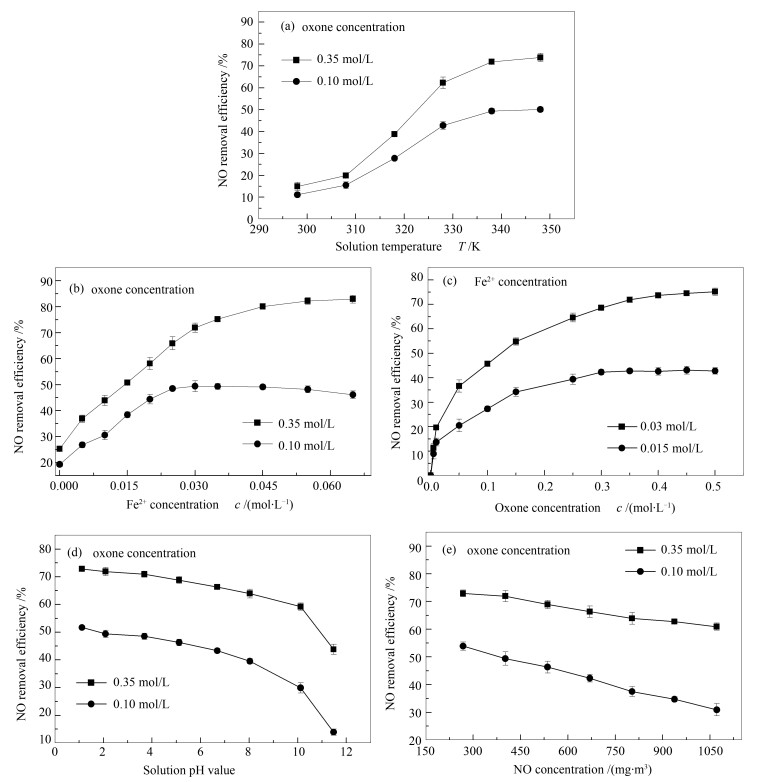
Figure 2.
Effects of solution temperature (a), Fe2+ concentration (b), oxone concentration (c), solution pH value (d) and NO concentration (b) on NO removal efficiency
SU C Y, RAN X, HU J L, SHAO C L. Photocatalytic process of simultaneous desulfurization and denitrification of flue gas by TiO2-polyacrylonitrile nanofibers[J]. Environ Sci Technol,
2013, 47(20):
11562-11568.
doi: 10.1021/es4025595
[2]
WEI Z S, NIU H J, JI Y F. Simultaneous removal of SO2 and NOx by microwave with potassium permanganate over zeolite[J]. Fuel Process Technol,
2009, 90(2):
324-329.
doi: 10.1016/j.fuproc.2008.09.005
[3]
LIU Y X, ZHNAG J, SHENG C D. Simultaneous removal of NO and SO2 from coal-fired flue gas by UV/H2O2 advanced oxidation process[J]. Chem Eng J,
2010, 162(3):
1006-1011.
doi: 10.1016/j.cej.2010.07.009
[4]
LIU Y X, ZHNAG J, PAN J F, TANG A K. Investigation on the removal of NO from SO2 containing simulated flue gas by an ultraviolet/fenton-like reaction[J]. Energy Fuels,
2012, 26(9):
5430-5436.
doi: 10.1021/ef3008568
[5]
ADEWUYI Y G, KHAN N E. Modeling the ultrasonic cavitation-enhanced removal of nitrogen oxide in a bubble column reactor[J]. AIChE J,
2012, 58(8):
2397-2411.
doi: 10.1002/aic.12751
[6]
GUO R T, PAN W G, ZHANG X B, REN J X. Removal of NO by using Fenton reagent solution in a lab-scale bubbling reactor[J]. Fuel,
2011, 90(11):
3295-3298.
doi: 10.1016/j.fuel.2011.06.030
[7]
ZHAO Y, WEN X Y, GUO T X, ZHOU J H. Desulfurization and denitrogenation from flue gas using Fenton reagent[J]. Fuel Process Technol,
2014, 128(10):
54-60.
[8]
ZHAO Y, YUAN B, SHEN Y, HAO R, YANG S. Simultaneous removal of NO and SO2 from flue gas using vaporized H2O2 catalyzed by nanoscale zero-valent iron[J]. Environ Sci Pollut R,
2018, 25(25):
1-12.
[9]
LIU Y X, WANG Y. Elemental mercury removal from flue gas using heat and Co2+/Fe2+ coactivated oxone oxidation system[J]. Chem Eng J,
2018, 348(15):
464-475.
[10]
XU W, LIU Y X, WANG Q, ZHANG J, PAN J F. Removal of nitric oxide from flue gas using sulfate/hydroxyl radicals from activation of oxone with cobalt and high temperature[J]. Environ Prog Sustainable Energy,
2017, 36(4):
1013-1021.
doi: 10.1002/ep.v36.4
[11]
LIU Y X, WANG Q. Removal of elemental mercury from flue gas by thermally activated ammonium persulfate in a bubble column reactor[J]. Environ Sci Technol,
2014, 48(20):
12181-12189.
doi: 10.1021/es501966h
[12]
ADEWUYI Y G, OWUSU S O. Aqueous absorption and oxidation of nitric oxide with oxone for the treatment of tail gases:Process feasibility, stoichiometry, reaction pathways, and absorption rate[J]. Ind Eng Chem Res,
2003, 42(17):
4084-4100.
doi: 10.1021/ie020709+
[13]
WU Y. Impinging Streams:Fundamentals, Properties, and Applications[M]. Amsterdam:Elsevier, 2007.
[14]
LIU Y X, WANG Y, YIN Y S, PAN J F, ZHANG J. Oxidation removal of nitric oxide from flue gas using ultraviolet light (UV) and heat coactivated oxone system[J]. Energy Fuels,
2018, 32(2):
1999-2008.
doi: 10.1021/acs.energyfuels.7b03165
[15]
LIU Y X, WANG Y, YANG W, PAN Z H, WANG Q. Simultaneous oxidation-absorption of nitric oxide and sulfur dioxide using aqueous ammonium persulfate synergistically activated by UV-light and heat[J]. Chem Eng Res Des,
2018, 130(2):
321-333.
[16]
ADEWUYI Y G, SAKYI N Y. Removal of nitric oxide by aqueous sodium persulfate simultaneously activated by temperature and Fe2+ in a lab-scale bubble reactor[J]. Ind Eng Chem Res,
2013, 52(41):
14687-14697.
doi: 10.1021/ie4025177
[17]
ADEWUYI Y G, KHAN M A, SAKYI N Y. Kinetics and modeling of the removal of nitric oxide by aqueous sodium persulfate simultaneously activated by temperature and Fe2+[J]. Ind Eng Chem Res,
2014, 53(2):
828-839.
doi: 10.1021/ie402801b
[18]
LIU Y X, WANG Y, WANG Q, PAN J F, ZHANG J. Simultaneous removal of NO and SO2 using vacuum ultraviolet light (VUV)/heat/peroxymonosulfate (PMS)[J]. Chemosphere,
2018, 190(1):
431-441.
[19]
LIU Y X, XU W, PAN J F, WANG Q. Oxidative removal of NO from flue gas using ultrasound, Mn2+/Fe2+ and heat coactivation of oxone in an ultrasonic bubble reactor[J]. Chem Eng J,
2017, 326(10):
1166-1176.
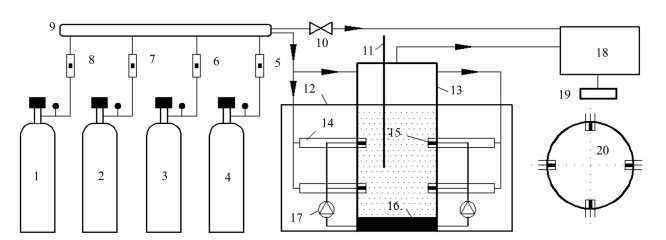
图 1
实验装置示意图
Figure 1
Schematic diagram of experimental apparatus
1-4: cylinder gases (N2/O2/SO2/NO); 5-8: rotameters; 9: gas blender; 10: gas valves; 11: thermometer; 12: constant temperature device; 13: impinging stream reactor; 14: accelerating tube; 15: atomizing nozzles; 16: solution; 17: circulating pump; 18: flue gas analyzer; 19: scrubber bottle; 20: nozzles distribution
Figure 2
Effects of solution temperature (a), Fe2+ concentration (b), oxone concentration (c), solution pH value (d) and NO concentration (b) on NO removal efficiency



 下载:
下载:


 下载:
下载:



