

 Table 1.
Catalytic results of different catalysts for conversion of glucose
Table 1.
Catalytic results of different catalysts for conversion of glucose
Citation:
CAO Yue-ling, WANG Jun-wei, KANG Mao-qing, ZHU Yu-lei. Catalytic conversion of glucose and cellobiose into ethylene glycol over various tungsten-based catalysts[J]. Journal of Fuel Chemistry and Technology,
2016, 44(7): 845-852.

不同钨基催化剂上葡萄糖和纤维二糖催化转化制备乙二醇
English
Catalytic conversion of glucose and cellobiose into ethylene glycol over various tungsten-based catalysts
Abstract:
Glucose and cellobiose were used as model compounds to investigate the effect of retro-aldol condensation and hydrogenation rates on the product distribution of cellulose conversion. It was shown that the product distribution obtained over the physical mixture of Ni/SBA-15 and WO3/SBA-15 in the glucose and cellobiose conversions were different from that attained on the Ni-WO3/SBA-15 prepared by the co-impregnation method. The ethylene glycol (EG) yield depended on the structures of tungstic compounds, and it increased in the order of WO3 < WO3/SBA-15 < (NH4)6W7O24·6H2O (AMT), while the particle sizes of them decreased in such an order. Regardless of the types of tungstic compounds, the EG yield obtained in the glucose conversion is lower than that attained in the cellobiose conversion at the same amount of catalyst.
-
Key words:
- glucose
- / cellobiose
- / hydrogenolysis
- / tungsten-based catalysts
- / ethylene glycol
-
Lignocelluloses, one of the major clean energy resources, has been considered to be a potential feedstock alternative to fossil resource for production of clean energy and renewable chemicals because of increasing concerns about the shortage of fossil fuels and the global warming as a result of emission of great amounts of CO2[1, 2]. Up to date, many routes have been developed for the sustainable production of liquid fuels and chemicals from lignocelluloses[3-12]. Among the proposed routes, one-pot transformation of cellulose into ethylene glycol (EG) has attracted considerable attention because EG is an important commodity chemical widely applied in the synthesis of polyesters, antifreeze and cosmetics, etc[5, 13].
In 2008, Ji et al[5] reported that nickel-promoted tungsten carbide were catalytically active for the production of EG from cellulose. After that, a series of tungsten-based catalysts, such as Ni-WxC/MC, Ni-W/SBA-15, Ni-W/SiO2-Al2O3, Ni-WO3/SBA-15, (WO3 + Ru/C), (H2WO4 + Ru/C) and (ammonium metatungstate (AMT) + Ru/AC), were also found to be effective for catalyzing this reaction[14-22]. In addition, a significant progress has been made in the design of catalysts and understanding of the catalytic mechanism[14-25]. Now, it is believed that one-pot conversion of cellulose to EG includes three consecutive reactions: hydrolysis of cellulose to soluble cellooligsaccharides and glucose; retro-aldol condensation of these sugar intermediates to glycolaldehyde; and hydrogenation of glycolaldehyde to EG[26]. These three reactions occur at different active sites, and the hydrolysis of cellulose to cellooligsaccharides and glucose is the rate-determining step, which is usually catalyzed by protons in situ generated reversibly from hot water or by additional acid. In contrast, the retro-aldol condensation of soluble sugar intermediates is effectively catalyzed by tungstic compounds. As for the hydrogenation of glycolaldehyde to EG, supported Ni or Ru catalyst is generally used[26-28]. Thus, the W to Ru or Ni ratio is a crucial factor determining the catalytic performance[15, 17-19, 22]. It has been shown that various types of tungstic compounds, such as metal W, WxC, WO3, H2WO4, AMT and phosphotungstic acid, all exhibit comparable catalytic ability for selective cleavage of C-C bond, suggesting that they contain the same type of active W-based species[22, 26, 29]. A detailed investigation shows that part of the tungstic compounds are transformed into soluble tungsten bronze (HxWO3) species during the reaction[29]. Unfortunately, the HxWO3 is very unstable in the presence of oxygen. Therefore, it is very difficult to separate it from aqueous solution, and thus, quantify its amount.
Although various types of tungsten species are highly effective for the conversion of cellulose, the obtained EG yields are different. In particular, most of the catalysts contain not only tungstic compounds but also metal Ru or Ni. Is the physical mixture more catalytically effective than the sample prepared by the co-impregnation method? Which type of tungsten species exhibits the highest efficiency for producing EG? To the best of our knowledge, these questions have not been answered yet.
Glucose is the basic structural unit of cellulose, and hence, an intermediate species during the conversion of cellulose to EG, while cellobiose is the smallest molecule possessing a β-1, 4-glycosidic bond. Nonetheless, hydrolysis, C-C bond cleavage and hydrogenation included in the cellulose conversion all occur in the cellobiose conversion. Understanding of the relationship between product distribution and mass transfer limitation is vital to the design of new catalytic system. Therefore, a detailed comparison of glucose and cellobiose conversion processes will be helpful for illustrating the effect of mass transfer limitation on the catalytic properties.
In continuation of our previous work[17-19], hydrogenolysis of glucose and cellobiose over various kinds of tungsten-based catalysts are systematically investigated here. It will be shown that the Ni-WO3/SBA-15 prepared by the co-impregnation method is more catalytically effective than the physical mixture of Ni/SBA-15 and WO3/SBA-15 for the conversion of glucose and cellobiose to EG. In addition, the catalytic performances of WO3/SBA-15, WO3 and AMT were investigated, showing that the EG yield was related with the particle size of tungstic compounds.
1 Experimental
1.1 Materials
Glucose (Tianjin Dongliqu Tianda Chem. Reagent Factory, analytic grade), cellobiose (Aladdin Chem. Co. Ltd, analytic grade), tungstophosphoric acid hydrate [H3O40PW12·xH2O] (Sinopharm Chem. Reagent Co. Ltd., analytic grade), ammonium paratungstate [(NH4)6W7O24·6H2O] (Sinopharm Chem. Reagent Co., Ltd., analytic grade), nickel nitrate hexahydrate [Ni (NO3)2·6H2O] (Sinopharm Chem. Reagent Co. Ltd., analytic grade), and SBA-15 (Shanghai Novel Chem. Technol. Co., Ltd.) were used as received without further purification.
1.2 Preparation of catalysts
All the Ni/SBA-15, WO3/SBA-15 and Ni-WO3/SBA-15 catalysts were prepared by the conventional impregnation method[17]. Typically, SBA-15 was impregnated with tungstophosphoric acid hydrate [H3O40PW12·xH2O] and nickel nitrate hexahydrate [Ni (NO3)2·6H2O] aqueous solution, the volume of which was calculated using the measured incipient wetness of the support. The impregnated sample was dried at 100 ℃ for 12 h and calcined at 500 ℃ for 3 h. Before the reaction, all the samples were reduced at 500 ℃ for 1 h in a pure H2 flow. The bulk WO3 was obtained by calcining the ammonium paratungstate [(NH4)6W7O24·6H2O] at 500 ℃ for 3 h. The prepared catalysts were designed as x%Ni/SBA-15, y%WO3/SBA-15 or x%Ni-y%WO3/SBA-15 with x and y representing the nominal weight loading of metal Ni and WO3 respectively.
1.3 Catalytic reaction
Conversion of glucose or cellobiose was carried out at 6 MPa H2 (measured at room temperature) in a stainless-steel autoclave unless specified. Typically, 0.5 g glucose or cellobiose, 0.125 g 10%Ni/SBA-15, 10%Ni-15%WO3/SBA-15 or designed amount of tungstic compound and 40 g water were first sealed into a 100 mL autoclave. Then, the autoclave was purged with H2 to remove air, followed by filling with 6 MPa H2 and heating to the designated temperature under strong stirring conditions. The reaction was terminated by cooling the autoclave to room temperature with water. The solid fraction was filtered, and the products were analyzed by the internal standard method.
The amounts of low-boiling point products, including EG, 1, 2-propylene glycol (1, 2-PG), 1, 2-butanediol (1, 2-BG) and glycerol, were determined by a Shimadzu GC-2014 equipped with a polar CBP20 column (25 × 0.22 mm and 0.25 μm thickness) and a flame ionization detector (FID)]. The high boiling-point products were analyzed by an HPLC system equipped with a Ca-NP capillary chromatography column and an evaporated light scattering detector. Water was used as the mobile phase, the flow rate of which was 0.6 mL/min. The injection volume was 5.0 μL, and the column and detector temperatures were 80 and 70 ℃ respectively.
2 Results and discussion
2.1 Catalytic properties of different catalysts
In the conversion of cellulose to EG, many catalysts contain both tungstic compounds (WO3, H2WO4 or (NH4)6H2W12O40) and Ru/C or Raney Ni[20-22, 29]. It has been shown that the product distribution obtained over the physical mixture of catalysts is different from that attained on the sample prepared by the co-impregnation method. Tables 1 and 2 compare the catalytic results of different samples obtained in the glucose and cellobiose conversions. The EG yield decreased in the order of 10%Ni-15%WO3/SBA-15 > physical mixture of 10%Ni/SBA-15 and 15%WO3/SBA-15 > 10%Ni/SBA-15, while the sorbitol yield exhibited the opposite trend. No EG was obtained on the 10%Ni/SBA-15 in the conversion of glucose. It gave a sorbitol yield of 97.2% through the direct hydrogenation of glucose. This confirms that the active sites for selective cleavage of C-C bond are tungsten species, being consistent with the previously reported result[26]. The EG yields obtained over the physical mixture of 10%Ni/SBA-15 and 15%WO3/SBA-15 and the co-impregnated 10%Ni-15%WO3/SBA-15 were 15.2% and 29.8% respectively. It was reported that the activation energies (Ea) for cleavage of the C-C bond in glucose and hydrogenation of glucose were significantly different, being 141.3 and 49.6 kJ/mol respectively[23]. Thus, the lower EG yield obtained in the physical mixture of 10%Ni/SBA-15 and 15%WO3/SBA-15 was due to the higher rate of glucose hydrogenation than of retro-aldol condensation. This is because the W to Ni ratio of the co-impregnated 10%Ni-15%WO3/SBA-15 is larger than that of the physical mixture of 10%Ni/SBA-15 and 15%WO3/SBA-15 owing to the Ni in the latter being partially covered by WO3[19]. Thus, the retro-aldol condensation rate of glucose over the co-impregnated sample is higher than that over the physical mixture, resulting in the formation of more EG.
Table 1.
Catalytic results of different catalysts for conversion of glucose
Catalyst Conversion x/% Yield w /% EG 1, 2-PG glycerol sorbitol mannitol 10%Ni/SBA-15 100 trace trace trace 97.2 no 10%Ni/SBA-15+15%WO3/SBA-15a 100 15.2 1.0 2.3 54.5 7.7 10%Ni-15%WO3/SBA-15 100 29.8 2.4 2.9 36.5 7.5 reaction conditions: 0.5 g glucose, 40 g water, 0.125 g catalyst, 175 ℃, 80 min, 6 MPa H2 pressure
a: 0.125 g of 15%WO3/SBA-15 was used to make sure that it had the same WO3 content as the 10%Ni-15%WO3/SBA-15Table 1. Catalytic results of different catalysts for conversion of glucose
Table 2.
Catalytic results of different catalysts for conversion of cellobiose
Catalyst Conversion x/% Yield w/% EG 1, 2-PG glycerol sorbitol mannitol 10%Ni/SBA-15 97.8 trace trace trace 47.7 no 10%Ni/SBA-15+15%WO3/SBA-15a 100 15.3 1.1 1.8 51.7 4.6 10%Ni-15%WO3/SBA-15 100 40.5 3.4 2.8 18.5 2.0 reaction conditions: 0.5 g cellobiose, 40 g water, 0.125 g catalyst, 190 ℃, 30 min, 6 MPa H2 pressure
a: 0.125 g 15%WO3/SBA-15 was used to make sure that it had the same WO3 content as the 10%Ni-15%WO3/SBA-15Table 2. Catalytic results of different catalysts for conversion of cellobioseIn agreement with the result obtained in the glucose conversion, different product distributions were observed for the conversion of cellobiose over the physical mixture of 10%Ni/SBA-15 and 15%WO3/SBA-15 and the co-impregnated 10%Ni-15%WO3/SBA-15. The EG yield also decreased in the order of 10%Ni-15%WO3/SBA-15 > physical mixture of 10%Ni/SBA-15 and 15%WO3/SBA-15 > 10%Ni/SBA-15, but the sorbitol yield followed the order of physical mixture of 10%Ni/SBA-15 and 15%WO3/SBA-15 > 10%Ni/SBA-15 > 10%Ni-15%WO3/SBA-15. The lower sorbitol yield obtained on the 10%Ni/SBA-15 in the cellobiose conversion than in the glucose conversion might be due to the formation of 3-β-D-glucopyranosyl-D-glucitol through the direct hydrogenation of cellobiose, as the β-1, 4-glycosidic bonds in the hydrogenation product could not be hydrolyzed in the absence of tungsten oxide. Although the factors affecting the EG yield is the same for conversion of both glucose and cellobiose, the increase degree of the EG yield in the conversion of cellobiose is higher than that in the conversion of glucose. This may result from the higher activation energy (Ea) of retro-aldol condensation than that of glucose hydrogenation[23]. Thus, the increase degree of the reaction rate for cleavage of C-C bond is higher than that for hydrogenation of glucose as a result of conducting the conversion of cellobiose at high reaction temperature.
2.2 Effect of WO3/SBA-15 amount
The above results show that the EG yield obtained over the physical mixture of Ni/SBA-15 and WO3/SBA-15 catalysts was lower that of Ni-WO3/SBA-15. However, it was reported that binary catalysts, such as WO3+Ru/C, H2WO4+Ru/C, AMT+Ru/C, would give high EG yield in the conversion of cellulose, cellobiose or glucose[20-22]. This might be caused by the much higher content of tungsten-based components used in these binary catalysts than that in our catalytic system. To confirm this hypothesis, the effect of the WO3/SBA-15 amount on the EG yield was investigated.
Tables 3 and 4 summarize the catalytic results of different amounts of WO3/SBA-15 for conversion of glucose and cellobiose. The EG yield obtained in the glucose conversion increased from 15.2% to 36.5% when the amount of 15%WO3/SBA-15 was increased from 0.125 to 0.375 g. This is accompanied by the decrease in the sorbitol yield from 54.5% to 21.7%. This may be resulted from the increase in the retro-aldol condensation rate of glucose to glycolaldehyde with the amount of 15%WO3/SBA-15. For the conversion of cellobiose, the EG yield quickly increased from 15.3% to 37.6% with increasing amount of 15%WO3/SBA-15 from 0.125 to 0.250 g. A further increase in the 15%WO3/SBA-15 amount to 0.375 g just slightly increased the EG yield to 41.6%. In contrast, the sorbitol yield rapidly decreased from 51.7% to about 24%, and then remained almost the same. It is worth noting that the increase degree of the EG yield is more significant for cellobiose conversion than for glucose conversion. This could be attributed to the different activation energies between retro-aldol condensation and direct hydrogenation, and thus, the retro-aldol condensation of cellobiose is more probable to occur.
Table 3.
Catalytic results of different amounts of WO3/SBA-15 for glucose conversion
Catalyst Amount m/g Conversion x/% Yield w/% EG 1, 2-PG glycerol sorbitol mannitol 15%WO3/SBA-15 0.125 100 15.2 1.0 2.3 54.5 7.7 15%WO3/SBA-15 0.190 100 19.6 1.2 2.3 47.0 10.9 15%WO3/SBA-15 0.250 100 23.7 1.8 2.7 38.0 8.1 15%WO3/SBA-15 0.375 100 36.5 2.8 3.8 21.7 5.9 reaction conditions: 0.5 g glucose, 40 g water, 0.125 g 10%Ni/SBA-15, 175 ℃, 80 min, 6 MPa H2 pressure Table 3. Catalytic results of different amounts of WO3/SBA-15 for glucose conversion
Table 4.
Catalytic results of different amounts of WO3/SBA-15 for cellobiose conversion
Catalyst Amount m/g Conversion x/% Yield w/% EG 1, 2-PG glycerol sorbitol mannitol 15%WO3/SBA-15 0.125 100 15.3 1.1 1.8 51.7 4.6 15%WO3/SBA-15 0.190 100 30.8 2.1 2.1 32.2 5.2 15%WO3/SBA-15 0.250 100 37.6 3.4 3.5 23.4 5.4 15%WO3/SBA-15 0.375 100 41.6 3.7 3.6 24.7 5.0 reaction conditions: 0.5 g cellobiose, 40 g water, 0.125 g 10%Ni/SBA-15, 190 ℃, 30 min, 6 MPa H2 pressure Table 4. Catalytic results of different amounts of WO3/SBA-15 for cellobiose conversion2.3 Effect of WO3 amount
As shown above, the EG yield can be increased by increasing the 15%WO3/SBA-15 amount in the physical mixture of 10%Ni/SBA-15 and 15%WO3/SBA-15. If the high EG yield can be obtained by just increasing the amount of unsupported WO3, that would be much better. Therefore, the effect of the WO3 amount on the EG yield was investigated.
Table 5 shows that the EG yield is almost the same when the WO3 amount is smaller than 0.037 5 g (corresponding to 0.25 g 15% WO3/SBA-15), but subsequently it slightly increased with the WO3 amount, whereas the sorbitol yield gradually decreased. This might be caused by the bigger particle size of bulk WO3. The lower EG yield obtained over the WO3 than over the WO3/SBA-15 supported is perhaps attributed to the weak inhibition effect of WO3 on the hydrogenation of glucose[25].
Table 5.
Catalytic results of different amounts of WO3 for glucose conversion
Catalyst Amounta m/g Conversion x/% Yield w /% EG 1, 2-PG glycerol sorbitol mannitol WO3 0.018 7 100 2.7 0.2 1.3 82.3 4.9 WO3 0.037 5 100 2.6 0.3 1.7 85.6 10.0 WO3 0.056 2 100 8.3 0.3 1.6 71.8 11.0 WO3 0.082 5 100 13.4 0.5 1.9 61.0 6.2 reaction conditions: 0.5 g glucose, 40 g water, 0.125 g 10%Ni/SBA-15, 175 ℃, 80 min, 6 MPa H2 pressure
a: the WO3 amounts listed from the first to the fourth line are the same as those contained in 0.125, 0.250, 0.375 and 0.550 g 15%WO3/SBA-15, respectivelyTable 5. Catalytic results of different amounts of WO3 for glucose conversionTable 6 shows the catalytic results obtained over different amounts of WO3 in the cellobiose conversion. As expected, the EG yield increased, while the sorbitol yield decreased with the WO3 amount. It should be noted that the EG yield obtained in the cellobiose conversion is higher than that attained in the glucose conversion regardless of the WO3 amount used. Certainly, the sorbitol yield shows an opposite trend. It has been shown that high temperature is beneficial to the increase of the EG yield because of the large difference in the activation energies for formation of EG and sorbitol[22]. Since the conversion of cellobiose was carried out at higher reaction temperature than that of glucose, it was not difficult to understand that a higher EG yield was obtained in the cellobiose conversion. It could be also speculated that to attain the same EG yield as 15% WO3/SBA-15, much larger amounts of bulk WO3 would be needed.
Table 6.
Catalytic results of different amounts of WO3 for cellobiose conversion
Catalyst Amount m/g Conversion x/% Yield w /% EG 1, 2-PG glycerol sorbitol mannitol WO3 0.018 7 100 11.9 0.6 1.8 63.0 6.1 WO3 0.037 5 100 15.8 0.5 2.0 51.6 5.4 WO3 0.056 2 100 23.8 0.5 1.8 44.9 6.4 WO3 0.082 5 100 30.5 0.9 1.8 38.9 5.3 reaction conditions: 0.5 g cellobiose, 40 g water, 0.125 g 10%Ni/SBA-15, 190 ℃, 30 min, 6 MPa H2 pressure
a: the WO3 amounts listed from the first to the fourth line are the same as those contained in 0.125, 0.250, 0.375 and 0.550 g 15%WO3/SBA-15, respectivelyTable 6. Catalytic results of different amounts of WO3 for cellobiose conversion2.4 Effect of AMT amount
The above results show that the lower EG yield obtained over the physical mixture of 10%Ni/SBA-15 and WO3 than of 10%Ni/SBA-15 and 15%WO3/SBA-15 may be due to the insolubility and large particle size of WO3. To confirm this assumption, water-soluble AMT was selected as the tungsten source.
Tables 7 shows that the EG yield obtained in the glucose conversion sharply increased from 22.6% to 41.4% when the AMT amount was increased from 0.021 8 to 0.043 6 g. Irrespective of this, a further increase in the AMT amount had no positive effect. It is unexpected that both the EG and the sorbitol yields are nearly independent of the AMT amount in the cellobiose conversion (Table 8). This may be attributed to the homogeneous characteristic of AMT, which leads to a great increase in the glycolaldehyde formation rate.
Table 7.
Catalytic results of different amounts of AMT for glucose conversion
Catalyst Amounta m/g Conversion x/% Yield w/% EG 1, 2-PG glycerol sorbitol mannitol AMT 0.021 8 100 22.6 1.2 2.4 48.6 4.4 AMT 0.033 1 100 35.9 1.5 2.4 30.5 3.7 AMT 0.043 6 100 41.4 2.5 2.6 22.9 2.6 AMT 0.065 4 100 44.5 2.7 2.9 21.2 2.7 reaction conditions: 0.5 g glucose, 40 g water, 0.125 g 10%Ni/SBA-15, 175 ℃, 80 min, 6 MPa H2 pressure
a: the W amounts listed from the first to the fourth line are the same as those contained in 0.125, 0.190, 0.250 and 0.375 g 15%WO3/SBA-15, respectivelyTable 7. Catalytic results of different amounts of AMT for glucose conversion
Table 8.
Catalytic results of different amounts of AMT for cellobiose conversion
Catalyst Amount m/g Conversion x/% Yield w/ % EG 1, 2-PG glycerol sorbitol mannitol AMT 0.0218 100 52.4 2.9 2.0 19.6 2.6 AMT 0.0331 100 50.6 2.8 2.0 18.8 2.8 AMT 0.0436 100 51.0 3.1 2.0 20.2 2.4 AMT 0.0654 100 49.6 3.2 1.9 17.6 2.4 reaction conditions: 0.5 g cellobiose, 40 g water, 0.125 g 10%Ni/SBA-15, 190 ℃, 30 min, 6 MPa H2 pressure
a: the W amounts listed from the first to the fourth line are the same as those contained in 0.125, 0.190, 0.250 and 0.375 g 15%WO3/SBA-15, respectivelyTable 8. Catalytic results of different amounts of AMT for cellobiose conversion2.5 Catalytic tests of various tungstic compounds
As mentioned above, in combination with Ni or Ru, various tungstic compounds are highly effective for catalytic transformation of glucose and cellulose into EG. However, the reported EG yields obtained over different types of W compounds are often contradictory[22, 25, 29]. Tai et al[29] found that H2WO4 and Raney Ni exhibited high catalytic performance for the conversion of cellulose to EG, and the EG yield increased in the order of H2WO4 > WO3 > H3PW12O40 > H4SiW12O40. In contrast, Zhao et al[22] reported that AMT gave higher EG yield than tungstophosphoric acid, tungstic acid and tungstosilicic acid in the glucose conversion, while Zhang et al[25] concluded in the hydrogenolysis of glucose at 220 ℃ that the retro-aldol condensation activity of different tungstic compounds increased in the order of H2WO4>AMT>H3PW12O40>WO3>H4SiW12O40. Our results show that WO3, WO3/SBA-15 and (NH4)6W7O24 also exhibit different efficiency for the conversion of glucose and cellobiose to EG. To understand the contradictory results, effects of the amounts of various tungsten species on the EG yields obtained in both the glucose and the cellobiose conversions are investigated.
Figure 1 shows that AMT, followed by 15%WO3/SBA-15, gave the highest EG yield in the glucose conversion. It is in accordance with the decrease in the particle size of these three types of tungstic compounds: WO3(macro-scale) > WO3/SBA-15 (nano-scale) > AMT (molecular scale). The same result was obtained in the cellobiose conversion (Figure 2). Therefore, it can be concluded that AMT shows higher efficiency than the other two types of tungstic compounds for the conversion of cellulose to EG.
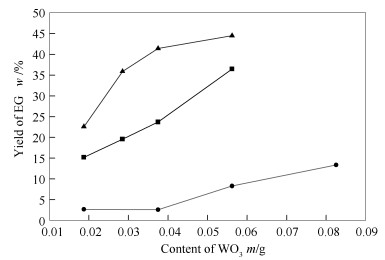 Figure 1.
EG yield obtained over various tungstic compounds in the glucose conversion
Figure 1.
EG yield obtained over various tungstic compounds in the glucose conversion
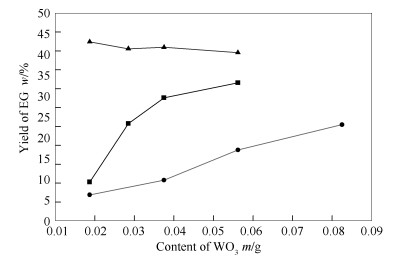 Figure 2.
EG yield obtained over various tungstic compounds in the cellobiose conversion
Figure 2.
EG yield obtained over various tungstic compounds in the cellobiose conversion
It should be pointed out that the EG yield obtained in the glucose conversion is lower than that attained in the cellobiose conversion no matter which type of tungstic compound is used. This can be accounted for by the following three reasons. First, cellobiose shows lower reactivity in the direct hydrogenation due to the presence of β-1, 4-glycosidic bonds. Second, the optimum reaction temperature of cellobiose conversion is higher than that of glucose conversion. Third, the apparent activation energy of retro-aldol condensation of glucose (141.3 kJ/mol) is much higher than that of hydrogenation (49.6 kJ/mol)[23]. Therefore, high reaction temperature is favorable to the cleavage of C-C bond. Thus, the higher reaction temperature for the conversion of cellobiose than for the conversion of glucose would result in a higher concentration of glycolaldehyde, consequently giving higher EG yield.
3 Conclusions
The Ni-WO3/SBA-15 catalyst prepared by the co-impregnation method gives high EG yield than the physical mixture of Ni/SBA-15 and WO3/SBA-15 in the hydrogenolysis of glucose and cellobiose. Nonetheless, the EG yield obtained in the physical mixture can be increased by increasing amount of WO3/SBA-15. In addition, it was found that the EG yield obtained from cellobiose conversion was higher than that from glucose conversion at the same amount of WO3/SBA-15. Different types of tungstic compounds exhibited different efficiency for producing EG. The EG yield increased in the order of WO3 < WO3/SBA-15 < AMT, being consistent with the increase in the particle size of various tungstic compounds, viz. AMT (molecular scale) < WO3/SBA-15 (nano-scale) < WO3 (macro-scale). It is expected that conversion of cellulose would produce high yield of EG due to the presence of β-1, 4-glycosidic bonds in the molecular structure and conduction of the reaction at high temperature.
-
-
[1]
HUBER G W, IBORRA S, CORMA A. Synthesis of transportation fuels from biomass: Chemistry, catalysts, and engineering[J]. Chem Rev, 2006, 106(9): 4044-4098. doi: 10.1021/cr068360d
-
[2]
CORMA A, IBORRA S, VELTY A. Chemical routes for the transformation of biomass into chemicals[J]. Chem Rev, 2007, 107(6): 2411-2502. doi: 10.1021/cr050989d
-
[3]
ONDA A, OCHI T, YANAGISAWA K. Selective hydrolysis of cellulose into glucose over solid acid catalysts[J]. Green Chem, 2008, 10(10): 1033-1037. doi: 10.1039/b808471h
-
[4]
FUKUOKA A, DHEPE P A. Catalytic conversion of cellulose into sugar alcohols[J]. Angew Chem Int Ed, 2006, 45(31): 5161-5163. doi: 10.1002/(ISSN)1521-3773
-
[5]
JI N, ZHANG T, ZHENG M Y, WANG A Q, WANG H, WANG X D, CHEN J G. Direct catalytic conversion of cellulose into ethylene glycol using nickel-promoted tungsten carbide catalysts[J]. Angew Chem, 2008, 120(44): 8638-8641. doi: 10.1002/ange.v120:44
-
[6]
SU Y, BROWN H M, HUANG X W, ZHOU X D, AMONETTE J E, ZHANG Z C. Single-step conversion of cellulose to 5-hydroxymethlfurfural (HMF), a versatile platform chemical[J]. Appl Catal A: Gen, 2009, 361(1/2): 117-122.
-
[7]
KUO I J, SUZUKI N, YAMAUCHI Y, WU K C. W. Cellulose-to-HMF conversion using crystalline mesoporous titania and zirconia nanocatalysts in ionic liquid systems[J]. RSC Adv, 2013, 3(6): 2028-2034. doi: 10.1039/C2RA21805D
-
[8]
ZHANG J Z, LIU X, SUN M, MA X H, HAN Y. Direct conversion of cellulose to glycolic acid with a phosphomolybdic acid catalyst in a water medium[J]. ACS Catal, 2012, 2(8): 1698-1702. doi: 10.1021/cs300342k
-
[9]
AN D L, YE A H, DENG W P, ZHANG Q H, WANG Y. Selective conversion of cellobiose and cellulose into gluconic acid in water in the presence of oxygen, catalyzed by polyoxometalate-supported gold nanoparticles[J]. Chem Eur J, 2012, 18(10): 2938-2947. doi: 10.1002/chem.201103262
-
[10]
SERRANO-RUIZ J C, BRADEN D J, WEST R M, DUMESIC J A. Conversion of cellulose to hydrocarbon fuels by progressive removal of oxygen[J]. Appl Catal B: Environ, 2010, 100(1/2): 184-189.
-
[11]
LIU Y, CHEN L G, WANG T J, ZHANG X H, LONG J X, ZHANG Q, MA L L. High yield of renewable hexanes by direct hydrolysis-hydrodeoxygenation of cellulose in an aqueous phase catalytic system[J]. RSC Adv, 2015, 5(15): 11649-11657. doi: 10.1039/C4RA14304C
-
[12]
REZAEI P S, SHAFAGHAT H, DAUD W M A W. Suppression of coke formation and enhancement of aromatic hydrocarbon production in catalytic fast pyrolysis of cellulose over different zeolites: Effects of pore structure and acidity[J]. RSC Adv, 2015, 5(80): 65408-65414. doi: 10.1039/C5RA11332F
-
[13]
YUE H R, ZHAO Y J, MA X B, GONG J L. Ethylene glycol: Properties, synthesis, and applications[J]. Chem Soc Rev, 2012, 41(11): 4218-4244. doi: 10.1039/c2cs15359a
-
[14]
ZHANG Y H, WANG A Q, ZHANG T. A new 3D mesoporous carbon replicated from commercial silica as a catalyst support for direct conversion of cellulose into ethylene glycol[J]. Chem Commun, 2010, 46(6): 862-864. doi: 10.1039/B919182H
-
[15]
ZHENG M Y, WANG A Q, JI N, PANG J F, WANG X D, ZHANG T. Transition metal-tungsten bimetallic catalysts for the conversion of cellulose into ethylene glycol[J]. ChemSusChem, 2010, 3(1): 63-66. doi: 10.1002/cssc.v3:1
-
[16]
BAEK I G, YOU S J, PARK E D. Direct conversion of cellulose into polyols over Ni/W/SiO2-Al2O3[J]. Bioresour Technol, 2012, 114: 684-690. doi: 10.1016/j.biortech.2012.03.059
-
[17]
CAO Y L, WANG J W, LI Q F, YIN N, LIU Z M, KANG M Q, ZHU Y L. Hydrolytic hydrogenation of cellulose over Ni-WO3/SBA-15 catalysts[J]. J Fuel Chem Technol, 2013, 41(8): 943-949. doi: 10.1016/S1872-5813(13)60041-9
-
[18]
CAO Y L, WANG J W, KANG M Q, ZHU Y L. Efficient synthesis of ethylene glycol from cellulose over Ni-WO3/SBA-15 catalysts[J]. J Mole Catal A: Gen, 2014, 381: 46-53. doi: 10.1016/j.molcata.2013.10.002
-
[19]
CAO Y L, WANG J W, KANG M Q, ZHU Y L. Catalytic conversion of glucose and cellobiose to ethylene glycol over Ni-WO3/SBA-15 catalysts[J]. RSC Adv, 2015, 5(110): 90904-90912. doi: 10.1039/C5RA15400F
-
[20]
LIU Y, LUO C, LIU H C. Tungsten trioxide promoted selective conversion of cellulose into propylene glycol and ethylene glycol on a ruthenium catalyst[J]. Angew Chem, 2012, 124(13): 3303-3307. doi: 10.1002/ange.v124.13
-
[21]
TAI Z J, ZHANG J Y, WANG A Q, ZHENG M Y, ZHANG T. Temperature-controlled phase-transfer catalysis for ethylene glycol production from cellulose[J]. Chem Commun, 2012, 48(56): 7052-7054. doi: 10.1039/c2cc32305b
-
[22]
ZHAO G H, ZHENG M Y, ZHANG J Y, WANG A Q, ZHANG T. Catalytic conversion of concentrated glucose to ethylene glycol with semicontinuous reaction system[J]. Ind Eng Chem Res, 2013, 52(28): 9566-9572. doi: 10.1021/ie400989a
-
[23]
ZHANG J Y, HOU B L, WANG A Q, LI Z L, WANG H, ZHANG T. Kinetic study of the competitive hydrogenation of glycolaldehyde and glucose on Ru/C with or without AMT[J]. AIChE J, 2014, 61(1): 224-238.
-
[24]
ZHANG J Y, YANG X F, HOU B L, WANG A Q, LI Z L, WANG H, ZHANG T. Comparison of cellobiose and glucose transformation to ethylene glycol[J]. Chin J Catal, 2014, 35(11): 1811-1817. doi: 10.1016/S1872-2067(14)60151-0
-
[25]
ZHANG J Y, HOU B L, WANG X F, LI Z L, WANG A Q, ZHANG T. Inhibiting effect of tungstic compounds on glucose hydrogenation over Ru/C catalyst[J]. J Energ Chem, 2015, 24(1): 9-14. doi: 10.1016/S2095-4956(15)60278-9
-
[26]
WANG A Q, ZHANG T. One-pot conversion of cellulose to ethylene glycol with multifunctional tungsten-based catalysts[J]. Acc Chem Res, 2013, 46(7): 1377-1386. doi: 10.1021/ar3002156
-
[27]
LUO C, WANG S, LIU H C. Cellulose conversion into polyols catalyzed by reversibly formed acids and supported ruthenium clusters in hot water[J]. Angew Chem Int Eng, 2007, 46(40): 7636-7639. doi: 10.1002/(ISSN)1521-3773
-
[28]
RINALDI R, SCHÜTH F. Design of solid catalysts for the conversion of biomass[J]. Energy Environ Sci, 2009, 2(6): 610-626. doi: 10.1039/b902668a
-
[29]
TAI Z J, ZHANG J Y, WANG A Q, PANG J F, ZHENG M Y, ZHANG T. Catalytic conversion of cellulose to ethylene glycol over a low-cost binary catalyst of Raney Ni and tungstic acid[J]. Chem Sus Chem, 2013, 6(4): 652-658. doi: 10.1002/cssc.201200842
-
[1]
-

Figure 1 EG yield obtained over various tungstic compounds in the glucose conversion
■: WO3/SBA-15; ●: WO3; ▲: AMT

Figure 2 EG yield obtained over various tungstic compounds in the cellobiose conversion
■: WO3/SBA-15; ●: WO3; ▲: AMT
Table 1. Catalytic results of different catalysts for conversion of glucose
Catalyst Conversion x/% Yield w /% EG 1, 2-PG glycerol sorbitol mannitol 10%Ni/SBA-15 100 trace trace trace 97.2 no 10%Ni/SBA-15+15%WO3/SBA-15a 100 15.2 1.0 2.3 54.5 7.7 10%Ni-15%WO3/SBA-15 100 29.8 2.4 2.9 36.5 7.5 reaction conditions: 0.5 g glucose, 40 g water, 0.125 g catalyst, 175 ℃, 80 min, 6 MPa H2 pressure
a: 0.125 g of 15%WO3/SBA-15 was used to make sure that it had the same WO3 content as the 10%Ni-15%WO3/SBA-15 下载: 导出CSV
Table 2. Catalytic results of different catalysts for conversion of cellobiose
Catalyst Conversion x/% Yield w/% EG 1, 2-PG glycerol sorbitol mannitol 10%Ni/SBA-15 97.8 trace trace trace 47.7 no 10%Ni/SBA-15+15%WO3/SBA-15a 100 15.3 1.1 1.8 51.7 4.6 10%Ni-15%WO3/SBA-15 100 40.5 3.4 2.8 18.5 2.0 reaction conditions: 0.5 g cellobiose, 40 g water, 0.125 g catalyst, 190 ℃, 30 min, 6 MPa H2 pressure
a: 0.125 g 15%WO3/SBA-15 was used to make sure that it had the same WO3 content as the 10%Ni-15%WO3/SBA-15
下载: 导出CSV
Table 3. Catalytic results of different amounts of WO3/SBA-15 for glucose conversion
Catalyst Amount m/g Conversion x/% Yield w/% EG 1, 2-PG glycerol sorbitol mannitol 15%WO3/SBA-15 0.125 100 15.2 1.0 2.3 54.5 7.7 15%WO3/SBA-15 0.190 100 19.6 1.2 2.3 47.0 10.9 15%WO3/SBA-15 0.250 100 23.7 1.8 2.7 38.0 8.1 15%WO3/SBA-15 0.375 100 36.5 2.8 3.8 21.7 5.9 reaction conditions: 0.5 g glucose, 40 g water, 0.125 g 10%Ni/SBA-15, 175 ℃, 80 min, 6 MPa H2 pressure
下载: 导出CSV
Table 4. Catalytic results of different amounts of WO3/SBA-15 for cellobiose conversion
Catalyst Amount m/g Conversion x/% Yield w/% EG 1, 2-PG glycerol sorbitol mannitol 15%WO3/SBA-15 0.125 100 15.3 1.1 1.8 51.7 4.6 15%WO3/SBA-15 0.190 100 30.8 2.1 2.1 32.2 5.2 15%WO3/SBA-15 0.250 100 37.6 3.4 3.5 23.4 5.4 15%WO3/SBA-15 0.375 100 41.6 3.7 3.6 24.7 5.0 reaction conditions: 0.5 g cellobiose, 40 g water, 0.125 g 10%Ni/SBA-15, 190 ℃, 30 min, 6 MPa H2 pressure
下载: 导出CSV
Table 5. Catalytic results of different amounts of WO3 for glucose conversion
Catalyst Amounta m/g Conversion x/% Yield w /% EG 1, 2-PG glycerol sorbitol mannitol WO3 0.018 7 100 2.7 0.2 1.3 82.3 4.9 WO3 0.037 5 100 2.6 0.3 1.7 85.6 10.0 WO3 0.056 2 100 8.3 0.3 1.6 71.8 11.0 WO3 0.082 5 100 13.4 0.5 1.9 61.0 6.2 reaction conditions: 0.5 g glucose, 40 g water, 0.125 g 10%Ni/SBA-15, 175 ℃, 80 min, 6 MPa H2 pressure
a: the WO3 amounts listed from the first to the fourth line are the same as those contained in 0.125, 0.250, 0.375 and 0.550 g 15%WO3/SBA-15, respectively
下载: 导出CSV
Table 6. Catalytic results of different amounts of WO3 for cellobiose conversion
Catalyst Amount m/g Conversion x/% Yield w /% EG 1, 2-PG glycerol sorbitol mannitol WO3 0.018 7 100 11.9 0.6 1.8 63.0 6.1 WO3 0.037 5 100 15.8 0.5 2.0 51.6 5.4 WO3 0.056 2 100 23.8 0.5 1.8 44.9 6.4 WO3 0.082 5 100 30.5 0.9 1.8 38.9 5.3 reaction conditions: 0.5 g cellobiose, 40 g water, 0.125 g 10%Ni/SBA-15, 190 ℃, 30 min, 6 MPa H2 pressure
a: the WO3 amounts listed from the first to the fourth line are the same as those contained in 0.125, 0.250, 0.375 and 0.550 g 15%WO3/SBA-15, respectively
下载: 导出CSV
Table 7. Catalytic results of different amounts of AMT for glucose conversion
Catalyst Amounta m/g Conversion x/% Yield w/% EG 1, 2-PG glycerol sorbitol mannitol AMT 0.021 8 100 22.6 1.2 2.4 48.6 4.4 AMT 0.033 1 100 35.9 1.5 2.4 30.5 3.7 AMT 0.043 6 100 41.4 2.5 2.6 22.9 2.6 AMT 0.065 4 100 44.5 2.7 2.9 21.2 2.7 reaction conditions: 0.5 g glucose, 40 g water, 0.125 g 10%Ni/SBA-15, 175 ℃, 80 min, 6 MPa H2 pressure
a: the W amounts listed from the first to the fourth line are the same as those contained in 0.125, 0.190, 0.250 and 0.375 g 15%WO3/SBA-15, respectively
下载: 导出CSV
Table 8. Catalytic results of different amounts of AMT for cellobiose conversion
Catalyst Amount m/g Conversion x/% Yield w/ % EG 1, 2-PG glycerol sorbitol mannitol AMT 0.0218 100 52.4 2.9 2.0 19.6 2.6 AMT 0.0331 100 50.6 2.8 2.0 18.8 2.8 AMT 0.0436 100 51.0 3.1 2.0 20.2 2.4 AMT 0.0654 100 49.6 3.2 1.9 17.6 2.4 reaction conditions: 0.5 g cellobiose, 40 g water, 0.125 g 10%Ni/SBA-15, 190 ℃, 30 min, 6 MPa H2 pressure
a: the W amounts listed from the first to the fourth line are the same as those contained in 0.125, 0.190, 0.250 and 0.375 g 15%WO3/SBA-15, respectively
下载: 导出CSV
-


 扫一扫看文章
计量
- PDF下载量: 0
- 文章访问数: 0
- HTML全文浏览量: 0
 下载:
下载:

