

 Figure 1.
FESEM images at magnification of ×105
Figure 1.
FESEM images at magnification of ×105
Citation:
Zahra Gholami, Noor Asmawati Mohd Zabidi, Fatemeh Gholami, Mohammadtaghi Vakili. Synthesis and characterization of niobium-promoted cobalt/iron catalysts supported on carbon nanotubes for the hydrogenation of carbon monoxide[J]. Journal of Fuel Chemistry and Technology,
2016, 44(7): 815-821.

Synthesis and characterization of niobium-promoted cobalt/iron catalysts supported on carbon nanotubes for the hydrogenation of carbon monoxide
English
Synthesis and characterization of niobium-promoted cobalt/iron catalysts supported on carbon nanotubes for the hydrogenation of carbon monoxide
Abstract:
Bimetallic Co/Fe catalysts supported on carbon nanotubes (CNTs) were prepared, and niobium (Nb) was added as promoter to the 70Co:30Fe/CNT catalyst. The physicochemical properties of the catalysts were characterized, and the catalytic performances were analyzed at the same operation conditions (H2:CO (volume ratio)=2:1, p=1 MPa, and t=260 ℃) in a tubular fixed-bed microreactor system. The addition of Nb to the bimetallic catalyst decreases the average size of the oxide nanoparticles and improves the reducibility of the bimetallic catalyst. Evaluation of the catalyst performance in a Fischer-Tropsch reaction shows that the catalyst results in high selectivity to methane, and the selectivity to C5+ increased slightly in the bimetallic catalyst unlike that in the monometallic catalysts. The addition of 1% Nb to the bimetallic catalyst increases CO conversion and selectivity to C5+. Meanwhile, a decrease in methane selectivity is observed.
-
Key words:
- Fischer-Tropsch synthesis
- / bimetallic catalyst
- / niobium promoter
- / carbon nanotubes
-
Conventional energy resources, such as coal, petroleum, and natural gas, are fulfilling the major energy demands; however, these resources are on the verge of being exhausted, and fossil oil sources are estimated to be depleted by 2050[1]. The increasing population, economic development, and limited supplies of fossil fuels led to the development of new approaches to produce renewable liquid fuels[2]. Fischer-Tropsch synthesis (FTS) gained popularity as an alternative approach to transform different non-petroleum carbon resources, such as coal, natural gas, and biomass, into valuable chemicals from syngas (H2 and CO) or clean transportation fuels[3]. FTS is a process that catalytically converts syngas into clean hydrocarbon fuels, whereas syngas can be derived from non-petroleum feedstock, such as coal, natural gas, or biomass. Increasing the quality of products by developing novel catalysts with high activity and selectivity is desirable in FTS reactions[4]. In FTS reactions, syngas is transformed into liquid fuel through catalytic polymerization, which results in various products, such as paraffins, olefins, alcohols, and aldehydes.
Some challenges still remain in catalyzing FTS reactions. From a fundamental perspective, one of the important difficulties is the control of selectivity. CO undergoes dissociative or hydrogen-assisted dissociative chemisorption on the surface of active metal phases to produce CHx (x=0-3) intermediates as monomers for polymerization. The connection between CHx monomers results in chain growth and provides CnHm intermediates. CnHm intermediates with different carbon numbers can undergo hydrogenation or dehydrogenation to produce paraffins or olefins as final products[5, 6].
Ni, Fe, Co, and Ru are known to be the most active elements for FTS reactions[7-9] because of their ability to dissociatively adsorb CO and H2[10]. One of the parameters that affect the activity of a catalyst is the chemical composition of the catalyst[11-13]. However, other parameters, including appropriate physical properties and high surface area, are also important for the catalytic activity in FTS reactions[13-15]. To overcome the problems associated with conventional metal oxide supports, researchers started using carbon as a catalyst support. Unlike other allotropes of carbon, carbon nanotubes (CNTs) have received significant attention because of their applications and fundamental properties. The presence of these micropores can reduce the full accessibility of reactant particles to active sites[16]. CNTs are stable and inactive in many acidic and basic media. Traditional supports are rendered useless after a reaction. CNTs are more stable toward oxidation and hydrogenation than traditional carbon-based supports[17, 18].
The present work aimed to examine the performance of CNTs as monometallic Co and Fe and bimetallic Co-Fe catalysts supported on CNTs for FTS reactions. Moreover, niobium (Nb)-promoted bimetallic catalysts were prepared and characterized, and their performance in the FTS reaction was tested. In addition, the effect of increasing the H2:CO volume ratio from 1:1 to 4:1 was studied.
1 Experimental
1.1 Catalyst preparation
Prior to catalyst preparation, the commercial MWCNT (Nanostructured and Amorphous Materials Inc. USA, >95%) supports underwent concentrated acid treatment and thermal treatments. MWCNTs were first treated with HNO3 (65%, Merck) at 120 ℃ for 14 h, washed with deionized water, and dried at 120 ℃ for 6 h. The obtained MWCNT powders were subjected to thermal treatments at 900 ℃ for 3 h with a heating rate of 5 ℃/min in an inert argon atmosphere. All catalysts were prepared using the co-impregnation of cobalt nitrate hexahydrate (Co (NO3)2·6H2O >99%, Merck) and iron nitrate nanohydrate (Fe (NO3)3·9H2O, 99%, Merck) as precursors, which were added to the support dropwise with constant stirring. After 24 h of stirring, all impregnates were dried at 120 ℃ overnight. The impregnates were calcined at 350 ℃ under flowing argon for 6 h with a heating rate of 5 ℃/min. Different catalysts containing a fixed amount of total metal (10%, by weight) were prepared and denoted as Co/CNT, and 70Co:30Fe/CNT, respectively. To prepare the promoted catalysts after drying the bimetallic catalysts, Nb (ammonium niobate (V) oxalate hydrate, 99.99%, Aldrich) was introduced to the bimetallic catalyst after drying by sequential impregnation at 1% under constant stirring for 24 h. The obtained powders were calcined at 350 ℃ under argon for 6 h with a heating rate of 5 ℃/min.
1.2 Catalyst characterization
All the prepared catalysts were characterized by Transmission Electron Microscopy (TEM). The samples for TEM studies were prepared by the ultrasonic dispersion of the catalysts in n-hexane. The suspensions were dropped onto a copper grid. TEM investigations were carried out using a Zeiss LIBRA 200 FE TEM (200 kV). The surface morphology of the prepared catalysts was studied using Field Emission Scanning Electron Microscopy (FESEM-EDX) with the CARL Zeiss Supra 55VP instrument equipped with the Oxford INCA 400 EDX microanalysis system. X-ray photoelectron spectra were obtained from K-Alpha spectrometer (Thermo Scientific) at 50 eV pass energy. The reduction behavior of the catalysts was studied using a Thermo Finnigan TPD/R/O 1 100 equipped with a thermal conductivity detector and mass spectrometer. Typically, 20 mg of catalyst was placed in the quartz tube. The catalyst samples were pretreated under nitrogen flow at 200 ℃ to remove traces of water and impurities from the catalyst pores. H2 temperature programmed reduction (H2-TPR) was performed using 5% H2/N2 with a flow rate of 20 mL/min and heating from 40 ℃ to 800 ℃ at 5 ℃/min.
1.3 Catalytic performance test
The catalytic activity of the prepared catalysts in FTS was evaluated in a tubular fixed-bed microreactor system (PID Eng & Tech). Typically, 35 mg of the catalyst was charged to the reactor. The catalyst was reduced in situ under 20 mL/min pure H2 at 400 ℃ for 3 h. The reactor temperature was reduced to 260 ℃, and the reaction was performed at 260 ℃, 10 bar, H2:CO (volume ratio)=2, and space velocity (SV)=51 L/(g·h). Online gas analysis was performed during the FTS reaction using a gas chromatograph (Agilent Technologies 7890) equipped with TCD and FID detectors. CO conversion, Hydrocarbon (HC) selectivity, and olefinity were calculated using Equations (1), (2), and (3), respectively.
2 Results and discussion
2.1 Characterization of catalysts
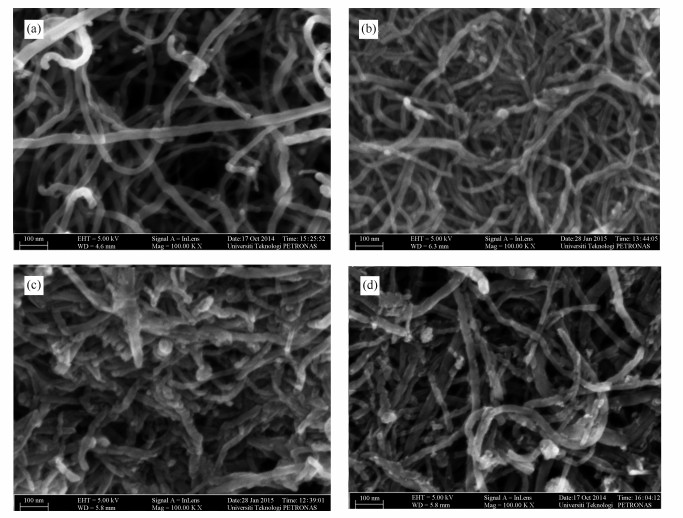
The particle morphology, shape, and size of the prepared catalysts were characterized by FESEM-EDX. The representative images are shown in Figure 1. This figure indicates that the metal oxide particles are distributed on the CNT support (Figures 1(b)-(d)). The EDX result of Co/CNT, 70Co:30Fe/CNT and 1Nb-70Co:30Fe/CNT catalysts are shown in Figure 2. Since elemental dispersive X-ray (EDX) is more of a point analysis technique, therefore, EDX results obtained from the average of four different points for each sample.
Figure 1.
FESEM images at magnification of ×105
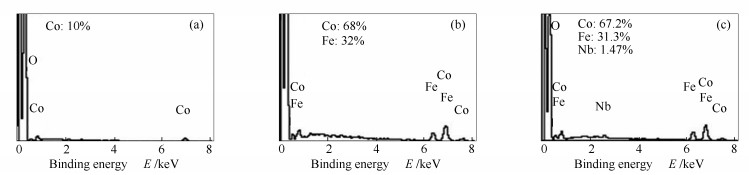 Figure 2.
EDX spectra of (a) Co/CNT, (b) 70Co:30Fe/CNT and (c) 1Nb-70Co:30Fe/CNT
Figure 2.
EDX spectra of (a) Co/CNT, (b) 70Co:30Fe/CNT and (c) 1Nb-70Co:30Fe/CNT
The TEM images of CNT, 70Co:30Fe/CNT, and 1Nb-70Co:30Fe/CNT catalysts are presented in Figure 3. The graphite layers of multi-wall CNTs are visible in Figure 3(a). Figures 3(b) and 3(c) show the distribution of metal oxide nanoparticles inside the tubes and on the outer walls of the tubes. The CNT channels evidently limit the growth of the particles inside the CNTs[19, 20]. The metal oxide nanoparticles attached to the outer surface of CNTs grow to an average size of 10.3 nm, whereas the particles in the inner walls grow to about 8 nm. The size distribution of the particles for 70Co:30Fe/CNTs and 1Nb-70Co:30Fe/CNTs catalysts based on TEM images are shown in Figure 4. Incorporation of the Nb promoter in the catalyst decreases the size of metal particles. The average sizes of the metal oxide nanoparticles for the 1 Nb-70Co:30Fe/CNTs are 7.5 and 6.2 nm on the outer and inner walls, respectively.
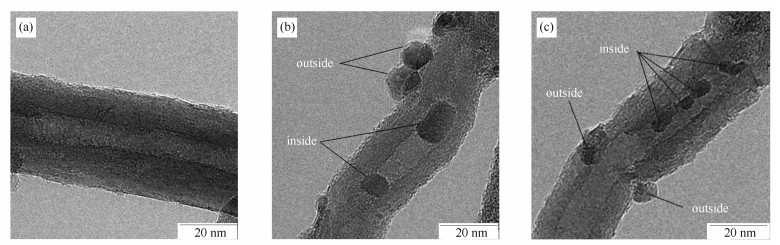 Figure 3.
TEM images of the (a) CNT, (b) 70Co:30Fe/CNT and (c) 1Nb-70Co:30Fe/CNT catalysts
Figure 3.
TEM images of the (a) CNT, (b) 70Co:30Fe/CNT and (c) 1Nb-70Co:30Fe/CNT catalysts
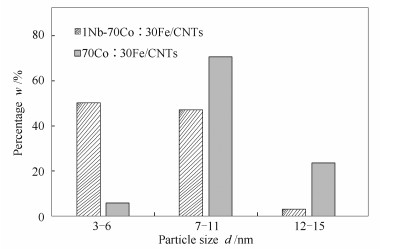 Figure 4.
Size distribution of the particles for 70Co:30Fe/CNTs and 1Nb-70Co:30Fe/CNTs catalysts based on TEM images
Figure 4.
Size distribution of the particles for 70Co:30Fe/CNTs and 1Nb-70Co:30Fe/CNTs catalysts based on TEM images
Figure 5 presents the results of XPS analysis, which was performed to confirm the elemental composition of the promoted and unpromoted catalysts. The survey scan of both samples is shown in this figure. The survey scans of 70Co:30Fe/CNT and 1Nb-70Co:30Fe/CNT catalysts confirm the presence of Co, Fe, and C at binding energies (BEs) of 780.5, 712.2, and 284.9 eV, respectively. The small peak at 207.6 eV corresponds to the presence of Nb in this sample.
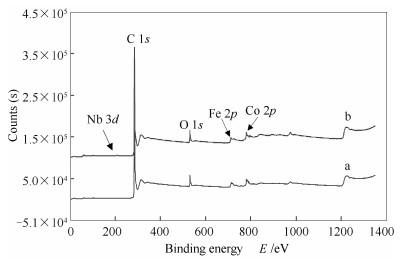 Figure 5.
XPS Co 2p spectra of Co of the (a) 70Co:30Fe/CNT and (b) 1Nb-70Co:30Fe/CNT catalysts
Figure 5.
XPS Co 2p spectra of Co of the (a) 70Co:30Fe/CNT and (b) 1Nb-70Co:30Fe/CNT catalysts
XPS was employed to investigate the chemical characteristics of the solid materials[21]. The XPS spectra of cobalt in both 70Co:30Fe/CNT and 1Nb-70Co:30Fe/CNT catalysts are shown in Figure 6, and the results are summarized in Table 1. The Co 2p3/2 peaks are at 780.2 and 779.0 eV for 70Co:30Fe/CNT and 1 Nb-70Co:30Fe/CNT, respectively. For the Nb-promoted catalyst, the Co 2p slightly shifts to lower values, and the BEs) (ΔECo=ECo 2p1/2-ECo 2p3/2) for the unpromoted and Nb-promoted catalysts are 15.5 and 15.6 eV, respectively. These results indicate that Co is presented in the Co3O4 phase and the presence of Nb results in the electronic modification of Co. The addition of Nb increases the amount of Co2+, and the Co2+/Co3+ atomic ratio of the catalyst increases from 0.46 to 0.64. This increase in the Co2+/Co3+ atomic ratio can be due to the near distance interaction of Nb with Co and Fe.
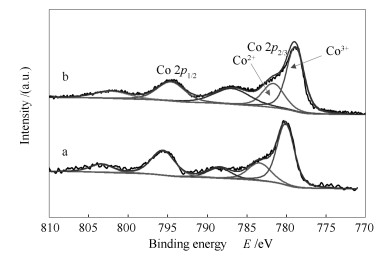 Figure 6.
XPS Co 2p spectra of Co of the (a) 70Co:30Fe/CNT and (b) 1Nb-70Co:30Fe/CNT catalysts
Figure 6.
XPS Co 2p spectra of Co of the (a) 70Co:30Fe/CNT and (b) 1Nb-70Co:30Fe/CNT catalysts
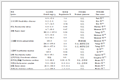 Table 1.
XPS analysis of 70Co:30Fe/CNT and 1Nb-70Co:30Fe/CNT catalysts
Table 1.
XPS analysis of 70Co:30Fe/CNT and 1Nb-70Co:30Fe/CNT catalysts
Catalyst XPS binding energy E/eV Co2+/Co3+(atomic ratio) ΔECo Co 2 p1/2 Co 2 p3/2 70Co:30Fe/CNT 795.7 780.2 0.46 15.5 1Nb-70Co:30Fe/CNT 794.6 779.0 0.64 15.6 Table 1. XPS analysis of 70Co:30Fe/CNT and 1Nb-70Co:30Fe/CNT catalystsThe H2-TPR profiles of the catalysts are given in Figure 7. The first peak of the H2-TPR profile of the Co/CNT catalyst occurs at 266 ℃, which is typically assigned to the first step reduction of Co3O4 to CoO[22], whereas the peak at 460 ℃ is mainly assigned to the second step reduction of CoO to Co0[22]. This peak also includes the reduction of the cobalt species that interact with the CNT support[22]. The peak at 579 ℃ in the H2-TPR spectra of the Co/CNT catalyst is due to the gasification of CNTs in the presence of H2 at elevated temperature[23, 22].
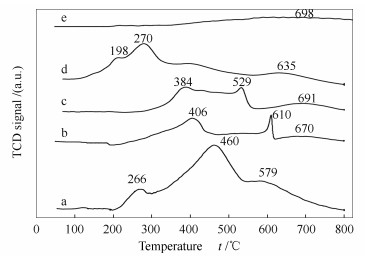 Figure 7.
H2-TPR profiles of (a) Co/CNT, (b) Fe/CNT, (c) 70Co:30Fe/CNT, (d) 1Nb-70Co:30Fe/CNT catalysts and (e) CNTs
Figure 7.
H2-TPR profiles of (a) Co/CNT, (b) Fe/CNT, (c) 70Co:30Fe/CNT, (d) 1Nb-70Co:30Fe/CNT catalysts and (e) CNTs
H2-TPR analysis for the Fe/CNT catalyst reveals two main peaks at 406 and 610 ℃, which are assigned to the reduction of Fe2O3 to Fe3O4 and Fe3O4 to Fe0, respectively[23, 24]. The peak at 670 ℃ is due to the gasification of CNTs in the presence of H2 at various temperatures to produce methane[24]. The reduction of Fe2O3 to Fe occurs in three steps. First, Fe2O3 is reduced to Fe3O4. Second, Fe3O4 is reduced to FeO. Finally, FeO is reduced to Fe.
However, the transition step to and from FeO is generally unexpected to appear in the H2-TPR profile because FeO is thermodynamically unstable compared with Fe and Fe2O3[25, 26]. Consequently, the reduction of Fe2O3 to Fe normally takes place in two steps:
Incorporation of Fe to the Co/CNT catalyst increases the reduction temperature. The first peak increases from 266 to 384 ℃, and the reduction temperature of the second peak increases from 460 to 529 ℃. This trend can be attributed to the difficulty to reduce the Fe-rich phase during the synthesis of the bimetallic catalysts[23, 25]. The peak at 691 ℃ also corresponds to the gasification of CNTs, as indicated by the H2-TPR of pure CNT support at 698 ℃.
The Nb-promoted catalyst exhibits different reduction patterns unlike unpromoted catalysts, and the addition of Nb shifts both peaks significantly to low temperatures. An increase in hydrogen consumption is observed for the Nb-promoted catalyst. The levels of hydrogen consumption are 756, 519, 812, and 1 027 μmol/g-cat for Co/CNT, Fe/CNT, 70Co:30Fe/CNT and 1Nb-70Co:30Fe/CNT catalysts, respectively. The obtained results are consistent with the findings reported by Ali el al[4]. Thus, incorporating Nb to the Fe/CNT catalyst increases hydrogen consumption.
2.2 Fischer-Tropsch synthesis performance
The performance of all the catalysts in FTS was tested in a fixed-bed microreactor. The experiments were carried out at 260 ℃, H2:CO (volume ratio)=2, SV=51, and pressure of 1 MPa. The gas product was analyzed to measure CO conversion and HC selectivities, and the results are summarized in Table 2. The Co/CNT catalyst exhibits higher selectivity to C5+ HCs with a lower selectivity to methane, whereas the Fe/CNT catalyst shows the highest selectivity to methane.
Table 2.
Catalytic activity and products selectivity of catalysts
Catalyst CO conversion x/% CO2 selectivity s/% Product selectivity s/% Olefin/Paraffin C1 C2-4 C5+ Co/CNT 3.0 0.026 80.1 7.1 2.8 0.01 Fe/CNT 2.8 0.025 85.6 13.3 1.5 0.05 70Co30Fe/CNT 3.7 0.026 83.8 12.9 3.3 0.02 1Nb-70Co30Fe/CNT 4.7 0.025 78.1 18.1 3.8 0.04 260 ℃, 1 MPa, H2:CO (volume ratio)=2, SV=51 and 7 h Table 2. Catalytic activity and products selectivity of catalystsThe CO conversions of the monometallic Co and Fe nanocatalysts are 3.0% and 2.8%, respectively. Incorporation of 30% Fe into the cobalt catalyst increases the conversion of CO. This increase in the conversion can be attributed to the improved catalyst structure, such as enhanced dispersion, smaller particle size, and more available metal active sites for the FTS reaction. In addition, methane selectivity increases, unlike in the Co/CNT catalyst. This result is most likely due to the highly dispersed metal particles in the bimetallic catalyst, which is reported to increase olefin-to-paraffin ratio[27-29]. More uniform cobalt clusters also decrease CH4 selectivity and increased C5+ selectivity because of the effective participation of olefins in the propagation of the carbon chain[30].
The Nb-promoted catalyst enhances the selectivity to C2-4 and the olefin-to-paraffin ratio. Incorporation of 1% Nb results in better dispersion and more metal active sites[31]. Compared with unpromoted bimetallic catalysts, the 1Nb-70Co:30Fe/CNT catalyst increases the olefin-to-paraffin ratio and suppresses methane selectivity, which is attributed to the formation of new catalytic sites of the FTS reaction. Previous studies on anchored Co/Nb2O5/Al2O3 catalysts reported the formation of new interfaces involving Co0-NbOx sites during the FTS process, and Co0, Co0-Co2+, and Co0-NbOx are suggested as the active sites at the surface. The high amount of Co2+ species significantly affects the performance of the catalysts[32]. In the present study, the XPS results show that the Co2+/Co3+ atomic ratio increases after the addition of Nb to the structure of the bimetallic catalyst. Moreover, the formation of CO2 is excessively low for all the catalysts (0.025%), and the formation of CO2 is not affected by changing the composition of the catalysts.
The effect of the H2:CO volume ratio on CO conversion and product selectivities can be observed in Figures 8(a) and (b). As shown in Figure 8(a), increasing the H2:CO volume ratio increases CO conversion. This behavior can be ascribed to the strong CO adsorption ability on Co-based catalysts. A previous study reported that the surface of a Co-based catalyst is almost fully covered with adsorbed CO or with the produced species of -CH2 during the FTS reaction[33, 34]. This phenomenon inhibits the dissociative adsorption of H2 and affects the global reaction rate. An increase in the H2:CO volume ratio in the feedstock reduces the partial pressure of CO and lowers the concentration of adsorbed CO. Consequently, a high amount of H2 can be adsorbed and dissociated, which increases CO conversion and the reaction rates of all hydrogenation reactions.
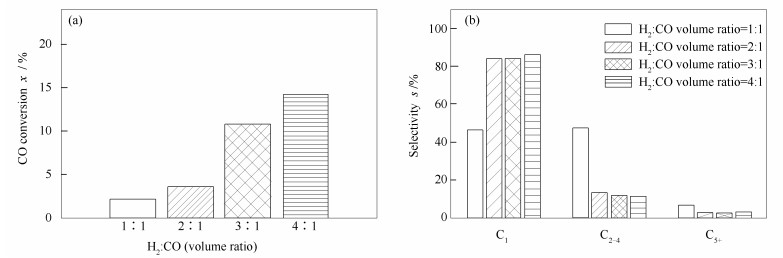 Figure 8.
Effect of H2:CO volume ratio on the (a) CO conversion and (b) product distribution over 70Co:30Fe/CNT catalyst
Figure 8.
Effect of H2:CO volume ratio on the (a) CO conversion and (b) product distribution over 70Co:30Fe/CNT catalyst
Figure 8(b) illustrates that methane selectivity increases by elevating the H2:CO volume ratio. However, different behaviors are observed for the C2-4 and C5+ products. These variations in the distribution of products can be attributed to the high concentration of H2 in the feedstock, which is suitable for both methanation and chain termination reactions; such changes decrease the formation of C2-4 and C5+ products, and the formation of high-molecular-weight products is reduced by increasing the H2:CO volume ratio in the FTS reaction[33, 34].
3 Conclusions
CNT-supported monometallic Co and Fe and bimetallic 70Co:30Fe/CNT catalysts were studied. The bimetallic catalyst exhibits physicochemical properties different from those of the monometallic catalysts. The addition of 30% Fe to the Co catalyst enhances its catalytic activity in the FTS reaction. The addition of Nb as a promoter for the bimetallic catalyst results in the higher selectivity to C2-4 and increases the olefin-to-paraffin ratio. Increasing the H2:CO volume ratio from 1:1 to 4:1 for the bimetallic catalyst can increase CO conversion. Raising the H2:CO volume ratio decreases the partial pressure of CO and the amount of adsorbed CO, which increases CO conversion and the reaction rate of all hydrogenation reactions. Moreover, the selectivity to methane increases by elevating the H2:CO volume ratio. However, C2-4 and C5+ products exhibit various behaviors.
-
-
[1]
KHANNA S, GOYAL A, MOHOLKAR V S. Microbial conversion of glycerol: Present status and future prospects[J]. Crit Rev Biotechnol, 2012, 32(3): 235-262. doi: 10.3109/07388551.2011.604839
-
[2]
HANNON M, GIMPEL J, TRAN M, RASALA B, MAYFIELD S. Biofuels from algae: Challenges and potential[J]. Biofuels, 2010, 1(5): 763-784. doi: 10.4155/bfs.10.44
-
[3]
MEHTA S, DESHMANE V, ZHAO S, KUILA D. Comparative studies of silica-encapsulated iron, cobalt, and ruthenium nanocatalysts for Fischer-Tropsch synthesis in silicon-microchannel microreactors[J]. Ind Eng Chem Res, 2014, 53(42): 16245-16253. doi: 10.1021/ie502193e
-
[4]
ALI S, ZABIDI N A M, SUBBARAO D. Effect of niobium promoters on iron-based catalysts for Fischer-Tropsch reaction[J]. J Fuel Chem Technol, 2012, 40(1): 48-53. doi: 10.1016/S1872-5813(12)60006-1
-
[5]
ZENNARO R, TAGLIABUE M, BARTHOLOMEW C H. Kinetics of Fischer-Tropsch synthesis on titania-supported cobalt[J]. Catal Today, 2000, 58(4): 309-319. doi: 10.1016/S0920-5861(00)00264-9
-
[6]
BAHOME M C, JEWELL L L, PADAYACHY K, HILDEBRANDT D, GLASSER D, DATYE A K, COVILLE N J. Fe-Ru small particle bimetallic catalysts supported on carbon nanotubes for use in Fischer-Tröpsch synthesis[J]. Appl Catal A: Gen, 2007, 328(2): 243-251. doi: 10.1016/j.apcata.2007.06.018
-
[7]
VAN SANTEN R, MARKVOORT A, FILOT I, GHOURI M, HENSEN E. Mechanism and microkinetics of the Fischer-Tropsch reaction[J]. Phys Chem Chem Phys, 2013, 15(40): 17038-17063. doi: 10.1039/c3cp52506f
-
[8]
BLANCHARD J, ABATZOGLOU N. Nano-iron carbide synthesized by plasma as catalyst for Fischer-Tropsch synthesis in slurry reactors: The role of iron loading and K, Cu promoters[J]. Catal Today, 2014, 237: 150-156. doi: 10.1016/j.cattod.2013.12.027
-
[9]
SARI A. Investigation of the supercritical conditions for Fischer-Tropsch reaction over an industrial Co-Ru/γ-Al2O3 catalyst[J]. Chem Eng J, 2014, 244: 317-326. doi: 10.1016/j.cej.2014.01.086
-
[10]
WEI Z, ZOU Y R, CAI Y, TAO W, WANG L, PENG P. Composition of closed-system Fischer-Tropsch synthesis gases and the constraint factors[J]. Pet Sci Technol, 2014, 32(21): 2635-2641. doi: 10.1080/10916466.2011.632801
-
[11]
DE KLERK A. Fischer-Tropsch refining: Technology selection to match molecules[J]. Green Chem, 2008, 10(12): 1249-1279. doi: 10.1039/b813233j
-
[12]
JAHANGIRI H, BENNETT J, MAHJOUBI P, WILSON K, GU S. A review of advanced catalyst development for Fischer-Tropsch synthesis of hydrocarbons from biomass derived syn-gas[J]. Catal Sci Technol, 2014, 4(8): 2210-2229. doi: 10.1039/C4CY00327F
-
[13]
ZHANG Q, CHENG K, KANG J, DENG W, WANG Y. Fischer-Tropsch catalysts for the production of hydrocarbon fuels with high selectivity[J]. ChemSusChem, 2014, 7(5): 1251-1264. doi: 10.1002/cssc.201300797
-
[14]
ARSALANFAR M, MIRZAEI A A, BOZORGZADEH H R, SAMIMI A, GHOBADI R. Effect of support and promoter on the catalytic performance and structural properties of the Fe-Co-Mn catalysts for Fischer-Tropsch synthesis[J]. J Ind Eng Chem, 2014, 20(4): 1313-1323. doi: 10.1016/j.jiec.2013.07.011
-
[15]
MIRZAEI AA, VAHID S, TORSHIZI HO. Effect of support and promoter on the catalytic performance and structural properties of the Fe-Co-Ni catalysts for CO hydrogenation[J]. J Nat Gas Sci Eng, 2013, 15: 106-117. doi: 10.1016/j.jngse.2013.10.002
-
[16]
KHARE R, BOSE S. Carbon nanotube based composites-A review[J]. J Miner Mater Charact Eng, 2005, 4(1): 31-46.
-
[17]
BEZEMER G L, RADSTAKE P B, KOOT V, VAN DILLEN A J, GEUS JW, DE JONG K P. Preparation of Fischer-Tropsch cobalt catalysts supported on carbon nanofibers and silica using homogeneous deposition-precipitation[J]. J Catal, 2006, 237(2): 291-302. doi: 10.1016/j.jcat.2005.11.015
-
[18]
BOTES M, EUGENE CLOETE T. The potential of nanofibers and nanobiocides in water purification[J]. Crit Rev Microbiol, 2010, 36(1): 68-81. doi: 10.3109/10408410903397332
-
[19]
TRÉPANIER M, TAVASOLI A, ANAHID S. Deactivation behavior of carbon nanotubes supported cobalt catalysts in Fischer-Tropsch synthesis[J]. Iran J Chem Chem Eng, 2011, 30(1): 34-37.
-
[20]
ALI S, ZABIDI N A M, SUBBARAO D. Correlation between Fischer-Tropsch catalytic activity and composition of catalysts[J]. Chem Cent J, 2011, 5: 68-75. doi: 10.1186/1752-153X-5-68
-
[21]
LU C Y, WEY M Y. The performance of CNT as catalyst support on CO oxidation at low temperature[J]. Fuel, 2007, 86(7/8): 1153-1161.
-
[22]
TAVASOLI A, SADAGIANI K, KHORASHE F, SEIFKORDI A, ROHANI A, NAKHAEIPOUR A. Cobalt supported on carbon nanotubes-A promising novel Fischer-Tropsch synthesis catalyst[J]. Fuel Process Technol, 2008, 89(5): 491-498. doi: 10.1016/j.fuproc.2007.09.008
-
[23]
TAVASOLI A, TRÉPANIER M, ABBASLOU R M M, DALAI A K, ABATZOGLOU N. Fischer-Tropsch synthesis on mono-and bimetallic Co and Fe catalysts supported on carbon nanotubes[J]. Fuel Process Technol, 2009, 90(12): 1486-1494. doi: 10.1016/j.fuproc.2009.07.007
-
[24]
DUVENHAGE D, COVILLE N. Fe: CoTiO2 bimetallic catalysts for the Fischer-Tropsch reaction I. Characterization and reactor studies[J]. Appl Catal A: Gen, 1997, 153(1): 43-67.
-
[25]
MACKAY R A, HENDERSON W. Introduction to Modern Inorganic Chemistry[M]. 6th edition. Abingdon: Taylor & Francis, 2002.
-
[26]
YU S, ZHANG T, XIE Y, WANG Q, GAO X, ZHANG R, ZHANG Y, SU H. Synthesis and characterization of iron-based catalyst on mesoporous titania for photo-thermal F-T synthesis[J]. Int J Hydrogen Energy, 2015, 40(1): 870-877. doi: 10.1016/j.ijhydene.2014.10.121
-
[27]
WANG D, ZHOU X, JI J, DUAN X, QIAN G, ZHOU X G, CHEN D, YUAN W. Modified carbon nanotubes by KMnO4 supported iron Fischer-Tropsch catalyst for direct conversion of syngas to lower olefins[J]. J Mater Chem A, 2015, 3(8): 4560-4567. doi: 10.1039/C4TA05202A
-
[28]
RIBEIRO M C, JACOBS G, DAVIS B H, CRONAUER D C, KROPF A J, MARSHALL C L. Fischer-Tropsch Synthesis: An in-situ TPR-EXAFS/XANES investigation of the influence of group I alkali promoters on the local atomic and electronic structure of carburized iron/silica catalysts[J]. J Phys Chem C, 2010, 114(17): 7895-7903. doi: 10.1021/jp911856q
-
[29]
TORRES GALÜIS H M, DE JONG K P. Catalysts for production of lower olefins from synthesis gas: A review[J]. ACS Catal, 2013, 3(9): 2130-2149. doi: 10.1021/cs4003436
-
[30]
ZABIDI N A M. Synthesis of nanocatalysts via reverse microemulsion route for Fischer-Tropsch reactions. Microemulsions-An Introduction to Properties and Applications[M]. Croatia: InTech, 2012.
-
[31]
FABIANO D P, NAPOLITANO M N, TEIXEIRA G A, GUIMARÃES L L, FONSECA L C, SOARES R R. Fischer-Tropsch synthesis by Nb2O5-supported iron or cobalt catalysts[C]. The 2008 Annual Meeting Philadelphia. Pennsylvania Convention Center.
-
[32]
MENDES F M T, PEREZ C A C, NORONHA F B, SOUZA C D D, CESAR D V, FREUND H J, SCHMAL M. Fischer-Tropsch synthesis on anchored Co/Nb2O5/Al2O3 catalysts: The nature of the surface and the effect on chain growth[J]. J Phys Chem B, 2006, 110(18): 9155-9163. doi: 10.1021/jp060175g
-
[33]
CHOUDHURY H A, MOHOLKAR V S. An optimization study of Fischer-Tropsch synthesis using commercial cobalt catalyst[J]. Int J Sci Eng Technol, 2013, 2(2): 31-39.
-
[34]
DAVIS B H, OCCELLI M L. Advances in Fischer-Tropsch Synthesis, Catalysts, and Catalysis[M]. Boca Raton: CRC Press, 2009.
-
[1]
-

Figure 1 FESEM images at magnification of ×105
(a): CNT; (b): Co/CNT; (c): 70Co:30Fe/CNT; (d): 1Nb-70Co:30Fe/CNT

Figure 3 TEM images of the (a) CNT, (b) 70Co:30Fe/CNT and (c) 1Nb-70Co:30Fe/CNT catalysts

Figure 4 Size distribution of the particles for 70Co:30Fe/CNTs and 1Nb-70Co:30Fe/CNTs catalysts based on TEM images

Figure 5 XPS Co 2p spectra of Co of the (a) 70Co:30Fe/CNT and (b) 1Nb-70Co:30Fe/CNT catalysts

Figure 6 XPS Co 2p spectra of Co of the (a) 70Co:30Fe/CNT and (b) 1Nb-70Co:30Fe/CNT catalysts

Figure 7 H2-TPR profiles of (a) Co/CNT, (b) Fe/CNT, (c) 70Co:30Fe/CNT, (d) 1Nb-70Co:30Fe/CNT catalysts and (e) CNTs

Figure 8 Effect of H2:CO volume ratio on the (a) CO conversion and (b) product distribution over 70Co:30Fe/CNT catalyst
Table 1. XPS analysis of 70Co:30Fe/CNT and 1Nb-70Co:30Fe/CNT catalysts
Catalyst XPS binding energy E/eV Co2+/Co3+(atomic ratio) ΔECo Co 2 p1/2 Co 2 p3/2 70Co:30Fe/CNT 795.7 780.2 0.46 15.5 1Nb-70Co:30Fe/CNT 794.6 779.0 0.64 15.6  下载: 导出CSV
Table 2. Catalytic activity and products selectivity of catalysts
Catalyst CO conversion x/% CO2 selectivity s/% Product selectivity s/% Olefin/Paraffin C1 C2-4 C5+ Co/CNT 3.0 0.026 80.1 7.1 2.8 0.01 Fe/CNT 2.8 0.025 85.6 13.3 1.5 0.05 70Co30Fe/CNT 3.7 0.026 83.8 12.9 3.3 0.02 1Nb-70Co30Fe/CNT 4.7 0.025 78.1 18.1 3.8 0.04 260 ℃, 1 MPa, H2:CO (volume ratio)=2, SV=51 and 7 h
下载: 导出CSV
-


 扫一扫看文章
计量
- PDF下载量: 0
- 文章访问数: 0
- HTML全文浏览量: 0
 下载:
下载:

